10 minutes free every day
Continue audio lessons in the app
Word explanations appear automatically in sync with the audio.
No login required · synced translations · playback with the screen locked
Choose your learning language and open this lesson in the app.

About This Lesson
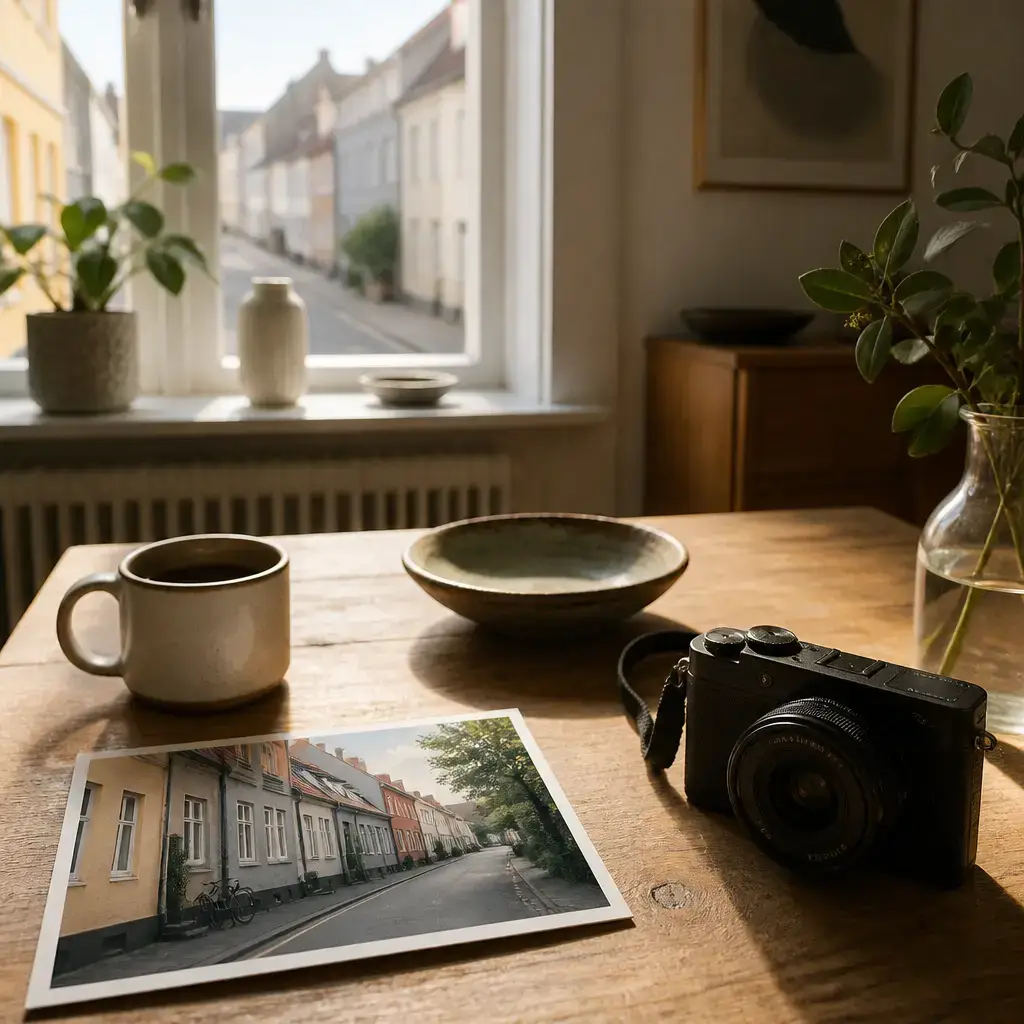
Use Taking photos of quiet streets to practice Danish conversation, pronunciation, vocabulary, grammar, and quizzes.
Dialogue
Tager du billeder?
TAIR doo BEL-uh? Do you take photos?Jeg bruger mit lille kamera de fleste dage.
yai BROO-er mid LEL-uh ka-MAIR-uh dee FLEH-stuh DAIR-wuh. I use my small camera most days.Hvad kan du lide at tage billeder af?
va kan doo LEE-thuh uh TAIR BEL-uh ow? What do you like to photograph?Jeg kan bedst lide stille gader.
yai kan best LEE-thuh STEL-uh GAIR-uh. Quiet streets are my favorite.Må jeg se et?
Maw yai SAY AEDH? Can I see one?Her er et, jeg tog tæt på mit hjem.
HAIR air AEDH, yai toh TED poh mid YEM. Here is one I took near my home.Det ser enkelt og klart ud.
Deh SAIR ENG-gult oh KLAH-th OOTH. It looks simple and clear.Jeg øver mig, når jeg har tid.
yai EUH-vuh mai, NOR yai har TEEDH. I practice whenever I have time.Sentence explanations
Tager du billeder?
Do you take photos?
- Tager
- take
- du
- you
- billeder
- photos
More detail
Tager is the present-tense form of tage, “to take.” In Danish, the present form is normally the same for different persons and numbers: jeg tager = “I take,” du tager = “you take,” and de tager = “they take.” Here the object billeder makes the intended activity taking photos. du means “you” and is the singular second-person pronoun. It is the subject here. Danish questions commonly place the finite verb before the subject: Tager du ...? naturally means “Do you ...?” The corresponding statement pattern is Du tager ... (“You take ...”). Billeder is the plural indefinite form of billede, “picture” or “photo.” The singular is et billede; the plural is billeder. The definite plural is billederne, “the pictures/photos.” Example: Jeg tager et billede. — “I take a picture.” Together, Tager du billeder? uses the pattern present-tense verb + subject + object. Tager supplies the action, du identifies the person being asked, and billeder identifies photos as the object: “Do you take photos?”
Jeg bruger mit lille kamera de fleste dage.
I use my small camera most days.
- Jeg
- I
- bruger
- use
- mit
- my
- lille
- small
- kamera
- camera
- de fleste
- most
- dage
- days
More detail
Jeg means “I” here: the speaker is the subject, the person carrying out the action. Danish subject pronouns include jeg “I,” du “you,” and han/hun “he”/“she.” bruger means “use” in this sentence. It is the present-tense form of bruge “to use”; Danish verbs generally do not change form for different subjects in the present tense. For example, Jeg bruger telefonen. means “I use the phone,” while du bruger telefonen means “you use the phone.” mit means “my” before the neuter singular noun kamera. Danish possessive forms distinguish gender and number: min is used with common-gender singular nouns, mit with neuter singular nouns, and mine with plural nouns. The possessive form agrees with the possessed noun, not with the owner. For example, min bog means “my book,” but mit hus means “my house.” lille means “small.” In this sentence it is the singular form modifying kamera. Danish uses lille with singular nouns of either grammatical gender, while små is the plural form: et lille kamera “a small camera,” but små kameraer “small cameras.” kamera means “camera.” It is a neuter-gender noun, shown by the neuter article et: et kamera. Its plural is kameraer, as in to kameraer “two cameras.” de fleste means “most” in the expression de fleste dage “most days.” Here, fleste is the definite superlative form of flest “most.” The useful comparison chain is mange “many” → flere “more” → flest “most”; before a plural noun in this expression, the form is de fleste. For example, De fleste mennesker arbejder. means “Most people work.” dage means “days.” It is the plural of dag “day.” Danish plural forms are not all formed in the same way, so this form is best learned with its singular–plural pair: en dag → dage. Together, Jeg bruger mit lille kamera says “I use my small camera.” Adding de fleste dage gives “I use my small camera most days.” The whole utterance describes a regular habit, with the present-tense verb bruger and the time expression de fleste dage.
Hvad kan du lide at tage billeder af?
What do you like to photograph?
- Hvad
- what
- kan du
- can you
- lide
- like
- tage
- take
- billeder
- pictures
More detail
Hvad means “what” here and asks for the thing being photographed. Compare hvem (“who”) when the answer would be a person and hvor (“where”) when the answer would be a place. kan du combines the modal verb kan with the subject pronoun du. Here, kan belongs with lide in the fixed expression kan lide, meaning “like,” rather than expressing physical ability. Kan is the present form of kunne, and it does not change for du in this construction. Danish questions commonly place the finite verb before the subject, as in Kan du ...?. lide is the infinitive after kan in kan lide, the everyday Danish expression for “to like.” The infinitive pattern is at kunne lide (“to like”), while kan lide is the present-tense form with a subject. Example: Jeg kan lide kaffe. — “I like coffee.” tage means “take” and is the infinitive form used after at here. In the reusable pattern tage billeder af X, it combines with billeder af to mean “take pictures of X,” or more naturally “photograph X.” billeder means “pictures” here. It is the plural of billede (“picture”). In tage billeder af X, the noun is part of the expression “take pictures of X.” The final af belongs to the pattern tage billeder af X. In this question, hvad is the fronted object, so the preposition remains at the end: Hvad ... billeder af?. Together, Hvad asks for the object, kan du lide asks what the addressee likes, and at tage billeder af names the activity. The complete utterance means “What do you like to photograph?”
Jeg kan bedst lide stille gader.
Quiet streets are my favorite.
- Jeg
- I
- kan … lide
- like
- bedst
- best
- stille
- quiet
- gader
- streets
More detail
Jeg means “I” here: the speaker is the subject of the sentence. Danish uses jeg for the first-person singular subject; it does not change for grammatical gender. kan lide is the useful Danish construction for “like.” kan is the present-tense form of kunne (“can/be able to”), and lide is the infinitive used in this expression. Do not translate kan as physical ability here: together, kan lide expresses liking. Example: Jeg kan lide kaffe. — “I like coffee.” bedst means “best” or, with kan lide, “most.” It is the superlative related to god/godt (“good/well”): godt → bedre (“better”) → bedst (“best”). In kan bedst lide, it marks the strongest preference among possible things: “like ... best.” stille means “quiet” here. It is an adjective before the noun gader; Danish adjectives can take different forms depending on the noun phrase, but stille has this same written form with these plural nouns. Example: en stille gade — “a quiet street”; stille gader — “quiet streets.” gader means “streets.” Its base form is gade (“street”); gader is the plural form. Example: Gaderne er stille. — “The streets are quiet.” The ending in gader marks plural, while stille describes the streets. Together, stille gader is the noun phrase “quiet streets.” The construction Jeg kan bedst lide says “I like ... best,” so the complete utterance means “I like quiet streets best,” matching the fixed translation “Quiet streets are my favorite.”
Må jeg se et?
Can I see one?
- Må jeg
- Can I …?
- se
- see
- et
- one
More detail
Må jeg is a reusable Danish way to ask for permission: må is the present form of måtte (“may/be allowed to”), followed by the subject pronoun jeg (“I”). The form må does not change here for the singular subject. Example: Må jeg komme ind? — “May I come in?” se means “see”. After the modal må, Danish uses the infinitive without at: må se, not må at se. Example: Må jeg se bogen? — “May I see the book?” et means “one” here: it stands alone instead of repeating an understood neuter noun. As a standalone form, it is also the neuter singular indefinite article, but the fixed translation shows its pronoun-like meaning in this sentence. The omitted noun is not identified more specifically by the supplied sentence. Example: Jeg har et. — “I have one.” Together, Må jeg se et? follows the pattern Må jeg + infinitive + et? and means “Can I see one?” The question asks permission to see one item, without naming the item again.
Her er et, jeg tog tæt på mit hjem.
Here is one I took near my home.
- Her er
- here is
- et
- one
- tog
- took
- tæt på
- near
- mit
- my
- hjem
- home
More detail
Her er is a reusable Danish presentation pattern meaning “here is/are.” Er is the present form of være (“to be”); the form used here presents something now. For example: Her er min bog. — “Here is my book.” et means “one” here, referring to an understood neuter item rather than naming it again. Danish uses en and et for the two grammatical-gender patterns of indefinite nouns; this form is also the neuter form of the indefinite article. The surrounding context supports the meaning “one” without identifying the item's specific type. tog means “took” here. It is the past form of tage (“to take”), so the taking happened before the current presentation. For example: Jeg tog et billede. — “I took a picture.” tæt på is a two-word expression meaning “near” or “close to.” It introduces the location relative to which the taking happened. For example: Skolen ligger tæt på mit hjem. — “The school is near my home.” mit means “my” before a neuter singular noun. It is the possessive form used with a noun such as hjem; possession belongs to the speaker here. Danish possessives also vary with the noun pattern: min is used with an en-pattern noun, while mit is used with an et-pattern noun. For example: mit hus — “my house.” hjem means “home.” In this sentence it is the place belonging to or associated with the speaker, expressed by mit hjem, “my home.” Together, Her er et presents an unspecified item, and jeg tog identifies the speaker as the person who took it in the past. tæt på mit hjem gives the location where the taking occurred. The whole utterance therefore means: “Here is one I took near my home.”
Det ser enkelt og klart ud.
It looks simple and clear.
- Det
- it
- ser … ud
- looks; seems
- enkelt
- simple
- klart
- clear
More detail
Det means “it” here and is the subject of the sentence. In this use, it is a third-person singular pronoun; the fixed translation identifies the thing being described as “it,” without specifying what that thing is. ser ... ud is a two-part Danish construction meaning “looks” or “seems.” ser is the present-tense form of se (“to see”), while ud is a particle; together they form the meaning “look/seem.” A reusable pattern is Det ser + adjective + ud: “It looks + adjective.” enkelt means “simple” here. Its base form is enkel; enkelt is the neuter singular form, agreeing with the neuter pronoun det. For example, Det er enkelt. means “It is simple.” klart means “clear” here. Its base form is klar; klart is its neuter singular form, also matching det. The adjective klar can have other meanings in suitable contexts, such as “ready,” but “clear” is the meaning supported here. Together, Det ser enkelt og klart ud. uses Det ser ... ud around two coordinated adjectives: “It looks simple and clear.” The adjectives describe how the unspecified “it” appears, rather than asserting that it is objectively simple or clear.
Jeg øver mig, når jeg har tid.
I practice whenever I have time.
- Jeg
- I
- øver mig
- practice
- når
- when
- har
- have
- tid
- time
More detail
Jeg is the first-person singular subject pronoun: “I.” It identifies the speaker as the person doing the practicing. Compare jeg (“I”) with du (“you”) in a simple example: Jeg læser. — “I read.” øver mig comes from the reflexive expression øve sig, “to practice.” øver is the present-tense form of øve; mig is the first-person reflexive form matching jeg. Together, they mean that the speaker practices, without specifying what is being practiced. Example: Hun øver sig. — “She practices.” Here, sig changes to match the third-person subject. når introduces a time condition and means “when” or “whenever” in this use. It introduces the subordinate clause når jeg har tid, which states when the practice happens. Example: Jeg læser, når jeg har tid. — “I read whenever I have time.” har is the present-tense form of have, “to have.” In Danish, har is used with different subjects in the present, for example jeg har (“I have”) and hun har (“she has”). In this sentence, it forms the ordinary expression have tid, meaning “to have time.” tid means “time.” In have tid, it refers to having time available, rather than to a particular measured period. Example: Vi har tid. — “We have time.” The sentence has the pattern Jeg øver mig, når jeg har tid: “I practice whenever I have time.” The main clause says what the speaker does; the clause introduced by når gives the condition or occasion for it. The comma separates the main clause from this following time clause.
Grammar Points
se ud → ser ... ud
ser ... ud
SAIR ... OOTHlook; appear
In Danish, ud stays after the verb, even when another element comes between the verb and ud.
øve sig → øver mig
øver mig
EUH-vuh maipractice
Reflexive verbs use a pronoun that changes with the subject; mig means myself for the first person.
Danish Vocabulary
- Gender
- neuter
Tager du billeder?
Jeg bruger mit lille kamera de fleste dage.
- Gender
- common
de fleste dage
- Gender
- common
stille gader
Her er et, jeg tog tæt på mit hjem.
Hvad kan du lide at tage billeder af?
- Gender
- neuter
mit lille kamera
Hvad kan du lide at tage billeder af?
- Gender
- neuter
mit lille kamera
Må jeg se et?
stille gader
Tager du billeder?
Quiz
Word Order
Arrange the words in the correct order.
Do you take photos?
Show Answer
Tager du billeder?Quiet streets are my favorite.
Show Answer
Jeg kan bedst lide stille gader.Can I see one?
Show Answer
Må jeg se et?Spelling
Tap the letters to spell the word.
camera
Show Answer
kameratake; photograph
Show Answer
tagerquiet
Show Answer
stillepicture; photo