10 minutes free every day
Continue audio lessons in the app
Word explanations appear automatically in sync with the audio.
No login required · synced translations · playback with the screen locked
Choose your learning language and open this lesson in the app.

About This Lesson
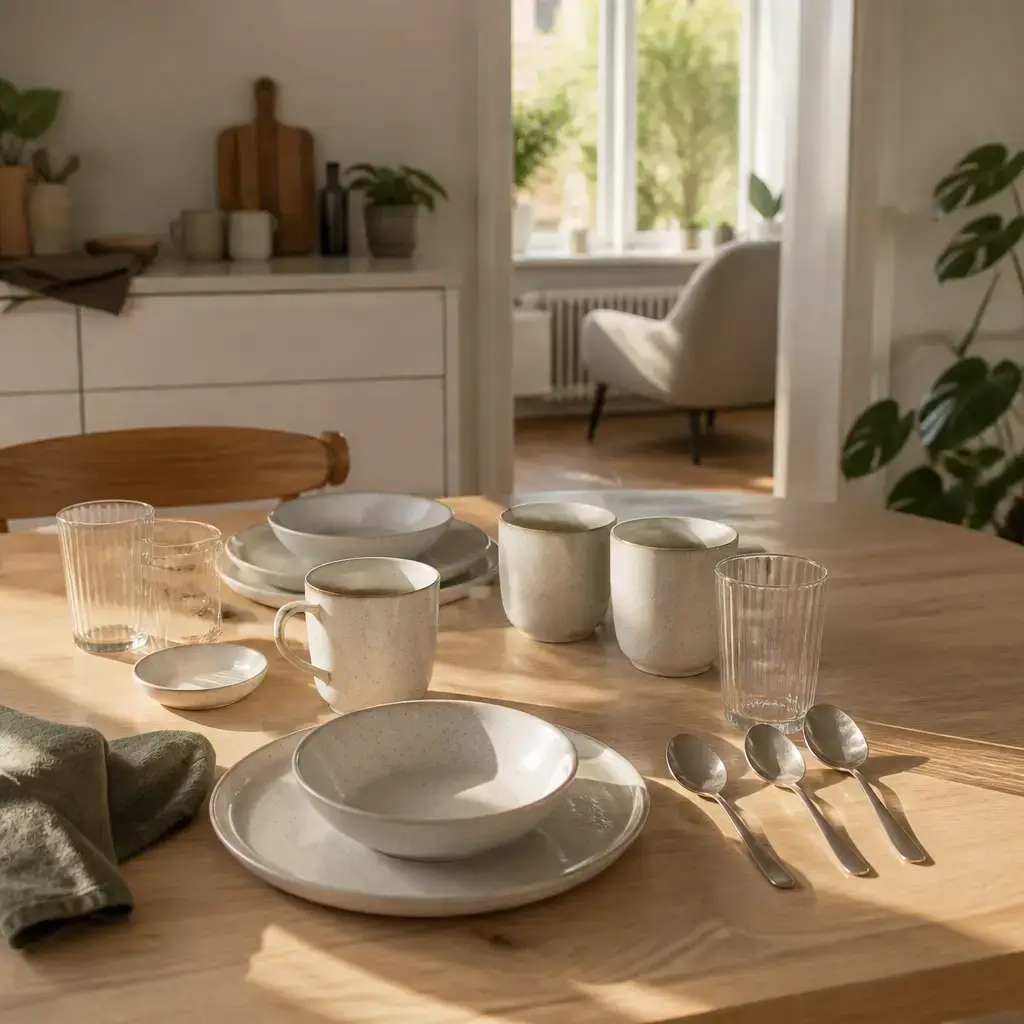
Use Checking a table-setting list to practice Danish conversation, pronunciation, vocabulary, grammar, and quizzes.
Dialogue
Lad os se på listen.
LAD uhs SAY paw LESS-duh. Let's look at the list.Jeg har den her.
YAI hah den HAIR. I have it here.Er kopperne klar?
AIR KUB-uh-nuh klah? Are the cups ready?Jeg vaskede dem alle sammen.
YAI VAS-guh-thuh dem AL-uh SAM-uhn. I washed them all.Mangler der noget?
MANG-luh dah NOH-uh? Is anything missing?Vi mangler stadig en ske.
vee MANG-luh STAI-thee uhn SKAY. We still need one spoon.Jeg kan hente en til.
YAI kan HEN-duh uhn TEHL. I can get another one.Så er bordet dækket.
SOH air BOHR-thuh DEH-guhth. Then the table is set.Sentence explanations
Lad os se på listen.
Let's look at the list.
- Lad os
- let’s
- se på
- look at
- listen
- the list
More detail
Lad os is the Danish pattern for “let’s”: lad is the imperative of lade (“let/allow”), followed by os (“us”). It is used to suggest a joint action. For example, Lad os gå. means “Let’s go.” se på means “look at.” se is the infinitive form of “see/look,” and på is the preposition used here for the thing receiving the visual attention. The same pattern can be reused with another object, such as Se på billedet. — “Look at the picture.” listen means “the list.” The noun’s indefinite form is en liste; its definite singular form is made with the ending -n: liste → listen. Here, the definite form identifies a particular list in the situation. The noun itself carries this definiteness, not på. Together, Lad os + se på + listen forms “Let’s look at the list.” The wording presents looking at that particular list as a joint suggestion.
Jeg har den her.
I have it here.
- Jeg
- I
- har
- have
- den her
- this one here
More detail
Jeg means “I” here and is the subject: the speaker is the person who has something. It is the first-person singular pronoun; compare du (“you,” singular) in a different sentence. har is the present-tense form of have. The base form is have, and har is used with jeg as well as with other present-tense subjects. Here it expresses having the item with the speaker, not a separate claim about ownership. Example: Jeg har en liste. — “I have a list.” den her means “this one here.” It is a demonstrative expression referring to one nearby or contextually identified common-gender singular item. den carries the common-gender singular form; her adds the sense of proximity (“here”). The expression does not itself identify exactly which item is meant. Example: Jeg vælger den her. — “I choose this one here.” Together, Jeg har den her follows the pattern “I have this one here”: Jeg is the subject, har is the present-tense verb, and den her is the object. In this utterance, the fixed meaning is “I have it here.”
Er kopperne klar?
Are the cups ready?
- Er
- are
- kopperne
- the cups
- klar
- ready
More detail
Er is the present-tense form of være (“to be”). Danish uses er with all persons and numbers, so it does not change to show “are” rather than “is.” In a yes/no question, the finite verb comes first: Er du klar? = “Are you ready?” kopperne means “the cups.” Its base noun is kop (“cup”); kopper is the plural, and -ne marks the definite plural: kopper = “cups,” kopperne = “the cups.” klar means “ready” here. The adjective’s base form is klar; klart is its neuter singular form, and klare is used with plural subjects and in other agreement contexts. Thus, in the supplied text, klar is the observed adjective form, while the plural agreement form in a standard version of this question would be klare: Er kopperne klare? = “Are the cups ready?” Together, Er + kopperne + klar is intended as a yes/no question about the cups’ readiness, corresponding to “Are the cups ready?” The question itself does not state whether they are ready.
Jeg vaskede dem alle sammen.
I washed them all.
- Jeg
- I
- vaskede
- washed
- dem
- them
- alle sammen
- all together
More detail
Jeg is the Danish first-person singular subject pronoun: “I.” It identifies the speaker as the person carrying out the action. Compare du (“you,” singular) and vi (“we”). vaskede means “washed” here. It is the past-tense form of vaske (“to wash”). Danish regular past forms such as vaskede do not change for the subject’s person or number: jeg vaskede (“I washed”) and de vaskede (“they washed”) use the same verb form. Example: Jeg vaskede bilen. — “I washed the car.” dem is the third-person plural object pronoun, “them.” It is used for the people or things receiving the action. Its form is not changed for grammatical gender; dem is the plural object form, contrasted with subject de (“they”). Example: Jeg så dem. — “I saw them.” alle sammen is a common construction meaning “all of them” or “all together.” alle expresses the whole set, while sammen reinforces that the members are taken collectively. In this sentence, it makes clear that the washing applied to the entire group referred to by dem. Together, Jeg vaskede dem alle sammen. means “I washed them all.” The speaker is the washer, dem identifies the plural objects, and alle sammen says that the action included the complete group.
Mangler der noget?
Is anything missing?
- Mangler
- is missing
- noget
- anything
More detail
Mangler is the present-tense form of mangle, meaning “to be missing” or, with a person as subject, “to lack/need” something. In this utterance it is placed first because Danish forms a yes/no question with the verb before the subject or subject-like element. The question form is therefore reusable as Mangler ...? (“Is ... missing?” / “Do ... lack ...?”). In the following context, Vi mangler stadig en ske shows the related “we still need a spoon” use. noget means “something” in an affirmative statement, but in this question it corresponds naturally to “anything.” It is the indefinite form used for an unspecified thing; the English choice “anything” follows the question’s meaning rather than indicating a separate Danish word. For example, Mangler du noget? means “Do you need anything?” Here du is a new example subject, not a participant identified in the supplied utterance. Together, Mangler der noget? asks whether anything is missing: Mangler supplies the question and “is missing” meaning, while noget identifies the unspecified thing being asked about. The whole utterance is therefore “Is anything missing?”
Vi mangler stadig en ske.
We still need one spoon.
- Vi
- we
- mangler
- need
- stadig
- still
- en
- a/an
- ske
- spoon
More detail
Vi is the subject pronoun meaning “we.” It is the first-person plural form; the singular counterpart is jeg (“I”). Danish subject pronouns do not change for grammatical gender. mangler is the present-tense form of mangle, meaning “need” or “lack” here. Danish present tense normally has the same verb form with different subjects: jeg mangler (“I need”), vi mangler (“we need”). The pattern mangle + thing is useful for saying that someone needs or lacks something. stadig means “still.” It indicates that the need continues at the relevant time. It is separate from mangler: vi mangler means “we need,” while vi mangler stadig means “we still need.” en is the indefinite article used with a singular common-gender noun. It marks ske as an unspecified singular spoon. The English translation uses “one spoon,” but en itself is primarily the article here and does not by itself establish a numerical count in every context. Danish also has et with singular neuter nouns, so the article is selected by the noun’s grammatical gender. ske means “spoon.” Its indefinite singular form is en ske; the plural is skeer (“spoons”). The noun is common gender, which is why it combines with en rather than et. Together, vi mangler (“we need/lack”), stadig (“still”), and en ske (“a spoon,” rendered in the fixed translation as “one spoon”) produce: “We still need one spoon.”
Jeg kan hente en til.
I can get another one.
- Jeg kan
- I can
- hente
- get; fetch
- en til
- another one
More detail
Jeg kan means “I can.” Jeg is the first-person singular pronoun “I,” and kan is the present-tense form of kunne, “can” or “be able to.” Danish uses the infinitive after this modal without an infinitive marker: Jeg kan hente means “I can get.” hente means “get” or “fetch” here. It is the infinitive form, and it remains in the infinitive after kan. Example: Jeg kan hente vand. — “I can get water.” en til means “another one” here. This is a compact way to refer to one more item without repeating the noun; til contributes the meaning “in addition” or “more.” The bounded context supports understanding the additional item as a spoon. Example: Vil du have en til? — “Would you like another one?” Together, Jeg kan hente en til means “I can get another one.” The utterance presents obtaining one additional item as something the speaker can do; it does not by itself assert that the speaker has already done it or explicitly promise to do it.
Så er bordet dækket.
Then the table is set.
- Så
- then
- er
- is
- bordet
- the table
- dækket
- set
More detail
Så means “then” here and places the situation in sequence with what came before. In other contexts, it can have other functions, but here it introduces the situation that follows. er is the present-tense form of være (“to be”). In Danish, this form does not change for person or number: jeg er means “I am,” de er means “they are,” and bordet er means “the table is.” bordet means “the table” here. Its base form is bord (“table”); the ending -et marks the definite singular form of this neuter noun: et bord (“a table”), bordet (“the table”). The indefinite article marks an indefinite noun phrase; it does not by itself assert a numerical count being emphasized. dækket means “set” here, referring to the table’s resulting state. It is the past participle of dække (“to cover; to set [a table]”). This participle can occur in a passive or resultative construction: bordet er dækket presents the table as being in the state of having been set. For comparison, at dække bordet means “to set the table,” while bordet er dækket means “the table is set.” Together, Så er bordet dækket. means “Then the table is set.” The words occur in the order Så (“then”), er (“is”), bordet (“the table”), and dækket (“set”). The utterance describes the table as set at that point in the sequence.
Grammar Points
Bestemt form: kop + -perne → kopperne; bord + -et → bordet
kopperne på bordet
KUB-uh-nuh paw BOHR-thuhthe cups on the table
Danish often marks “the” by adding an ending to the noun: -et for singular and -ene for plural.
Danish Vocabulary
Quiz
Word Order
Arrange the words in the correct order.
Let's look at the list.
Show Answer
Lad os se på listen.I have it here.
Show Answer
Jeg har den her.Are the cups ready?
Show Answer
Er kopperne klar?Spelling
Tap the letters to spell the word.
cup
Show Answer
kopperneready
Show Answer
klarlist
Show Answer
listenwash