10 minutes free every day
Continue audio lessons in the app
Word explanations appear automatically in sync with the audio.
No login required · synced translations · playback with the screen locked
Choose your learning language and open this lesson in the app.

About This Lesson
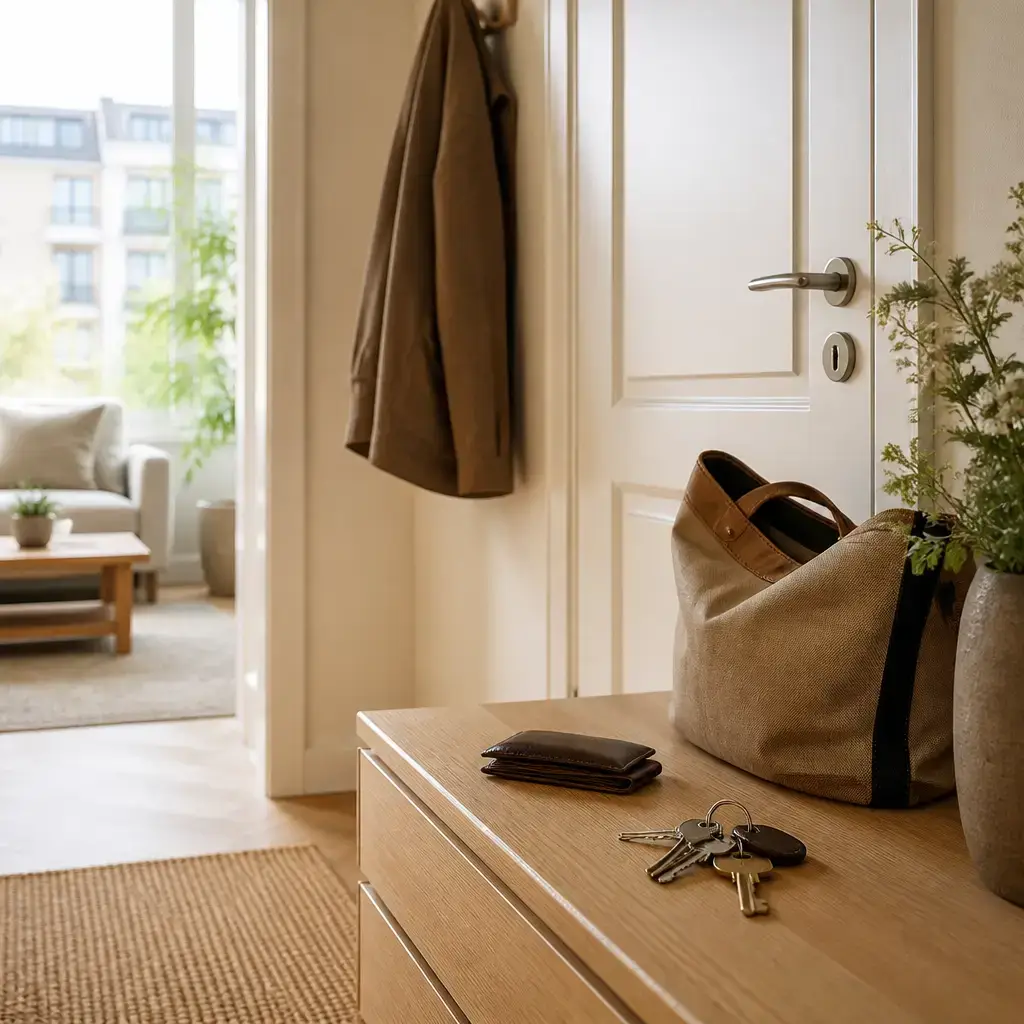
Use Checking before leaving to practice Danish conversation, pronunciation, vocabulary, grammar, and quizzes.
Dialogue
Har vi alt, før vi går?
hah vee AHL, fuh vee GOH? Do we have everything before we leave?Lad os tjekke nu.
lah ohs CHEH-guh NOO. Let's check now.Har du dine nøgler?
hah doo DEE-nuh NUR-luh? Do you have your keys?De er i min lomme.
dee air ee meen LAW-muh. They're in my pocket.Er din pung i din taske?
air din PONG ee din TAS-guh? Is your wallet in your bag?Jeg lagde den derind.
yai LEH-dhuh den dair-EN. I put it in there.Er døren låst?
air DUR-uh LOHST? Is the door locked?Jeg tjekkede den lige før.
yai CHEH-guh-dhuh den LEE-uh fuh. I checked it just now.Sentence explanations
Har vi alt, før vi går?
Do we have everything before we leave?
- Har vi
- do we have
- alt
- everything
- før
- before
- går
- leave; go
More detail
Har vi combines the present-tense form har (“have”) with the subject vi (“we”). In this yes/no question, the verb comes before the subject: Har vi ...? is the reusable pattern “Do we have ...?” In a statement, the usual order is Vi har ... (“We have ...”). alt means “everything” here. It is used independently as a pronoun, rather than modifying a stated noun. The phrase have everything can therefore be reused with other subjects, for example: Har du alt? — “Do you have everything?” før introduces a time relation and means “before”. The following clause is vi går: vi is “we”, and går is the present form of gå. The verb gå can mean “go”, “walk”, or, as fixed by this translation and context, “leave”. In før vi går, the present form refers to the departure that is expected to happen later: “before we leave.” Together, Har vi alt asks whether the group has everything, and før vi går sets the time condition for that check. The complete meaning is: “Do we have everything before we leave?”
Lad os tjekke nu.
Let's check now.
- Lad os
- let's
- tjekke
- check
- nu
- now
More detail
Lad os is the Danish construction for suggesting a joint action: “let’s …”. Lad is the imperative of lade (“let/allow”), and os means “us”; together, they form a fixed, reusable suggestion pattern. Example: Lad os gå. — “Let’s go.” tjekke means “check” here. It is the infinitive used after Lad os, so the pattern is Lad os + infinitive. The infinitive is not marked for person or number. Example: Lad os vente. — “Let’s wait.” nu is the adverb “now”. It places the suggested checking at the present time. Example: Vi gør det nu. — “We are doing it now.” Together, Lad os tjekke nu. means “Let’s check now.” It presents checking as a joint suggestion and specifies that it should happen now.
Har du dine nøgler?
Do you have your keys?
- Har du
- Do you have
- dine
- your
- nøgler
- keys
More detail
Har du is the question pattern “do you have…?” Danish uses har (the present form of have) before the subject du in this yes/no question. In a statement, the same elements appear as du har (“you have”); the order changes to form the question. dine means “your” here and is used with a plural thing owned by the person addressed. Danish possessives agree with the possessed noun, not with the owner: din is used with a singular common-gender noun, dit with a singular neuter noun, and dine with a plural noun. For example, dine bøger means “your books.” nøgler means “keys.” Its singular form is nøgle (“key”); nøgler is the plural form. The noun is therefore plural, which is why the possessive is dine rather than din or dit. Together, Har du + dine nøgler asks whether the person addressed has their keys: “Do you have your keys?”
De er i min lomme.
They're in my pocket.
- De
- they
- er
- are
- i
- in
- min
- my
- lomme
More detail
De means “they” here. It is the third-person plural pronoun; Danish does not mark gender in this form. The fixed translation identifies the intended reading as “they,” rather than another possible use of the same spelling. er is the present-tense form of være, “to be.” Være → er; the present form er is used with both singular and plural subjects. Example: De er hjemme. — “They are at home.” i means “in” and introduces the location. It is used for something located inside a place or container. Example: Nøglerne er i tasken. — “The keys are in the bag.” min means “my” before a singular common-gender noun. Its form agrees with the possessed noun, not with the possessor: min lomme is “my pocket,” while mit is used with a singular neuter noun and mine with a plural noun. Example: Min bog er i tasken. — “My book is in the bag.” lomme means “pocket.” Its plural is lommer: en lomme — “a pocket”; to lommer — “two pockets.” In this sentence, lomme is singular and follows the possessive min. Together, De er gives “they are,” and i min lomme gives “in my pocket.” The complete utterance is therefore “They’re in my pocket.”
Er din pung i din taske?
Is your wallet in your bag?
- Er
- is
- din
- your
- pung
- wallet
- i
- in
- taske
- bag
More detail
Er is the present-tense form of være (“to be”). Danish uses er for all persons in the present: jeg er (“I am”), du er (“you are”), and de er (“they are”). In this utterance, placing er first marks a yes–no question: Er ...? din means “your” and appears twice. It is the possessive form used with one singular common-gender noun. Danish contrasts din with dit for a singular neuter noun and dine for plural nouns. The same form is used before both pung and taske because each is singular and common gender. pung means “wallet.” Its base form is pung; a plural form is punge. Example: Min pung er her. — “My wallet is here.” i means “in” when it introduces the location containing something. Example: Nøglerne er i tasken. — “The keys are in the bag.” taske means “bag.” Its plural form is tasker. With the definite article, it becomes tasken (“the bag”): Tasken er her. — “The bag is here.” The reusable question pattern is Er + possessive + noun + i + possessive + noun? Here, Er din pung asks whether the wallet belongs to the person addressed, and i din taske gives the location and again marks the bag as belonging to that person. Together, the utterance means: “Is your wallet in your bag?”
Jeg lagde den derind.
I put it in there.
- Jeg
- I
- lagde
- put
- den
- it
- derind
- in there
More detail
Jeg is the first-person singular subject pronoun: “I.” It is used for the speaker, whether the speaker is one person or a represented voice. The corresponding object form is mig, as in Hun ser mig — “She sees me.” lagde is the past-tense form of lægge, meaning “to put” or “to place.” The verb describes placing something somewhere; it is not the past form of ligge, which means “to lie/be situated.” For example, Jeg lægger bogen på bordet means “I put the book on the table” in the present, while Jeg lagde bogen på bordet means “I put the book on the table” in the past. den is the singular common-gender object pronoun, meaning “it” here. Its form indicates the pronoun’s grammatical class, but the supplied sentence does not identify exactly what object it refers to. Danish uses det for a singular neuter-gender object and dem for plural objects: Jeg lagde det derind — “I put it in there”; Jeg lagde dem derind — “I put them in there.” derind is a place adverb meaning “in there,” with an inward or destination-oriented meaning. The word der means “there,” while the ending -ind adds the idea of movement into an interior space. A related contrast is derinde, “in there” as a location without necessarily presenting it as the destination of movement. For example, Gå derind means “Go in there.” Together, Jeg supplies the actor, lagde says that the placing happened in the past, den is the object being placed, and derind gives the destination. The complete utterance therefore means “I put it in there.”
Er døren låst?
Is the door locked?
- Er
- is
- døren
- the door
- låst
- locked
More detail
Er is the present-tense form of være (“to be”). In this yes/no question, it comes before the subject: Er ...? means “Is ...?” The same form is used with singular and plural subjects; the subject determines the meaning, not a special form of er. døren means “the door” here. It is the definite singular form of dør (“door”): dør = “a door” in an indefinite context, while døren = “the door.” The ending -en marks definiteness for this noun. Example: Jeg åbner døren. — “I open the door.” låst means “locked” here. It is the past participle of låse (“to lock”), and it is also used adjectivally to describe the door’s resulting state. Useful forms are låse (infinitive), låser (present), låste (past), and låst (past participle). Example: Døren er låst. — “The door is locked.” Together, Er døren låst? uses the yes/no-question pattern Er + subject + description?: Er asks about the state, døren identifies the subject, and låst gives its state. The complete meaning is “Is the door locked?”
Jeg tjekkede den lige før.
I checked it just now.
- Jeg
- I
- tjekkede
- checked
- den
- it
- lige før
- just now
More detail
Jeg is the first-person singular pronoun, meaning “I.” It identifies the speaker as the person who carried out the checking. tjekkede is the past-tense form of tjekke, “to check.” The ending -ede is used here to mark a completed past action: tjekke → tjekkede. For example, Jeg tjekkede døren. means “I checked the door.” den means “it” here and refers to the door mentioned in the preceding question. In this use, it is a singular third-person pronoun for a common-gender referent. Danish also uses det for a neuter-gender singular referent; the choice follows the grammatical gender of the referent, not the meaning “it” alone. lige før is a temporal expression meaning “just now” in this sentence. Literally, it combines the idea of “right” or “just” with før, “before,” and together it places the checking shortly before the moment of speaking. The exact time span is not specified. Together, Jeg tjekkede den means “I checked it,” and lige før adds when that happened: “I checked it just now.”
Grammar Points
lad os + infinitiv
Lad os tjekke alt nu.
lah ohs CHEH-guh AHL NOO.Let's check everything now.
Use lad os + infinitive to suggest an action together. The verb stays in the infinitive form.
lige før
Lige før.
LEE-uh FUH-uh.Just now.
Lige før is a fixed expression meaning “just now”; it refers to a very recent moment.
Danish Vocabulary
- Gender
- common
- Gender
- common
- Gender
- common
Quiz
Word Order
Arrange the words in the correct order.
Do we have everything before we leave?
Show Answer
Har vi alt, før vi går?Let's check now.
Show Answer
Lad os tjekke nu.Do you have your keys?
Show Answer
Har du dine nøgler?Spelling
Tap the letters to spell the word.
to check
Show Answer
tjekkeShow Answer
lommekey
Show Answer
nøglerbag