10 minutes free every day
Continue audio lessons in the app
Word explanations appear automatically in sync with the audio.
No login required · synced translations · playback with the screen locked
Choose your learning language and open this lesson in the app.

About This Lesson
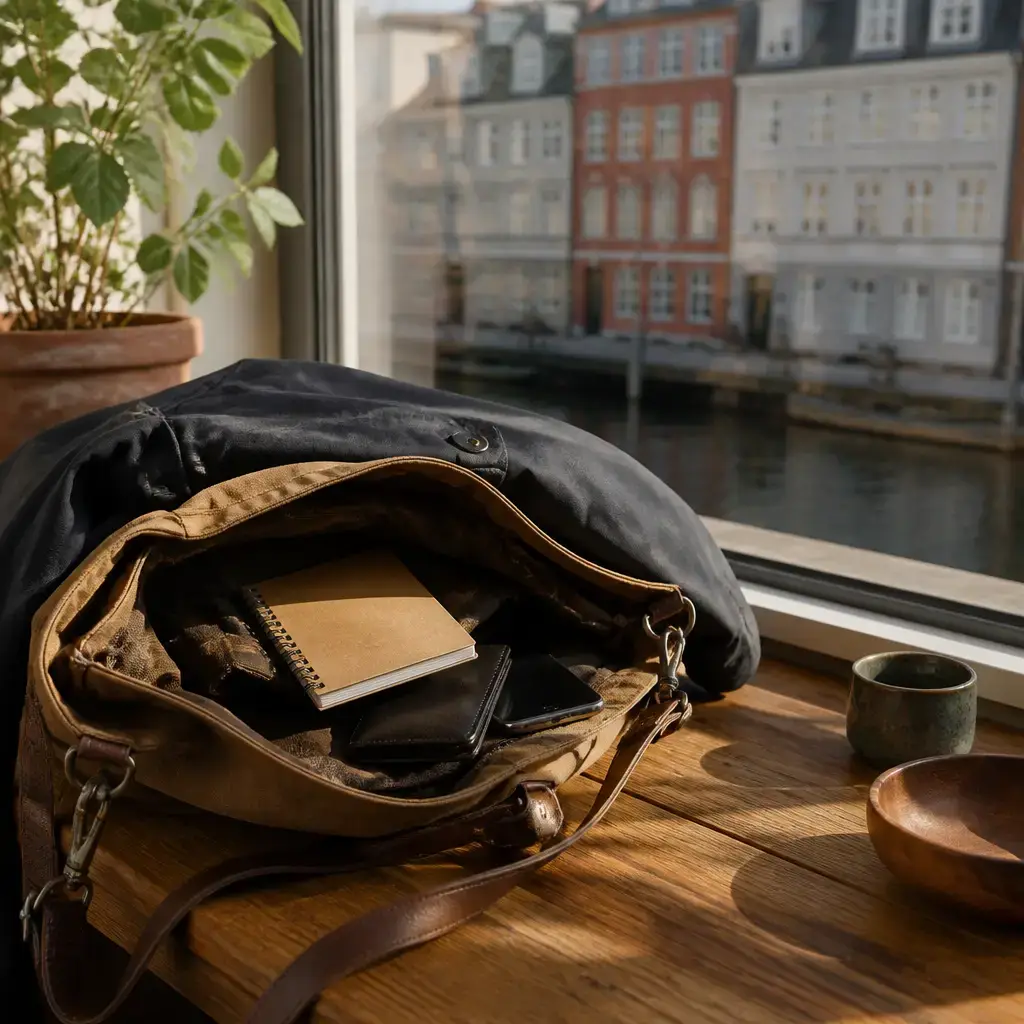
Use Checking a bag to practice Danish conversation, pronunciation, vocabulary, grammar, and quizzes.
Dialogue
Kan du hjælpe mig med at tjekke min taske?
kan doo YEL-buh my meh ehd CHEG-uh min TAS-guh? Can you help me check my bag?Jeg kan kigge den igennem sammen med dig.
yai kan KEE-guh den ee-GEH-num SAH-mun meh dai. I can look through it with you.Kan du se, om der mangler noget?
kan doo SAY, om dair MANG-luh NOH-uh? Do you see anything missing?Din pung og telefon er begge her.
deen POHNG oh teh-leh-FOHN air BEG-uh HAIR. Your wallet and phone are both here.Hvor er min lille notesbog?
vohr air meen LEL-uh NOH-duhs-BOH? Where is my small notebook?Den ligger under din jakke.
den LEG-uh ON-uh deen YAH-guh. It is under your jacket.Så har jeg alt.
SOH har yai AHLT. Then I have everything.Du kan lukke tasken nu.
doo kan LAW-guh TAS-gun NOO. You can close the bag now.Sentence explanations
Kan du hjælpe mig med at tjekke min taske?
Can you help me check my bag?
- Kan du
- Can you
- hjælpe
- help
- mig
- me
- tjekke
- check
- min
- my
- taske
- bag
More detail
Kan du is a reusable way to ask whether someone is able or willing to do something: “Can you …?” kan is the present form of kunne (“can, be able to”). After this modal, the next verb normally appears in the infinitive without at: Kan du hjælpe? = “Can you help?” hjælpe means “help” here. It is the infinitive of hjælpe; the same form is also used after kan. Danish uses hjælpe with an object for the person being helped: Jeg hjælper dig. = “I help you.” mig means “me” and is the object form of the first-person pronoun. Compare jeg (“I”) as the subject and mig (“me”) as the object: Du hjælper mig. = “You help me.” tjekke means “check” or “inspect” here. It is an infinitive, and it follows med at in the phrase hjælpe mig med at tjekke ..., literally organizing the idea as “help me with checking …”. The at before an infinitive is different from the infinitive used directly after kan: Jeg vil tjekke den. = “I want to check it.” min means “my” before the singular noun taske. Danish possessive forms vary with the possessed noun’s grammatical number and gender: min is used with a singular common-gender noun, mit with a singular neuter noun, and mine with plural nouns. The form agrees with the possessed noun, not with the owner. taske means “bag”. It is a noun; its indefinite form is en taske, and its definite form is tasken (“the bag”). Here, min taske means “my bag”. Together, Kan du hjælpe mig med at tjekke min taske? asks the other person whether they can help the speaker inspect the speaker’s bag. The structure is Kan du + infinitive hjælpe + object mig + med at + infinitive tjekke + possessive noun phrase min taske. The fixed meaning is therefore: “Can you help me check my bag?”
Jeg kan kigge den igennem sammen med dig.
I can look through it with you.
- Jeg kan
- I can
- kigge
- look
- den
- it
- igennem
- through
- sammen med dig
- together with you
More detail
Jeg kan combines jeg (“I”) with kan, the present-tense form of kunne (“can; be able to”). It expresses present ability or permission here: “I can.” The subject is jeg; kan does not change for person or number. Example: Vi kan vente. — “We can wait.” kigge is the infinitive “to look.” After the modal kan, Danish uses the infinitive without at: kan kigge, “can look.” The form kigge is different from the past form kiggede, “looked.” den is a third-person singular pronoun meaning “it” here. It is the object of the action, while jeg is the one doing the looking. Its specific referent is the thing being checked; the fixed translation supports “it.” Example: Jeg ser den. — “I see it.” igennem means “through.” With kigge, the combination kigge ... igennem means “look through” or “inspect.” Danish can place the object between the verb and this particle: kigge den igennem. This is a useful pattern for an action directed through or over an object. Example: Hun læser bogen igennem. — “She reads through the book.” sammen med dig means “together with you.” sammen med introduces someone who participates with the subject. dig is the object form corresponding to the subject form du: du = “you” as subject, dig = “you” after expressions such as med. Example: Jeg går sammen med dig. — “I walk with you.” Together, Jeg kan + kigge den igennem + sammen med dig gives: “I can look through it with you.” The speaker offers or states the ability to inspect the relevant thing jointly with the listener. In the surrounding checking context, this naturally describes examining the item together.
Kan du se, om der mangler noget?
Do you see anything missing?
- Kan du
- can you
- se
- see
- om
- whether / if
- der
- there
- mangler
- is missing
- noget
- anything / something
More detail
Kan du combines kan, the present-tense form of the modal verb kunne (“can/be able to”), with du (“you”). In a yes/no question, the modal comes before the subject: Kan du ...? means “Can you ...?” The following verb stays in the bare infinitive, without an infinitive marker. Example: Kan du hjælpe? — “Can you help?” se means “see”. Its base form is also se; after the modal kan, it does not take a person ending. The pattern Kan du se ...? is therefore a reusable way to ask whether someone can see or notice something. om introduces an indirect yes/no question. Here it is best understood as “whether” or “if”: se, om ... means “see whether ...”. Example: Jeg ved ikke, om han kommer. — “I don’t know whether he is coming.” der is a grammatical subject used in the existential pattern der .... In this sentence it does not refer to a particular place or object; it helps present the fact that something is missing. Compare Der er en fejl. — “There is an error.” mangler is the present form of mangle, “to be missing” or “to lack”. Danish verbs do not change form for the subject’s person or number, so mangler can be used with different subjects. In der mangler noget, the construction says that something is absent. Example: Der mangler en nøgle. — “A key is missing.” noget is an indefinite pronoun meaning “something”. In this question, the open yes/no meaning makes the natural English translation “anything”: it asks whether there is anything that is missing, without specifying what it would be. It is not a stated count. Together, Kan du se asks whether the listener can notice something, and om der mangler noget gives the content of what they should check: whether anything is absent. The whole utterance means “Do you see anything missing?” It is a neutral, reusable way to ask someone to check for an unspecified missing item.
Din pung og telefon er begge her.
Your wallet and phone are both here.
- Din
- your
- pung
- wallet
- og
- and
- telefon
- phone
- er
- is/are
- begge
- both
- her
- here
More detail
Din means “your” here. It is a possessive word referring to the person addressed; it agrees with the possessed noun’s gender and number in Danish, not with the owner. With a common-gender singular noun such as pung, the form is din; compare dit with a neuter singular noun and dine with plural nouns. pung means “wallet.” Its plural is punge: en pung (“a wallet”), to punge (“two wallets”). The word is a noun, so its form changes for number. og means “and.” It joins the two nouns pung and telefon into one coordinated subject. A useful pattern is A og B (“A and B”). telefon means “phone.” Its plural is telefoner: en telefon (“a phone”), to telefoner (“two phones”). Here it is the second member of the coordinated subject. er is the present-tense form of være, “to be.” Danish uses er with singular and plural subjects, so the form itself does not show the difference between “is” and “are.” In this sentence, the coordinated subject makes the English translation “are.” Example: Telefonen er her. — “The phone is here.” begge means “both.” It emphasizes that the statement applies to the two items named together. It is used for exactly two people or things, for example: Begge bøger er her. — “Both books are here.” her means “here,” referring to the location relevant in the situation. It is a location word and does not change for number or gender. The pattern er her means “is/are here.” Together, Din pung og telefon means “your wallet and phone,” er supplies the present form of “to be,” begge emphasizes the two items, and her gives their location. The complete utterance therefore means: “Your wallet and phone are both here.”
Hvor er min lille notesbog?
Where is my small notebook?
- Hvor er
- where is
- min
- my
- lille
- small
- notesbog
- notebook
More detail
Hvor er asks for a location: hvor means “where,” and er is the present-tense form of være, “to be.” Together, Hvor er ...? is a reusable Danish pattern meaning “Where is ...?” Example: Hvor er din telefon? — “Where is your phone?” min means “my” here. It is the first-person singular possessive form used with a singular common-gender noun. Danish uses mit with a singular neuter noun and mine with plural nouns. The possessive agrees with the thing possessed, not with the person who possesses it. lille means “small” here. In this singular noun phrase it is the singular form of the adjective; its plural form is små. Example: en lille taske — “a small bag”; små tasker — “small bags.” notesbog is the noun “notebook.” Its definite form is notesbogen, and its plural is notesbøger. The form in the sentence is singular and indefinite in form, while min identifies it as the speaker’s notebook. The sentence combines the location question Hvor er with the noun phrase min lille notesbog: literally, it asks where the speaker’s small notebook is. Thus the complete meaning is “Where is my small notebook?” The following context answers with Den ligger under din jakke (“It is under your jacket”), where den refers to the notebook.
Den ligger under din jakke.
It is under your jacket.
- Den
- it
- ligger
- is located
- under
- under
- din
- your
- jakke
- jacket
More detail
Den is a third-person singular pronoun meaning “it” here. In the supplied context, it refers to the notebook mentioned in the preceding question. Danish uses den with singular common-gender nouns; with a singular neuter noun, the corresponding form is det, and with plural nouns, de. ligger is the present-tense form of ligge, “to lie” or “to be located.” In this sentence it describes the item's position, not necessarily an action of lying down. Example: Bogen ligger på bordet. — “The book is on the table.” under is a preposition meaning “under” or “beneath.” It introduces the location of the item in relation to another thing. Example: Nøglen ligger under stolen. — “The key is under the chair.” din means “your” when one person is being addressed and the possessed noun is singular common gender. Its forms contrast with dit before a singular neuter noun and dine before a plural noun. Example: din bog — “your book”; dit hus — “your house”; dine bøger — “your books.” jakke means “jacket.” It is a common-gender noun: en jakke is “a jacket,” while jakken is “the jacket.” Here it follows din, so din jakke means “your jacket.” Together, Den ligger identifies the item and states its location, while under din jakke gives that location: the item is beneath the addressee’s jacket. The complete utterance therefore means “It is under your jacket.”
Så har jeg alt.
Then I have everything.
- Så
- then
- har
- have
- jeg
- I
- alt
- everything
More detail
Så means “then” here and links this statement to what has just been established. It can also have other uses in Danish, such as “so” in some contexts, but this utterance uses the time/sequence meaning. har is the present-tense form of at have (“to have”). The present form is the same for different subjects: jeg har = “I have”, while du har = “you have”. Example: Jeg har en bog. — “I have a book.” jeg is the first-person singular pronoun, “I”. In this sentence it is the person who possesses or has something. Example: Jeg har tid. — “I have time.” alt means “everything” here. It is a pronoun referring to all relevant things as a whole; it is not the noun for a particular object. Example: Alt er klart. — “Everything is ready.” The pattern is Så + finite verb + subject + object: Så har jeg alt. Danish main clauses commonly place the finite verb in the second position, so when Så comes first, har comes before jeg. Together, har jeg alt means “I have everything”, and the complete utterance means “Then I have everything.”
Du kan lukke tasken nu.
You can close the bag now.
- Du kan
- you can
- lukke
- close
- tasken
- the bag
- nu
- now
More detail
Du kan means “you can.” Du is the second-person singular pronoun, used for one person addressed directly. kan is the present form of the modal verb kunne (“can, be able to”). In Danish, a modal such as kan is followed by an infinitive without at: kan lukke = “can close.” lukke means “close” here. It is the infinitive form, so it stays unchanged after kan. The same form can be reused with other subjects after a modal: Jeg kan lukke døren. — “I can close the door.” tasken means “the bag.” It is the definite singular form of taske (“bag”): taske → tasken. Danish commonly marks singular definiteness with a suffix; the definite form refers to the particular bag intended in this utterance. An indefinite form is en taske, “a bag.” nu means “now.” It is a time adverb and places the closing at the present time. Together, Du kan + lukke forms “you can close,” tasken identifies what is to be closed, and nu specifies when. The whole utterance means: “You can close the bag now.”
Grammar Points
Definit form: jakke → jakken
Alt ligger under jakken.
AHLT LEG-uh ON-uh YAH-gun.Everything is under the jacket.
På dansk får et bestemt navneord ofte endelsen -en eller -et: jakke bliver jakken.
Verb-second efter nu
Nu ligger notesbogen under jakken.
NOO LEG-uh NOH-duhs-BOH-un ON-uh YAH-gun.Now the notebook is under the jacket.
Når nu står først, kommer verbet før subjektet: Nu ligger notesbogen.
Danish Vocabulary
- Gender
- common
- Gender
- common
- Gender
- common
- Gender
- common
- Gender
- common
Quiz
Word Order
Arrange the words in the correct order.
Where is my small notebook?
Show Answer
Hvor er min lille notesbog?It is under your jacket.
Show Answer
Den ligger under din jakke.Then I have everything.
Show Answer
Så har jeg alt.Spelling
Tap the letters to spell the word.
check
Show Answer
tjekkehelp
Show Answer
hjælpebe missing
Show Answer
manglerwallet