10 minutes free every day
Continue audio lessons in the app
Word explanations appear automatically in sync with the audio.
No login required · synced translations · playback with the screen locked
Choose your learning language and open this lesson in the app.

About This Lesson
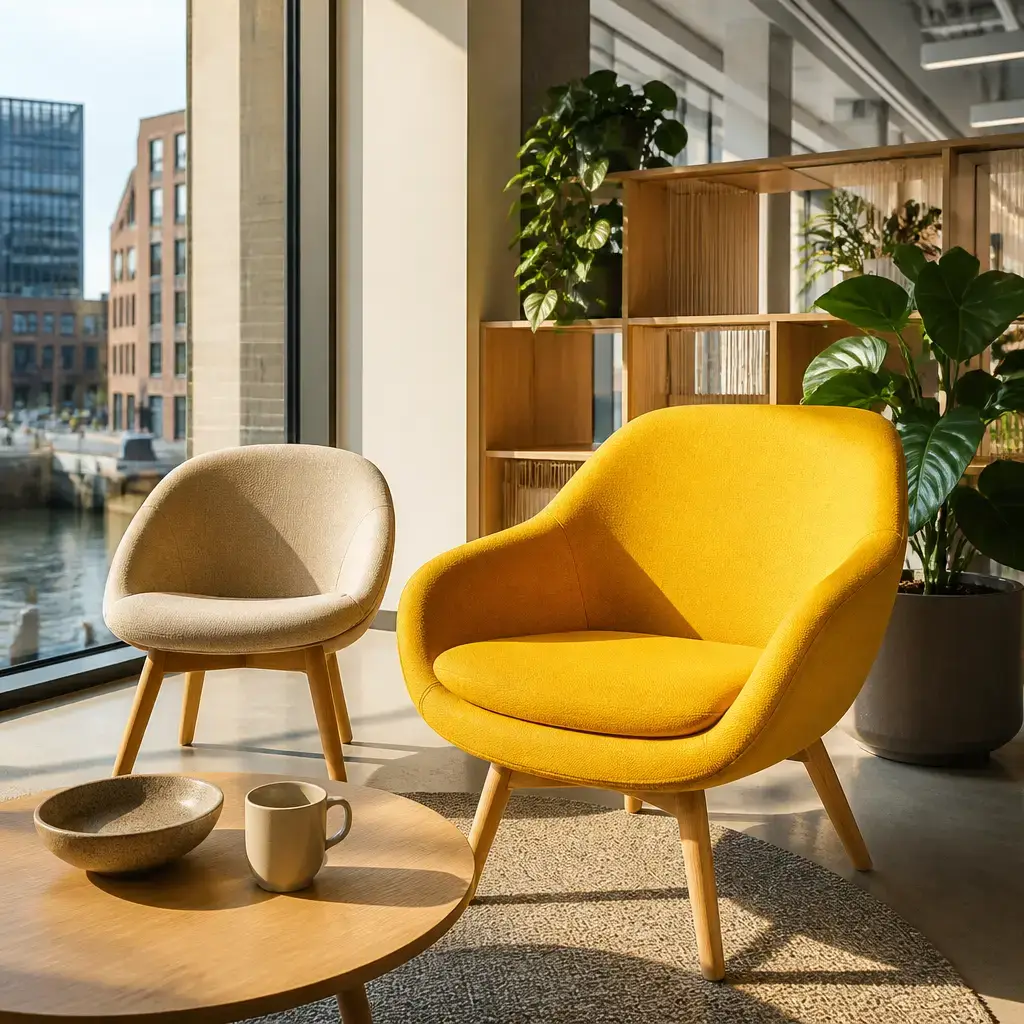
Use Choosing a Comfortable Chair to practice Danish conversation, pronunciation, vocabulary, grammar, and quizzes.
Dialogue
Hvilken stol skal vi vælge?
VEL-ken STOHL skal vee VEL-uh? Which chair should we choose?Denne stol ser behagelig ud.
DEN-uh STOHL sair beh-HAH-uh-lee oo. This one looks comfortable.Den anden stol virker for lille.
den AN-en STOHL VIR-guh fohr LEL-uh. The other chair seems too small.Så burde denne stol være fin.
soh BOO-uh DEN-uh STOHL VAIR-uh feen. Then this one should work.Hvad synes du om den klare farve?
veh SOO-nuh doo om den KLAH-uh FAH-vuh? What do you think of the bright color?Det gør stolen nem at få øje på.
deh guh(r) STOH-len naim ad foh OY-uh poh. It makes the chair easy to spot.Lad os vælge denne stol.
lad ohs VEL-uh DEN-uh STOHL. Let's choose this chair.Jeg flytter den herhen.
yai FLEW-duh den hair-HEN. I will move it over here.Sentence explanations
Hvilken stol skal vi vælge?
Which chair should we choose?
- Hvilken
- which
- stol
- chair
- skal vi
- should we
- vælge
- choose
More detail
Hvilken means “which” and is used here before the singular common-gender noun stol. Danish contrasts hvilken with hvilket before a singular neuter-gender noun and hvilke before plural nouns. The choice depends on the noun’s gender or number, not on the person making the choice. stol means “chair.” Its indefinite form is en stol, while the definite form is stolen (“the chair”). In this question, the noun is indefinite because the question asks which chair from a set of possible chairs. skal vi contains the modal verb skal and the subject pronoun vi (“we”). Skal comes from skulle; in this sentence it expresses what the speakers should choose or are to choose, matching “should we.” Danish places the subject after the modal in this question pattern: Skal vi ...? The modal is followed by an infinitive without at, as in Skal vi gå? (“Shall we go?”). vælge is the infinitive “to choose.” Its present-tense form is vælger, as in Vi vælger stolen. (“We choose the chair.”) After skal, Danish uses the infinitive vælge, not the present form. Together, Hvilken stol asks which chair is intended, and skal vi vælge asks what the speakers should choose. The complete utterance means “Which chair should we choose?”
Denne stol ser behagelig ud.
This one looks comfortable.
- Denne
- this one
- stol
- chair
- ser … ud
- looks / appears
- behagelig
- comfortable
More detail
Denne means “this one” here and points to a single nearby or contextually identified item. In this sentence it agrees with stol, which is a common-gender singular noun. Danish also has denne for common gender and dette for neuter gender; the form is selected by the noun’s gender as well as by singular number. Example: Denne bog er god. — “This book is good.” Stol means “chair.” Its base form is singular; the plural is stole. The noun is common gender, which is why the demonstrative before it is denne rather than dette. Ser ... ud is a separable-looking verb construction meaning “looks” or “appears” when describing how something seems. The verb is se (“to see”); in this present-tense construction, ser is followed by ud in the sentence. Example: Hun ser træt ud. — “She looks tired.” The adjective after this construction describes the impression something gives, not necessarily a confirmed permanent quality. Behagelig means “comfortable” here. It is an adjective in its basic form, used with the common-gender singular noun stol. Its neuter form is behageligt, and its plural form is behagelige. Example: Sengen ser behagelig ud. — “The bed looks comfortable.” Together, Denne stol identifies one chair, and ser behagelig ud says that it appears comfortable. Thus the whole utterance means “This one looks comfortable,” with the surrounding context making the chair the identified item.
Den anden stol virker for lille.
The other chair seems too small.
- Den anden
- the other
- stol
- chair
- virker
- seems
- for lille
- too small
More detail
Den anden means “the other” here. den is the common-gender singular definite article, matching stol, while anden is the common-gender singular form of anden (“other”). The forms change with the noun: den anden stol (common gender), det andet ... (neuter), and de andre ... (plural). The phrase identifies a different chair from one already relevant, as in the supplied context. stol means “chair.” Its indefinite form is en stol, and its definite form is stolen (“the chair”). Danish nouns with en are common gender; this is why the phrase uses den anden, not det andet. virker is the present-tense form of virke, “to seem” in this use. The ending -er marks the present form here: jeg virker, den virker, and de virker all use virker. In other contexts, virke can also mean “work” or “function,” but with the adjective for lille it expresses an impression: the chair appears too small. for lille means “too small.” lille is the adjective “small”; its comparative is mindre (“smaller”), and its superlative is mindst (“smallest”). for placed before an adjective can mark excess: for lille = “too small,” whereas meget lille = “very small.” Together, Den anden stol is the subject, virker says how it appears, and for lille describes the excessive degree of its size. The whole utterance therefore means “The other chair seems too small.”
Så burde denne stol være fin.
Then this one should work.
- Så
- then
- burde
- should
- denne
- this
- stol
- chair
- være
- be
- fin
- fine; suitable
More detail
Så means “then” here and links the conclusion to what has just been said. It can also mean “so” in other contexts, but this sentence uses it to introduce a result or judgment. burde is the modal verb meaning “should” or “ought to” here. It is the observed form associated with bør; bør is the present-tense form, while burde is used for past or conditional-looking modal meanings. Here it expresses an expectation and is followed by the infinitive være. Example: Det burde hjælpe. — “That should help.” denne means “this” and appears directly with the singular noun stol. Danish uses denne before a singular common-gender noun such as stol; the form is not the noun’s inflection. The related form dette is used with a singular neuter noun. Example: denne bog — “this book.” stol means “chair.” Its definite form is stolen (“the chair”), while the indefinite plural is stole (“chairs”). In this utterance, stol is the indefinite singular form after denne. være is the infinitive of “to be.” After the modal burde, Danish uses the infinitive: burde være means “should be.” Example: Det burde være nemt. — “It should be easy.” fin means “fine” or “suitable” here. With være, the combination være fin can describe something as acceptable for the relevant purpose, which supports the translation “work” in this context. The adjective agrees with a common-gender singular subject here; compare fint with a neuter singular subject and fine in the plural. Example: Denne løsning er fin. — “This solution is suitable.” Together, Så burde denne stol være fin means “Then this one should work.” Så introduces the conclusion, burde være expresses the expectation that something is suitable, and denne stol identifies the item being evaluated. The fixed translation uses “this one” for that item.
Hvad synes du om den klare farve?
What do you think of the bright color?
- Hvad
- what
- synes
- think
- du
- you
- om
- about; of
- den
- the
- klare
- bright
- farve
- color
More detail
Hvad means “what” here and asks for the thing or opinion being requested. It is a question word, not a statement about a particular object. Compare hvem (“who”) when asking about a person. Example: Hvad vælger du? — “What are you choosing?” synes means “to think” or “to have an opinion.” It is both the infinitive and present-tense form in Danish, so the present form does not change with the subject. In synes om, the verb and om form the useful pattern for asking what someone thinks of something; in this sentence it is naturally translated “think of.” This is distinct from tror, which commonly means “believe” or “think” in the sense of judging that something is true. du means “you” for one person. It is the second-person singular subject of synes: du synes means “you think.” om follows synes in the reusable pattern synes om + noun or synes om + pronoun. Together with synes, it asks for an opinion about something. The meaning of this om is therefore part of the construction rather than an independent “about” added to a separate English-style phrase. den is the definite article used with a singular common-gender noun. It corresponds here to “the” and agrees with farve, which is a common-gender noun. Danish also has det with singular neuter nouns; the choice is determined by the noun’s grammatical gender, not by the number of objects alone. klare is the definite singular common-gender form of the adjective klar, meaning “bright” here. The -e form appears because the adjective follows the definite article den: en klar farve — “a bright color”; den klare farve — “the bright color.” Its comparison forms are klar, klarere, klarest — “bright,” “brighter,” “brightest.” In this utterance it describes the color as bright; it is not itself a form of the noun farve. farve means “color.” It is a common-gender noun: en farve is “a color,” and its definite singular form is farven, “the color.” Its plural is farver, and its definite plural is farverne, “the colors.” Together, Hvad synes du om asks for the listener’s opinion, while den klare farve identifies the subject of that opinion as “the bright color.” The complete utterance is therefore: “What do you think of the bright color?”
Det gør stolen nem at få øje på.
It makes the chair easy to spot.
- Det
- it
- gør
- makes
- stolen
- the chair
- nem
- easy
- få øje på
- spot
More detail
Det is the subject pronoun “it” here. Together with the preceding context, it can refer back to something already mentioned, such as the bright color; the sentence itself does not repeat that referent. Danish det can also refer to a neuter noun or to a previously stated situation, so its exact use is determined by context. gør is the present-tense form of gøre, “to do” or “to make.” In this sentence it has a causative pattern: gøre + object + adjective + at-infinitive. This pattern describes causing the object to have a quality for carrying out an action. Example: Det gør arbejdet lettere at forstå. — “It makes the work easier to understand.” stolen means “the chair.” Its base form is stol; the ending -en marks definite singular in this noun’s form, so stolen means “the chair,” while en stol means “a chair.” The article-like ending expresses definiteness, not a stated numerical count beyond the singular form. nem means “easy” here. It is the adjective in the pattern nem at ..., “easy to ...,” and describes stolen as the object of gør. The adjective’s form is nem in this sentence; it does not itself carry a visible plural ending here. Its comparative is nemmere, “easier,” and its superlative is nemmest, “easiest.” Example: Denne opgave er nem at løse. — “This task is easy to solve.” få øje på is a fixed verb expression meaning “spot” or “notice.” Its literal components are not combined as a normal English-style phrase in the translation; learn the reusable pattern få øje på + something for noticing something. få is the infinitive form of få, and at få follows the adjective in this sentence. Example: Jeg får øje på en rød bil. — “I spot a red car.” The sentence assembles as Det gør (“It makes”) + stolen (“the chair”) + nem (“easy”) + at få øje på (“to spot”), giving: “It makes the chair easy to spot.”
Lad os vælge denne stol.
Let's choose this chair.
- Lad os
- let's
- vælge
- choose
- denne
- this
- stol
- chair
More detail
Lad os is a Danish construction meaning “let’s.” Lad is the imperative of lade (“let” or “allow”), and os is the object form meaning “us.” Together, Lad os introduces a suggestion for a shared action. For example: Lad os gå. — “Let’s go.” vælge means “to choose.” It is the infinitive form, used here after Lad os; the construction is Lad os + infinitive. The verb’s present form is vælger, as in Vi vælger stolen. — “We choose the chair.” denne means “this” and identifies one nearby or contextually selected item. It is the common-gender singular form used with stol, which is a common-gender noun: en stol. The related plural form is disse (“these”), as in disse stole — “these chairs.” stol means “chair.” Its indefinite singular form is en stol, its definite singular form is stolen (“the chair”), and its plural is stole (“chairs”). Together, Lad os vælge denne stol. forms the suggestion “Let’s choose this chair.” The shared-action construction supplies “let’s,” vælge names the action, and denne stol identifies the chair being chosen.
Jeg flytter den herhen.
I will move it over here.
- Jeg
- I
- flytter
- move
- den
- it
- herhen
- over here
More detail
Jeg is the first-person singular pronoun meaning “I.” It identifies the speaker as the agent of the action. A useful contrast is du (“you,” singular), which refers to the person addressed. flytter means “move” here. Its base form is flytte, and flytter is the present-tense form. Danish present tense can describe a planned or intended future action when the context supports that reading; here, the fixed translation gives that future reading: “will move.” The same form can also mean “am moving” in a different context. Example: Jeg flytter stolen. — “I move the chair” or “I am moving the chair.” den is the singular object pronoun “it” in this sentence. It is used for a referent belonging to the common-gender (en) class; the form itself does not identify the referent’s name. The related neuter singular form is det, used when the referent belongs to the neuter (et) class. Here den is the object receiving the action of flytter. herhen means “over here” with a directional sense: toward this place. It combines the location element her (“here”) with hen, which indicates movement toward a destination. Compare her in Kom her. — “Come here,” where the destination is expressed without the same compound directional form. Together, Jeg flytter den herhen. has the structure “I + move + it + to-here.” In the supplied context and fixed translation, it means “I will move it over here.”
Grammar Points
for + adjektiv
Den anden virker for lille.
den AN-en VIR-guh fohr LEL-uh.The other one seems too small.
for står foran et adjektiv og betyder “too”; det ændrer betydningen fra “small” til “too small”.
den + bestemte adjektivform + substantiv
Den klare farve gør stolen fin.
den KLAH-uh FAH-vuh guh(r) STOH-len feen.The bright color makes the chair fine.
Efter den får adjektivet den bestemte form: klar bliver til klare foran et bestemt substantiv.
Danish Vocabulary
- Gender
- common
This chair looks comfortable.
The other chair seems too small.
- Gender
- common
This chair looks comfortable.
The other chair seems too small.
- Gender
- common
Which chair should we choose?
The other chair seems too small.
This chair looks comfortable.
- Gender
- common
Which chair should we choose?
Then this one should work.
This chair looks comfortable.
The other chair seems too small.
Which chair should we choose?
Quiz
Word Order
Arrange the words in the correct order.
Which chair should we choose?
Show Answer
Hvilken stol skal vi vælge?This one looks comfortable.
Show Answer
Denne stol ser behagelig ud.The other chair seems too small.
Show Answer
Den anden stol virker for lille.Spelling
Tap the letters to spell the word.
which
Show Answer
hvilkenthis
Show Answer
denneseems; appears to be
Show Answer
virkerchoose