10 minutes free every day
Continue audio lessons in the app
Word explanations appear automatically in sync with the audio.
No login required · synced translations · playback with the screen locked
Choose your learning language and open this lesson in the app.

About This Lesson
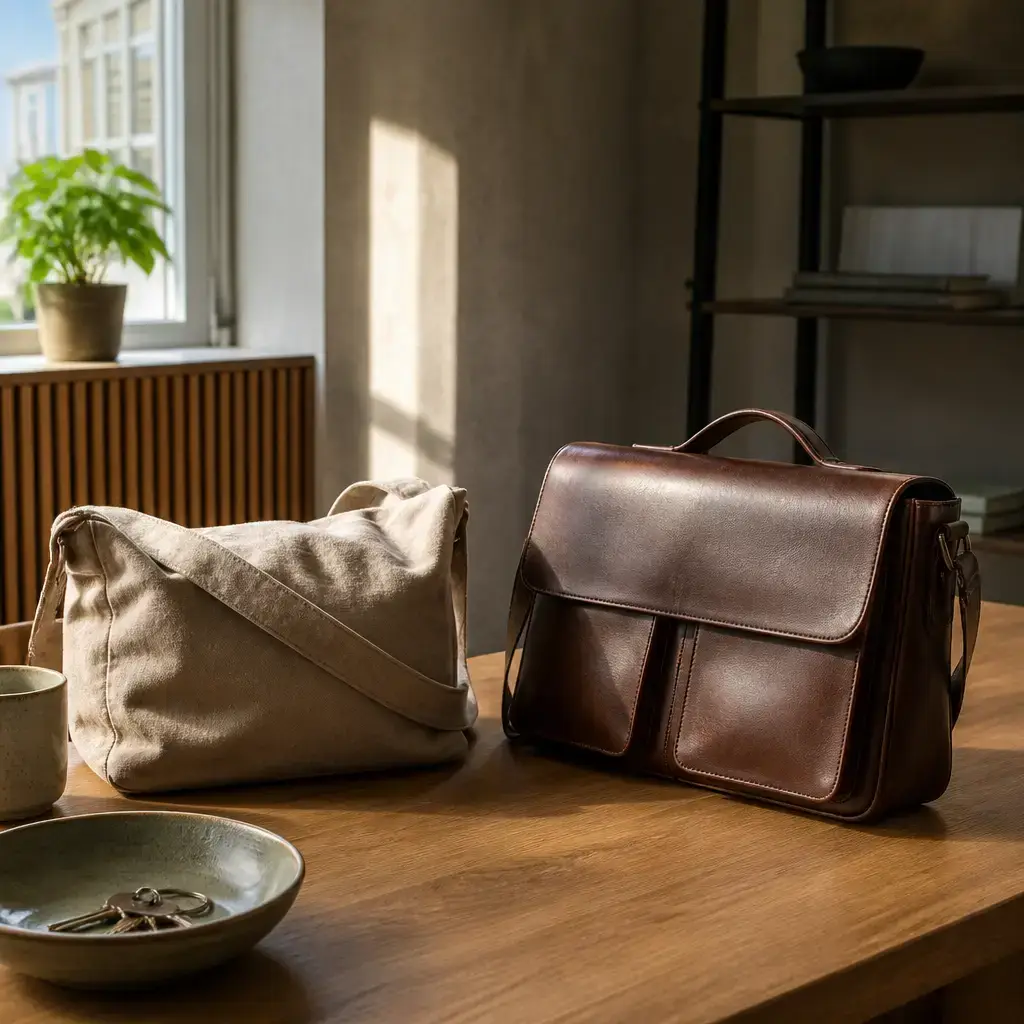
Use Choosing between two bags to practice Danish conversation, pronunciation, vocabulary, grammar, and quizzes.
Dialogue
Hvilken taske skal jeg vælge?
VIL-kuhn TAS-guh sgal yai VEL-guh? Which bag should I choose?Denne er let.
DEN-uh air LAYD. This one is light.Den anden taske ser stærkere ud.
den AHN-uhn TAS-guh sair STAIR-guh-ruh ooth. The other bag looks stronger.Den har også to lommer.
den hah AW-suh toh LOM-uh. It also has two pockets.Jeg har brug for en taske til arbejde.
yai hah BROO faw uhn TAS-guh tehl AH-bye-thuh. I need a bag for work.Så giver den stærkere taske mening.
soh GEE-vuh den STAIR-guh-ruh TAS-guh MAY-ning. Then the stronger one makes sense.Jeg kan lægge mine papirer i lommerne.
yai kan LAY-uh MEE-nuh pah-PEER-uh ee LOM-uh-nuh. I can put my papers in the pockets.Det burde fungere godt for dig.
deh BOOR-thuh fong-KAIR gohth faw dye. That should work well for you.Sentence explanations
Hvilken taske skal jeg vælge?
Which bag should I choose?
- Hvilken
- which
- taske
- bag
- skal jeg
- should I
- vælge
- choose
More detail
Hvilken means “which” here and asks the listener to identify one choice from a set. It is the singular common-gender form used with a common-gender noun such as taske; compare hvilket with a singular neuter noun and hvilke with plural nouns. Example: Hvilken bog vil du læse? — “Which book do you want to read?” taske means “bag.” Its base form is the singular indefinite form: en taske (“a bag”). The definite singular is tasken (“the bag”), and the plural is tasker (“bags”) or taskerne (“the bags”). skal jeg combines the modal verb skal with the subject pronoun jeg (“I”). In this question, skal expresses what the speaker ought to or is expected to choose, matching “should I.” Jeg is the first-person singular subject form; it is distinct from the object form mig (“me”). Example: Skal jeg vente? — “Should I wait?” vælge is the infinitive “choose.” After the modal skal, Danish uses the infinitive without at: skal jeg vælge (“should I choose”). The verb’s present form is vælger: Jeg vælger tasken — “I choose/am choosing the bag.” Together, Hvilken taske asks which bag is meant, while skal jeg vælge asks what choice the speaker should make. The whole utterance therefore means “Which bag should I choose?”
Denne er let.
This one is light.
- Denne
- this one
- er
- is
- let
- light
More detail
Denne means “this one” here. In the supplied context, it refers to the bag being chosen. Danish uses denne for a singular common-gender “this”; when the noun is omitted, it can stand on its own as “this one.” The corresponding form for a singular neuter noun is dette, and the plural form is disse. Example: Denne er ny. — “This one is new.” er is the present-tense form of at være, “to be.” It is used with all subjects in the present: jeg er (“I am”), du er (“you are”), and denne er (“this one is”). Example: Tasken er tung. — “The bag is heavy.” let means “light” here in the sense of not heavy. Its comparison forms are lettere (“lighter”) and lettest (“lightest”); the adjective’s base form is let. Danish uses let with both common- and neuter-gender singular nouns: en let taske and et let kamera. Example: Denne taske er lettere. — “This bag is lighter.” Together, Denne er let. means “This one is light.” The demonstrative identifies the selected item, er links it to a description, and let describes its weight. The sentence is a reusable pattern: Denne er + adjective — “This one is + adjective.”
Den anden taske ser stærkere ud.
The other bag looks stronger.
- Den anden
- the other
- taske
- bag
- ser … ud
- looks
- stærkere
- stronger
More detail
Den anden means “the other” here. In den anden taske, den is the common-gender singular form used with a definite noun phrase containing an adjective, and anden is the form of anden used with a common-gender singular noun. The translation establishes the intended meaning “other,” rather than a numerical claim that this is the second bag. A reusable pattern is den anden + noun: “the other + noun.” taske means “bag.” It is a common-gender noun; its definite form is tasken (“the bag”) when no adjective is placed in front. With an adjective, Danish uses the pattern den + adjective + noun, as in den anden taske. ser ... ud is the Danish construction meaning “looks” or “appears” when describing how something seems. The two parts belong together even though ud follows the adjective. For example, Hun ser glad ud. means “She looks happy.” This is different from using ser alone for the act of seeing. stærkere means “stronger” here. It is the comparative form of stærk (“strong”): stærk → stærkere → stærkest (“strong” → “stronger” → “strongest”). In this sentence, the comparative presents the bag as having greater apparent strength than the comparison item understood from the context. The adjective is the word carrying the comparison, not taske. Together, den anden taske identifies the other bag, and ser stærkere ud says that it looks stronger. The whole utterance therefore means: “The other bag looks stronger.”
Den har også to lommer.
It also has two pockets.
- Den
- it
- har
- has
- også
- also
- to
- two
- lommer
- pockets
More detail
Den means “it” here and is the subject. In Danish, den is used for a singular common-gender referent; det is the corresponding form for a neuter referent. The fixed translation gives the intended pronoun meaning, while the nearby context concerns a bag. The pronoun’s form itself does not encode a more specific noun. har is the present-tense form of have (“to have”). Danish uses har with different subjects: jeg har (“I have”), du har (“you have”), and den har (“it has”). Here it expresses possession or a feature: the item has something. også means “also” or “too”. In Den har også ..., it adds this property to other information about the same item: it has this feature as well. Example: Tasken er også sort. — “The bag is also black.” to is the numeral “two”. Here it gives the exact number of pockets, rather than merely indicating that there is more than one. lommer means “pockets” here. It is the plural of lomme (“pocket”): en lomme (“a pocket”), to lommer (“two pockets”). The form lommer is therefore appropriate after the explicit numeral to. Together, Den har også to lommer. means “It also has two pockets.” The structure is subject + present-tense possession verb + også + number + plural noun: Den har også [to lommer]. The sentence adds the fact that the already-discussed item has exactly two pockets.
Jeg har brug for en taske til arbejde.
I need a bag for work.
- Jeg
- I
- har brug for
- need
- taske
- bag
- arbejde
- work
More detail
Jeg is the first-person singular pronoun, meaning “I.” It refers to the speaker. It does not change for grammatical gender. har brug for is a fixed Danish construction meaning “need.” Its form is built from har, the present form of have, plus brug for; use the whole construction rather than translating the words separately. Example: Jeg har brug for hjælp. — “I need help.” taske means “bag.” Its indefinite form is en taske; the article en belongs to the noun phrase and does not by itself state a numerical count. Example: Hun køber en taske. — “She is buying a bag.” arbejde means “work” here. After til, it forms the purpose expression til arbejde, “for work.” The same spelling can also be a verb meaning “to work” in another context, but here it is a noun because it names the purpose of the bag. Example: Han tager til arbejde. — “He goes to work.” Together, Jeg har brug for + en taske + til arbejde gives: “I need a bag for work.”
Så giver den stærkere taske mening.
Then the stronger one makes sense.
- Så
- then
- den
- the
- stærkere
- stronger
- taske
- bag
- giver … mening
- makes sense
More detail
Så means “then” here and marks the conclusion drawn in this sentence. Danish så can have other uses in other contexts. den appears before an adjective and noun to form a definite singular common-gender noun phrase. Here it belongs with stærkere taske, giving “the stronger bag.” With a neuter noun, Danish uses det in the corresponding pattern; without a preceding adjective, definiteness is commonly expressed by a noun ending, as in tasken (“the bag”). stærkere means “stronger” here. It is the comparative form of stærk (“strong”): stærk → stærkere. The comparative ending is -ere; this form itself does not mark singular or plural. Example: Denne taske er stærkere. — “This bag is stronger.” taske means “bag.” It is a common-gender noun, as shown by en taske (“a bag”). Its plural is tasker (“bags”), and its definite singular form without an adjective is tasken (“the bag”). giver ... mening is the reusable Danish construction “makes sense.” giver is the present-tense form of give; Danish present-tense verbs do not change for person or number, so giver itself is not a singular form. The noun mening means “sense” in this expression. Example: Det giver mening. — “That makes sense.” Together, den stærkere taske is the subject and means “the stronger bag.” It comes before giver mening, producing the whole meaning “Then the stronger one makes sense.” The fixed translation uses “one” instead of repeating “bag,” while the Danish sentence explicitly contains taske.
Jeg kan lægge mine papirer i lommerne.
I can put my papers in the pockets.
- Jeg kan
- I can
- lægge
- put; place
- mine
- my
- papirer
- papers; documents
- i
- in
- lommerne
- the pockets
More detail
Jeg kan means “I can.” Jeg is the first-person singular subject “I”, and kan is the present-tense form of kunne (“can; be able to”). After a modal such as kan, Danish uses the infinitive without at: Jeg kan læse = “I can read.” lægge means “put/place” here. It is the infinitive of lægge. A useful contrast is lægge for putting something somewhere, versus ligge for something being located somewhere: Jeg lægger bogen på bordet = “I put the book on the table”; Bogen ligger på bordet = “The book is on the table.” mine means “my” before a plural noun. It is the plural form of the possessive min/mit/mine: min is used with common-gender singular nouns, mit with neuter singular nouns, and mine with plural nouns. The form agrees with the possessed noun, not with the possessor. papirer means “papers” here. It is the plural of papir (“paper; document”). In this sentence, the plural refers to the papers being put away; it does not by itself specify how many papers there are. i means “in” and introduces the location containing the papers. Danish uses i for being or placing something inside a space or container: Bogen er i tasken = “The book is in the bag.” lommerne means “the pockets.” It is the definite plural of lomme (“pocket”): lommer is the plural, and lommerne adds the definite ending “the.” The definite form presents the pockets as identifiable in the intended context. Together, Jeg kan lægge mine papirer i lommerne means “I can put my papers in the pockets.” The structure is Jeg kan + infinitive lægge + the object mine papirer + the location phrase i lommerne. It expresses the speaker’s ability or possibility of placing the papers inside the pockets.
Det burde fungere godt for dig.
That should work well for you.
- Det
- That
- burde
- should
- fungere
- work
- godt
- well
- for dig
- for you
More detail
Det is the subject pronoun here, meaning “that” in the supplied translation. It is the neuter singular form used for a thing, situation, or idea; the sentence itself does not identify a more specific referent. Do not assume that the nearest noun in another sentence must be its referent. burde expresses an expected or advisable result: “should.” It is the past-form counterpart of bør, but in this use it commonly expresses a present or future expectation rather than simple past time. Danish modal forms such as burde are not marked for person or number. A modal is followed by an infinitive: burde fungere = “should work.” fungere is the infinitive “to work” or “to function.” After burde, it stays in the infinitive rather than taking a finite ending. Example: Det kan fungere. — “That can work.” godt is the adverb “well” here. It modifies how fungere happens. It is related to the adjective god (“good”), but this sentence needs the adverbial form because it describes the functioning, not a noun. Example: Det fungerer godt. — “It works well.” for dig means “for you.” dig is the singular second-person object form of du, used after a preposition such as for. The form identifies one addressee; the fixed sentence gives no further information about that person's identity or register. Together, Det burde fungere godt for dig says that the thing or situation referred to as “that” is expected to work well for the listener: “That should work well for you.”
Grammar Points
substantiv + -ne
lommerne
LOM-uh-nuhthe pockets
Danish often marks definite plural nouns with the ending -ne: lommer becomes lommerne.
have brug for + substantiv
have brug for arbejde
HAH-vuh BROO faw AH-bye-thuhneed work
The fixed Danish expression have brug for means “need” and is followed by what is needed.
Danish Vocabulary
- Gender
- common
Quiz
Word Order
Arrange the words in the correct order.
Which bag should I choose?
Show Answer
Hvilken taske skal jeg vælge?This one is light.
Show Answer
Denne er let.The other bag looks stronger.
Show Answer
Den anden taske ser stærkere ud.Spelling
Tap the letters to spell the word.
which
Show Answer
hvilkenother
Show Answer
andenstronger
Show Answer
stærkerechoose