10 minutes free every day
Continue audio lessons in the app
Word explanations appear automatically in sync with the audio.
No login required · synced translations · playback with the screen locked
Choose your learning language and open this lesson in the app.

About This Lesson
Use Choosing a Place to Sit to practice Danish conversation, pronunciation, vocabulary, grammar, and quizzes.
Dialogue
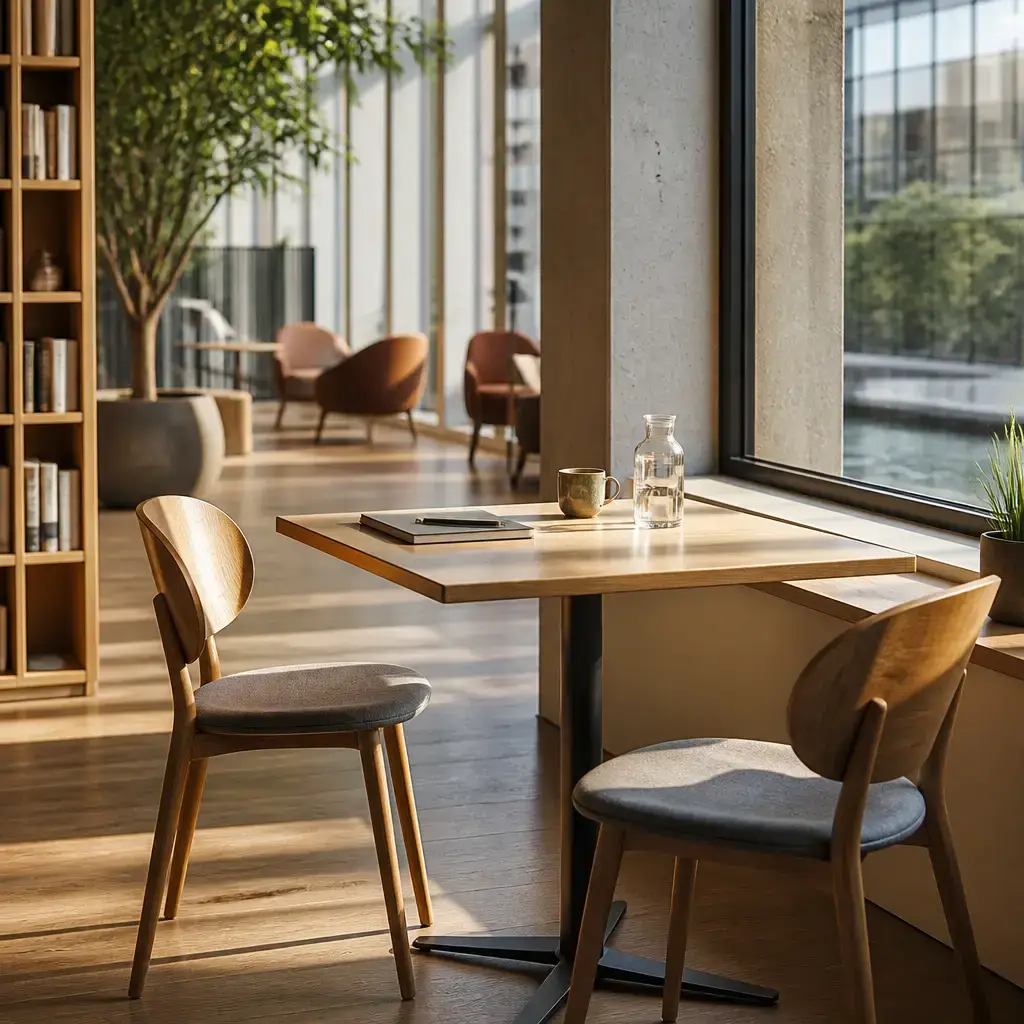
Hvor skal vi sidde?
vohr skal vee SID-uh? Where should we sit?Bordet i hjørnet står et roligt sted.
BOHR-deth ee YUR-nuhd stohr ed ROH-lee STED. The corner table is in a quiet spot.Der er også godt lys ved dette bord.
dair air OH-soh goht LEWS vay DEH-duh BOHR. This table has nice light too.Dette bord ville være bedre at læse ved.
DEH-duh BOHR VIL-uh VAIR-uh BAY-druh uh LAY-suh vay. This table would be better for reading.Er disse stole behagelige?
air DEE-suh STOH-luh beh-HAH-guh-lee-uh? Are these chairs comfortable?De føles helt fine for mig.
dee FUR-luh helt FEE-nuh fohr MY. They feel fine to me.Lad os sidde ved dette bord.
lath ohs SID-uh vay DEH-duh BOHR. Let's sit at this table.Jeg lægger vores tasker under det.
yai LEH-guh VOH-us TAS-kuh OON-uh deh. I'll put our bags under it.Sentence explanations
Hvor skal vi sidde?
Where should we sit?
- Hvor
- where
- skal vi
- should we
- sidde
- sit
More detail
Hvor means “where” and asks about a place. It is a question word used when the missing information is a location. Example: Hvor bor du? — “Where do you live?” skal vi combines skal, the present form of skulle, with vi, “we.” Here skal expresses what the participants should do, giving the intended meaning “should.” Danish verbs do not change form according to the subject’s person, so skal is not a special first-person-plural form; vi is the first-person-plural pronoun and identifies the participants as the speaker together with at least one other person. Example: Skal vi gå? — “Should we go?” sidde means “sit.” It is the infinitive used after skal; skal carries the present-tense marking, while sidde remains in the infinitive. Example: Vi skal sidde her. — “We should sit here.” Together, Hvor skal vi sidde? asks which place the speaker and the other participant(s) should sit in: “Where should we sit?” The following context mentions a table in the corner, but the question itself asks for the seating location rather than asserting a particular choice.
Bordet i hjørnet står et roligt sted.
The corner table is in a quiet spot.
- Bordet
- the table
- i hjørnet
- in the corner
- står
- is located
- roligt
- quiet
- sted
- place
More detail
Bordet is the definite singular form of bord (“table”): bord = “a table,” bordet = “the table.” The ending -et marks definiteness here; it is not a separate word. In this sentence, it is the subject. i hjørnet means “in the corner.” i introduces the location, and hjørnet is the definite singular form of hjørne (“corner”): et hjørne = “a corner,” hjørnet = “the corner.” Together with Bordet, this identifies the table as the one in the corner. står is the present-tense form of stå (“stand”). With furniture or objects, stå can describe where something is situated, so it contributes “is located” here rather than only the physical act of standing. Example: Lampen står ved vinduet. — “The lamp is by the window.” roligt means “quiet” in this sentence. It is the neuter singular form of the adjective rolig, because it describes sted, which is an et-word: et roligt sted. Compare en rolig gade — “a quiet street,” where the adjective is rolig rather than roligt. sted means “place” or “spot.” In et roligt sted, it appears with the indefinite article et, forming “a quiet place.” The indefinite article does not by itself assert a numerical count; it introduces an unspecified place. As a whole, Bordet i hjørnet is “the table in the corner.” står et roligt sted says that this table is situated in a quiet place. Together, the utterance means: “The corner table is in a quiet spot.”
Der er også godt lys ved dette bord.
This table has nice light too.
- Der er
- there is / there are
- også
- also / too
- godt
- good / nice
- lys
- light
- ved
- by / at
- dette
- this
- bord
- table
More detail
Der er is the Danish existential pattern “there is/are.” It presents something as existing or being present; the form er is from være (“to be”). It is not a statement about a specific person or thing called “there.” også means “also/too” and adds this information to something already relevant in the situation. Its position can vary, but here it comes directly after Der er and before the description of the light. godt means “good” here, naturally “nice” when describing the quality of the light. It is the neuter singular form of the adjective god because it describes lys, which is an et-word: et lys, godt lys. Compare god with common-gender singular nouns, as in en god stol (“a good chair”). lys means “light” in this sentence, understood as illumination. It can also refer to a light source in other contexts, but here the intended meaning is the quality or presence of illumination. The form is the same in the singular and plural: et lys (“a light”) and flere lys (“several lights”). ved means “by” or “at” and places an activity or position in relation to something. In ved dette bord, it means “at/by this table.” For example, Jeg sidder ved bordet means “I am sitting at the table.” dette means “this” and is the neuter singular form of the demonstrative. It agrees with the noun in dette bord; bord is an et-word. The corresponding common-gender form is denne, as in denne stol (“this chair”). bord means “table.” After the demonstrative, Danish uses the noun in its non-definite form: dette bord means “this table,” while bordet means “the table” without a demonstrative. The context identifies this as the table being referred to, but the grammar of dette itself expresses “this” rather than naming a particular kind of table. Together, Der er også godt lys says “There is also nice light,” and ved dette bord specifies where that light is relevant: “at this table.” The complete utterance means “This table has nice light too.”
Dette bord ville være bedre at læse ved.
This table would be better for reading.
- Dette
- this
- bord
- table
- ville være
- would be
- bedre
- better
- læse
- read
- ved
- at; by
More detail
Dette means “this” and points to a singular neuter noun here. Danish demonstratives agree with the noun’s grammatical gender and number: dette is used with neuter singular nouns, while denne is used with common-gender singular nouns and disse with plural nouns. The form itself does not identify a referent beyond the supported table reference here. bord means “table.” Its indefinite form is et bord, and its definite form is bordet (“the table”). The noun’s neuter gender is why the sentence uses dette bord rather than denne bord. ville være expresses “would be.” ville is the past form of vil in this modal use, followed by the infinitive være (“be”): vil være = “will be,” while ville være commonly expresses a conditional or hypothetical “would be.” The modal construction, rather than være alone, gives the sentence its conditional meaning. bedre means “better” in this sentence. It is the comparative form of god (“good”): god → bedre → bedst (“best”). The comparison presents the table as a better choice for the stated activity, without specifying what other option is being compared. læse means “read” in the infinitive. With the neighboring at, at læse is the infinitive construction “to read.” For example, Jeg kan lide at læse. means “I like reading” or literally “I like to read.” ved is a preposition meaning “at” or “by” here, indicating the place where the reading takes place. In læse ved dette bord, it connects the activity with the table as its location; it is not the infinitive marker at. Together, Dette bord identifies the table as the subject. ville være bedre says that it would be a better choice, and at læse ved dette bord specifies the activity and location. The whole utterance therefore means: “This table would be better for reading.”
Er disse stole behagelige?
Are these chairs comfortable?
- Er disse
- Are these …?
- stole
- chairs
- behagelige
- comfortable
More detail
Er disse begins a yes/no question. Er is the present-tense form of være (“to be”). In a basic Danish question without a question word, the finite verb comes before the subject or demonstrative phrase: Er disse ...? means “Are these ...?” A statement such as Disse ... er ... places the verb after the subject. stole is the plural of stol (“chair”). The sentence uses the plural because disse (“these”) refers to more than one item. Danish indefinite plural nouns commonly have no article: stole means “chairs,” while en stol means “a chair.” behagelige is the plural form of the adjective behagelig (“comfortable”). Danish adjectives commonly take -e with plural nouns: behagelig stol (“a comfortable chair”), but behagelige stole (“comfortable chairs”). The adjective describes the chairs’ comfort here; it does not assert a particular physical cause of that comfort. Together, Er disse stole behagelige? asks whether the chairs identified as “these” are comfortable. The following context confirms that the chairs are the items being evaluated: De føles helt fine for mig means “They feel fine to me.”
De føles helt fine for mig.
They feel fine to me.
- De
- they
- føles
- feel
- helt
- completely
- fine
- fine
- for mig
- to me
More detail
De means “they” here and functions as the subject. In Danish, de is the plural third-person pronoun; it is different from singular den and det. The capitalized form can also be a formal “you” in some contexts, but the fixed translation establishes the plural “they” reading here. føles comes from føle, “to feel.” It is the present-tense form used with a third-person subject, and it can describe how something feels to a person: Det føles godt. — “It feels good.” In this sentence, føles is about the subject’s perceived quality, not about the subjects actively touching or sensing something. helt is an adverb meaning “completely” or “entirely.” It modifies fine, strengthening the evaluation. A reusable pattern is helt + adjective, as in helt klar — “completely ready.” fine means “fine” or “okay” here. It is the form of the adjective fin used with a plural subject; the main forms are fin with a common-gender singular noun, fint with a neuter singular noun, and fine with plural or definite forms. The plural subject De therefore matches fine in this sentence. Fine here expresses an acceptable or satisfactory condition, not a claim that something is delicate or expensive. for mig means “to me.” mig is the object form of the first-person pronoun: jeg means “I,” while mig is used after a preposition such as for. This phrase marks whose assessment or experience is being stated. For example, Det er fint for mig. means “That is fine for me.” Together, De føles gives “they feel,” helt fine gives “completely fine,” and for mig identifies the speaker’s perspective. The whole utterance therefore means “They feel fine to me.”
Lad os sidde ved dette bord.
Let's sit at this table.
- Lad os
- let’s
- sidde
- sit
- ved
- at
- dette
- this
- bord
- table
More detail
Lad os is the reusable Danish construction for “let’s …”. Lad is the imperative of lade (“let/allow”), and os is the object form of vi (“we”). In this construction, os identifies the group included in the proposed action. The following verb stays in its infinitive form. sidde means “sit” in the sense of being seated or remaining seated. It is the infinitive used after Lad os. Danish also has sætte sig for the action of sitting down, so the choice depends on whether the focus is being seated or moving into a seated position. ved is a preposition meaning “at/by” here, identifying the place where the sitting takes place. Its meaning is completed by the following noun phrase; it is not itself the whole meaning “at this table.” dette means “this” and specifies a singular neuter noun in this use. Danish demonstratives agree with the noun’s grammatical gender and number: dette is used with a singular neuter noun, while denne is used with a singular common-gender noun. The form does not by itself identify any additional physical detail beyond the intended “this” reference. bord means “table.” Its base form is bord; with the singular neuter indefinite article it is et bord, and with the definite suffix it is bordet (“the table”). After the demonstrative dette, Danish uses the noun form bord, giving dette bord (“this table”). Together, Lad os sidde ved dette bord forms the proposal “Let’s sit at this table”: Lad os introduces a shared suggestion, sidde names the action, and ved dette bord gives its location.
Jeg lægger vores tasker under det.
I'll put our bags under it.
- Jeg
- I
- lægger
- put/place
- vores
- our
- tasker
- bags
- under
- under
- det
- it
More detail
Jeg means “I” and is the first-person singular subject pronoun. It identifies the speaker as the person carrying out the action. Example: Jeg sidder her. — “I am sitting here.” lægger is the present-tense form of lægge, “to put/place.” Danish present-tense verbs do not change for the subject’s person or number, so lægger is not specifically a jeg form. In this utterance, the present form has the future/planned meaning shown by the fixed translation, “I’ll put.” Example: Jeg lægger bogen på bordet. — “I put the book on the table.” vores means “our” and shows possession by the speaker together with at least one other person. It comes before the possessed noun. Vores does not change for the gender or number of that noun: vores taske is “our bag,” while vores tasker is “our bags.” tasker means “bags.” It is the plural form of taske, “bag”; the plural ending -er is visible here. Example: Taskerne er tunge. — “The bags are heavy.” under means “under” and introduces the location below something. It can be used in a pattern such as under X, meaning “under X.” Example: Bogen ligger under bordet. — “The book is under the table.” det means “it” here and is the neuter singular third-person pronoun. The preceding context mentions dette bord, and the fixed translation confirms that det refers to that table. Thus under det means “under it.” Danish pronoun forms can reflect the grammatical gender and number of the referent; det is the neuter singular form. Together, Jeg lægger gives the speaker’s planned placing action, vores tasker identifies the bags being placed, and under det gives their destination. The whole utterance therefore means “I’ll put our bags under it,” with “it” referring to the table mentioned in the preceding context.
Grammar Points
et-noun + adjective på -t
Dette sted er roligt.
DEH-duh STED air ROH-lee.This place is quiet.
After an et-noun, the adjective usually takes -t: rolig becomes roligt.
lad os + infinitiv
Lad os læse.
lath ohs LAY-suh.Let's read.
Use lad os followed by the infinitive to suggest an action together.
Danish Vocabulary
- Gender
- neuter
Bordet i hjørnet står et roligt sted.
Der er også godt lys ved dette bord.
- Gender
- neuter
Der er også godt lys ved dette bord.
- Gender
- neuter
Bordet i hjørnet står et roligt sted.
Hvor skal vi sidde?
Bordet i hjørnet står et roligt sted.
- Gender
- neuter
Der er også godt lys ved dette bord.
Der er også godt lys ved dette bord.
- Gender
- neuter
Bordet i hjørnet står et roligt sted.
Hvor skal vi sidde?
- Gender
- neuter
Bordet i hjørnet står et roligt sted.
Bordet i hjørnet står et roligt sted.
Quiz
Word Order
Arrange the words in the correct order.
Where should we sit?
Show Answer
Hvor skal vi sidde?Are these chairs comfortable?
Show Answer
Er disse stole behagelige?They feel fine to me.
Show Answer
De føles helt fine for mig.Spelling
Tap the letters to spell the word.
corner
Show Answer
hjørnetsit
Show Answer
siddequiet
Show Answer
roligtstand