10 minutes free every day
Continue audio lessons in the app
Word explanations appear automatically in sync with the audio.
No login required · synced translations · playback with the screen locked
Choose your learning language and open this lesson in the app.

About This Lesson
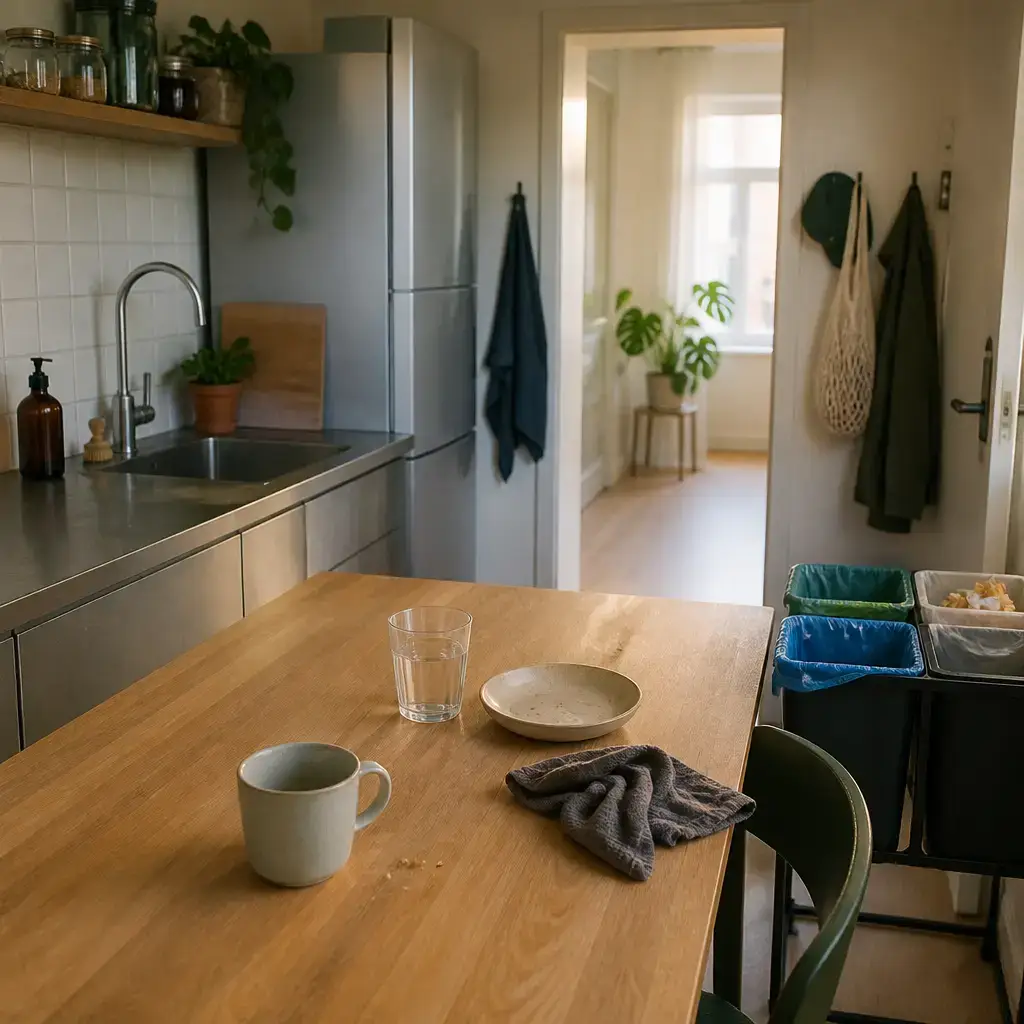
Use Keeping a shared kitchen clean to practice Danish conversation, pronunciation, vocabulary, grammar, and quizzes.
Dialogue
Må jeg vaske min kop her?
moh yai VAH-sguh meen kohb hair Can I wash my cup here?Brug vasken til venstre.
BROO VAH-sguhn teel VEN-streh Use the sink on the left.Jeg vil gerne holde området rent.
yai veel GAIR-nuh HOL-uh ohm-ROH-uhd rent I want to keep the space clean.Tør venligst bordet af, når du er færdig.
TAIR VEN-leest BOHR-uh ahv, nor doo air FAIR-dee Please wipe the table after you finish.Skal skraldet i denne skraldespand?
sgal SGRAL-duh ee DEN-uh SGRAL-duh-sban Does trash go in this bin?Læg det i skraldespanden ved døren.
lai deh ee SGRAL-duh-sban vehd DAIRN Put it in the bin by the door.Jeg tager mig af det nu.
yai TAY-uh my ahv deh noo I will take care of it now.Så er køkkenet klar til alle.
soh air KUH-guh-nuh klahr teel AL-uh That keeps the kitchen ready for everyone.Sentence explanations
Må jeg vaske min kop her?
Can I wash my cup here?
- Må jeg
- Can I / May I
- vaske
- wash
- min
- my
- kop
- cup
- her
- here
More detail
Må jeg means “Can I” here as a request for permission. må is the present form of måtte and is used with an infinitive to express permission or possibility; it does not change for the subject. jeg means “I”. For example, Må jeg komme ind? means “May I come in?” vaske means “wash”. It is the infinitive, which follows the modal verb må: må + infinitive. The infinitive is not marked for the subject here. For example, Jeg må vaske koppen. means “I have to/may wash the cup,” depending on context. min means “my” before a singular common-gender noun. Its form agrees with the possessed noun, not with the possessor: min with an en-word, mit with an et-word, and mine with plural nouns. In this sentence, min belongs with kop. kop means “cup”. It is a common-gender noun: en kop means “a cup”, and the definite form is koppen, “the cup”. For example, Jeg har en kop. means “I have a cup.” her means “here”. It is a place adverb and does not change according to the place or the speaker. For example, Koppen står her. means “The cup is here.” Together, Må jeg vaske min kop her? forms a permission question: må + subject jeg + infinitive vaske + possessive noun phrase min kop + location her. The whole utterance means “Can I wash my cup here?”
Brug vasken til venstre.
Use the sink on the left.
- Brug
- use
- vasken
- the sink
- til venstre
- on the left
More detail
Brug means “use” here. It is the imperative form of bruge (“to use”), so it gives a direct instruction. Danish imperatives commonly omit the subject: Brug ... can mean “Use ...”. For example, Brug døren. means “Use the door.” vasken means “the sink” here. It is the definite singular form of the noun vask: vask = “a sink”, vasken = “the sink”. The ending -en marks definite singular for this noun. Although vask is related in form to the verb meaning “wash,” vasken in this sentence is a noun naming the sink. til venstre means “on the left.” venstre means “left,” and this phrase is a common way to identify a position. For example, Døren er til venstre. means “The door is on the left.” Together, Brug vasken til venstre. gives the instruction “Use the sink on the left.” Brug supplies the imperative, vasken identifies the definite sink, and til venstre specifies which sink by its position.
Jeg vil gerne holde området rent.
I want to keep the space clean.
- Jeg vil gerne
- I want to / I would like to
- holde
- keep
- området
- the area / the space
- rent
- clean
More detail
Jeg vil gerne expresses a polite or willing desire: “I want to” or “I would like to.” vil is the present form of ville, “to want” in this construction, and gerne adds the sense of being willing or pleased to do something. Danish commonly places an infinitive after this pattern: Jeg vil gerne hjælpe. — “I would like to help.” holde is the infinitive of holde, “to keep” or “to hold.” Here it means maintaining a condition, not physically holding something. The reusable pattern is holde + object + adjective: Vi holder døren åben. — “We keep the door open.” området means “the area” or “the space” here. Its base form is område, “area” or “space”; området is the definite singular form, formed with the ending -t. The noun’s definiteness identifies a particular space in the situation, without stating how many spaces there are. rent means “clean” here. It is the neuter singular form of the adjective ren, “clean,” agreeing with the neuter noun området in this use. A useful contrast is ren with a common-gender singular noun and rent with a neuter singular noun: en ren stol — “a clean chair”; et rent bord — “a clean table.” Together, Jeg vil gerne holde området rent means “I want to keep the space clean.” The first part expresses the speaker’s desire, holde introduces the action of maintaining a condition, området is the space being maintained, and rent names the condition to be maintained.
Tør venligst bordet af, når du er færdig.
Please wipe the table after you finish.
- Tør … af
- wipe ... off
- venligst
- please
- bordet
- the table
- når
- when
- du er færdig
- you are finished
More detail
Tør ... af is a reusable Danish pattern meaning “wipe ... off.” Tør is the imperative of tørre (“to wipe”); the person addressed is understood as “you.” The particle af belongs with the verb here, and the object can come between them. Example: Tør skoene af. — “Wipe the shoes off.” venligst means “please” and makes the request more polite. It does not change the action or its timing. bordet means “the table.” The noun is bord (“table”), and -et marks its definite singular form: et bord means “a table,” while bordet means “the table.” når introduces a time clause meaning “when.” Example: Ring, når du er klar. — “Call when you are ready.” du er færdig means “you are finished.” du is the second-person singular pronoun “you,” and er is the present form of være (“to be”). færdig is the adjective “finished.” In this form, it is singular common-gender; it does not identify the addressee’s gender. The corresponding neuter singular form is færdigt, and the plural form is færdige. Example: Jeg er færdig. — “I am finished.” Together, Tør ... af gives the command “wipe ... off,” bordet identifies what to wipe, and når du er færdig sets the time condition. venligst marks the request as polite. The complete utterance means: “Please wipe the table after you finish.”
Skal skraldet i denne skraldespand?
Does trash go in this bin?
- Skal
- should / is supposed to
- skraldet
- the trash
- i
- in
- denne
- this
- skraldespand
- bin
More detail
Skal is the present-tense form of skulle. In this question, it asks whether the trash is supposed to go somewhere: “is the trash meant to go…?” It can also express “shall” or “should” in other contexts. In a yes/no question, Danish commonly places the verb before the subject: Skal + subject + ...? Example: Skal jeg komme? — “Should I come?” skraldet means “the trash” here. The base noun is skrald; -et marks definite singular for this neuter noun, giving “the trash.” The form does not itself express a particular quantity. Example: Skraldet er vådt. — “The trash is wet.” i means “in” here and introduces the place where something is to go or be located. Example: Bogen er i tasken. — “The book is in the bag.” denne means “this” and modifies the noun that follows. It is the common-gender singular form used with skraldespand, rather than the neuter singular form dette. Danish demonstratives agree with the noun’s grammatical gender and number: denne stol — “this chair,” but dette bord — “this table.” skraldespand means “bin” or “trash can.” It is a common-gender noun: en skraldespand. Its definite singular form is skraldespanden, and its plural is skraldespande. Example: Skraldespanden står ved døren. — “The bin is by the door.” Together, Skal places the question in the “is it supposed to…” pattern; skraldet is the thing being discussed; and i denne skraldespand identifies this bin as the destination. The whole utterance therefore means “Does trash go in this bin?” or, more literally, “Is the trash supposed to go in this bin?” The wording is a direct, ordinary question about where the trash belongs.
Læg det i skraldespanden ved døren.
Put it in the bin by the door.
- Læg
- put
- det
- it
- i
- in
- skraldespanden
- the bin
- ved
- by
- døren
- the door
More detail
Læg is the imperative of lægge, meaning “put” or “place” here. The imperative addresses someone directly and normally has no stated subject: Læg bogen her. = “Put the book here.” Do not confuse it with ligge, “lie”; lægge describes placing something, while ligge describes something being located or lying somewhere. det is a neuter singular object pronoun meaning “it” in this sentence. Its exact referent is supplied by the situation, while its grammatical form is neuter singular. As an object pronoun, it comes after the imperative verb here: Flyt det. = “Move it.” i is the preposition “in” and introduces the destination or container. In this sentence it connects the action of putting something with the bin: Læg den i tasken. = “Put it in the bag.” skraldespanden means “the bin.” Its base noun is skraldespand, “bin” or “wastebasket”; the ending -en marks the common-gender singular definite form, “the bin.” Danish commonly marks definiteness by a suffix rather than by a separate word before the noun. The indefinite singular is en skraldespand, “a bin,” while skraldespanden is “the bin.” ved means “by” or “at,” expressing location near a reference point. Here it introduces the location of the bin, not the destination of the putting action: Hun står ved døren. = “She is standing by the door.” døren means “the door.” Its base noun is dør, “door,” and -en marks its common-gender singular definite form. Thus en dør means “a door,” while døren means “the door.” Together, Læg det gives the direct instruction “Put it,” i skraldespanden specifies the destination “in the bin,” and ved døren specifies which bin by locating it “by the door.” The whole utterance therefore means: “Put it in the bin by the door.”
Jeg tager mig af det nu.
I will take care of it now.
- Jeg
- I
- tager mig af
- take care of
- det
- it
- nu
- now
More detail
Jeg means “I” here: it is the first-person singular subject, the person who performs the action. In a reusable sentence pattern, Jeg can be followed by a present-tense verb: Jeg arbejder. — “I am working.” tager mig af is the Danish construction meaning “take care of” in this sentence. Its lexical verb is tager, the present form of tage (“take”); mig is the first-person object form of jeg, and af is part of the construction. The whole combination is what gives the meaning “take care of,” rather than simply “take.” For another subject, the object form changes with the person: Hun tager sig af det. — “She takes care of it.” det is a singular neuter third-person pronoun, corresponding here to “it.” The fixed translation identifies its intended role as the thing or matter being taken care of, without specifying that thing by name. Danish also uses den for singular common-gender reference in contexts where that form is required; the choice is governed by the referenced noun's grammatical gender or by the established pronoun use, not by the English word “it” alone. nu means “now” and places the action at the present time. Danish present tense can also describe an intended or imminent action when the context and a time word such as nu make that reading clear. Thus Jeg tager mig af det nu. naturally conveys “I will take care of it now,” even though tager is formally present tense. Together, Jeg + tager mig af + det + nu produces: “I will take care of it now.” The sentence presents the speaker as undertaking responsibility for the understood matter at this time.
Så er køkkenet klar til alle.
That keeps the kitchen ready for everyone.
- Så
- so; then
- er
- is
- køkkenet
- the kitchen
- klar
- ready
- til alle
- for everyone
More detail
Så connects this utterance with what came before and means “so” or “then” here. A reusable pattern is Så er X ..., which can present X as being in a resulting or subsequent state: Så er døren åben. — “Then the door is open.” er is the present-tense form of være, “to be.” It describes a current state, as in Køkkenet er åbent. — “The kitchen is open.” køkkenet means “the kitchen.” Its base noun is køkken; the ending -et marks the definite singular form. Danish nouns use different definite endings, so the ending is learned with the noun rather than inferred from English. klar means “ready” here. In Danish, the adjective has the forms klar with common-gender singular nouns, klart with neuter singular nouns, and klare in plural and several definite attributive contexts. køkkenet is a definite singular neuter noun, so the usual agreeing adjective form in that environment is klart; the fixed source itself is quoted exactly as written. Example: Jeg er klar. — “I am ready.” til alle means “for everyone.” til marks the intended person or group here, and alle refers to everyone or all people. Example: Det er til alle. — “It is for everyone.” Together, the target wording presents the kitchen as ready for everyone, with Så linking that state to what came before. The fixed translation gives the intended overall meaning as “That keeps the kitchen ready for everyone”; the more surface-level reading of the target wording is “So/Then the kitchen is ready for everyone.”
Grammar Points
Imperativ: verbets stamme uden -e
Tør bordet.
TAIR BOHR-uhWipe the table.
The imperative often drops the infinitive ending -e: tørre → Tør, bruge → Brug, lægge → Læg.
Bestemt form: -en eller -et
Brug vasken.
BROO VAH-sguhnUse the sink.
Danish often marks “the” with a noun suffix: vask → vasken and bord → bordet.
Danish Vocabulary
- Gender
- common
- Gender
- neuter
- Gender
- neuter
- Gender
- common
Quiz
Word Order
Arrange the words in the correct order.
Can I wash my cup here?
Show Answer
Må jeg vaske min kop her?Use the sink on the left.
Show Answer
Brug vasken til venstre.I want to keep the space clean.
Show Answer
Jeg vil gerne holde området rent.Spelling
Tap the letters to spell the word.
wash
Show Answer
vaskeuse
Show Answer
Brugsink
Show Answer
vaskenkeep