10 minutes free every day
Continue audio lessons in the app
Word explanations appear automatically in sync with the audio.
No login required · synced translations · playback with the screen locked
Choose your learning language and open this lesson in the app.

About This Lesson
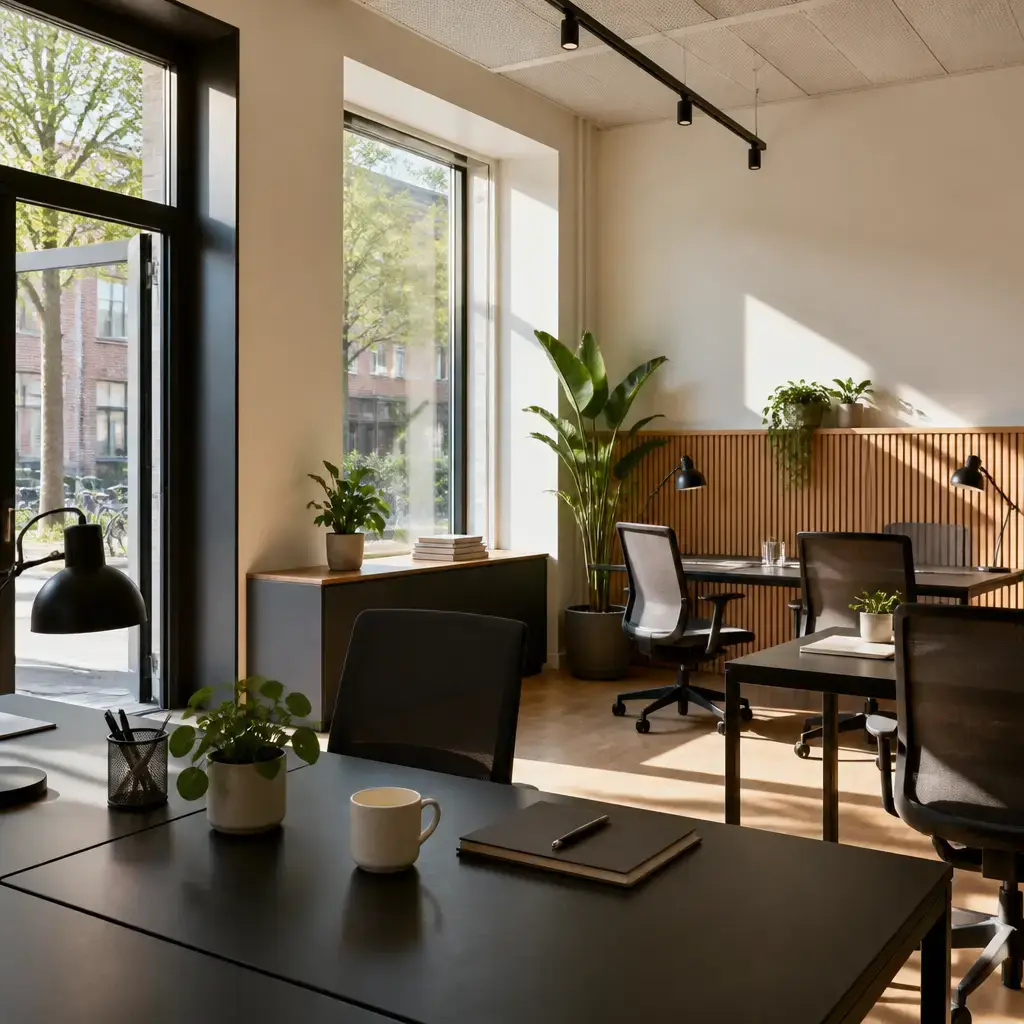
Use Using a shared office to practice Danish conversation, pronunciation, vocabulary, grammar, and quizzes.
Dialogue
Må jeg arbejde på dette fælleskontor?
MOH yai AH-bye-thuh poh DEH-duh FEH-luhs-kohn-TOHR? Can I work in this shared office?Vælg et ledigt skrivebord.
VEL' ehth LAY-thid SGREE-vuh-BOHR. Choose an open desk.Jeg kan bruge det ved døren.
YAI kan BROO-uh dehth VAY DUHR-en. I can use the one near the door.Lad det være rent, når du er færdig.
LAHth dehth VEH-uh REHND, NOR doo ehr FAIR-dee. Leave it clean when you finish.Jeg har brug for et roligt sted.
YAI hah BROO fohr ehth ROH-leed STEHth. I need a quiet place.Prøv skrivebordet ved væggen.
PRURV SGREE-vuh-BOHR-uhth VAY VEH-gən. Try the desk by the wall.Jeg rydder mine ting væk, før jeg går.
YAI RUR-thuh MEE-nuh TENG VEHg, FUR yai GOHR. I will clear my things before I leave.Så er skrivebordet klar til den næste person.
SOH ehr SGREE-vuh-BOHR-uhth KLAHR TEHL dehn NEHS-tuh peh-SOHN. That keeps the desk ready for the next person.Sentence explanations
Må jeg arbejde på dette fælleskontor?
Can I work in this shared office?
- Må jeg
- May I …?
- arbejde
- work
- på
- in / at
- dette
- this
- fælleskontor
- shared office
More detail
Må jeg is a reusable permission-question pattern: “May I …?” Here, må is the modal verb må, and jeg is the first-person singular pronoun “I.” In this sentence, må asks whether the speaker is allowed to do something; the fixed English translation uses “Can I?” for that intended permission meaning. The question pattern is Må jeg + infinitive. arbejde means “work” here and is the infinitive used after the modal må. The present-tense form is arbejder, as in Jeg arbejder her. — “I work here.” After a modal, Danish uses the infinitive without an extra infinitive marker. på is the preposition used here for the place where the work takes place. With this office expression, its natural meaning is “in” or “at,” not the literal spatial meaning “on.” For example, Hun arbejder på et kontor. means “She works in an office.” dette means “this” and is the singular neuter form of the demonstrative. It agrees with the neuter noun fælleskontor; it is not the form used with every noun. The corresponding common-gender singular form is denne, as in denne stol — “this chair.” fælleskontor is one compound noun meaning “shared office.” Its parts are fælles (“shared/common”) and kontor (“office”), but the observed word is written as one compound. The next sentence’s et ledigt skrivebord (“an available desk”) fits the office setting, but it does not change the meaning of this noun. Together, Må jeg asks for permission, arbejde supplies the activity, and på dette fælleskontor identifies the place. The complete utterance therefore means: “Can I work in this shared office?”
Vælg et ledigt skrivebord.
Choose an open desk.
- Vælg
- choose
- ledigt
- available; open
- skrivebord
- desk
More detail
Vælg is the imperative of vælge, “to choose.” It gives a direct instruction to the listener. The same verb in the present tense is vælger, as in Jeg vælger et bord. — “I choose a table.” ledigt means “open” or “available” here: the desk is free for someone to use. It is the neuter singular form of the adjective ledig, because skrivebord is a neuter noun and is introduced with et. Compare en ledig stol — “an available chair” — and et ledigt bord — “an available table.” The adjective agrees with the noun’s grammatical gender and number; ledigt itself describes the desk, not the act of choosing. skrivebord means “desk.” It is a compound noun referring to a table used for writing or work. Its definite form is skrivebordet, “the desk,” and its plural is skriveborde, “desks.” In this sentence, et skrivebord means “an open desk,” with et marking the noun as singular and neuter; it does not by itself state a numerical count as an important part of the instruction. Together, Vælg et ledigt skrivebord combines the imperative “choose” with the noun phrase “an open desk.” The complete meaning is: “Choose an open desk.”
Jeg kan bruge det ved døren.
I can use the one near the door.
- Jeg kan
- I can
- bruge
- use
- det
- the one
- ved
- near; by
- døren
- the door
More detail
Jeg kan combines jeg, “I,” with the modal verb kan, “can.” Kan is the present-tense form used here; the related past or conditional form is kunne. Danish normally places the infinitive without at after this modal: Jeg kan bruge means “I can use.” bruge is the infinitive “to use.” It keeps this form after kan, as in Jeg kan læse (“I can read”). The sentence presents using the item as possible or permitted, without stating that the action has already happened. det is a singular neuter pronoun meaning “it” or, as in the fixed translation, “the one.” In this exchange it refers to the selected item, understood from the surrounding desk context. The pronoun itself does not name the item; it lets the speaker refer back to it. ved is a preposition meaning “near” or “by” in this use. It introduces the location phrase ved døren, “near the door.” døren means “the door.” Its base form is dør, “door”; the ending -en marks the definite singular form: dør → døren. This is different from the indefinite singular en dør, “a door.” Together, det + ved døren identifies the usable item by its location: “the one near the door.” The complete utterance Jeg kan bruge det ved døren. therefore means “I can use the one near the door.”
Lad det være rent, når du er færdig.
Leave it clean when you finish.
- Lad
- leave; let
- det
- it
- være
- be
- rent
- clean
- når
- when
- du
- you
- er
- are
- færdig
- finished
More detail
Lad is the imperative of lade, used here to give the instruction “leave/let.” In the useful pattern lad + object + være + description, it tells someone to keep or leave something in a stated condition. Example: Lad døren være åben. — “Leave the door open.” det is the object pronoun “it.” Its exact referent is supplied by the situation; the fixed translation confirms that it refers to something that should be left clean. Danish object pronouns differ from subject pronouns: compare du (“you,” subject) with dig (“you,” object). være is the infinitive of at være, “to be.” After the imperative lad in this construction, the infinitive introduces the condition: lad det være ... — “leave it ... / let it be ...”. rent means “clean” here. It is the neuter singular form of the adjective ren: ren with common-gender singular nouns, rent with neuter singular nouns, and rene in the plural and definite forms. Here rent agrees with det in the construction. Example: Glasset skal være rent. — “The glass must be clean.” når means “when” and introduces a time clause. It connects an event or state to the time when another event happens. Example: Ring, når du kommer hjem. — “Call when you get home.” du is the second-person singular subject pronoun “you” in standard Danish. It is used for one addressee; the ordinary second-person plural pronoun is I. Here du is the subject of the subordinate clause. er is the present-tense form of at være (“to be”). Danish uses the same present form er with different subjects: jeg er (“I am”), du er (“you are”), and de er (“they are”). færdig means “finished” or “done” here, describing the state of du after completing an activity. It is the common-gender singular form; the neuter singular form is færdigt, and the plural/definite form is færdige. Example: Jeg er færdig. — “I am finished.” Together, Lad det være rent means “Leave it clean”: lad gives the instruction, det is the object, and være rent states the condition to maintain. når du er færdig means “when you finish,” literally “when you are finished.” The complete utterance is therefore “Leave it clean when you finish.”
Jeg har brug for et roligt sted.
I need a quiet place.
- Jeg
- I
- har brug for
- need
- roligt
- quiet
- sted
- place
More detail
Jeg means “I” and is the first-person singular subject pronoun. It identifies the speaker as the one who needs something. Example: Jeg læser. — “I am reading.” har brug for is the reusable Danish construction meaning “need” or “have need of.” It uses har, the present-tense form of have, together with brug for; do not replace it with a direct word-for-word English-style verb pattern. Example: Vi har brug for hjælp. — “We need help.” roligt means “quiet” here. Its base form is rolig; the ending -t is used because it describes the neuter singular noun sted. The form changes with the noun it describes: en rolig plads — “a quiet spot,” but et roligt sted — “a quiet place.” sted means “place.” It is a noun whose indefinite singular form appears here with et: et sted. A useful plural is steder: flere steder — “several places.” Together, Jeg har brug for (“I need”) + et roligt sted (“a quiet place”) gives the complete meaning: “I need a quiet place.” The article et marks sted as an indefinite neuter singular noun; it does not by itself assert a numerical count. roligt agrees with the neuter noun sted. The sentence is a straightforward present-tense statement of the speaker’s need.
Prøv skrivebordet ved væggen.
Try the desk by the wall.
- Prøv
- try
- skrivebordet
- the desk
- ved
- by
- væggen
- the wall
More detail
Prøv is the imperative of prøve (“to try”). The imperative addresses the listener directly and makes this an instruction: “Try …”. Compare prøve in the infinitive, as in at prøve (“to try”). skrivebordet means “the desk” here. It is the definite singular form of et skrivebord (“a desk”); the ending -et marks definiteness for this neuter noun. The useful pattern is et skrivebord → skrivebordet. For example, Jeg bruger skrivebordet. means “I use the desk.” ved is a preposition meaning “by” or “next to” in this sentence. It introduces the location phrase ved væggen, identifying which desk is intended by its position. væggen means “the wall”. It is the definite singular form of en væg (“a wall”); this common-gender noun uses the ending -en for definiteness. The pattern is en væg → væggen. For example, Stolen står ved væggen. means “The chair is by the wall.” Together, skrivebordet ved væggen means “the desk by the wall”. The imperative Prøv is followed by that noun phrase, so the whole utterance is: “Try the desk by the wall.”
Jeg rydder mine ting væk, før jeg går.
I will clear my things before I leave.
- Jeg
- I
- rydder
- clear; tidy
- mine
- my
- ting
- things
- væk
- away
- før
- before
- går
- leave; go
More detail
Jeg means “I” here. Danish uses jeg for the first-person singular subject. The same form is used whether the action is present or future; the surrounding time expression supplies the future reading in this sentence. rydder is the present form of rydde, “to clear” or “to tidy.” Here it describes clearing the speaker’s things. A useful pattern is jeg rydder ... = “I clear/tidy ...”. Danish present forms do not change for the subject: jeg rydder and de rydder use the same verb form. mine means “my” before a plural noun. It is the possessive form used with plural nouns; compare min with a common-gender singular noun and mit with a neuter singular noun. In this sentence, mine marks ting as plural. ting means “things” here. Its base form is also ting; the singular and plural forms are identical, so mine provides the clear plural signal in this phrase. Example: Mine ting ligger her. — “My things are here.” væk means “away.” With rydder, it completes the idea of removing or clearing things away: rydde ... væk is a reusable verb-plus-adverb pattern. The adverb adds the direction or result “away”; it is not part of the possessive phrase. før means “before” and introduces the event that must happen later than the clearing. A reusable pattern is før + a clause, as in før jeg går — “before I leave/go.” går is the present form of gå, “to go.” In this sentence, the fixed translation identifies the intended sense as “leave,” not merely movement toward a destination. The form is unchanged for different subjects in the present tense: jeg går = “I go/I leave,” while vi går = “we go/we leave.” Together, Jeg rydder mine ting væk means “I clear my things away.” før jeg går adds the time relationship “before I leave.” The complete utterance therefore means “I will clear my things before I leave.” The Danish present forms rydder and går can express this future sequence when the context makes the intended timing clear.
Så er skrivebordet klar til den næste person.
That keeps the desk ready for the next person.
- Så
- then; so
- er
- is
- skrivebordet
- the desk
- klar
- ready
- til
- for; to
- næste
- next
- person
- person
More detail
Så stands first and links this sentence to the preceding action. Here it has the consequence meaning “so” or “then”: after the speaker clears their things away, the stated result follows. A reusable pattern is så + clause, as in Jeg rydder bordet, så er det klart. — “I clear the table, so it is ready.” er is the present-tense form of være (“to be”) for the subject here. The form er is used with singular and plural subjects, so the subject’s number is not shown by this verb. In this sentence it describes the desk’s resulting state rather than an action. skrivebordet means “the desk.” Its base noun is skrivebord, and the ending -et marks the definite singular form: et skrivebord means “a desk,” while skrivebordet means “the desk.” klar means “ready” here and is the adjective describing the desk. Danish adjectives can agree with a noun: klar is used with common-gender singular nouns, while the neuter form is klart and the plural form is klare. Because skrivebord is a neuter noun, the corresponding standard agreement form would be klart; the fixed utterance itself contains the exact form klar, whose intended meaning is still clear from the translation. til introduces what the desk is ready for: “for” in this sentence. It commonly connects something to a recipient, purpose, or destination, but here the relevant pattern is klar til + noun (“ready for + noun”). næste means “next” in den næste person. It is the form used here in a definite noun phrase and does not take a separate neuter form in this use. person is the singular noun “person”; together, den næste person means “the next person.” For example, Den næste person kan bruge bordet. means “The next person can use the table.” Putting the parts together, Så presents a consequence, er skrivebordet klar describes the desk as ready, and til den næste person identifies who it is ready for. The whole utterance therefore means “That keeps the desk ready for the next person,” matching the fixed translation and the preceding context: clearing the speaker’s things leaves the desk available in that state.
Grammar Points
Lad + objekt + være + adjektiv
Lad det være rent.
LAHth dehth VEH-uh REHND.Leave it clean.
Lad ... være is used to tell someone to let something remain in a particular state.
før + subjekt + verb
Jeg rydder mine ting væk, før du går.
YAI RUR-thuh MEE-nuh TENG VEHg, FUR doo GOHR.I clear my things away before you leave.
før introduces a time clause. The subject and verb follow it in the subordinate clause.
Danish Vocabulary
- Gender
- common
- Gender
- neuter
- Gender
- neuter
- Gender
- neuter
Quiz
Word Order
Arrange the words in the correct order.
Can I work in this shared office?
Show Answer
Må jeg arbejde på dette fælleskontor?Choose an open desk.
Show Answer
Vælg et ledigt skrivebord.I can use the one near the door.
Show Answer
Jeg kan bruge det ved døren.Spelling
Tap the letters to spell the word.
shared office
Show Answer
fælleskontorchoose
Show Answer
Vælgwork
Show Answer
arbejdeuse