10 minutes free every day
Continue audio lessons in the app
Word explanations appear automatically in sync with the audio.
No login required · synced translations · playback with the screen locked
Choose your learning language and open this lesson in the app.

About This Lesson
Use Using a Shared Fridge to practice Danish conversation, pronunciation, vocabulary, grammar, and quizzes.
Dialogue
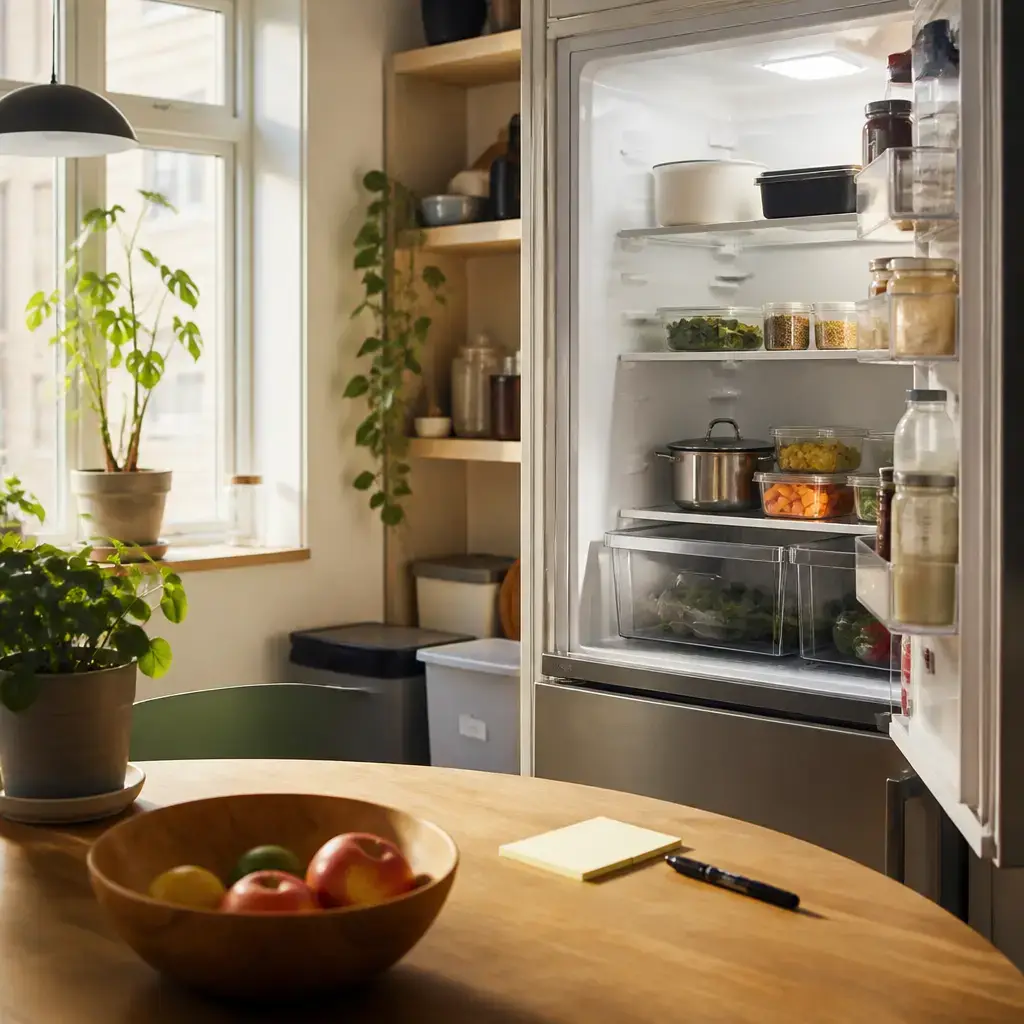
Må jeg bruge det fælles køleskab?
maw yai BROO-eh deh FELL-ess KURR-luh-SGAY Can I use the shared fridge?Sæt en etiket på din mad, før du sætter den ind.
SED en eh-tee-KAYD poh deen MAYTH, FURR doo SED-uh den en Label your food before you put it in.Hvor kan jeg finde en etiket?
vohr kan yai FEN-eh en eh-tee-KAYD Where can I find a label?Der er etiketter ved siden af køleskabet.
dair air eh-tee-KAYD-uh veh SEE-thn ow KURR-luh-sgAB-eth There are labels beside the fridge.Er der nok plads derinde?
air dair NOHK PLESS dair-EN-eh Is there enough space inside?Brug den øverste hylde. Der er plads der.
BROO den URR-vuh-steh HURR-luh. dair air PLESS dair Use the top shelf; there is room there.Jeg tager min mad ud senere.
yai TAY-uh men MAYTH OOTH SAY-nuh-uh I will take my food out later.Så er der plads til andre.
SOH air dair PLESS tel AN-ruh That keeps space open for other people.Sentence explanations
Må jeg bruge det fælles køleskab?
Can I use the shared fridge?
- Må jeg
- May I
- bruge
- use
- fælles
- shared
- køleskab
- fridge
More detail
Må jeg asks for permission: “May I …?” In this utterance, må is the present form of måtte, used with jeg to ask whether the speaker is allowed to do something. The subject is jeg (“I”); the construction is reusable with another infinitive, for example: Må jeg komme ind? — “May I come in?” bruge means “use” here. It is the infinitive form, following the modal verb må: må + infinitive. The same verb can be used with an object in other sentences, for example: Jeg bruger telefonen. — “I use the phone.” fælles describes something shared by several people or used jointly. It is an adjective, and this form does not change for grammatical gender or number in Danish. In this sentence it describes køleskab, rather than expressing who specifically owns or uses it. køleskab means “fridge” or “refrigerator.” It is a noun; its indefinite form is et køleskab, and its definite form is køleskabet (“the fridge”). A useful example is: Køleskabet er fuldt. — “The fridge is full.” Together, Må jeg bruge asks for permission to use something, and det fælles køleskab identifies that thing as the shared fridge. The whole utterance therefore means: “Can I use the shared fridge?”
Sæt en etiket på din mad, før du sætter den ind.
Label your food before you put it in.
- Sæt
- label
- etiket
- label
- på
- on
- din
- your
- mad
- food
- før
- before
- du sætter den ind
- you put it in
More detail
Sæt is the imperative of sætte. In this sentence, sætte means “to put” or, with a label as its object and på as the placement word, “to label.” The imperative addresses one person directly and has no written subject: Sæt ... = “Label ...” / “Put ...”. etiket means “label.” Its indefinite form is en etiket; the plural is etiketter. In Sæt en etiket ..., the label is what should be put on something. The article en marks an indefinite noun; it does not by itself assert a numerical count here. på means “on” in this placement pattern. sætte noget på noget means “put something on something.” Example: Sæt koppen på bordet. — “Put the cup on the table.” din means “your” and agrees with a singular common-gender noun. Here it agrees with mad, whose form is en mad; compare dit with a singular neuter noun and dine with a plural noun. The possessive identifies the food as belonging to or being associated with the person addressed. mad means “food.” It is a common-gender noun: en mad, maden (“the food”). In the fixed sentence, it is the thing receiving the label. før introduces a time clause and means “before.” It places the action in the clause after it later than the labeling. Example: Vask hænder, før du spiser. — “Wash your hands before you eat.” du sætter den ind means “you put it in.” du is the subject “you,” and sætter is the present-tense form of sætte; unlike the imperative Sæt, it has the subject du. den is a singular common-gender object pronoun, referring here to the food identified in the first clause. ind adds the direction “in.” The pattern sætte noget ind means “put something in.” Together, Sæt en etiket på din mad means “Label your food.” før links this instruction to du sætter den ind, “you put it in,” so the complete utterance is: “Label your food before you put it in.”
Hvor kan jeg finde en etiket?
Where can I find a label?
- Hvor
- where
- kan jeg
- can I
- finde
- find
- etiket
- label
More detail
Hvor means “where” and asks about a place. It commonly appears at the beginning of a Danish information question. Compare hvornår (“when”), which asks about time. Example: Hvor bor du? — “Where do you live?” kan jeg combines kan, the present form of the modal verb kunne (“can; be able to”), with jeg (“I”). Here, kan presents finding a label as a possible or available action. After a modal verb, Danish normally uses the following verb in the infinitive without at: Jeg kan hjælpe. — “I can help.” finde is the infinitive of finde (“find”). The form is unchanged here because it follows the modal kan; it is not a past-tense form. Example: Jeg vil finde en løsning. — “I will find a solution.” etiket is a noun meaning “label.” In this sentence it is singular and indefinite, marked by the article en before it: en etiket, “a label.” Its plural is etiketter, as in the contextual sentence Der er etiketter ... — “There are labels ...”. The article en belongs to the noun phrase but is not included in the selected quote etiket. Together, Hvor asks for a place, kan jeg finde means “can I find,” and en etiket means “a label.” The complete utterance Hvor kan jeg finde en etiket? means “Where can I find a label?”
Der er etiketter ved siden af køleskabet.
There are labels beside the fridge.
- Der er
- there is / there are
- etiketter
- labels
- ved siden af
- beside / next to
- køleskabet
- the fridge
More detail
Der er is the Danish existential construction used to state that something exists or is located somewhere. It corresponds to “there is” with a singular noun and “there are” with a plural noun; the form er does not change between these two patterns. The following noun shows the number: Der er en etiket. means “There is a label,” while Der er etiketter. means “There are labels.” etiketter means “labels” here. Its base form is singular etiket; the plural form is etiketter. Compare the earlier example en etiket (“a label”) with this sentence’s plural form. Example: Jeg ser to etiketter. — “I see two labels.” ved siden af is a fixed prepositional expression meaning “beside” or “next to.” It introduces the place used for comparison: one thing is positioned at the side of another. Example: Tasken står ved siden af stolen. — “The bag is beside the chair.” køleskabet means “the fridge.” The noun køleskab means “fridge,” and the ending -et marks the definite singular form, “the fridge.” This is a noun inflection, not part of the preposition. Example: Køleskabet er stort. — “The fridge is big.” Together, Der er presents the existence or presence of something, etiketter identifies that thing as plural labels, and ved siden af køleskabet gives their location. The complete meaning is: “There are labels beside the fridge.”
Er der nok plads derinde?
Is there enough space inside?
- Er der
- is there
- nok
- enough
- plads
- space; room
- derinde
- inside; in there
More detail
Er der is the Danish existential question pattern “is there …?” Here er is the present form of være (“to be”), and der is the existential subject-like element, not the location word meaning “there” in this construction. The word order places er before der because this is a yes/no question. Compare the reusable pattern Er der ...? (“Is there ...?”), for example: Er der kaffe? — “Is there coffee?” nok means “enough” and comes before the noun it evaluates. It expresses sufficiency, not a specific measured amount. The same word can also mean “probably” in other contexts, but that is not its meaning here. For example: Er der nok tid? — “Is there enough time?” plads means “space” or “room” in this sentence: available room for something. It is a noun; in other contexts, plads can also mean a place or spot, so the surrounding expression determines the sense. For example: Der er ikke plads. — “There is no room.” derinde means “inside” or “in there.” It is a location adverb referring to an interior area, while the existential der in Er der has a different function. The following context also uses der in Der er plads der, where that later der is a location reference meaning “there”; do not assume every occurrence of der has the same role. Together, Er der introduces an existence question, nok plads asks whether the available room is sufficient, and derinde specifies the interior location. The complete utterance therefore means: “Is there enough space inside?”`
Brug den øverste hylde. Der er plads der.
Use the top shelf; there is room there.
- Brug
- use
- øverste
- topmost
- hylde
- shelf
- Der er
- there is
- plads
- room
- der
- there
More detail
Brug means “use” here. It is the imperative of bruge (“to use”), addressing one or more people without stating the subject. Compare bruger (“use/uses” in a present-tense clause) and brugte (“used” in the past). Example: Brug døren. — “Use the door.” øverste means “topmost” or “uppermost” here. It is the superlative form related to øverst (“at the top”); the definite noun phrase den øverste hylde means “the top shelf.” This form is selected because the shelf is being identified as the highest one in a relevant set. Example: Hun bor på den øverste etage. — “She lives on the top floor.” hylde means “shelf.” It is a common-gender noun; the definite form is hylden (“the shelf”). In the fixed utterance, den and øverste appear before it in the definite noun phrase den øverste hylde. Der er is a reusable Danish existential/presentative pattern meaning “there is” or “there are.” er is the present form of være (“to be”), and the pattern introduces or states the existence or availability of something. Example: Der er tid. — “There is time.” plads means “room” or “space” here. It commonly refers to available space and is normally used without a plural ending when it has this meaning. Example: Der er ikke plads. — “There is no room.” der means “there” here, referring to the location indicated by the utterance and context. The same form can function in the existential pattern der er, but in plads der it is a separate locative word meaning “there.” Together, Brug den øverste hylde is an imperative: “Use the top shelf.” Der er plads der then states that there is room at that location: “There is room there.” The two sentences therefore combine an instruction with a statement about available room at the indicated location.
Jeg tager min mad ud senere.
I will take my food out later.
- Jeg
- I
- tager
- take
- min
- my
- mad
- food
- ud
- out
- senere
- later
More detail
Jeg means “I” here: it is the first-person singular subject pronoun referring to the speaker. In Danish, the subject pronoun is separate from the verb: Jeg tager can mean “I take,” and the time expression makes the intended event future. tager is the present-tense form of tage, “to take.” Danish commonly uses the present tense for a planned or expected future event when a time expression such as senere makes the timing clear. Unlike English, Danish verbs do not change form here to agree with a first-person singular subject. Example: Jeg tager bussen senere. — “I will take the bus later.” min means “my” before mad. It is the possessive form used with a common-gender singular noun. The possessive identifies the food as belonging to or being associated with the speaker; it does not state how much food there is. Compare min with a common-gender singular noun, mit with a neuter-gender singular noun, and mine with a plural noun. mad means “food.” In this use it is a mass noun, so the sentence refers to the speaker’s food without asserting a particular number of items. Example: Maden er klar. — “The food is ready.” Here maden is the definite form, “the food.” ud means “out.” With tager, it forms the separable verb pattern tage ... ud, meaning “take out.” The particle appears after the object in this sentence: tager min mad ud. Together, these words express the taking-out action. senere means “later.” It is a time adverb that places the taking-out event after the time of speaking. Example: Vi ses senere. — “We will see each other later.” Together, Jeg tager min mad ud means “I take my food out,” with tage ... ud expressing the taking-out action. Adding senere places that action later, so the whole utterance means “I will take my food out later.”
Så er der plads til andre.
That keeps space open for other people.
- Så
- so; then
- er der plads
- there is room
- til
- for; to
- andre
- others
More detail
Så means “so” or “then” here: it links this statement to the preceding action and presents the result. In other contexts, så can have additional functions, so its exact meaning depends on how it connects to the surrounding sentence. er der plads uses the Danish existence pattern der er (“there is/are”). er is the present form of være (“to be”), while der is a formal existential subject rather than a specific place reference. Plads is a noun meaning “space” or “room.” The expression can be reused with another noun: Der er tid. — “There is time.” til introduces what the space is intended for. In this sentence it means “for,” not movement “to.” For example, Der er plads til en stol. means “There is room for a chair.” andre means “other people” in the fixed translation. It is the plural form used substantivally, so the people are understood rather than named. It is related to the adjective anden (“other”): en anden means “another/another person,” while andre refers to multiple others. The form here does not identify which people they are. Together, Så er der plads til andre means “That way, there is room for other people,” or, matching the fixed translation, “That keeps space open for other people.” The sentence presents the available space as the result of the preceding action, without adding a specific number of people.
Grammar Points
Sæt + objekt + ind
Sæt mad ind.
SED MAYTH enPut food inside.
The imperative uses the verb form Sæt without a subject. The particle ind comes after the object.
sætter + objekt + ind
Jeg sætter mad ind.
yai SED-uh MAYTH enI put food inside.
The verb-particle combination sætter ind means “puts inside”; the object comes between the verb and ind.
Danish Vocabulary
Må jeg bruge det fælles køleskab?
- Gender
- common
en etiket
- Gender
- common
Der er etiketter ved siden af køleskabet.
det fælles køleskab
før du sætter den ind
Hvor kan jeg finde en etiket?
du sætter den ind
Må jeg bruge det fælles køleskab?
- Gender
- neuter
det fælles køleskab
- Gender
- common
din mad
Sæt en etiket på din mad
du sætter den ind
Quiz
Word Order
Arrange the words in the correct order.
Can I use the shared fridge?
Show Answer
Må jeg bruge det fælles køleskab?Where can I find a label?
Show Answer
Hvor kan jeg finde en etiket?Is there enough space inside?
Show Answer
Er der nok plads derinde?Spelling
Tap the letters to spell the word.
fridge; refrigerator
Show Answer
køleskabetlabels
Show Answer
etiketteruse
Show Answer
brugelabel