10 minutes free every day
Continue audio lessons in the app
Word explanations appear automatically in sync with the audio.
No login required · synced translations · playback with the screen locked
Choose your learning language and open this lesson in the app.

About This Lesson
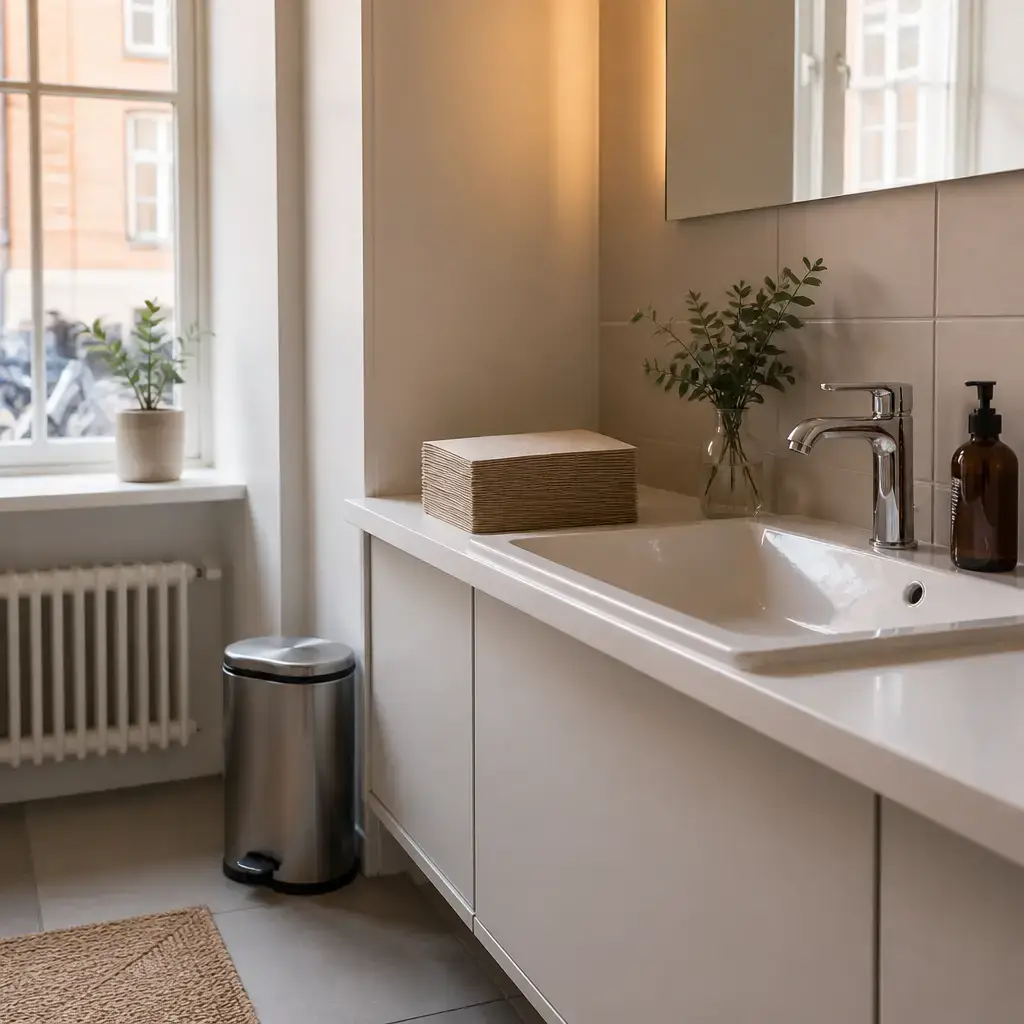
Use Keeping a Shared Bathroom Clean to practice Danish conversation, pronunciation, vocabulary, grammar, and quizzes.
Dialogue
Kan jeg bruge dette fælles badeværelse?
kan yai BROO-uh DEH-duh FEL-uhs BEH-thuh-VAIR-uhls-uh? Can I use this shared bathroom?Det kan du, og hold venligst området ved vasken rent.
deh kan doo, oh HOHL VEN-lihst OHM-rah-duhth veh VAS-gən RENT. You can, and please keep the sink area clean.Jeg har brug for et stykke køkkenrulle.
yai hah BROO for eh STU-keh KUR-ken-ROO-luh. I need a paper towel.Der er nogle ved vasken.
dair air NOH-luh veh VAS-gən. There are some near the sink.Skal det her i skraldespanden?
skahl deh HAIR ee SKRAH-luhs-PEN-dn? Does this go in the trash?Læg det i den lille skraldespand.
LEH deh ee den LIL-luh SKRAH-luhs-SPAN. Put it in the small bin.Jeg vil også hurtigt tørre vasken af.
yai vil OH-suh HOR-dee TUR-uh VAS-gən af. I will wipe the sink quickly too.Det hjælper den næste person.
deh YEL-per den NES-duh peh-SOHN. That helps the next person.Sentence explanations
Kan jeg bruge dette fælles badeværelse?
Can I use this shared bathroom?
- Kan jeg
- Can I…?
- bruge
- use
- dette
- this
- fælles
- shared
- badeværelse
- bathroom
More detail
Kan jeg is the Danish question pattern “Can I…?”: kan is the present form of kunne and expresses ability or, as here, permission; jeg means “I.” Danish normally places the verb before the subject in this type of question. After a modal such as kan, the next verb is normally an infinitive without at. bruge means “to use.” It is the infinitive after kan; the form does not show the subject here because kan carries the finite verb role. For example, Kan jeg bruge din telefon? means “Can I use your phone?” dette means “this” and is the neuter singular form used with the neuter noun badeværelse. The corresponding common-gender singular form is denne; these forms agree with the noun, not with the speaker. fælles means “shared” or “common.” In this phrase it describes something used by more than one person. fælles has the same form with common-gender and neuter singular nouns, and it also commonly remains fælles in the plural. For example, et fælles køkken means “a shared kitchen.” badeværelse means “bathroom.” It is a neuter noun: et badeværelse is “a bathroom,” while badeværelset is “the bathroom,” and badeværelser is the plural “bathrooms.” Together, Kan jeg bruge dette fælles badeværelse? forms a permission question: “Can I use this shared bathroom?” The demonstrative and adjective describe the bathroom, while kan + bruge asks whether the speaker may use it.
Det kan du, og hold venligst området ved vasken rent.
You can, and please keep the sink area clean.
- Det kan du
- You can
- hold
- keep
- venligst
- please
- området
- the area
- vasken
- the sink
- rent
- clean
More detail
Det kan du means “you can” here: du is the subject, and kan is the present-tense form of kunne (“can/be able to”). Danish kan does not change for person or number. Det refers to the understood action, not to a newly named noun, so this short reply can stand for “You can [do that].” Example: Kan jeg komme ind? – Ja, det kan du. = “Can I come in? – Yes, you can.” hold is the imperative of holde, “to keep/maintain.” The imperative addresses one or more people in the same form; the subject is understood rather than stated. Example: Hold døren åben. = “Keep the door open.” venligst is a polite “please.” It modifies the request and does not itself express the action. In this sentence it makes the imperative more courteous. området means “the area.” It is the definite singular form of område; the ending -et marks this noun as definite singular. område is a neuter noun, so the indefinite form is et område, while the definite form is området. vasken means “the sink.” It is the definite singular form of vask; the ending -en marks this noun as definite singular. The preposition ved means “by/at,” so området ved vasken is “the area by the sink.” rent means “clean” here. It is the neuter singular form of the adjective ren, agreeing with området, which is neuter singular. Compare en ren vask (“a clean sink”) with et rent område (“a clean area”); the adjective changes because of the noun’s grammatical gender and number, not because of the nearby preposition. Together, Det kan du gives permission or confirms ability to do the understood action, and og hold venligst området ved vasken rent adds a polite instruction: keep the area by the sink clean. The whole utterance therefore means “You can, and please keep the sink area clean.”
Jeg har brug for et stykke køkkenrulle.
I need a paper towel.
- Jeg
- I
- har brug for
- need
- et stykke
- a piece
- køkkenrulle
- paper towel
More detail
Jeg means “I” and is the first-person singular subject pronoun. It identifies the speaker as the person who needs something. For example: Jeg kommer nu. — “I’m coming now.” har brug for is the Danish construction for “need” in this sentence. Its form is built from har, the present form of at have (“to have”), plus brug for; learn the whole pattern Jeg har brug for ... rather than translating each word separately. The construction is followed by the thing needed. For example: Jeg har brug for hjælp. — “I need help.” et stykke means “a piece.” Here it introduces a portion of the following material or product. et is the indefinite article used with neuter stykke; it does not by itself state a separate numeric count beyond the noun phrase’s indefinite form. The plural is stykker, as in to stykker — “two pieces.” køkkenrulle means “paper towel” here, specifically the kitchen-roll or paper-towel product. It is a compound noun; keep it as the single observed word. The same word can refer to the product generally, while et stykke køkkenrulle refers to a piece of it. Together, Jeg har brug for et stykke køkkenrulle. means “I need a paper towel.” The subject is Jeg (“I”), har brug for expresses the need, and et stykke køkkenrulle names what is needed.
Der er nogle ved vasken.
There are some near the sink.
- Der er
- there are
- nogle
- some
- ved
- near
- vasken
- the sink
More detail
Der er is the common Danish existential pattern for saying that something or someone is present in a place: “there is/are …”. Er is the present form of være (“to be”), while der functions here as an introductory, nonreferential element rather than pointing to a specific place. The following noun phrase determines whether the English translation uses “is” or “are.” Example: Der er en kop på bordet. — “There is a cup on the table.” nogle means “some” here: an unspecified number of people or things. It is used without naming exactly how many. In this sentence it stands on its own as the indefinite element referring to the unspecified things that are present. Example: Der er nogle på bordet. — “There are some on the table.” The exact referent of nogle is not identified by the sentence. ved is a preposition meaning “near” or “by” when it places something close to a location. It introduces vasken, the location associated with the unspecified things. Example: Koppen står ved vasken. — “The cup is by the sink.” vasken means “the sink.” Its base noun is vask, and the ending -en marks the definite singular form: en vask (“a sink”) → vasken (“the sink”). The definite form identifies one sink in the relevant situation; en here is the indefinite article, not a claim that there is a numerical count of one. Together, Der er + nogle states that unspecified things are present, and ved vasken places them near the sink. The complete meaning is: “There are some near the sink.”
Skal det her i skraldespanden?
Does this go in the trash?
- Skal
- should / is supposed to
- det her
- this
- i
- in
- skraldespanden
- the trash bin
More detail
Skal is the present-tense form of skulle. Here it is a modal question word meaning whether something is supposed to go somewhere; it is not the ordinary word for a simple present action. In a main-clause question, the modal comes before the subject: Skal ...? = “Is ... supposed to ...?” det her means “this” and points to the item being discussed. Det is the neuter singular form of the demonstrative pronoun, while her adds the sense “here” or “this one.” The exact referent is not named in the sentence. Compare the reusable pattern det her (“this”) with den her (“this,” used with a common-gender noun). i means “in” and introduces the place or container destination. With verbs describing putting or disposing of something, it can indicate where the item should end up: Læg den i skraldespanden. = “Put it in the trash bin.” skraldespanden means “the trash bin.” Its base noun is skraldespand; the ending -en marks the definite singular form: en skraldespand = “a trash bin,” skraldespanden = “the trash bin.” The noun is common gender, which is why its indefinite article is en. Together, Skal + det her forms a question about the intended action for “this,” and i skraldespanden specifies the destination. The whole utterance therefore means: “Does this go in the trash?”
Læg det i den lille skraldespand.
Put it in the small bin.
- Læg
- put
- det
- it
- i
- in
- den
- the
- lille
- small
- skraldespand
- bin
More detail
Læg is the imperative of lægge, “to put/place.” The imperative gives a direct instruction and normally has the same form for the addressed person regardless of singular or plural: Læg bogen her. — “Put the book here.” Do not confuse it with ligge, “to lie/be situated”: Bogen ligger her. — “The book is here.” det is the neuter singular object pronoun meaning “it” here. Its exact referent is supplied by the situation, while its form shows neuter singular agreement; it is not itself a marker of location. In another context, den can be used for a common-gender singular referent, so the choice between den and det depends on the referent’s grammatical gender and role. i is the preposition “in.” With a placement verb such as lægge, it introduces the destination or container: Læg nøglen i skuffen. — “Put the key in the drawer.” den is the definite article for a common-gender singular noun before the noun phrase: den lille skraldespand — “the small bin.” It marks the bin as definite; it does not itself express a numeric count. lille means “small.” In this phrase it is the attributive singular form modifying skraldespand. The same form is also used with a neuter singular noun, while the plural form is små: små skraldespande — “small bins.” skraldespand means “bin” or “trash bin.” It is a common-gender compound noun; its definite singular form is skraldespanden, as in i skraldespanden — “in the bin.” Here the bare form appears after the separate article den, so the noun phrase is already definite without the noun taking the definite ending. Together, Læg det gives the instruction “put it,” and i den lille skraldespand specifies the destination: “in the small bin.” The complete utterance is therefore “Put it in the small bin.”
Jeg vil også hurtigt tørre vasken af.
I will wipe the sink quickly too.
- Jeg vil
- I will
- også
- also; too
- hurtigt
- quickly
- tørre … af
- wipe off
- vasken
- the sink
More detail
Jeg vil means “I will” here and introduces the speaker’s intended or planned action. vil is the present form of ville; with an infinitive, the pattern jeg vil + infinitive commonly expresses “I will/want to …” depending on context. Here the fixed translation supports the future/intention reading. Example: Jeg vil læse. — “I will read.” også adds the meaning “also” or “too.” Its position can vary, but here it comes after Jeg vil and adds this action to something already relevant in the context. Example: Jeg vil også hjælpe. — “I will help too.” hurtigt means “quickly” and describes how the wiping is done. It is related to the adjective hurtig (“quick”); hurtigt is the form used here as an adverb. Example: Hun går hurtigt. — “She walks quickly.” The separated construction tørre ... af means “wipe off” or “wipe.” tørre is the infinitive after vil, while af is the particle that completes this verb construction. In Danish, the particle can appear after an object: tørre bordet af — “wipe the table.” The form tørre is distinct from the present form tørrer, as in Jeg tørrer bordet af. — “I am wiping the table.” vasken means “the sink” in this sentence. It is the definite singular form of the noun vask: en vask means “a sink,” and vasken means “the sink.” The ending -en marks definiteness for this common-gender noun. The fixed translation identifies the intended sense of vask here as a sink. Together, Jeg vil også hurtigt tørre vasken af forms Jeg vil + også + the adverb hurtigt + the separated verb construction tørre ... af, with vasken as its object: “I will wipe the sink quickly too.”
Det hjælper den næste person.
That helps the next person.
- Det
- That
- hjælper
- helps
- den
- the
- næste
- next
- person
- person
More detail
Det is a standalone pronoun here meaning “that.” It points to an understood thing or situation, but the supplied sentence does not identify exactly what it is. In this use, det is the subject; it is not the definite article before a noun. hjælper means “helps” here. Its base form is hjælpe (“to help”); hjælper is the present-tense form. Danish present-tense verbs generally do not change for the subject’s person or number, so the same form can occur with different subjects. Example: Det hjælper. — “That helps.” den is the definite article used with a singular common-gender noun. It means “the” in this noun phrase. It does not itself state a numerical quantity; definiteness identifies the person as a particular, identifiable one in the situation. næste means “next.” It specifies position in an order or sequence: den næste person is “the next person.” Example: Hun er den næste. — “She is next.” person means “person.” It is a common-gender noun. Its indefinite singular form is person, while its definite singular form is personen and its plural is personer. Example: En person venter. — “A person is waiting.” Together, den næste person forms the definite noun phrase “the next person”: den marks the phrase as definite, næste identifies the person’s place in a sequence, and person names the participant. The subject Det (“That”) combines with present-tense hjælper (“helps”), giving the complete meaning: “That helps the next person.”
Grammar Points
har brug for + substantiv
Jeg har brug for køkkenrulle.
yai hah BROO for KUR-ken-ROO-luh.I need kitchen roll.
The fixed expression har brug for means “need” and is followed by the thing that is needed.
Imperativ: verbets stamme
Læg det her i skraldespanden.
LEH deh HAIR ee SKRAH-luhs-PEN-dn.Put this here in the trash bin.
The Danish imperative usually uses the verb stem without the infinitive ending -e.
Danish Vocabulary
- Gender
- neuter
- Gender
- neuter
- Gender
- neuter
- Gender
- neuter
- Gender
- common
Quiz
Word Order
Arrange the words in the correct order.
Can I use this shared bathroom?
Show Answer
Kan jeg bruge dette fælles badeværelse?There are some near the sink.
Show Answer
Der er nogle ved vasken.Does this go in the trash?
Show Answer
Skal det her i skraldespanden?Spelling
Tap the letters to spell the word.
bathroom
Show Answer
badeværelsethe area
Show Answer
områdetuse
Show Answer
brugekeep