10 minutes free every day
Continue audio lessons in the app
Word explanations appear automatically in sync with the audio.
No login required · synced translations · playback with the screen locked
Choose your learning language and open this lesson in the app.

About This Lesson
Use Fixing a Loose Door Handle to practice Danish conversation, pronunciation, vocabulary, grammar, and quizzes.
Dialogue
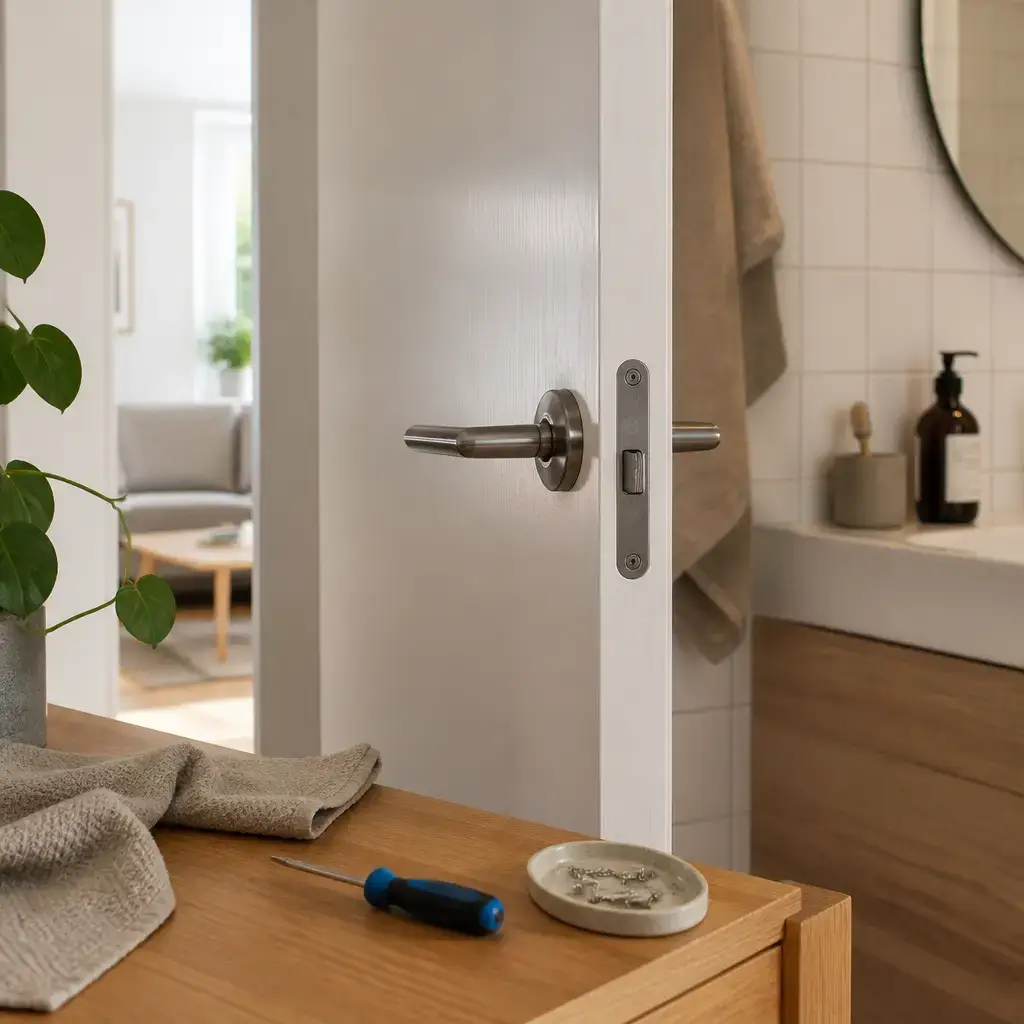
Håndtaget på badeværelsesdøren føles løst igen.
HAWN-teh-thuhd paw bah-deh-VAIR-uhls-es-DOHR-en FOHLS LOHST ee-GAIN. The bathroom door handle feels loose again.Jeg lagde mærke til det i går, men glemte at stramme det.
YAI LEH-thuh MAIR-keh teel deh ee GOHR, men GLEM-deh uh STRAH-muh deh. I noticed it yesterday but forgot to tighten it.Har vi en skruetrækker i skuffen?
HAH vee en SKROO-uh-treh-ger ee SKOO-fen? Do we have a screwdriver in the drawer?Den lille burde virke til de her skruer.
Den LEL-uh BOO-uh-thuh VAIR-guh teel dee hair SKROO-uh. The small one should work for these screws.Kan du holde håndtaget, mens jeg strammer det?
Kan doo HUL-uh HAWN-teh-thuhd, mens YAI STRAH-muh deh? Could you hold the handle while I tighten it?Jeg holder det fast, mens du drejer det.
YAI HUL-uh deh FESD, mens doo DRY-uh deh. I'll keep it steady while you turn it.Det føles meget mere stabilt nu.
Deh FOHLS MYE-uh MAY-uh stah-BEELD noo. It feels much firmer now.Lad os tjekke det igen senere, bare for en sikkerheds skyld.
LATH ohs CHEK-uh deh ee-GAIN SAY-nuh-ruh, BAH-ruh fohr en SEH-guh-haiths SGEEL. Let's check it once more later, just in case.Sentence explanations
Håndtaget på badeværelsesdøren føles løst igen.
The bathroom door handle feels loose again.
- Håndtaget
- the handle
- badeværelsesdøren
- the bathroom door
- føles
- feels
- løst
- loose
- igen
- again
More detail
Håndtaget means “the handle” here. The base noun is håndtag (“handle”), and -et marks its definite singular form: håndtag → håndtaget. Danish also has håndtagene for the definite plural (“the handles”). badeværelsesdøren means “the bathroom door.” It is a compound: badeværelse (“bathroom”) + dør (“door”), with the definite ending -en on dør: dør → døren. The linking -s in badeværelses- connects the first noun to the compound; it is not a separate word meaning “of.” føles is the present-tense form of føle, “to feel.” With a thing as subject, føles can describe how that thing seems by touch or sensation. Example: Stoffet føles blødt. — “The fabric feels soft.” løst means “loose” in this sentence. Its base form is the adjective løs. The -t form agrees with the neuter singular subject håndtaget: en løs skrue (“a loose screw”), but et løst håndtag (“a loose handle”). In plural, the adjective is løse, as in de løse skruer (“the loose screws”). With a definite noun before an adjective, attributive Danish also uses løse, as in det løse håndtag; that is a different construction from the predicative håndtaget føles løst here. igen means “again.” It shows that the handle feels loose once more or as it did before. Example: Det regner igen. — “It is raining again.” Together, Håndtaget på badeværelsesdøren is “the handle on the bathroom door.” føles løst says that the handle feels loose, with løst taking the neuter form required by the singular subject håndtaget. Adding igen gives the complete meaning: “The bathroom door handle feels loose again.”
Jeg lagde mærke til det i går, men glemte at stramme det.
I noticed it yesterday but forgot to tighten it.
- Jeg
- I
- lagde mærke til
- noticed
- det
- it
- i går
- yesterday
- glemte
- forgot
- at stramme
- to tighten
- det
- it
More detail
Jeg is the first-person singular pronoun, “I.” It identifies the speaker as the person who both noticed and forgot. The corresponding object form is mig, used when “me” is an object: Hun ser mig means “She sees me.” lagde mærke til is the fixed expression “noticed” in this sentence. Its base expression is lægge mærke til; lagde is its past-tense form. Danish uses this expression for becoming aware of something: Jeg lægger mærke til lyden means “I notice the sound.” The following til belongs to the expression, so it is useful to learn the whole pattern lægge mærke til + noget rather than translating each word separately. The first det is a neuter singular pronoun meaning “it” here. In the supplied context, it refers to the loose bathroom-door handle. Danish det can refer back to a neuter noun or to an already identified thing; its form does not itself identify the referent. i går means “yesterday.” It is a fixed time expression. Compare i dag (“today”) and i morgen (“tomorrow”); these expressions place an event in time without changing the verb form. glemte means “forgot” here. It is the past-tense form of glemme (“to forget”): jeg glemmer is present, while jeg glemte is past. A useful pattern is glemme at + infinitive, as in Jeg glemte at ringe — “I forgot to call.” at stramme means “to tighten.” stramme is the base form, and at marks the infinitive in this construction. The verb describes making something tighter, for example at stramme skruen means “to tighten the screw.” The second det is again “it” and refers here to the same relevant object, the loose handle. Repeating the pronoun as the object of stramme makes clear what was to be tightened. Together, Jeg lagde mærke til det i går means “I noticed it yesterday.” men connects this with a contrast, and glemte at stramme det means “forgot to tighten it.” The whole utterance is therefore: “I noticed it yesterday but forgot to tighten it.”
Har vi en skruetrækker i skuffen?
Do we have a screwdriver in the drawer?
- Har
- have
- vi
- we
- en
- a/an
- skruetrækker
- screwdriver
- skuffen
- the drawer
More detail
Har is the present-tense form of have, “to have.” In a yes/no question, Danish commonly places the finite verb before the subject: Har vi ...? means “Do we have ...?” The same verb appears after the subject in a statement: Vi har en skruetrækker. — “We have a screwdriver.” vi means “we,” the first-person plural pronoun. It identifies the speaker together with at least one other person; it does not by itself specify exactly who else is included. en is the indefinite article used here with a singular noun of the en class: en skruetrækker, “a screwdriver.” Here it introduces an unspecified screwdriver, not a stated numerical count. skruetrækker means “screwdriver.” It is a noun: en skruetrækker is indefinite singular, while skruetrækkeren is definite singular (“the screwdriver”) and skruetrækkere is plural (“screwdrivers”). skuffen means “the drawer.” The base noun is skuffe, “drawer”; the ending -en marks definite singular: skuffe → skuffen. With i, the phrase i skuffen means “in the drawer.” Together, Har vi forms the yes/no question “Do we have,” en skruetrækker identifies the thing being asked about, and i skuffen gives its location. The complete utterance therefore means, “Do we have a screwdriver in the drawer?”
Den lille burde virke til de her skruer.
The small one should work for these screws.
- Den
- the one
- lille
- small
- burde
- should
- virke
- work
- til
- for
- de her
- these
- skruer
- screws
More detail
Den and lille form den lille, “the small one.” Here the adjective is used substantivally: it stands for an understood common-gender singular item instead of directly modifying a stated noun. Den marks the definite singular form used with this construction; the exact item is not named in the sentence, although the preceding context makes a tool a plausible referent. lille means “small” here. Its base form is lille; a useful comparison is mindre “smaller” and mindst “smallest.” Example: Den lille er lettere. — “The small one is lighter.” This example illustrates the same adjective-as-noun pattern, not an additional fact about the supplied conversation. burde expresses what is expected or advisable: “should” or “ought to.” It is the past-form modal related to bør, but in present-day use burde commonly expresses present or future expectation or recommendation. Example: Det burde virke. — “It should work.” virke means “to work” in the sense of functioning or being effective. It is the infinitive after the modal burde; the modal carries the finite tense, so virke itself is not marked for person or tense here. Example: Lampen virker. — “The lamp works.” til links something with the purpose or object it is suitable for. In virke til de her skruer, it means “for these screws,” describing suitability rather than a destination. Example: Denne nøgle passer til møtrikken. — “This wrench fits the nut.” de her means “these,” identifying plural items near the speaker or salient in the situation. de is the plural demonstrative, while her adds the sense of proximity. Example: De her bøger er nye. — “These books are new.” skruer means “screws.” Its singular base form is skrue; skruer is the ordinary plural form. Example: Jeg mangler to skruer. — “I am missing two screws.” The sentence itself does not state a number; the plural simply refers to screws as a group. Together, den lille identifies the small item, burde virke says that it is expected to function, and til de her skruer specifies what it should be suitable for. The whole utterance therefore means: “The small one should work for these screws.”
Kan du holde håndtaget, mens jeg strammer det?
Could you hold the handle while I tighten it?
- Kan du
- Could you
- holde
- hold
- håndtaget
- the handle
- mens
- while
- jeg
- I
- strammer
- tighten
- det
- it
More detail
Kan du combines the modal verb kan (“can”) with du (“you”). kan is the present-tense form of kunne; in this question it makes a request, so the natural meaning is “Could you …?” Danish questions commonly place the verb before the subject: Kan du ...?. holde is the infinitive of holde, “to hold” or, in some contexts, “to keep.” It follows the modal kan without an infinitive marker. The pattern kan + infinitive is reusable: Kan du vente? means “Can you wait?” håndtaget means “the handle.” The base noun is håndtag; -et marks the definite singular form for this noun. The indefinite form is et håndtag (“a handle”), while håndtaget identifies a particular handle in the situation. mens introduces an action happening at the same time as another action and means “while.” A reusable pattern is mens + clause: Jeg læser, mens hun laver mad. means “I read while she cooks.” jeg is the first-person singular pronoun “I.” It is the subject of the clause after mens, so the speaker performs the action in that clause. strammer is the present-tense form of stramme, “to tighten.” The present form can describe an action occurring during the other action here: jeg strammer means “I tighten” in the sense of “I am tightening.” For example, Jeg strammer skruen. means “I tighten the screw.” det is the neuter singular object pronoun “it.” In this utterance, the fixed translation supports its referring to the handle: the speaker asks the other person to hold the handle while the speaker tightens it. Danish pronouns must fit the grammatical properties of their referent; det is the neuter form, whereas den is used for common-gender singular referents. Together, Kan du holde håndtaget asks whether the listener can hold the handle. mens jeg strammer det adds the simultaneous action: the speaker will tighten the handle while the listener holds it. The complete meaning is “Could you hold the handle while I tighten it?”
Jeg holder det fast, mens du drejer det.
I'll keep it steady while you turn it.
- Jeg
- I
- holder
- hold; keep
- det
- it
- fast
- steady; firmly
- du
- you
- drejer
- turn
- det
- it
More detail
Jeg means “I” here, the first-person singular subject. The form does not change for gender; compare du for one person addressed as “you.” holder is the present-tense form of holde, “to hold” or “to keep.” In holder det fast, it describes maintaining the object in a steady or firm state. The present form is used for the action in this coordinated situation; the English translation uses “I’ll” to express the intended action. Example: Jeg holder døren. — “I hold the door.” The first det is a third-person singular object pronoun meaning “it.” Its grammatical form is det; the sentence does not identify the object by a noun here. In this clause it is the thing being held steady. fast means “steady” or “firmly” in this construction. With holde, holde noget fast is a reusable pattern meaning “hold something steady/firmly,” where noget is a placeholder pattern, not part of the fixed sentence. fast can also describe something that is fixed in place, as in Døren sidder fast — “The door is stuck.” du is the second-person singular subject pronoun, “you,” addressing one person. It is the subject of the following action, whereas Jeg is the subject of the first clause. drejer is the present-tense form of dreje, “to turn.” Here du drejer means “you turn.” Example: Du drejer knappen. — “You turn the knob.” The present form can describe an action occurring as part of the same situation; the translation renders the coordinated action as “while you turn it.” The second det is again the third-person singular object pronoun “it.” Here it is the object of drejer: the person addressed turns the same unspecified object referred to by the fixed translation. mens connects the two clauses and means “while.” The structure is Jeg holder det fast, mens du drejer det: the first clause states that I keep the object steady, and the mens clause states that you turn it at the same time. Together, the utterance means “I’ll keep it steady while you turn it.”
Det føles meget mere stabilt nu.
It feels much firmer now.
- Det
- it
- føles
- feels
- meget mere
- much more
- stabilt
- firmer
- nu
- now
More detail
Det is the Danish neuter singular pronoun “it.” Here it refers to the thing being held and turned in the supplied context. Danish uses det for a neuter singular referent; the pronoun itself does not identify the referent by proximity alone. føles comes from føle, “to feel,” and is the present-tense form used with det. In this sentence it describes how the thing seems or feels, rather than someone actively touching it. Example: Det føles koldt. — “It feels cold.” meget mere means “much more.” mere is the comparative form expressing a higher degree, and meget strengthens that comparison. The pattern meget mere + adjective is reusable: meget mere sikker means “much safer” or “much more certain,” depending on the adjective’s meaning. stabilt comes from the adjective stabil, “stable” or “firm.” In this sentence it is the neuter singular form, agreeing with det; the comparison is made with mere: mere stabilt, “firmer” or literally “more stable.” The fixed translation selects the intended sense “firmer” here. Example: Bordet føles mere stabilt. — “The table feels firmer.” nu means “now” and places the feeling in the present situation. It contrasts with a later time, as in senere, “later.” Together, Det føles presents the current impression of the object, while meget mere stabilt says that it has a substantially higher degree of firmness or stability, and nu locates that comparison in the present: “It feels much firmer now.”
Lad os tjekke det igen senere, bare for en sikkerheds skyld.
Let's check it once more later, just in case.
- Lad os
- let’s
- tjekke
- check
- det
- it
- igen
- again
- senere
- later
- bare for en sikkerheds skyld
- just in case
More detail
Lad os is a reusable Danish way to suggest an action: “let’s …”. lad is the imperative of lade (“let/allow”), and os is the object form of vi (“we/us”). Together, Lad os + infinitive introduces a shared suggestion, not a command to one person alone. tjekke means “check” here. It is the infinitive form, used after Lad os; the same verb can appear in other forms, such as tjekker (“check/checks” in the present) and tjekkede (“checked” in the past). Example: Vi tjekker det nu. — “We are checking it now.” det is the Danish neuter singular pronoun corresponding here to “it.” Its specific referent is not identified in the sentence, so it is best understood as the thing being checked. Danish det can also be used in other grammatical roles, but this occurrence is the object of tjekke. igen means “again” or “once more.” It shows that the checking is being repeated. Example: Læs det igen. — “Read it again.” senere means “later,” referring to a time after the current point. It does not itself specify exactly when. Example: Vi taler sammen senere. — “We will talk later.” bare for en sikkerheds skyld is a fixed expression meaning “just in case.” Literally, it refers to doing something for the sake of safety, but in this expression it signals a precaution. bare softens the suggestion to “just,” while for en sikkerheds skyld forms the idiomatic precaution phrase. Example: Tag en paraply med, bare for en sikkerheds skyld. — “Take an umbrella, just in case.” Putting the parts together, Lad os tjekke det igen senere means “Let’s check it again later,” and bare for en sikkerheds skyld adds the precautionary reason: “just in case.” The complete utterance is therefore: “Let’s check it once more later, just in case.”
Grammar Points
et-ord + adjective with -t: løst, stabilt
Håndtaget er løst.
HAWN-teh-thuhd air LOHST.The handle is loose.
After an et-word, the adjective usually takes -t: løs becomes løst, and stabil becomes stabilt.
lægge mærke til → lagde mærke til
Jeg lagde mærke til badeværelsesdøren i går.
YAI LEH-thuh MAIR-keh teel bah-deh-VAIR-uhls-es-DOHR-en ee GOHR.I noticed the bathroom door yesterday.
The fixed phrase lægge mærke til means “notice”; its past form is the irregular lagde mærke til.
Danish Vocabulary
- Gender
- common
badeværelsesdøren
glemte at stramme det
- Gender
- neuter
Håndtaget på badeværelsesdøren
Den lille
Jeg lagde mærke til det i går
- Gender
- neuter
føles løst igen
- Gender
- common
- Gender
- common
Quiz
Word Order
Arrange the words in the correct order.
The bathroom door handle feels loose again.
Show Answer
Håndtaget på badeværelsesdøren føles løst igen.Do we have a screwdriver in the drawer?
Show Answer
Har vi en skruetrækker i skuffen?It feels much firmer now.
Show Answer
Det føles meget mere stabilt nu.Spelling
Tap the letters to spell the word.
loose
Show Answer
løstagain
Show Answer
igenforget
Show Answer
glemtescrewdriver