10 minutes free every day
Continue audio lessons in the app
Word explanations appear automatically in sync with the audio.
No login required · synced translations · playback with the screen locked
Choose your learning language and open this lesson in the app.

About This Lesson
Use Tidying the living room before guests arrive to practice Danish conversation, pronunciation, vocabulary, grammar, and quizzes.
Dialogue
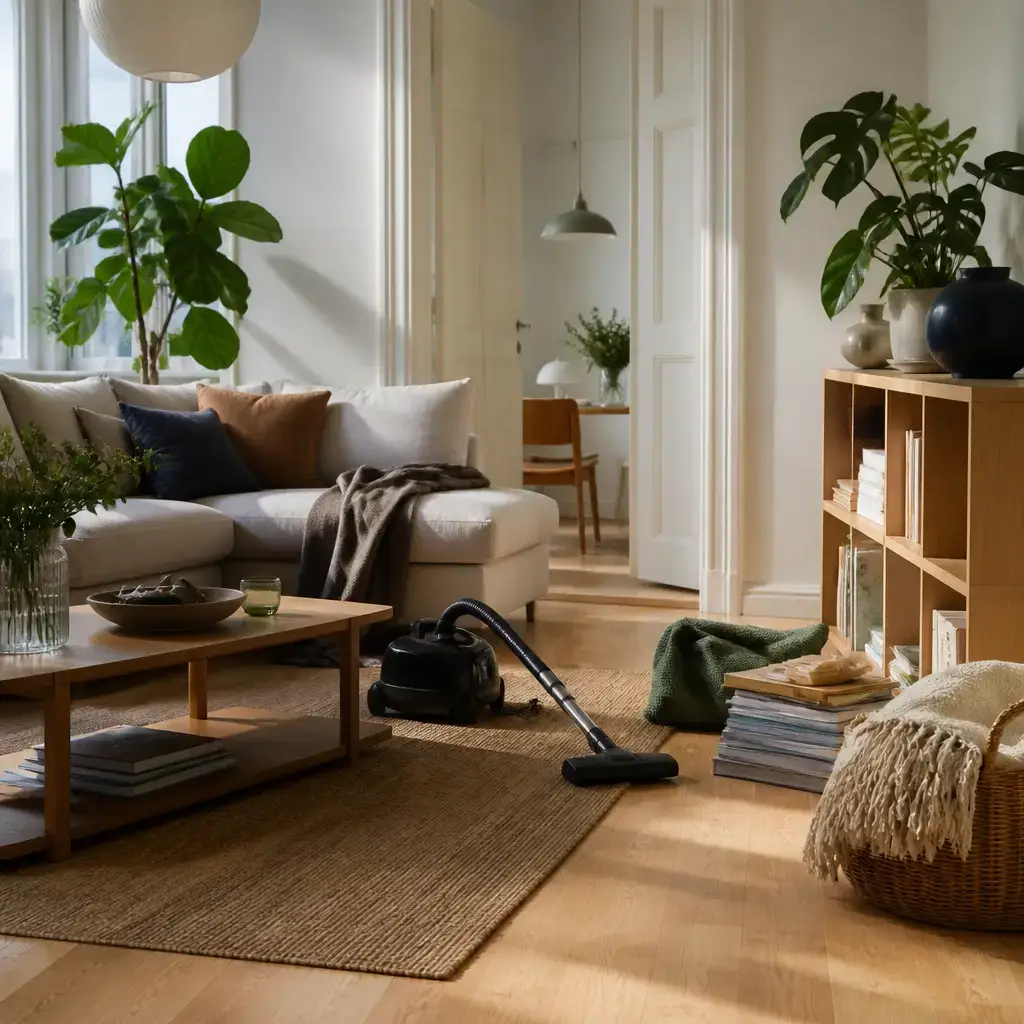
Vores gæster kommer snart.
VOH-uhs GESS-duh-nuh KOM-uh snaht. Our guests are coming soon.Så bør vi rydde stuen, før de kommer.
soh buhr vee RÜD-uh SDOO-uhn, fur dee KOM-uh. Then we should clear the living room before they arrive.Jeg lægger bøgerne tilbage på hylden.
YIGH LEG-uh BÜH-uh-nuh teh-BAIR poh HÜL-n. I'll put the books back on the shelf.Jeg retter puderne på sofaen.
YIGH RED-uh POO-uh-nuh poh SOH-fair-uhn. I'll straighten the cushions on the sofa.Skal vi også støvsuge tæppet?
SGAHL vee OH-soh SDUH-soo-uh TEB-uhd? Should we vacuum the rug as well?Det ville hjælpe at støvsuge, især nær døren.
DEH VEL-uh YEL-buh ehd SDUH-soo-uh, ee-SAIR NAIR DÜH-uhn. Vacuuming would help, especially near the doorway.Stuen føles allerede mere behagelig.
SDOO-uhn FÖH-luhs al-RAIR-duh MAIR beh-HAH-uh-lee. The room already feels more comfortable.Lad os lave te, når alt er klart.
LAHD ohs LAIR-vuh tay, nor alhd air KLAHD. Let's make tea once everything is ready.Sentence explanations
Vores gæster kommer snart.
Our guests are coming soon.
- Vores
- our
- gæster
- guests
- kommer
- are coming
- snart
- soon
More detail
Vores means “our” here. It is the possessive form used with a first-person plural possessor, and it does not change according to the gender or number of the possessed noun. For comparison, min means “my” with a singular common-gender noun, mit with a singular neuter noun, and mine with a plural noun. Example: vores hus means “our house.” gæster means “guests” here. Its base form is gæst “guest”; gæster is the regular plural. Example: En gæst kommer means “A guest is coming,” while Flere gæster kommer means “Several guests are coming.” kommer is the present-tense form of komme, “to come.” In this sentence, the present tense describes an event expected in the near future, as confirmed by snart “soon.” Example: Hun kommer i morgen means “She is coming tomorrow.” snart means “soon,” indicating that the coming will happen after a short interval. It is an adverb and does not change for number or gender. Together, Vores gæster is “our guests,” kommer says that they are coming, and snart places that event in the near future. The complete meaning is “Our guests are coming soon.”
Så bør vi rydde stuen, før de kommer.
Then we should clear the living room before they arrive.
- Så
- then
- bør vi
- we should
- rydde
- clear; tidy
- stuen
- the living room
- før
- before
- de
- they
- kommer
- come; arrive
More detail
Så means “then” here: it links this proposal to what has just been said. It can also mean “so” in other contexts, but the intended use here is a time or sequence link. bør vi is a reusable Danish pattern meaning “we should”. bør is the present form of burde, a modal verb expressing advice, recommendation, or what is appropriate. The subject vi means “we”. After a modal such as bør, the following verb is normally in the infinitive: vi bør rydde = “we should clear”. rydde means “clear” or “tidy” in this sentence. It is the infinitive form, used after bør. Example: Vi bør rydde køkkenet. — “We should tidy the kitchen.” stuen means “the living room”. The base noun is stue; stuen is its definite singular form, “the living room”. Danish commonly marks definiteness on the noun itself rather than using a separate word corresponding to English “the”. før introduces the time relation “before”. It can introduce a full clause, as here: før de kommer = “before they arrive”. It can also introduce a shorter phrase, for example før mødet = “before the meeting”. de is the third-person plural pronoun “they”. In this context, the intended group is the guests mentioned in the preceding sentence. The form de marks plural subjects; it does not itself specify the group’s gender or identity. kommer is the present form of komme, “come” or “arrive”. In the subordinate clause after før, Danish present tense can describe a later event, so de kommer is naturally translated “they arrive” or “they come”, even though the arrival is later. Example: De kommer i morgen. — “They are coming tomorrow.” Together, vi bør rydde stuen means “we should clear the living room”. The clause før de kommer adds the deadline or sequence: this clearing should happen before the guests arrive. With Så at the beginning, the whole utterance means: “Then we should clear the living room before they arrive.”
Jeg lægger bøgerne tilbage på hylden.
I'll put the books back on the shelf.
- Jeg
- I
- lægger
- put/place
- bøgerne
- the books
- tilbage
- back
- på
- on
- hylden
- the shelf
More detail
Jeg means “I” and is the first-person singular subject pronoun. It does not itself indicate whether the action happens now or later. lægger is the present-tense form of lægge, “to put” or “to place.” The verb is used for placing something somewhere; compare ligge, which describes something already being located somewhere. In this sentence, the present form can express the intended action in the fixed translation: “I’ll put …”. bøgerne means “the books.” Its base form is bog (“book”); bøger is the plural, and bøgerne is the definite plural. The ending -ne marks “the” for this plural form. For one book, Danish uses bogen for “the book.” tilbage means “back,” indicating a return to an earlier place or position. Together with lægger, lægger ... tilbage gives the reusable pattern “put/place ... back.” Example: Hun lægger koppen tilbage. — “She puts the cup back.” på means “on” here, introducing the surface or location where the books are placed. It can have other meanings in Danish, so its exact meaning comes from the surrounding phrase. hylden means “the shelf.” Its base form is hylde; hylden is the singular definite form. The ending -en marks “the” with this noun. The plural is hylder, and “the shelves” is hylderne. The chunks combine as Jeg + lægger + bøgerne + tilbage + på hylden: “I put the books back on the shelf.” In the supplied context, this present-tense Danish sentence is understood as the speaker’s intended action, matching the fixed translation “I’ll put the books back on the shelf.”
Jeg retter puderne på sofaen.
I'll straighten the cushions on the sofa.
- retter
- straighten
- puderne
- the cushions
- sofaen
- the sofa
More detail
retter is the present-tense form of rette. Here it means physically straightening or arranging something, not correcting an error. Danish present-tense verbs generally do not change for person: jeg retter means “I straighten,” while hun retter means “she straightens.” The same form can also mean “corrects” in another context, as in Jeg retter svaret (“I correct the answer”), but the cushions make the physical sense clear. puderne means “the cushions” here. Its base form is pude (“cushion”); puder is the plural, and the definite plural adds -ne: puderne. Compare en pude (“a cushion”) with puden (“the cushion”) and puderne (“the cushions”). The definite plural shows that the utterance refers to particular cushions, without stating how many beyond more than one. sofaen is the definite singular form of sofa (“sofa”): en sofa is “a sofa,” while sofaen is “the sofa.” The ending -en marks definite singular for this noun. In på sofaen, på means “on,” and the whole phrase identifies where the cushions are being straightened. The pattern Jeg + present-tense verb expresses the speaker’s action or intention in this context. Danish does not need a separate future auxiliary for the intended “I’ll” reading here; the fixed translation presents the present form as an intention about the immediate task. retter puderne gives the action and its object, while på sofaen gives the location. Together, Jeg retter puderne på sofaen. means “I’ll straighten the cushions on the sofa.”
Skal vi også støvsuge tæppet?
Should we vacuum the rug as well?
- Skal vi
- shall we
- også
- also; as well
- støvsuge
- vacuum
- tæppet
- the rug
More detail
Skal vi is a reusable Danish way to ask whether “we” should do something or whether “we” should do it as a suggestion: Skal vi + infinitive? Here, skal is the present form of skulle, and vi means “we.” The construction is not just a statement about obligation; in a question like this it naturally makes a proposal. også means “also” or “as well.” It adds this activity to something else under discussion. Its position before the infinitive is common, but its exact placement can vary with the intended emphasis. støvsuge is the infinitive “to vacuum.” After skal, Danish uses the infinitive without an English-style “to”: Vi skal støvsuge means “We should/must vacuum” or “We are going to vacuum,” depending on context. Example: Jeg skal støvsuge. — “I have to vacuum.” tæppet means “the rug.” The base noun is tæppe, “rug” or “carpet”; tæppet is its singular definite form, formed with the ending -et. The ending belongs to the noun, not to støvsuge. Example: Jeg flytter tæppet. — “I move the rug.” Together, Skal vi asks for a proposal, også adds this task, støvsuge names the action, and tæppet identifies the object. The complete meaning is: “Should we vacuum the rug as well?”
Det ville hjælpe at støvsuge, især nær døren.
Vacuuming would help, especially near the doorway.
- Det ville
- it would
- hjælpe
- help
- støvsuge
- vacuum
- især
- especially
- nær
- near
- døren
- the door
More detail
Det ville means “it would.” Here det is an impersonal or anticipatory subject: the following infinitive clause identifies what would help, rather than det identifying a particular participant. ville is the past form of vil; in this construction it expresses a hypothetical or conditional result, “would.” Danish commonly uses ville with an infinitive: Det ville hjælpe at åbne vinduet. — “It would help to open the window.” hjælpe means “to help.” It is the infinitive after ville; this form does not show a person or number. In Det ville hjælpe, the following infinitive clause specifies what would be helpful. Example: Det hjælper at tage en pause. — “It helps to take a break.” støvsuge means “to vacuum.” In the full pattern at støvsuge, it is an infinitive introduced by at, “to vacuum.” The present-tense form is støvsuger, as in Hun støvsuger gulvet. — “She vacuums the floor.” In the supplied sentence, at støvsuge functions as what would help; it does not specify who will do it. især means “especially.” It singles out the location introduced afterward as particularly relevant. Example: Det hjælper især om morgenen. — “It helps especially in the morning.” nær is a preposition meaning “near.” It introduces a reference point, as in nær vinduet — “near the window.” døren means “the door” here. Its base form is dør; døren is the definite singular form, with the definite ending -en. The corresponding indefinite form is en dør, “a door.” The ending belongs to the noun dør, not to nær. Together, Det ville hjælpe at støvsuge says that vacuuming would be helpful. især nær døren adds that this would be particularly helpful in the area near the door. The complete meaning is: “Vacuuming would help, especially near the doorway.”
Stuen føles allerede mere behagelig.
The room already feels more comfortable.
- Stuen
- the room
- føles
- feels
- allerede
- already
- mere behagelig
- more comfortable
More detail
Stuen means “the room” here, more specifically “the living room” in ordinary Danish usage. It is the definite singular form of stue (“living room”): en stue = “a living room”, stuen = “the living room”. The definite ending is part of the word, so it is not a separate article. føles is the form used here for “feels” in the sense of being perceived as having a quality. It is the present-tense -s form of føle (“feel”), used in expressions such as Det føles godt (“It feels good”) and Stolen føles hård (“The chair feels hard”). Do not replace it with føler in this sentence: føler normally presents a person or other subject as the one doing the feeling, whereas føles presents something as having a felt quality. The form føles itself does not show person or number here. allerede means “already” and places the change or state earlier than might otherwise be expected. For example, Det er allerede klart means “It is already clear.” mere behagelig means “more comfortable”. Behagelig is the adjective “comfortable” or “pleasant”; mere forms its comparative rather than changing the adjective: behagelig = “comfortable”, mere behagelig = “more comfortable”, mest behagelig = “most comfortable”. Here mere modifies behagelig, not the noun. For example, Denne stol er mere behagelig means “This chair is more comfortable.” Together, Stuen supplies the thing being described, føles says that its quality is perceived, allerede adds “already”, and mere behagelig gives the comparative quality. The complete utterance therefore means: “The room already feels more comfortable.”
Lad os lave te, når alt er klart.
Let's make tea once everything is ready.
- Lad os
- let’s
- lave
- make
- te
- tea
- når
- when; once
- alt
- everything
- er
- is; are
- klart
- ready
More detail
Lad os is the Danish pattern for suggesting a joint action: lad os + infinitive means “let’s …”. Lad is the imperative of lade (“let/allow”), and os means “us”; together, this fixed construction is not a literal command to release someone. lave means “make” here. It is the infinitive form, used after lad os. The same verb can describe making or preparing something in other contexts. Example: Lad os lave mad. — “Let’s make food.” te is the noun “tea”. Danish nouns can have grammatical gender, but this form itself does not show a number or definiteness ending here. Example: Jeg drikker te. — “I am drinking tea.” når introduces a time clause and means “when” or “once” here. It connects the suggested action with the condition that follows. Example: Vi går, når du er klar. — “We’ll go when you are ready.” alt means “everything” in this sentence. It is a pronoun referring to the complete set of relevant things, without the sentence specifying those things individually. Alt is the neuter singular form associated with the adjective form in klart. er is the present-tense form of være (“be”). It is used with the subject alt; Danish present er does not change for person or number in the way some languages’ present-tense forms do. Example: Alt er godt. — “Everything is good.” klart means “ready” here. It is the neuter singular form of the adjective klar, agreeing with neuter singular alt. The base form is klar; compare klar with common-gender singular nouns and klart with neuter singular nouns. Example: Maden er klar. — “The food is ready.” Together, Lad os lave te means “Let’s make tea.” The clause når alt er klart adds the time condition “once everything is ready,” so the complete utterance means “Let’s make tea once everything is ready.”
Grammar Points
Bestemt form: -en, -et eller -ene
gæsterne kommer snart.
GESS-duh-nuh KOM-uh snaht.The guests are coming soon.
Danish often marks “the” by adding a suffix to the noun: gæsterne means “the guests”.
før + helsætning
før gæsterne kommer
fur GESS-duh-nuh KOM-uhbefore the guests come
før introduces a time clause; the verb follows the subject: gæsterne kommer.
Danish Vocabulary
- Gender
- common
- Gender
- common
- Gender
- common
- Gender
- common
Quiz
Word Order
Arrange the words in the correct order.
Our guests are coming soon.
Show Answer
Vores gæster kommer snart.I'll put the books back on the shelf.
Show Answer
Jeg lægger bøgerne tilbage på hylden.I'll straighten the cushions on the sofa.
Show Answer
Jeg retter puderne på sofaen.Spelling
Tap the letters to spell the word.
soon
Show Answer
snartour
Show Answer
voresput; place
Show Answer
læggerthe guests