10 minutes free every day
Continue audio lessons in the app
Word explanations appear automatically in sync with the audio.
No login required · synced translations · playback with the screen locked
Choose your learning language and open this lesson in the app.

About This Lesson
Use A weekly cleaning schedule at home to practice Danish conversation, pronunciation, vocabulary, grammar, and quizzes.
Dialogue
Vi har brug for en bedre rengøringsplan for lejligheden.
VEE hah BROO foh en BEH-thruh ren-GUR-ings-plahn-en foh LYE-lay-thun. We need a better cleaning schedule for the apartment.Vi har ikke delt pligterne ligeligt.
VEE hah IK-uh delt PLIK-tuh-nuh LEE-uh-guhld. We have not been dividing the chores evenly.Jeg kan tørre støv af hylderne lørdag morgen.
YAI kan TUR-uh stuhv ah HULL-uh-nuh LUR-dye MOR-un. I can dust the shelves on Saturday morning.Så vasker jeg gulvet i køkkenet efter frokost.
SOH VAS-guh YAI GOOL-vuth ee KUR-guh-nuth EF-duh FROH-kust. Then I'll mop the kitchen after lunch.Skal vi gøre badeværelset rent hver søndag?
SKAHL vee GUR-uh BAY-thuh-vairl-suth rahn vair SURN-dye? Should we clean the bathroom every Sunday?Søndag passer godt, fordi badeværelset hurtigt bliver beskidt.
SURN-dye PAS-uh goht, foh-THEE BAY-thuh-vairl-suth HOOR-dee BLEE-uh buh-SKIDT. Sunday makes sense because it gets dirty quickly.Jeg sætter rengøringsplanen på køleskabet.
YAI SET-uh ren-GUR-ings-plahn-en poh KUR-luh-SKAY-buth. I'll put the schedule on the fridge.Det burde hjælpe os med at huske hver opgave.
DEH BOO-thuh YEL-buh ohss meh uh HOOS-kuh vair OH-pah-vuh. That should help us remember each task.Sentence explanations
Vi har brug for en bedre rengøringsplan for lejligheden.
We need a better cleaning schedule for the apartment.
- har brug for
- need
- bedre
- better
- rengøringsplan
- cleaning schedule
- lejligheden
- the apartment
More detail
har brug for means “need” in this sentence. This is a fixed Danish construction: have + brug for + noun, literally involving “have use for,” but it is learned as the usual way to express needing something. The subject is Vi (“we”), and har is the present-tense form of have; the same present form is used with different subjects. Example: Jeg har brug for hjælp. — “I need help.” bedre means “better” here. It is the comparative form related to god (“good”): god → bedre → bedst (“best”). Use bedre when comparing quality, explicitly or implicitly; here the schedule is understood to be better than the current or an alternative one. Example: Denne plan er bedre. — “This plan is better.” rengøringsplan means “cleaning schedule.” It is a compound noun referring to a plan for cleaning, rather than the act of cleaning itself. The first part relates to rengøring (“cleaning”), and the second part is plan (“plan”); Danish compounds are written as one word. Example: Vi laver en rengøringsplan. — “We are making a cleaning schedule.” lejligheden means “the apartment.” The base noun is lejlighed (“apartment”); the ending -en marks the singular definite form, “the apartment.” This is different from the indefinite singular en lejlighed, “an apartment.” The fixed sentence identifies the apartment as the thing the schedule is for; the form itself marks definiteness, not a numeric count. Together, Vi har brug for + en bedre rengøringsplan + for lejligheden gives: “We need a better cleaning schedule for the apartment.” The indefinite article en introduces the type of schedule being needed, while lejligheden refers to the definite apartment associated with that schedule.
Vi har ikke delt pligterne ligeligt.
We have not been dividing the chores evenly.
- Vi har
- we have
- ikke
- not
- delt
- divided; shared
- pligterne
- the chores
- ligeligt
- evenly
More detail
Vi har means “we have” here. Vi is the first-person plural pronoun for the speaker together with at least one other person. Har is the present-tense form of have; it is used as the auxiliary in the perfect construction. Example: Vi har en plan. — “We have a plan.” Ikke is the standard Danish negation word, “not.” In this sentence it comes after the auxiliary and before the participle, giving har ikke delt — “have not divided/shared.” Example: Vi har ikke tid. — “We do not have time.” Delt is the past participle of dele, “to divide” or “to share.” With har, it forms the perfect: har delt means “have divided/shared.” The fixed translation presents this as an activity that has not been carried out evenly; the Danish form itself is a perfect construction, not a separate progressive verb form. Example: De har delt arbejdet. — “They have divided the work.” Pligterne means “the chores” in this sentence. It is the definite plural form of pligt, “chore” or “duty”: pligt → pligter (indefinite plural) → pligterne (definite plural). The ending -ne marks the plural definite form here. Example: Pligterne er fordelt. — “The chores have been assigned.” Ligeligt means “evenly” or “equally” and describes how the chores were divided. It is an adverb related to the adjective ligelig, “even/equal.” Compare en ligelig fordeling — “an even distribution” — with fordele noget ligeligt — “to distribute something evenly.” Together, Vi har ikke delt gives “we have not divided/shared,” pligterne identifies what was divided, and ligeligt says that the division was not even. The complete meaning is: “We have not been dividing the chores evenly.”
Jeg kan tørre støv af hylderne lørdag morgen.
I can dust the shelves on Saturday morning.
- Jeg kan
- I can
- tørre … af
- wipe ... off
- støv
- dust
- hylderne
- the shelves
- lørdag
- Saturday
- morgen
- morning
More detail
Jeg kan means “I can” here. kan is the present-tense form of kunne and is followed by an infinitive without at: jeg kan tørre (“I can wipe”). Here it presents the action as possible for the speaker; the fixed translation does not require a stronger promise that it will happen. tørre is the infinitive of the verb meaning “wipe” in this sentence. With støv and af hylderne, the pattern tørre støv af hylderne means “wipe dust off the shelves.” The af in the full phrase introduces what the dust is removed from: af hylderne means “off/from the shelves.” Thus, in this sentence, it is more precise to explain the whole tørre ... af hylderne pattern than to treat af alone as an independently fixed particle verb. Example: Jeg tørrer vand af bordet. — “I wipe water off the table.” støv is the noun “dust.” In this sentence it names the substance being removed, so it is not marked as a plural noun. It can also occur in compounds such as støvklud (“dust cloth”). hylderne means “the shelves.” Its base noun is hylde (“shelf”). A useful number-and-definiteness chain is hylde (a shelf), hylden (the shelf), hylder (shelves), hylderne (the shelves). The ending -ne marks definite plural here and belongs to the noun form, not to tørre. lørdag means “Saturday.” In this time expression, the day name appears without an article. morgen means “morning”; together, lørdag morgen gives “Saturday morning.” Example: søndag aften — “Sunday evening.” Putting the chunks together, Jeg kan + tørre støv af hylderne + lørdag morgen gives “I can dust the shelves on Saturday morning.”
Så vasker jeg gulvet i køkkenet efter frokost.
Then I'll mop the kitchen after lunch.
- Så
- then
- vasker
- mop; wash
- jeg
- I
- gulvet
- the floor
- køkkenet
- the kitchen
- frokost
- lunch
More detail
Så means “then” here, linking this action to what comes before. It is also useful for sequencing actions: Så går vi hjem. — “Then we go home.” vasker is the present-tense form of vaske, “to wash.” With gulvet in this context, it means “mop,” because the object is a floor. Danish present tense can also refer to a planned or imminent future action; that is why the fixed translation uses “I’ll mop.” The same form can mean “wash” with another object: Jeg vasker bilen. — “I wash the car.” jeg is the first-person singular pronoun “I.” It identifies the speaker as the person doing the action. Danish uses jeg for this role regardless of the speaker’s gender. gulvet means “the floor.” The base noun is gulv, a neuter noun. Its indefinite singular form is et gulv, while gulvet is the definite singular form, with the definite ending -et attached to the noun. køkkenet means “the kitchen.” Its base noun is køkken, also a neuter noun: et køkken means “a kitchen,” while køkkenet is the definite singular form with -et. The preposition i before it gives the location “in the kitchen.” frokost means “lunch.” In efter frokost, it follows efter, “after,” and names the meal in a general, uncounted way; no separate definite article is present. Efter frokost therefore means “after lunch.” Together, Så vasker jeg gives “Then I’ll mop,” gulvet is the object being mopped, i køkkenet specifies the location, and efter frokost specifies the time. The complete utterance means: “Then I’ll mop the kitchen after lunch.”
Skal vi gøre badeværelset rent hver søndag?
Should we clean the bathroom every Sunday?
- Skal vi
- Should we
- gøre … rent
- clean
- badeværelset
- the bathroom
- hver
- every
- søndag
- Sunday
More detail
Skal vi combines the modal verb skal with the pronoun vi (“we”). Here skal presents the cleaning as a suggestion or question about what they should do. In a yes/no question, Danish commonly places the finite verb before the subject: Skal vi ...? Compare the reusable pattern Skal vi gå? — “Shall we go?” gøre is the infinitive of gøre (“do; make”). After the modal skal, the following verb is in the infinitive. rent means “clean” here, and gøre rent is the ordinary Danish construction for “clean” or “clean something.” Together, the two separated parts express the cleaning action; gøre is not being used alone with its general meaning “do” in this sentence. badeværelset means “the bathroom.” Its base form is badeværelse; the ending -et marks the definite singular form, so badeværelset refers to a specific bathroom understood in the situation. The noun is an et-word, which is why this definite ending is used. Example: Et badeværelse — “a bathroom”; badeværelset — “the bathroom.” hver means “every” or “each.” In the pattern hver + singular noun, it distributes the action across individual recurring occasions: hver søndag means “every Sunday.” This differs from alle søndage, “all Sundays,” which uses a plural noun. søndag means “Sunday.” Danish names of weekdays are normally written with a lowercase initial. After hver, it remains singular: hver søndag — “every Sunday.” Assembled from left to right, Skal vi asks whether the speakers should act together, gøre ... rent names the cleaning action, badeværelset identifies what is cleaned, and hver søndag specifies the recurring time. The whole utterance therefore means: “Should we clean the bathroom every Sunday?”
Søndag passer godt, fordi badeværelset hurtigt bliver beskidt.
Sunday makes sense because it gets dirty quickly.
- Søndag
- Sunday
- passer
- fits; works
- godt
- well
- fordi
- because
- badeværelset
- the bathroom
- hurtigt
- quickly
- bliver
- becomes; gets
- beskidt
- dirty
More detail
Søndag means “Sunday” here. The lowercase base form is søndag; it is capitalized because it begins the sentence. Danish names of weekdays are normally lowercase elsewhere. Example: Jeg arbejder søndag. — “I work on Sunday.” passer is the present-tense form of passe. In this sentence, passe means “to suit” or “to work/be convenient,” not “to fit” in a physical sense. Example: Tirsdag passer mig. — “Tuesday suits me.” godt means “well” and strengthens passer: passer godt means “works well” or “is a good choice.” It is the neuter form of the adjective god; the adverbial use here describes how well something works. The comparison is god → bedre (“better”) → bedst (“best”). fordi introduces the reason for the preceding statement. The reusable pattern is X ..., fordi Y ... — “X ..., because Y ...”. In the following clause, badeværelset is the subject, followed by hurtigt and then bliver. badeværelset means “the bathroom.” Its indefinite noun form is badeværelse; the ending -et marks the definite singular form: et badeværelse → badeværelset. Here it refers to the bathroom identified by the supplied context. hurtigt means “quickly.” It describes the speed of the change expressed by bliver beskidt. The related adjective is hurtig (“quick”); hurtigt is also the form used adverbially here. Example: Bussen kører hurtigt. — “The bus drives quickly.” bliver is the present-tense form of blive, “to become” or “get.” With an adjective, blive commonly expresses a change into a state: blive træt means “get tired,” and blive beskidt means “get dirty.” beskidt means “dirty” in the expression bliver beskidt, “gets dirty.” It is the neuter singular form of beskidt; the noun badeværelse is neuter. Other forms include beskidt with a common-gender singular noun and beskidte with a plural or definite noun, as in de beskidte badeværelser — “the dirty bathrooms.” Together, Søndag passer godt says that Sunday works well or is a suitable time. fordi badeværelset hurtigt bliver beskidt gives the reason: the bathroom gets dirty quickly. The complete meaning is: “Sunday works well because the bathroom gets dirty quickly.”
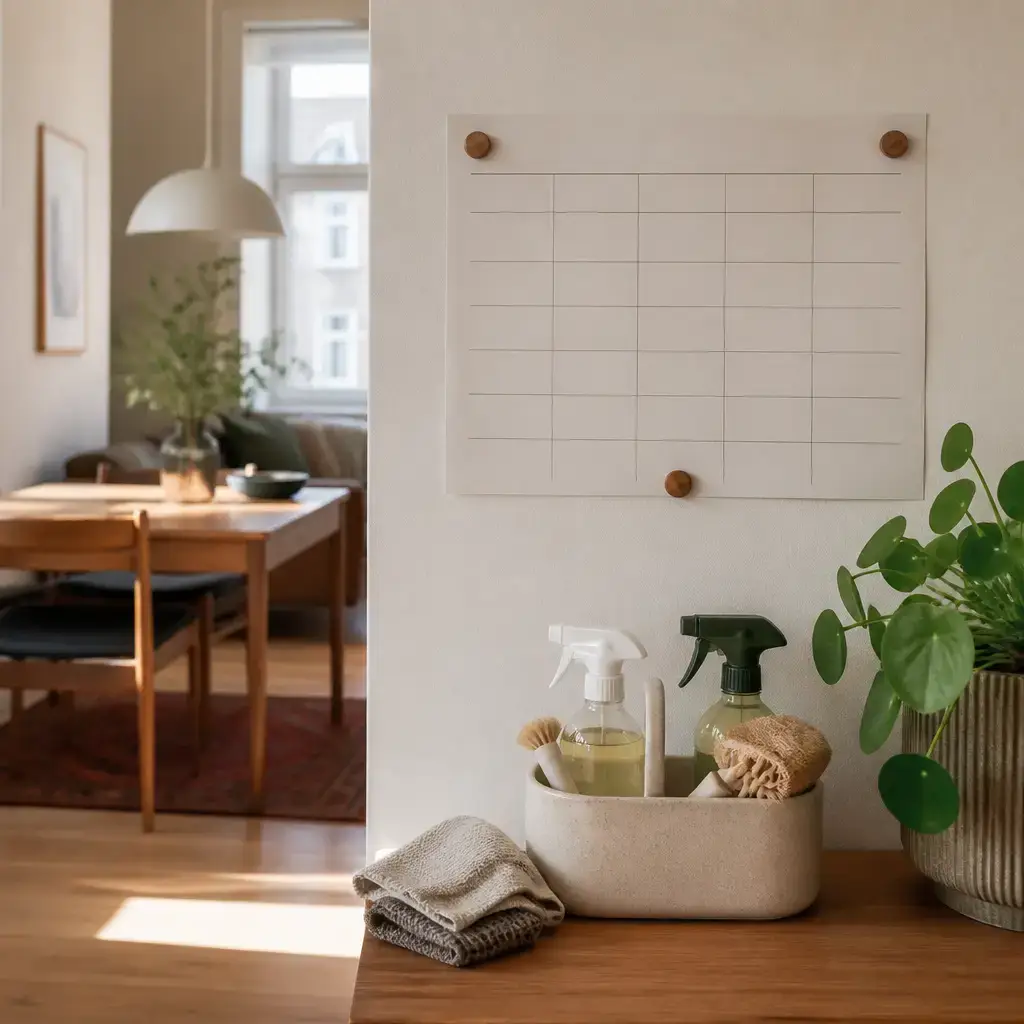
Jeg sætter rengøringsplanen på køleskabet.
I'll put the schedule on the fridge.
- Jeg
- I
- sætter
- put
- rengøringsplanen
- the cleaning schedule
- på
- on
- køleskabet
- the fridge
More detail
Jeg means “I” here and is the subject—the person carrying out the action. Danish subject pronouns include jeg (“I”), du (“you,” singular), and vi (“we”). Example: Jeg læser. — “I am reading.” sætter is the present-tense form of sætte, “to put” or “to place.” In this sentence it describes placing something at a location; with context, the Danish present tense can express a planned action that the English translation renders as “I’ll put.” Example: Jeg sætter koppen på bordet. — “I put the cup on the table.” The subject jeg does not require a special verb ending here; sætter is the form used with this subject in the present tense. rengøringsplanen means “the cleaning schedule.” It is a compound noun: rengøring means “cleaning,” and plan means “schedule” or “plan.” The ending -en marks the definite singular form of this common-gender noun: en rengøringsplan — “a cleaning schedule”; rengøringsplanen — “the cleaning schedule.” The definite form identifies the schedule as a particular one, but the sentence does not explain its contents. på means “on” here, introducing the surface or location where something is placed. Danish uses på with many surfaces and locations; it is different from i, which commonly means “in.” Example: Bogen ligger på bordet. — “The book is on the table.” køleskabet means “the fridge.” Its base form is køleskab, and its definite singular form is køleskabet: et køleskab — “a fridge”; køleskabet — “the fridge.” The ending -et is the definite singular ending for this neuter noun. The form itself does not express whether the fridge is large or small. Together, Jeg sætter gives “I put” or, in this planned-action context, “I’ll put.” rengøringsplanen is the object being placed, and på køleskabet gives its destination or position: “on the fridge.” The complete meaning is “I’ll put the cleaning schedule on the fridge.”
Det burde hjælpe os med at huske hver opgave.
That should help us remember each task.
- Det burde
- that should
- hjælpe
- help
- os
- us
- huske
- remember
- hver
- each
- opgave
- task
More detail
Det burde means “that should” here. det is the Danish neuter singular pronoun used as the subject of this clause; the supplied translation supports the intended “that,” but it does not identify exactly what det refers to. burde is the modal verb form related to bør, expressing an expected or appropriate result: “should.” It is followed here by an infinitive without at. hjælpe means “help.” After a modal such as burde, the following verb is in the infinitive: burde hjælpe, “should help.” A useful pattern is Det burde hjælpe ... — “That should help ...”. Example: Det burde hjælpe. — “That should help.” os means “us.” It is the object form of first-person plural vi (“we”): vi as subject, os as object. Example: Hun hjælper os. — “She helps us.” huske means “remember.” The construction hjælpe nogen med at huske means “help someone remember”: med at introduces the infinitive huske, while os identifies who is helped. Example: Det hjælper mig med at huske. — “It helps me remember.” hver means “each” or “every” in the singular. It selects one item at a time and is used with a singular count noun, as in hver opgave. It is different from alle, “all,” which normally presents the items collectively. Example: Hver elev får en bog. — “Each student gets a book.” opgave means “task” here. Its plural is opgaver; hver opgave remains singular because hver presents the tasks one by one. Example: Jeg afslutter en opgave. — “I finish a task.” Together, Det burde gives “That should,” hjælpe os med at huske gives “help us remember,” and hver opgave gives “each task.” The complete utterance therefore means: “That should help us remember each task.”
Grammar Points
have brug for + noun
Jeg har brug for en bedre rengøringsplan.
YAI hah BROO foh en BEH-thruh ren-GUR-ings-plahn.I need a better cleaning schedule.
Danish uses the fixed expression have brug for, literally “have use for,” to express need.
blive + adjective
Lejligheden bliver hurtigt beskidt.
LYE-lay-thun BLEE-uh HOOR-dee buh-SKIDT.The apartment gets dirty quickly.
Blive means “become” or “get” and is followed by an adjective such as beskidt.
Danish Vocabulary
Quiz
Word Order
Arrange the words in the correct order.
We have not been dividing the chores evenly.
Show Answer
Vi har ikke delt pligterne ligeligt.I'll put the schedule on the fridge.
Show Answer
Jeg sætter rengøringsplanen på køleskabet.Spelling
Tap the letters to spell the word.
shelf
Show Answer
hyldernedivide
Show Answer
deltbetter
Show Answer
bedrechore