10 minutes free every day
Continue audio lessons in the app
Word explanations appear automatically in sync with the audio.
No login required · synced translations · playback with the screen locked
Choose your learning language and open this lesson in the app.

About This Lesson
Use Fixing a Weak Internet Connection to practice Danish conversation, pronunciation, vocabulary, grammar, and quizzes.
Dialogue
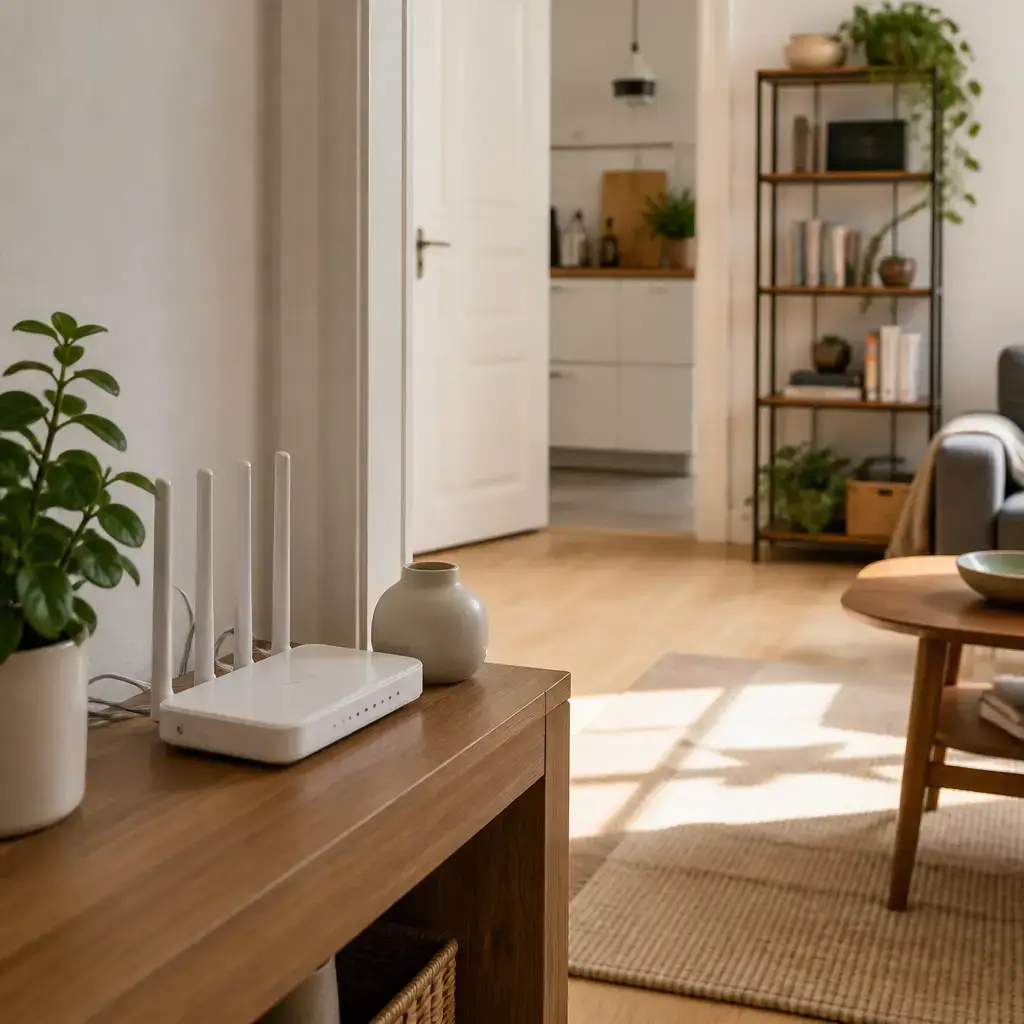
Internetforbindelsen er svag i dette rum.
en-uh-NED-fuh-BEN-el-sen air svay ee DEH-duh room The internet connection is weak in this room.Routeren har måske brug for en hurtig genstart.
ROW-tuh-ren hah MOH-skeh broo foh en HOO-dee gen-STAR The router may need a quick restart.Skal jeg slukke den og tænde den igen?
skal yay SLOO-guh den oh TEN-uh den ee-GEN Should I turn it off and on again?Gør det, og vent så, til statuslampen lyser igen.
GUR deh, oh ven soh, teel STAY-toos-lam-pen LEW-ser ee-GEN Do that, then wait until the status light comes back on.Siden indlæses bedre nu.
SEE-en en-LEH-ses BEH-thruh noo The page is loading better now.Det kan måske hjælpe endnu mere at stille den på en åben hylde.
deh kan MOH-skeh YEL-buh EN-noo MAY-uh ah STEL-uh den poh en OH-ben HIL-uh Putting it on an open shelf might help even more.Skal vi flytte den hen ved døren?
skal vee FLEW-duh den hen vay DUH-uhn Should we move it near the doorway?Det kan måske hjælpe signalet med at nå ind i dette rum.
deh kan MOH-skeh YEL-buh sig-NAH-let meh ah noh en ee DEH-duh room That could help the signal reach this room.Sentence explanations
Internetforbindelsen er svag i dette rum.
The internet connection is weak in this room.
- Internetforbindelsen
- the internet connection
- er
- is
- svag
- weak
- dette
- this
- rum
- room
More detail
Internetforbindelsen means “the internet connection” here. It is the definite singular form of internetforbindelse (“internet connection”): the ending -n marks a definite common-gender singular noun. The compound begins with internet-, which specifies the type of connection. er is the present-tense form of være (“to be”). It links the subject with a description. For example, Forbindelsen er stabil. means “The connection is stable.” svag means “weak” here. It is the common-gender singular form used with this subject in the predicate. Its base form is svag; a useful comparison is svagere (“weaker”) and svagest (“weakest”). For example, Signalet er svagere her. means “The signal is weaker here.” dette means “this” and is the neuter singular form of the demonstrative. It agrees with the neuter noun rum, rather than identifying the noun by itself. Danish also uses denne with common-gender singular nouns and disse for plural nouns. rum means “room.” It is a neuter noun; its indefinite singular form is et rum, while its definite singular form is rummet. In dette rum, the demonstrative already makes the reference definite, so no separate article appears. The sentence combines the definite subject Internetforbindelsen, the present-tense linking verb er, and the adjective svag: “The internet connection is weak.” The prepositional phrase i dette rum adds the location, giving the complete meaning “The internet connection is weak in this room.”
Routeren har måske brug for en hurtig genstart.
The router may need a quick restart.
- Routeren
- the router
- måske
- perhaps
- har … brug for
- need
- hurtig
- quick
- genstart
- restart
More detail
Routeren is the definite form of the noun router: en router = “a router,” routeren = “the router.” The ending -en marks definiteness here; it is not a separate word. In this sentence, it identifies the device being discussed. måske means “perhaps” or “maybe.” It marks the statement as uncertain. For example, Måske kommer hun senere. means “Maybe she is coming later.” har brug for is a fixed Danish construction meaning “need” or “have need of.” Its literal structure is “has use for,” but learn it as the reusable pattern have + brug for + noun: Jeg har brug for hjælp. = “I need help.” The verb har is the present form of have; brug for completes the construction. hurtig means “quick” or “fast.” It is the basic adjective form used here before the common-gender noun phrase en genstart. Danish adjectives can change according to the noun phrase; with a common-gender indefinite noun, the basic form appears, as in en hurtig løsning = “a quick solution.” genstart is a noun meaning “restart.” With the indefinite article, it appears as en genstart; in the definite form, genstarten means “the restart.” Here it names the restart that may be needed. Together, Routeren is the subject, måske marks uncertainty, and har brug for expresses need. en hurtig genstart is the needed item. The whole utterance means “The router may need a quick restart.”
Skal jeg slukke den og tænde den igen?
Should I turn it off and on again?
- Skal jeg
- should I
- slukke
- turn off
- den
- it
- og
- and
- tænde
- turn on
- den
- it
- igen
- again
More detail
Skal jeg places the modal skal before the subject jeg, which is the usual order in a yes/no question. Here skal asks whether the speaker ought to perform the action; it is not a claim that the action will happen. After a modal such as skal, Danish uses the infinitive without at: Skal jeg vente? — “Should I wait?” slukke is the infinitive meaning “turn off” here, specifically switching off the device mentioned in the surrounding context. Its other common use is “extinguish,” as in slukke lyset — “turn off the light.” The infinitive is unchanged after skal. den is the object pronoun “it.” In this sentence it is singular and has the common-gender form den; the context identifies the device as the router. The same pronoun is repeated after tænde, so the device turned on is the one that was turned off. Danish also has det for a neuter-gender singular referent, so pronoun choice depends on the referent's grammatical gender, not simply on the fact that it is singular. og connects the two coordinated actions: turning the device off and turning it on. Danish can coordinate infinitives directly, as in at læse og skrive — “to read and write.” tænde is the infinitive meaning “turn on” here. It can also mean “light” something, but with den in this context it refers to switching the device back on. Its opposite in this device-use pattern is slukke. The second den again functions as the object of tænde and refers back to the same device. Repeating the object makes the two actions parallel: slukke den and tænde den. igen means “again.” At the end of this utterance it indicates that the turning-on happens once more after the earlier turning-off action. For example, Prøv igen. means “Try again.” Together, Skal jeg + infinitive asks whether the speaker should do something. slukke den og tænde den igen means “turn it off and turn it on again,” with the same device as the object of both verbs. The complete utterance therefore means: “Should I turn it off and on again?”
Gør det, og vent så, til statuslampen lyser igen.
Do that, then wait until the status light comes back on.
- Gør
- do
- vent
- wait
- så
- then
- til
- until
- statuslampen
- the status light
- lyser
- is lit
- igen
- again
More detail
Gør is the imperative of gøre, “to do/make.” The imperative addresses the listener directly and normally has no subject stated. Here it combines with det (“it/that”) in Gør det—“Do that.” The pronoun’s specific referent is supplied by the situation, while its form is the neuter singular object form. Example: Gør det nu. — “Do it now.” vent is the imperative of vente, “to wait.” Danish imperatives commonly use this short form: vente → vent. Example: Vent her. — “Wait here.” så means “then” here. It links the two instructions in time: first Gør det, and after that vent. This is the temporal use of så, distinct from uses such as “so” in a result expression. til introduces the point up to which the waiting continues: “until.” It connects vent with the following event. Example: Vent, til døren åbner. — “Wait until the door opens.” statuslampen means “the status light.” It is the definite form of the compound noun statuslampe: statuslampe → statuslampen. The ending -n marks definiteness for this noun; it is not a separate word. Example: Statuslampen er grøn. — “The status light is green.” lyser is the present-tense form of lyse, “to shine” or “to give light.” In this sentence it describes the status light as lit again. Danish present tense can describe an event that occurs at the relevant future point after til; it does not require a separate future form here. Example: Lampen lyser. — “The lamp is lit.” igen means “again.” With lyser, it indicates that the status light is lit once more, matching “comes back on” in the fixed translation. Example: Lyset tænder igen. — “The light comes on again.” The utterance has two imperative actions in sequence: Gør det (“Do that”), followed by vent så (“then wait”). The waiting continues til statuslampen lyser igen—“until the status light comes back on.” Thus the whole sentence means: “Do that, then wait until the status light comes back on.”
Siden indlæses bedre nu.
The page is loading better now.
- Siden
- the page
- indlæses
- is loading
- bedre
- better
- nu
- now
More detail
Siden means “the page” here. It is the definite singular form of side (“page”): en side = “a page”, siden = “the page”. Danish marks definiteness by attaching the article ending to the noun in this pattern. Example: Jeg åbner siden. — “I open the page.” indlæses means “is loading” in this sentence. It is the present passive form of indlæse (“load”), formed with -s; the passive form does not name who or what is loading the page. The same verb in an active example is Systemet indlæser siden. — “The system is loading the page.” bedre means “better” and is the comparative form of god (“good”): god → bedre → bedst (“best”). Here it compares the page’s loading with its earlier or previous state, without specifying exactly how much better. Example: Det virker bedre nu. — “It works better now.” nu means “now” and places the situation at the current time. Example: Siden virker nu. — “The page works now.” Together, Siden indlæses says “the page is loading,” bedre adds that this is happening more successfully than before, and nu locates the improvement in the present. The whole utterance therefore means: “The page is loading better now.”
Det kan måske hjælpe endnu mere at stille den på en åben hylde.
Putting it on an open shelf might help even more.
- Det kan
- it can
- måske
- perhaps; might
- hjælpe
- help
- endnu mere
- even more
- at stille
- to place
- den
- it
- på
- on
- åben
- open
- hylde
- shelf
More detail
Det kan: Here det is an anticipatory subject, while the following infinitive clause gives the action being evaluated. It does not by itself identify a particular concrete referent. kan is the present form of kunne (“can; be able to”) and is followed by an infinitive without at: kan hjælpe. In this sentence, together with måske, it contributes the possibility expressed by “might help.” måske: This adverb means “perhaps” or “maybe” and signals uncertainty. It does not change form. Danish can place it after a modal verb, as here: kan måske hjælpe. hjælpe: This is the infinitive of hjælpe, “to help.” After kan, Danish uses this bare infinitive: kan hjælpe, not kan at hjælpe. Example: Det kan hjælpe. — “It can help.” endnu mere: This means “even more.” mere is the comparative form of meget (“much; a lot”), and endnu strengthens the comparison. Example: Det hjælper endnu mere. — “It helps even more.” at stille: at marks the infinitive, and stille means “to put/place” in this context. The verb can describe placing something, often with an upright or set position; lægge is commonly used when something is laid down. Example: Jeg vil stille koppen her. — “I will put the cup here.” den: This is a third-person singular common-gender object pronoun, translated here as “it.” Its grammatical form indicates the pronoun class and object role, but the supplied sentence does not uniquely identify what object it refers to. Example: Jeg flytter den. — “I move it.” på: This preposition means “on” in the location expressed here. It introduces the surface on which the object is placed: på en hylde (“on a shelf”). åben: This adjective means “open.” In en åben hylde, it has the common-gender singular indefinite form; the form agrees with hylde, not with den. Example: en åben dør — “an open door.” hylde: This noun means “shelf.” Its indefinite form is en hylde, and its definite form is hylden (“the shelf”). Example: Bogen står på en hylde. — “The book is on a shelf.” Putting the parts together, at stille den på en åben hylde is the infinitive clause “putting it on an open shelf.” That clause is the action being assessed by det kan ... hjælpe: the placement might help even more. The whole utterance therefore means, “Putting it on an open shelf might help even more.”
Skal vi flytte den hen ved døren?
Should we move it near the doorway?
- Skal vi
- Should we
- flytte
- move
- den
- it
- hen
- over there; to that place
- ved
- near; by
- døren
- the door
More detail
Skal vi opens a question about a possible joint action. skal is the present form of skulle; here it expresses “should” or “are we to,” while vi means “we.” In this sentence, vi is the subject of flytte, so the question asks whether the speakers should carry out the move together. A useful pattern is Skal vi + infinitive? — “Should we …?” flytte means “move” here, in the sense of changing something’s location. It is the infinitive form, used after the modal skal: skal flytte. The same verb can also be used when a person changes residence, but that is not the meaning established here. den is a singular common-gender object pronoun meaning “it.” Its grammatical form identifies the pronoun as common-gender singular, but the supplied sentence does not identify the object more specifically. The pronoun is the thing being moved, and den does not itself mean “the door” or “the shelf.” Example: Jeg flytter den. — “I’m moving it.” hen is a directional particle used with movement toward a place or position. Together with flytte, it adds the idea of moving the object over to a destination; it is not the verb “move” itself. The pattern flytte noget hen ... can be reused for “move something over to …” ved means “by” or “near” when it describes a location. Here it introduces the place used as the destination: ved døren, “near the door.” It is different from the movement particle hen: hen contributes direction, while ved identifies the destination’s location. døren means “the door.” Its base form is dør; døren is the definite singular form, formed with the ending -en. The noun itself, not ved, carries this definiteness. Compare en dør — “a door” — with døren — “the door.” Together, Skal vi flytte den asks whether the speakers should move the object, and hen ved døren specifies the destination as a position near the door. The complete meaning is: “Should we move it near the doorway?”
Det kan måske hjælpe signalet med at nå ind i dette rum.
That could help the signal reach this room.
- Det
- that
- kan måske
- could perhaps
- hjælpe
- help
- signalet
- the signal
- nå
- reach
- ind i
- into
- dette
- this
- rum
- room
More detail
Det means “that” here, but the supplied text does not identify exactly what it refers to. It is a singular neuter pronoun; its grammatical form should not be confused with its actual referent. kan måske combines kan, the present form of kunne (“can; be able to”), with måske (“perhaps; maybe”). Together they express a possible result: “could perhaps.” Kan is also used for present ability or possibility in other contexts, while måske adds uncertainty. hjælpe means “help.” In the reusable pattern hjælpe [someone/something] med at [verb], the thing helped is followed by med at and an infinitive: Det kan hjælpe signalet med at nå ... means “That can help the signal reach ...”. signalet means “the signal.” The base noun is signal; the ending -et marks the definite singular form, “the signal.” Danish nouns use different definite endings, so this ending belongs to signal, not to the surrounding verb. nå means “reach” or “get to.” It is the infinitive after at in the pattern med at nå; the infinitive itself does not show person or number. Example: Hun prøver at nå toget. — “She is trying to reach the train.” ind i means “into,” expressing movement toward the inside of a place. It is different from simply being inside, which is commonly expressed with i without the movement component. dette means “this” and modifies the following noun. Its form agrees with the neuter singular noun it accompanies; it is not itself the word that means “room.” rum means “room” in this sentence. It is the neuter singular indefinite form: et rum = “a room,” while dette rum = “this room.” The definite form is rummet = “the room.” Putting the parts together: Det (“that”) + kan måske hjælpe (“could perhaps help”) + signalet (“the signal”) + med at nå ind i (“reach into”) + dette rum (“this room”) gives: “That could perhaps help the signal reach into this room.” The fixed translation naturally renders this as “That could help the signal reach this room.”
Grammar Points
Bestemt ental: navneord + -en eller -et
Routeren, døren, signalet
ROW-tuh-ren, DUH-uhn, sig-NAH-letThe router, the door, the signal
Danish often adds -en or -et to a noun to express “the”; the ending depends on the noun’s gender.
Passiv med -s: indlæse → indlæses
Siden indlæses.
SEE-en en-LEH-sesThe page is loading.
The -s ending forms the passive, showing that the page is being loaded rather than loading something itself.
Danish Vocabulary
- Gender
- common
- Gender
- common
- Gender
- common
- Gender
- neuter
Quiz
Word Order
Arrange the words in the correct order.
The internet connection is weak in this room.
Show Answer
Internetforbindelsen er svag i dette rum.The page is loading better now.
Show Answer
Siden indlæses bedre nu.Spelling
Tap the letters to spell the word.
turn off
Show Answer
slukkeweak
Show Answer
svagquick
Show Answer
hurtigrestart