10 minutes free every day
Continue audio lessons in the app
Word explanations appear automatically in sync with the audio.
No login required · synced translations · playback with the screen locked
Choose your learning language and open this lesson in the app.

About This Lesson
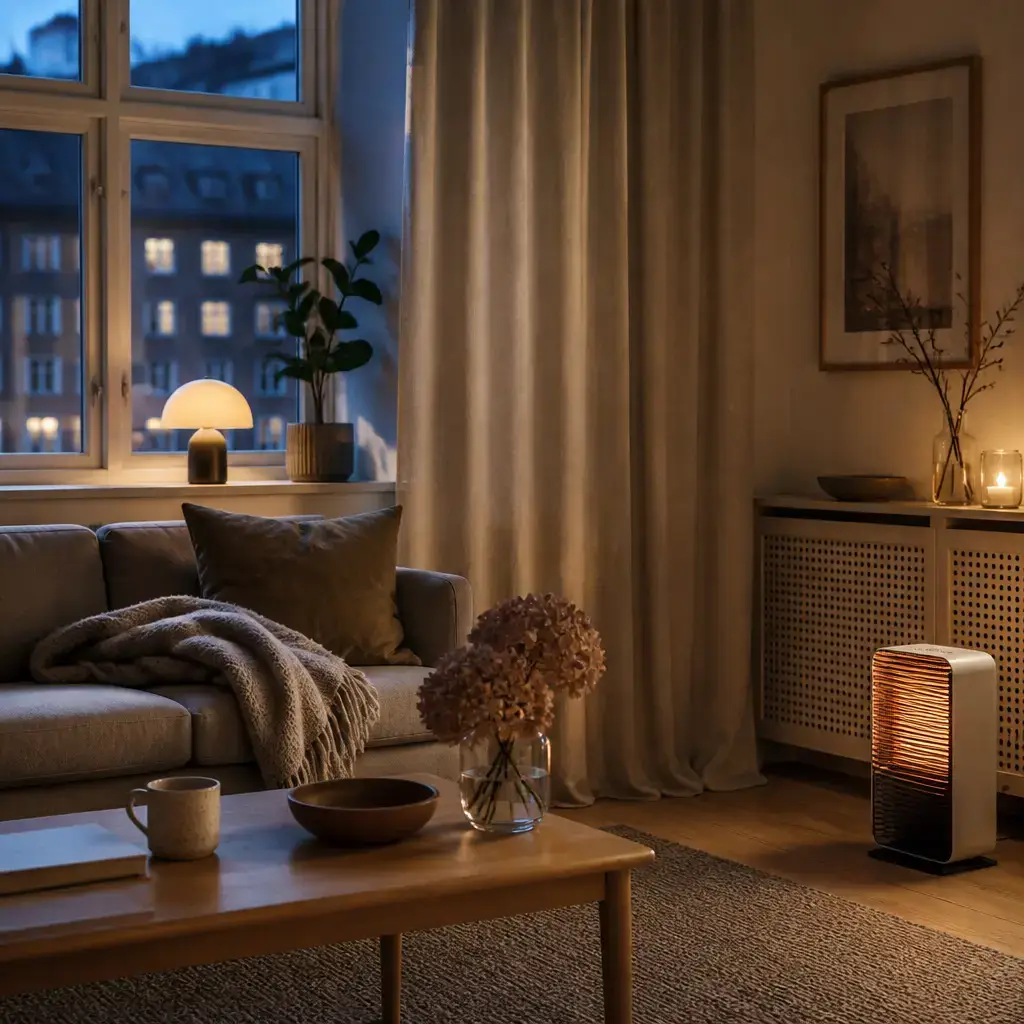
Use Making the room cozy to practice Danish conversation, pronunciation, vocabulary, grammar, and quizzes.
Dialogue
Det bliver mørkt tidligere for tiden.
deh BLEE-wuh murkt TEE-lee-uh-reh fohr TEE-en. It is getting dark earlier these days.Jeg lukker gardinerne før aftensmaden.
YAI LOOK-uh gar-DEE-nuh-nuh fur AF-ten-SMAH-thən. I will close the curtains before dinner.Kan du også tænde den lille varmeovn?
kan doo OH-suh TEN-uh den LIL-uh VAR-muh-ow-n? Could you switch on the small heater too?Jeg kan sætte den på lav varme.
YAI kan SET-uh den poh lau VAR-muh. I can set it to low.Men rummet føles allerede behageligt.
men ROOM-uh FUR-luhs all-REH-thuh beh-HAI-lee. But the room already feels comfortable.Jeg vil gerne have, at rummet føles hyggeligt i aften.
YAI vil YARN-uh hai, eh ROOM-uh FUR-luhs HUE-guh-lee ee AF-ten. I want the room to feel cozy this evening.En lampe med blødere lys kan måske gøre det uden at gøre rummet for varmt.
en LAM-buh meh BLUR-thuh-reh LYOOS kan MAY-skeh GUR-uh deh OO-thən eh GUR-uh ROOM-uh fohr VARMD. A softer lamp might do that without making it too warm.Det blødere lys får rummet til at føles meget roligere.
deh BLUR-thuh-reh LYOOS fohr ROOM-uh til eh FUR-luhs MAY-th ROH-lee-uh-reh. The softer light makes the room feel much calmer.Så kan vi slappe af, efter vi har spist.
soh kan vee SLAP-uh af, EF-tuh vee har SPEEST. Then we can relax after we eat.Sentence explanations
Det bliver mørkt tidligere for tiden.
It is getting dark earlier these days.
- Det
- it
- bliver
- gets; becomes
- mørkt
- dark
- tidligere
- earlier
- for tiden
- these days; at present
More detail
Det is the subject pronoun used here in the impersonal expression about becoming dark. In this sentence, it does not identify a particular person or object; it corresponds to the English “it” in a weather or time-related statement. bliver is the present-tense form of blive, “to become” or “to get.” The pattern blive + adjective describes a change into a state: Det bliver koldt. means “It is getting cold.” The present form can describe a change happening now or a current trend. mørkt is the adjective mørk, “dark,” in its neuter singular form. The -t ending agrees with det in this construction. Compare mørk in en mørk aften (“a dark evening”) with mørkt in Det bliver mørkt (“It is getting dark”). tidligere is the comparative form of tidlig, “early”: tidlig → tidligere (“earlier”) → tidligst (“earliest”). Here it compares the time when darkness arrives with an earlier reference time, without stating exactly what that reference time is. for tiden is a fixed time expression meaning “these days” or “at present.” It places the observation in the current period. It is different from a literal reference to a single clock time. Together, Det bliver mørkt means “It is getting dark,” and tidligere for tiden says that this is happening earlier these days. The complete utterance therefore means: “It is getting dark earlier these days.”
Jeg lukker gardinerne før aftensmaden.
I will close the curtains before dinner.
- Jeg
- I
- lukker
- close; shut
- gardinerne
- the curtains
- før
- before
- aftensmaden
- dinner
More detail
Jeg means “I” and is the first-person singular subject pronoun. It does not itself specify whether the action is present or future; that comes from the verb and context. lukker is the present-tense form of lukke, “to close” or “to shut.” Danish present tense can also describe a planned or expected future action, so here lukker is naturally understood as “will close” in the fixed translation. The same form is used with different singular and plural subjects: Jeg lukker = “I close/am going to close,” while De lukker = “They close/are going to close.” gardinerne means “the curtains.” The noun is gardin (“curtain”); -erne marks the definite plural, roughly “the ...s.” Compare gardiner (“curtains”) with gardinerne (“the curtains”). The definite form presents the curtains as identifiable in the situation, without adding information about exactly which curtains they are. før means “before.” It introduces the time relation between closing the curtains and the following event or time: the closing happens earlier. For example, Jeg spiser før arbejdet. means “I eat before work.” aftensmaden means “dinner” or “the evening meal.” The base noun is aftensmad (“evening meal/dinner”), and the ending -en marks singular definite form: aftensmad → aftensmaden. This form refers to the relevant dinner or evening meal as an identifiable meal, not to a numeric count. Together, Jeg lukker gardinerne means “I will close the curtains,” with the Danish present form lukker receiving a future/planned reading here. før aftensmaden adds the time relation “before dinner.” The whole utterance therefore means: “I will close the curtains before dinner.”
Kan du også tænde den lille varmeovn?
Could you switch on the small heater too?
- Kan du
- Could you
- også
- also; too
- tænde
- switch on
- den
- the
- lille
- small
- varmeovn
- heater
More detail
Kan du combines kan with du. kan is the present form of kunne (“can; be able to”) and du means “you.” At the beginning of this sentence, the order Kan du ...? forms a yes/no question and, with an action verb, is a polite request: “Could you ...?” The English “could” here does not require a past-time meaning. også means “also” or “too.” It adds this request to something else relevant in the situation. Its position before the main verb is common: Kan du også ...? — “Could you also ...?” tænde means “to switch on” or “to turn on.” It is the infinitive form, used after the modal verb kan: kan tænde — “can/could switch on.” Compare slukke (“switch off”) for the opposite action. Example: Kan du tænde lyset? — “Could you turn on the light?” den is the definite article form used here before an adjective and a common-gender singular noun. In this utterance, den ... varmeovn identifies the specific heater meant by the translation. The following context also refers back to it with den, but the form itself expresses grammatical definiteness and does not independently identify a particular object. lille means “small” or “little.” In den lille varmeovn, it is the singular form of the adjective. Danish uses lille with both common-gender and neuter-gender singular nouns, while små is the plural form: en lille ovn — “a small oven”; små ovne — “small ovens.” varmeovn is a noun meaning “heater,” specifically an appliance used for heating. It is a singular common-gender noun; its definite form is varmeovnen (“the heater”). Together, Kan du også makes a polite request, tænde supplies the requested action, and den lille varmeovn identifies the object. The complete meaning is: “Could you switch on the small heater too?”
Jeg kan sætte den på lav varme.
I can set it to low.
- Jeg kan
- I can
- sætte
- set; put
- den
- it; that one
- lav
- low
- varme
- heat
More detail
Jeg kan means “I can.” kan is the present-tense form of kunne (“can, be able to”). After this modal verb, Danish uses the infinitive without at: Jeg kan sætte ... = “I can set ...”. sætte means “set” or “put” here. It is the infinitive of sætte; the modal kan supplies the finite verb, so sætte does not show person or tense. A reusable pattern is kan + infinitive, for example: Hun kan åbne vinduet. — “She can open the window.” den means “it” here and refers to the heater identified in the supplied context. Danish den is the pronoun used for a singular common-gender noun; the corresponding singular neuter form is det. The pronoun’s grammatical form is separate from the fact that its referent here is the heater. lav means “low” in lav varme, “low heat.” It is the common-gender singular indefinite form of the adjective; compare neuter lavt and plural or definite lave. For example, lav temperatur means “low temperature,” while lavt tryk means “low pressure.” varme means “heat” here. It is a noun in this phrase, and lav varme is a compact noun phrase meaning “low heat.” The phrase sætte den på lav varme describes choosing or setting the heater to a low-heat level; på contributes the relation “to/on” in this setting pattern. Together, Jeg kan sætte den på lav varme. means “I can set it to low.” The subject is “I,” the modal expresses ability or possibility, sætte names the action, den is the heater being adjusted, and på lav varme specifies the selected heat level.
Men rummet føles allerede behageligt.
But the room already feels comfortable.
- Men
- but
- rummet
- the room
- føles
- feels
- allerede
- already
- behageligt
- comfortable
More detail
Men means “but” and connects this statement contrastively with something previously stated. It is a conjunction and does not inflect. rummet means “the room.” Its base form is the noun rum; et rum means “a room,” while rummet is its definite singular form. The ending -et marks definiteness for this neuter noun; it does not express a numerical count. føles means “feels” here. It is the present-tense -s form related to føle “to feel,” used when something is experienced as having a particular quality: Rummet føles behageligt means “The room feels comfortable.” This differs from Jeg føler mig træt — “I feel tired,” where jeg is the person doing the feeling. allerede means “already.” It presents the situation as true before a relevant expected or implied time. For example, Det er allerede sent means “It is already late.” behageligt means “comfortable” here. The adjective’s base form is behagelig; behageligt is its neuter singular form, required because it describes the neuter subject rummet in this predicative construction. Compare the examples en behagelig stol — “a comfortable chair” — and et behageligt rum — “a comfortable room.” Together, rummet føles behageligt says that the room has a comfortable felt quality or impression. allerede adds “already,” and Men links the whole statement as a contrast: “But the room already feels comfortable.”
Jeg vil gerne have, at rummet føles hyggeligt i aften.
I want the room to feel cozy this evening.
- Jeg vil gerne have
- I would like
- rummet
- the room
- føles
- feels
- hyggeligt
- cozy
- i aften
- this evening
More detail
Jeg vil gerne have is a reusable way to express a wish or preference: “I would like …” or, in this sentence, “I want …”. vil is the present-tense form of ville, “to want” or “will”; gerne softens and frames the statement as something the speaker would like. With have, the construction can introduce what the speaker wants: Jeg vil gerne have, at ... = “I would like ... to ...”. Example: Jeg vil gerne have, at døren står åben. — “I would like the door to remain open.” rummet means “the room” here. Its base form is rum, “room”; rummet is the definite singular form, marked by -et. Danish uses -et for definite singular nouns of the neuter gender. Example: Rummet er lille. — “The room is small.” føles means “feels” in this sentence, describing how the room seems through perception. It is the present-tense form of føle, “to feel”. The subject is rummet, so this is a finite clause: rummet føles ... = “the room feels ...”. Example: Stolen føles hård. — “The chair feels hard.” hyggeligt means “cozy” here. It is the neuter singular form of the adjective hyggelig. The ending agrees with the neuter singular subject rummet; compare hyggelig with a common-gender singular noun and hyggelige in the plural. Example: Værelset er hyggeligt. — “The room is cozy.” i aften is the time expression “this evening” or “tonight”. It identifies when the desired feeling applies. Example: Vi mødes i aften. — “We are meeting this evening.” Together, Jeg vil gerne have, at introduces the speaker’s desired situation. The subordinate clause rummet føles hyggeligt says that the room feels cozy, and i aften places that situation this evening. Thus the whole utterance means: “I want the room to feel cozy this evening.” Danish expresses the English-style “the room to feel” with a finite clause: literally, “that the room feels.”
En lampe med blødere lys kan måske gøre det uden at gøre rummet for varmt.
A softer lamp might do that without making it too warm.
- lampe
- lamp
- blødere
- softer
- lys
- light
- kan måske
- might perhaps
- gøre det
- do that
- uden at
- without …ing
- rummet
- the room
- varmt
- warm
More detail
lampe means “lamp” here. It is a common-gender noun: indefinite en lampe, definite lampen (“the lamp”). The indefinite article en introduces a non-specific lamp; it does not by itself assert a numerical count. blødere means “softer” and is the comparative form of blød (“soft”). The comparison is expressed on the adjective itself: blød → blødere (“softer”) → blødest (“softest”). Here it describes lys, so blødere lys means “softer light.” lys means “light” in this sentence. It is a neuter noun: et lys (“a light”) and lyset (“the light”). In med blødere lys, med means “with,” giving the pattern “a lamp with softer light.” kan måske combines kan, the present form of kunne (“can; be able to”), with måske (“perhaps/maybe”). Together, in this sentence, they present the possibility that the lamp could achieve the intended result: “might.” Kan can also express ability or permission in other contexts, so måske is important here for the uncertain possibility reading. gøre det means “do that.” gøre is the infinitive of gøre (“do; make”), and det is a neuter singular pronoun meaning “that/it” in this use. The pronoun refers to the intended action or result expressed in the surrounding situation, while the fixed translation supports the reading “do that.” A reusable pattern is kan gøre det (“can do that”). uden at introduces an action that is avoided: “without doing …” It is followed by an infinitive, as in uden at gøre. This construction describes an additional condition on the possible result, rather than making uden a separate description of the lamp. rummet means “the room.” It is the definite form of neuter rum: et rum (“a room”), rummet (“the room”). In gøre rummet ..., the room is the entity affected by the making action. varmt means “warm” here. It is the neuter singular form of varm (“warm”), agreeing with the neuter noun rummet; the adjective itself carries this form. With for, for varmt means “too warm,” where for marks an excessive degree. Compare varm with common-gender singular nouns, varmt with neuter singular nouns, and varme in relevant plural or definite environments; the exact form depends on the noun phrase’s grammatical properties. The sentence begins with En lampe med blødere lys, “a lamp with softer light.” kan måske gøre det says that this lamp might achieve that result. uden at gøre rummet for varmt adds the condition that it does so without making the room too warm. Together, the full meaning is: “A softer lamp might do that without making it too warm.”
Det blødere lys får rummet til at føles meget roligere.
The softer light makes the room feel much calmer.
- Det
- the
- blødere
- softer
- lys
- light
- får … til at
- makes ...
- rummet
- the room
- føles
- feel
- meget
- much
- roligere
- calmer
More detail
Det is the definite article used before a singular neuter noun when an adjective comes before it. Danish normally marks definiteness with a suffix, as in lyset “the light,” but with an attributive adjective the pattern is det + adjective + noun. Here det agrees with neuter lys; the article itself does not express a numeric quantity. blødere means “softer” here. It is the comparative form of the adjective blød “soft”: blød → blødere → blødest (“soft” → “softer” → “softest”). The comparison is between this light and some understood alternative, supported by the preceding context’s reference to softer light. lys means “light” here. It is a neuter noun; its singular indefinite form is also lys, while its singular definite form is lyset. In det blødere lys, the preceding det marks the noun phrase as definite. får ... til at is a reusable Danish causative pattern meaning “makes ...”. The pattern is få + object + til at + infinitive. får is the present form of få “get/make,” and the object placed between the two parts is rummet. Example: Det får hende til at smile. — “It makes her smile.” rummet means “the room.” It is the definite singular form of the neuter noun rum: et rum “a room” → rummet “the room.” In the causative pattern, rummet is the thing whose state is affected; it is not the thing doing the making. føles means “feels” in this sentence. It is the present-tense form used with rum as the subject of the feeling or apparent quality. The related verb is føle “feel”; Danish uses the -s form in expressions such as Det føles godt — “It feels good.” meget means “much” here because it intensifies the comparative roligere: “much calmer.” It is not describing a quantity of light or rooms. Example: Hun er meget glad. — “She is very happy.” roligere means “calmer.” It is the comparative of rolig “calm”: rolig → roligere → roligst (“calm” → “calmer” → “calmest”). The adjective describes the room’s resulting state, and meget strengthens the comparison. Together, det blødere lys is “the softer light.” The construction får rummet til at føles says that this light causes the room to have a particular felt quality, and meget roligere gives that quality as “much calmer.” Thus the whole utterance means: “The softer light makes the room feel much calmer.”
Så kan vi slappe af, efter vi har spist.
Then we can relax after we eat.
- Så
- then
- kan vi
- we can
- slappe af
- relax
- efter
- after
- spist
- eaten
More detail
Så means “then” here: it links the possibility in this sentence to what has just been established in the conversation. It can also mean “so” in other contexts, so its meaning comes from the surrounding relation. kan vi combines kan (“can/be able to”) with vi (“we”). kan is the present form of kunne; it expresses present ability or possibility, and vi identifies the subject as “we.” Example: Vi kan vente. — “We can wait.” slappe af is the fixed verb expression “to relax.” The verb is slappe, while af is part of the expression, so the two words should be learned together. Example: Jeg vil slappe af. — “I want to relax.” efter introduces what happens later than something else. Here it introduces the subordinate clause efter vi har spist, meaning “after we have eaten.” It can also introduce a noun phrase, as in efter frokost — “after lunch.” spist is the past participle of spise (“eat”). In this sentence it occurs with har: har spist means “have eaten.” The participle marks the eating as completed before the relaxing; it does not itself express the subject’s person or number. Example: Vi har spist. — “We have eaten.” Together, efter vi har spist says that eating is completed first, and så kan vi slappe af says that relaxing is then possible. The whole utterance means: “Then we can relax after we eat.”
Grammar Points
Det bliver + intetkønsadjektiv
Det bliver mørkt.
deh BLEE-wuh murkt.It gets dark.
Efter det får adjektivet intetkønsformen: mørk bliver til mørkt.
Adjektiv + -ere
Det føles roligere.
deh FUR-luhs ROH-lee-uh-reh.It feels calmer.
-ere bruges til at danne komparativ af mange adjektiver: rolig bliver til roligere.
Danish Vocabulary
- Gender
- common
Jeg lukker gardinerne før aftensmaden.
Det bliver mørkt tidligere for tiden.
Det bliver mørkt tidligere for tiden.
- Gender
- common
Jeg lukker gardinerne før aftensmaden.
Jeg kan sætte den på lav varme.
Kan du også tænde den lille varmeovn?
Jeg lukker gardinerne før aftensmaden.
- Gender
- neuter
Det bliver mørkt tidligere for tiden.
Jeg kan sætte den på lav varme.
Det bliver mørkt tidligere for tiden.
Kan du også tænde den lille varmeovn?
Kan du også tænde den lille varmeovn?
Quiz
Word Order
Arrange the words in the correct order.
It is getting dark earlier these days.
Show Answer
Det bliver mørkt tidligere for tiden.I will close the curtains before dinner.
Show Answer
Jeg lukker gardinerne før aftensmaden.But the room already feels comfortable.
Show Answer
Men rummet føles allerede behageligt.Spelling
Tap the letters to spell the word.
dinner
Show Answer
aftensmadenearlier
Show Answer
tidligeredark
Show Answer
mørktturn on; light