10 minutes free every day
Continue audio lessons in the app
Word explanations appear automatically in sync with the audio.
No login required · synced translations · playback with the screen locked
Choose your learning language and open this lesson in the app.

About This Lesson
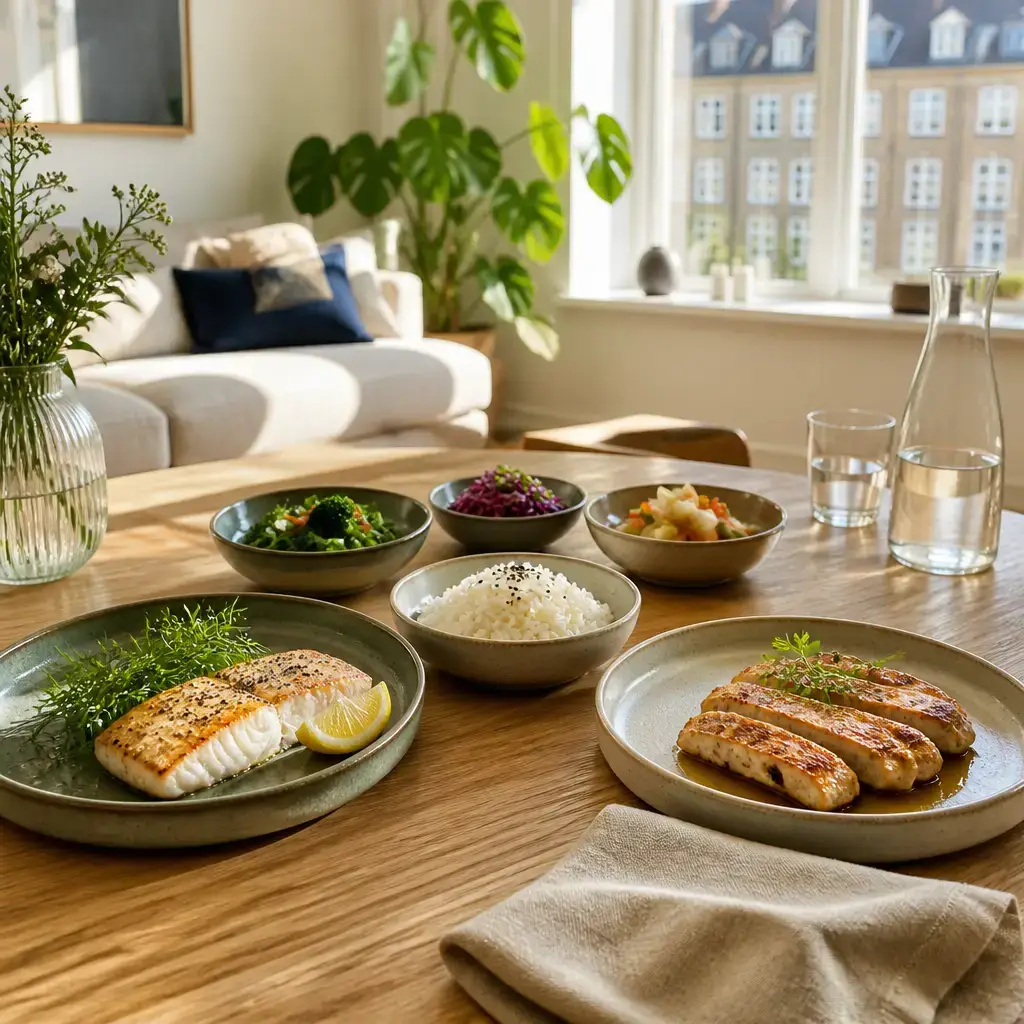
Use Choosing a lunch set to practice Danish conversation, pronunciation, vocabulary, grammar, and quizzes.
Dialogue
Jeg vil bestille en frokostmenu til os.
yai vel beh-STEL-uh en FROH-kost-meh-NOO tel ohs. I want to order a lunch set for us.Vil du helst have kylling eller fisk?
vel doo HELST HEH-vuh KULL-eng EL-uh FESK? Would you prefer chicken or fish?Fisk lyder bedre for mig i dag.
FESK LEW-uh BEH-thuh foh my ee DAY. Fish sounds better to me today.Den kommer med ris og et lille tilbehør.
den KAW-muh meh REES oh ed LIL-uh TEL-buh-HUR. It comes with rice and one small side.Hvilket tilbehør ser bedst ud?
VEL-guhd TEL-buh-HUR say-uh BEST oo-th? Which side looks best?Grøntsagerne ser friske og enkle ud.
GRURN-sah-wuh-nuh say-uh FRES-guh oh ENG-luh oo-th. The vegetables look fresh and simple.Lad os vælge grøntsagerne.
LAD ohs VEL-guh GRURN-sah-wuh-nuh. Let's choose the vegetables.Jeg kan bestille nu.
yai kan beh-STEL-uh noo. I can place the order now.Sentence explanations
Jeg vil bestille en frokostmenu til os.
I want to order a lunch set for us.
- Jeg vil
- I want
- bestille
- order
- frokostmenu
- lunch set
- til os
- for us
More detail
Jeg vil means “I want” here. Jeg is the first-person singular pronoun “I”. vil is the present form of ville; with an infinitive, it commonly expresses desire or intention, while in other contexts it can express future meaning. In this sentence, the fixed translation establishes the desire reading. Danish uses the infinitive directly after this modal: Jeg vil bestille = “I want to order.” bestille is the infinitive “to order” or “to book”; here it means “to order” food. The infinitive is the reusable form after vil. Example: Jeg vil bestille kaffe. — “I want to order coffee.” frokostmenu is a compound noun meaning “lunch menu” or, in this context, a lunch set. The first part identifies the meal type, and menu refers to the menu or set being ordered. Danish commonly forms compounds by joining nouns into one written word, so this observed form is not two separate words. Example: Vi bestiller en frokostmenu. — “We are ordering a lunch set.” til os means “for us” in this sentence. til is the preposition “for/to”, and os is the object form of vi, “we”. Thus vi is used as a subject, while os is used after a preposition or as an object. Example: Det er til os. — “It is for us.” Together, Jeg vil bestille expresses the speaker’s wish or intention to order, en frokostmenu identifies a lunch menu/set as the thing ordered, and til os identifies the intended beneficiaries as “us”. The complete utterance means: “I want to order a lunch set for us.”
Vil du helst have kylling eller fisk?
Would you prefer chicken or fish?
- Vil du
- would you
- helst
- preferably
- have
- have
- kylling
- chicken
- fisk
- fish
More detail
Vil du begins a yes/no question. vil is the present-tense form of ville; with a person as subject, it can express wanting or willingness. Here, combined with helst, it asks which option the listener would prefer. Danish yes/no questions commonly put the finite verb before the subject: Vil du ...? = “Would you ...?” du is the second-person singular pronoun and does not indicate the listener’s gender. helst means “preferably” or “rather.” It is the superlative form related to gerne (“gladly”); the useful contrast is gerne for doing something willingly and helst for choosing one possibility over another. In this sentence it gives Vil du ... helst the meaning “Would you prefer ...?” have is the infinitive of at have, “to have.” After the modal-like verb vil, the following lexical verb appears in the infinitive without at: vil have = “want/would like to have.” Here have describes the selected food option, not possession in a broader sense. kylling is the noun “chicken.” In this question it denotes chicken as a food choice. Danish nouns can be used without an article when naming an uncounted food option in this kind of menu question; the sentence does not state a particular number of portions. fisk is the noun “fish.” Here it is the alternative food choice. fisk can also refer to a fish or to fish as food in other contexts, but the fixed translation establishes the food meaning here. eller connects the two alternatives: kylling eller fisk = “chicken or fish.” The structure Vil du helst have X eller Y? is reusable for asking someone to choose between two things. The complete utterance therefore means, “Would you prefer chicken or fish?”
Fisk lyder bedre for mig i dag.
Fish sounds better to me today.
- Fisk
- fish
- lyder
- sounds
- bedre
- better
- for mig
- to me
- i dag
- today
More detail
Fisk means “fish” here, understood as the food being compared. The same Danish word can also refer to fish as an animal; the fixed translation and context support the food reading here. As a noun, its definite form is fisken, and its plural is fisk. lyder means “sounds” in this sentence, in the sense of “seems” or “comes across as” based on an impression. It is the present-tense form of lyde. Danish present-tense verbs do not change for the subject’s person or number, so lyder can occur with different subjects. Example: Det lyder godt. — “That sounds good.” bedre is the comparative form of god (“good”): god → bedre → bedst (“best”). It expresses a comparison, although the thing being compared with is not stated in this sentence. Do not confuse bedre with mere god; bedre is the ordinary comparative form of god. for mig literally presents the perspective of the speaker: for + mig means “to me” or “in my view.” Mig is the object form of the first-person pronoun; the corresponding subject form is jeg. Example: Det er vigtigt for mig. — “It is important to me.” i dag is the time expression “today.” It is written as two words and identifies the day relevant to the judgment. Example: Jeg arbejder i dag. — “I am working today.” Together, Fisk lyder bedre says that fish seems better, and for mig makes this the speaker’s evaluation. i dag places that evaluation today. The whole utterance therefore means: “Fish sounds better to me today.”
Den kommer med ris og et lille tilbehør.
It comes with rice and one small side.
- Den
- it
- kommer
- comes
- med
- with
- ris
- rice
- lille
- small
- tilbehør
- side
More detail
Den means “it” here and is the subject. Danish uses den for a singular common-gender referent and det for a singular neuter-gender referent. The fixed sentence does not identify what den refers to, so its grammatical form is clear even though the specific referent is not. kommer is the present-tense form of komme, “to come.” The present tense can describe what is happening now or a general feature. Here, together with med, it says that something is served or provided with the listed accompaniments. Example: Maden kommer med salat. — “The food comes with salad.” med is the preposition “with.” The reusable pattern komme med + accompaniment means “come with + accompaniment.” ris means “rice.” It is commonly used as a mass noun, so it can appear without an article when rice is meant as food in general or as an accompaniment. Example: Jeg spiser ris. — “I eat rice.” lille means “small.” Its base form is lille; the plural form is små. In the sentence, lille is singular and modifies tilbehør. Danish uses lille for singular nouns of both grammatical genders, while små is used in the plural: et lille hus — “a small house”; små huse — “small houses.” tilbehør means “side” or “accompaniment” in this food context. It is a neuter noun: et tilbehør. The phrase et lille tilbehør is therefore an indefinite singular noun phrase. The article et marks neuter gender and indefiniteness; although the fixed translation says “one small side,” the article alone does not necessarily assert a numerical count of one. Putting the parts together, Den kommer med ris og et lille tilbehør means “It comes with rice and one small side.” The structure is it comes with rice and a small side, with og (“and”) linking the two accompaniments. This is a useful way to describe what a dish or other item is served with.
Hvilket tilbehør ser bedst ud?
Which side looks best?
- Hvilket
- which
- tilbehør
- side dish
- ser … ud
- looks
- bedst
- best
More detail
Hvilket means “which” when selecting one neuter singular item. It agrees with the neuter noun tilbehør; the form for a common-gender singular noun is hvilken, and the plural form is hvilke. Example: Hvilket bord? — “Which table?” tilbehør is a neuter noun meaning “side dish” here. The preceding sentence confirms the food-related sense: et lille tilbehør means “one small side.” In other contexts, the same noun can mean an accessory or accompaniment. Its definite form is tilbehøret, “the side dish” or “the accessory,” depending on context. ser ... ud is a Danish construction meaning “looks” or “appears.” The verb is se, “to see”; ser is its present-tense form, and ud is part of the construction here rather than a separate meaning to add to the English gloss. Example: Maden ser frisk ud. — “The food looks fresh.” bedst means “best” and is the superlative form in the comparison chain god/godt — bedre — bedst (“good” — “better” — “best”). In ser bedst ud, it compares the appearance of the possible sides: one looks better than the others. Example: Denne passer bedst. — “This one fits best.” Together, Hvilket tilbehør asks which side dish is being selected, and ser bedst ud asks which one has the most favorable appearance. The complete meaning is “Which side looks best?”
Grøntsagerne ser friske og enkle ud.
The vegetables look fresh and simple.
- Grøntsagerne
- the vegetables
- ser … ud
- look / appear
- friske
- fresh
- enkle
- simple
More detail
Grøntsagerne means “the vegetables” here. It is the definite plural of grøntsag (“vegetable”): grøntsag → grøntsager (plural) → grøntsagerne (definite plural). The ending -ne marks definiteness in this plural form, while the word itself identifies the vegetables referred to in the fixed translation. ser ... ud is a common Danish construction meaning “look” or “appear” when describing how something seems. The verb ser is the present form of se (“see”); ud is a separate particle, so the construction is discontinuous here because the describing words come between ser and ud. For example, Hun ser træt ud. means “She looks tired.” friske means “fresh” in this sentence. The base form is frisk; friske is the form used with the plural subject grøntsagerne. In Grøntsagerne ser friske ud, it describes how the vegetables appear, rather than asserting a separate action by them. enkle means “simple” here. Its base form is enkel, and enkle agrees with the plural subject. The two adjectives are coordinated: the vegetables look both fresh and simple. For example, Retterne ser enkle ud. means “The dishes look simple.” Together, Grøntsagerne ser friske og enkle ud. means “The vegetables look fresh and simple.” The subject is grøntsagerne; ser ... ud presents an appearance, and friske og enkle gives the two qualities attributed to the vegetables.
Lad os vælge grøntsagerne.
Let's choose the vegetables.
- Lad os
- let's
- vælge
- choose
- grøntsagerne
- the vegetables
More detail
Lad os is a common Danish way to suggest an action jointly: “let's …”. Lad is the imperative of lade (“to let/allow”), and os is the first-person plural object pronoun (“us”). The following verb stays in the infinitive. Example: Lad os gå. — “Let's go.” vælge means “to choose” here. It is the infinitive, used after Lad os; the construction is Lad os + infinitive. The related present-tense form is vælger: Vi vælger grøntsager. — “We choose the vegetables.” grøntsagerne means “the vegetables” here. Its base noun is grøntsag (“vegetable”); grøntsager is the plural, and grøntsagerne is the definite plural, marked by -ne. Example: Jeg køber grøntsagerne. — “I am buying the vegetables.” Together, Lad os + vælge forms the joint suggestion “Let's choose”, and grøntsagerne identifies the vegetables being chosen. The complete utterance therefore means: “Let's choose the vegetables.”
Jeg kan bestille nu.
I can place the order now.
- Jeg kan
- I can
- bestille
- place an order
- nu
- now
More detail
Jeg kan combines the first-person pronoun jeg (“I”) with kan, the present-tense form of kunne (“can; be able to”). Kan expresses present ability or permission depending on context; here the fixed translation supports ability. Danish modal verbs such as kan are followed by the infinitive without at. bestille is the infinitive meaning “to order” here, specifically “to place the order.” It can also mean “to book” or “to order/request” in other contexts, so the surrounding meaning determines the sense. Example: Jeg kan bestille mad. — “I can order food.” nu means “now” and places the action at the present time. It is a time adverb and does not change form for the person carrying out the action. Together, Jeg kan bestille nu means “I can place the order now”: Jeg identifies the person, kan bestille expresses the ability to place the order, and nu specifies when this can happen.
Grammar Points
lad os + infinitiv
Lad os vælge.
LAD ohs VEL-guh.Let's choose.
The fixed expression “lad os” is followed by an infinitive to make a suggestion: “let us choose.”
hvilket + neuter noun
Hvilket tilbehør?
VEL-guhd TEL-buh-HUR?Which side dish?
Use “hvilket” before a neuter singular noun such as “tilbehør” when asking which one.
Danish Vocabulary
Fisk lyder bedre for mig i dag.
Jeg vil bestille en frokostmenu til os.
- Gender
- common
Vil du helst have kylling eller fisk?
- Gender
- common
Jeg vil bestille en frokostmenu til os.
Vil du helst have kylling eller fisk?
Fisk lyder bedre for mig i dag.
Den kommer med ris og et lille tilbehør.
- Gender
- common
Vil du helst have kylling eller fisk?
Fisk lyder bedre for mig i dag.
Jeg vil bestille en frokostmenu til os.
Den kommer med ris og et lille tilbehør.
- Gender
- neuter
Den kommer med ris og et lille tilbehør.
Quiz
Word Order
Arrange the words in the correct order.
Which side looks best?
Show Answer
Hvilket tilbehør ser bedst ud?The vegetables look fresh and simple.
Show Answer
Grøntsagerne ser friske og enkle ud.Let's choose the vegetables.
Show Answer
Lad os vælge grøntsagerne.Spelling
Tap the letters to spell the word.
better
Show Answer
bedrelunch set
Show Answer
frokostmenusounds
Show Answer
lyderfish