10 minutes free every day
Continue audio lessons in the app
Word explanations appear automatically in sync with the audio.
No login required · synced translations · playback with the screen locked
Choose your learning language and open this lesson in the app.

About This Lesson
Use Comparing jackets before buying to practice Danish conversation, pronunciation, vocabulary, grammar, and quizzes.
Dialogue
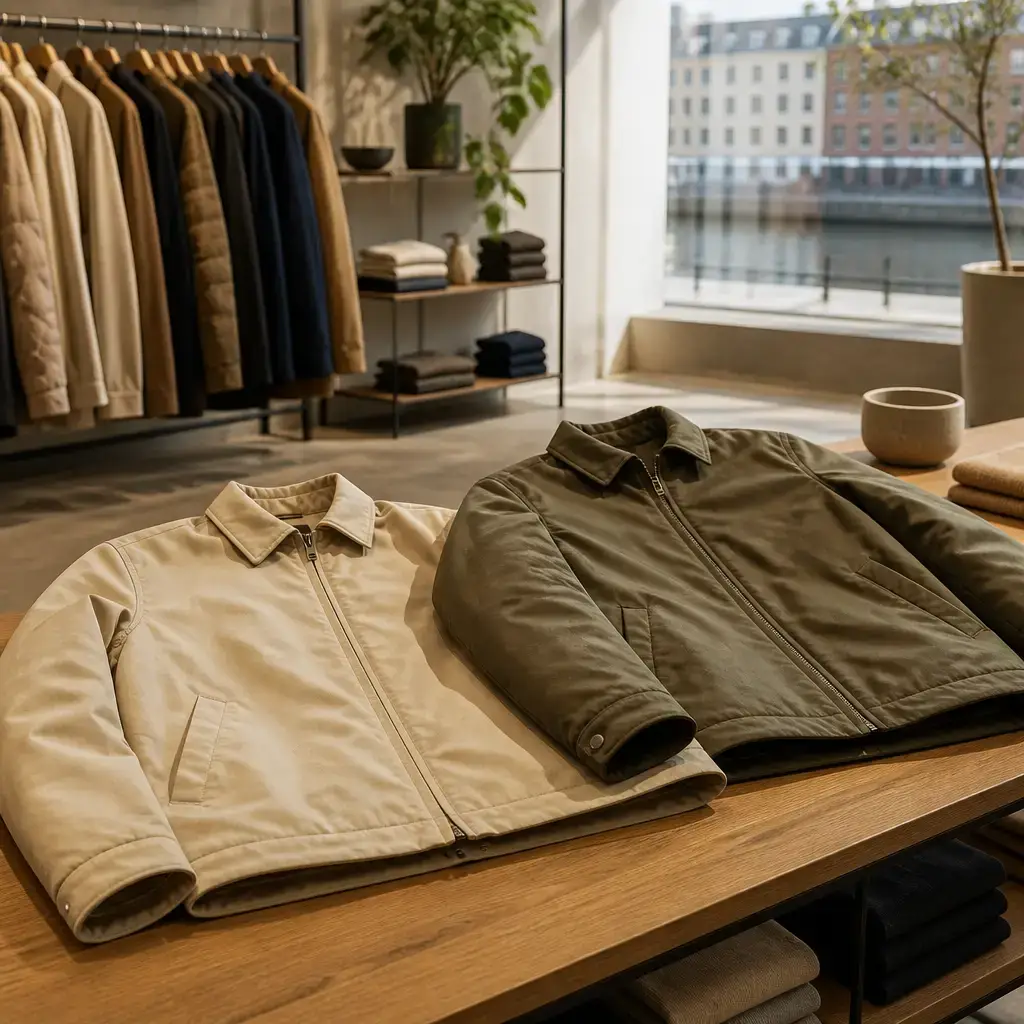
De to jakker ser meget ens ud.
dee toh YAH-guh sair MAY-uhth ens ooth. These two jackets look very similar.Lad os sammenligne stoffet og pasformen.
LAH ohs SAM-un-LEE-uh STAW-fut oh PAS-faw-mun. Let's compare the fabric and fit.Den her føles let.
den hair FUH-lus layd. This one feels light.Stoffet virker tyndt.
STAW-fut VAIR-guh TUHNT. The fabric seems thin.Den anden føles mere solid og varmere.
den AH-nun FUH-lus MAY-uh so-LÉETH uh VAH-muh-uh. The other one feels sturdier and warmer.Det kunne være bedre til hverdagsbrug.
deht KAW-nuh VAIR-uh BED-thruh teel VAIR-dahs-broo. That might be better for everyday use.Prøv den først, og se, hvordan den føles.
PRUH den FURST, uh sair voh-DAN den FUH-lus. Try it on first and see how it feels.Jeg vil prøve dem begge, før jeg beslutter mig.
YAI vel PRUH-vuh dem BEH-guh, fur YAI beh-SLOO-duh my. I will try both before I decide.Det burde gøre valget lettere.
deht BOO-uh-thuh KUH-uh VEL-guh LEH-duh. That should make the choice easier.Sentence explanations
De to jakker ser meget ens ud.
These two jackets look very similar.
- De to
- these two
- jakker
- jackets
- ser … ud
- look
- meget
- very
- ens
- similar
More detail
De to means “these two” here. De is the plural form used with a definite demonstrative reference, while to states the number. Together they identify two specific items in the situation; the phrase does not by itself explain how they are being compared. Example: De to bøger er nye. — “These two books are new.” jakker is the plural of the noun jakke, “jacket.” The plural form is used because to identifies two jackets. Example: Jeg har to jakker. — “I have two jackets.” ser ... ud is the Danish construction for “look” when describing appearance. The lexical verb is se, “see”; ser is its present-tense form. ud is a separate particle, and together ser ud describes how something appears rather than simply what someone sees. Example: Huset ser gammelt ud. — “The house looks old.” meget means “very” and strengthens the following description. It is placed before ens here. Example: De ser meget glade ud. — “They look very happy.” ens means “similar” or “alike” in this sentence. It is a predicative adjective describing the two jackets through ser ud; this form does not change here to mark the plural subject. Example: De to farver er ens. — “The two colors are alike.” Putting the parts together, De to jakker identifies two jackets, ser ... ud says how they appear, and meget ens says that their appearance is very similar. The complete meaning is: “These two jackets look very similar.”
Lad os sammenligne stoffet og pasformen.
Let's compare the fabric and fit.
- Lad os
- let's
- sammenligne
- compare
- stoffet
- the fabric
- pasformen
- the fit
More detail
Lad os is the Danish pattern for “let’s” when suggesting that the speaker and the listener do something together. Lad is the imperative of lade (“to let/allow”), and os is the object form of vi (“we”). The following verb stays in the infinitive: Lad os vente. — “Let’s wait.” sammenligne means “to compare.” It is the infinitive form, used here after Lad os. The related noun is sammenligning (“comparison”), while sammenligne is the verb. Example: Vi sammenligner priserne. — “We compare the prices.” stoffet means “the fabric” here. Its base noun is stof (“fabric/material”), and -et marks the definite singular form: et stof — “a fabric/material,” stoffet — “the fabric/material.” The ending belongs to stof, not to the nearby verb. pasformen means “the fit.” Its base noun is pasform (“fit”), a common-gender noun: en pasform — “a fit,” pasformen — “the fit.” The definite ending -en is attached to pasform. Example: Pasformen er god. — “The fit is good.” Together, Lad os sammenligne stoffet og pasformen means “Let’s compare the fabric and the fit.” og joins the two things being compared: the fabric and the fit. The sentence is a reusable suggestion pattern: Lad os + infinitive verb + the things involved.
Den her føles let.
This one feels light.
- Den her
- this one
- føles
- feels
- let
- light
More detail
Den her means “this one” here. den is the singular common-gender form used when a demonstrative or pronoun refers to one item; her adds the meaning “here,” marking the item as near or contextually present. The specific item is not identified by the sentence itself. føles is the present-tense s-form of føle, used here for how something feels when experienced, such as by touch. Compare active jeg føler ..., “I feel ...,” with den føles ..., “it feels ...,” where the item is described rather than given an object to feel. Example: Trøjen føles blød. — “The sweater feels soft.” let means “light” here in the sense of not heavy. The adjective’s base form is let; useful comparison forms are lettere (“lighter”) and lettest (“lightest”). In Danish, let is used with both common-gender and neuter singular indefinite nouns, while lette is used with plural or definite forms. Example: Denne taske er lettere. — “This bag is lighter.” Together, Den her identifies one nearby or contextually present item, føles describes its tactile impression, and let gives the property being perceived. The complete meaning is “This one feels light.”
Stoffet virker tyndt.
The fabric seems thin.
- Stoffet
- the fabric
- virker
- seems
- tyndt
- thin
More detail
Stoffet means “the fabric” here. It is the definite singular form of stof (“fabric” or “material”): stof → stoffet. The ending -et marks a definite singular noun of the neuter grammatical gender; it does not itself express a numerical quantity. virker comes from virke and is the present-tense form used here to mean “seems” or “appears,” rather than “works.” Danish verbs do not change form for the subject’s person or number, so virker is also used with other subject types in the present tense. A useful pattern is X virker + adjective: “X seems + adjective.” Example: Det virker svært. — “It seems difficult.” tyndt means “thin” here. The base adjective is tynd; tyndt is its neuter singular form, agreeing with the neuter noun stoffet. The adjective has the form tynd with a common-gender singular noun and tynde in plural or definite adjective phrases. The adjective’s form changes; it is not derived from the noun stof. Together, Stoffet virker tyndt. means “The fabric seems thin”: the definite noun is the subject, virker expresses an appearance or impression, and tyndt describes the fabric.
Den anden føles mere solid og varmere.
The other one feels sturdier and warmer.
- Den anden
- the other one
- føles
- feels
- mere solid
- sturdier; more solid
- varmere
- warmer
More detail
Den anden means “the other one” here. anden is the common-gender singular form of anden “other”: andet is the neuter singular form, and andre is the plural form. With den, this forms a noun-like expression referring to the other item, without repeating its noun. In this sentence, the fixed translation identifies the intended meaning as “the other one,” not an ordinal meaning such as “the second one.” føles is the present-tense form of føle, “feel.” It describes how something seems or is experienced, as in Stoffet føles blødt — “The fabric feels soft.” The subject is the item being experienced; Danish does not need an extra word equivalent to “it” in this structure. mere solid is a comparative expression meaning “more solid” or “sturdier.” solid is the adjective, and mere marks comparison with another item or standard. This is different from the synthetic comparative in varmere, where the adjective itself carries the comparative ending. A reusable pattern is mere + adjective, for example mere praktisk — “more practical.” varmere is the comparative form of varm, “warm”: varm → varmere (“warmer”) → varmest (“warmest”). The ending belongs to varm, not to the noun or pronoun referring to the item. For example, Denne jakke er varmere means “This jacket is warmer.” The sentence combines the subject Den anden with the present-tense verb føles, followed by two coordinated comparisons: mere solid and varmere. og connects the two descriptions, so the complete meaning is “The other one feels sturdier and warmer.”
Det kunne være bedre til hverdagsbrug.
That might be better for everyday use.
- Det kunne
- That/it could
- være
- be
- bedre
- better
- til
- for
- hverdagsbrug
- everyday use
More detail
Det kunne introduces a possibility about the situation: “that/it could” or “that/it might.” Det is a neuter singular pronoun; here the fixed translation supports the meaning “that/it,” without identifying a more specific referent. Kunne is the past-tense form of kunne “can, be able to,” and it commonly expresses possibility or a tentative suggestion in this pattern. Compare kan “can/is possible” with kunne “could/might.” Være means “be.” It is the infinitive form, used after the modal verb kunne: kunne være = “could/might be.” The infinitive does not mark the subject separately here; the subject is det. Bedre means “better.” It is the comparative form of god “good”: god → bedre → bedst (“good” → “better” → “best”). Danish uses bedre to compare a possible option with an understood alternative or standard; the comparison is not stated explicitly in this sentence. Til is a preposition meaning “for” in the expression til hverdagsbrug, indicating the purpose or situation in which something is used. Its meaning here is not the direction “to.” Hverdagsbrug means “everyday use.” It is a compound noun: hverdag means “weekday/everyday life,” while brug means “use.” In this compound, the whole word refers to ordinary, routine use. Example: Det er praktisk til hverdagsbrug. — “It is practical for everyday use.” Together, Det kunne være bedre says “That/it might be better,” and til hverdagsbrug specifies the relevant purpose: “for everyday use.” The complete meaning is: “That might be better for everyday use.”
Prøv den først, og se, hvordan den føles.
Try it on first and see how it feels.
- Prøv
- try
- den
- it
- først
- first
- se
- see
- hvordan
- how
- føles
- feels
More detail
Prøv is the imperative of prøve, “to try.” The imperative is used for a direct instruction and commonly has the same form as the verb stem without the infinitive marker at: at prøve → prøv. Example: Prøv igen. — “Try again.” den is a third-person singular object pronoun for a common-gender noun. Here it corresponds to “it,” but the supplied sentence does not by itself identify exactly what “it” refers to. Danish also uses det for a neuter-gender singular noun; the choice follows the grammatical gender of the omitted or previously established noun, not the English word “it” alone. først means “first” and places this action before the later action. In this sentence it modifies prøv: try it on first, then continue. It is different from før, which means “before” when introducing a following time or event. se is the imperative of se, “to see.” The two imperatives are joined by og: prøv ... og se ... gives a reusable instruction sequence, “try ... and see ...” Example: Se her. — “Look here.” hvordan introduces a clause describing the manner or quality being found: “how.” It is useful in patterns such as se, hvordan ... — “see how ...” It does not itself mean “why”; Danish hvorfor is used for “why.” føles is the present-tense form of føle, “to feel.” In den føles, it describes how the item feels to the person experiencing it, so the fixed meaning is “it feels.” The form is present tense and agrees with the third-person singular subject den; Danish present-tense verbs generally do not change for the subject’s person or number. Example: Stoffet føles blødt. — “The fabric feels soft.” Together, Prøv den først means “Try it on first,” and og se, hvordan den føles means “and see how it feels.” The comma introduces the hvordan clause, which states what to observe after trying it. The complete utterance is therefore: “Try it on first and see how it feels.”
Jeg vil prøve dem begge, før jeg beslutter mig.
I will try both before I decide.
- Jeg vil
- I will
- prøve
- try
- dem
- them
- begge
- both
- før
- before
- beslutter mig
- decide
More detail
Jeg vil means “I will” here: jeg is the first-person singular pronoun “I”, and vil is the present form of ville, used with an infinitive to express a future intention or willingness. The reusable pattern is Jeg vil + infinitive, as in Jeg vil vente — “I will wait.” prøve is the infinitive “to try.” After vil, Danish uses the infinitive without at: Jeg vil prøve — “I will try.” The same verb can also mean “to test” something, depending on context; here it means trying the items. dem is the plural object pronoun “them.” It refers to the two items intended in the fixed translation. Danish distinguishes object forms such as dem from the subject form de (“they”): Jeg ser dem — “I see them.” begge means “both,” referring to two items considered together. dem begge therefore means “both of them.” It does not identify the items by itself; the surrounding context supplies what is being tried. før introduces the time clause “before.” The pattern før + clause places one event earlier than another: Jeg spiser, før jeg går — “I eat before I leave.” beslutter mig means “decide.” beslutter is the present form of beslutte, and mig is the reflexive object pronoun referring back to the subject jeg. Danish commonly uses this reflexive form in beslutte sig: jeg beslutter mig, literally structured as “I decide myself,” but naturally translated as “I decide.” The subject changes the reflexive pronoun: hun beslutter sig — “she decides.” Together, Jeg vil prøve dem begge says “I will try both of them,” and før jeg beslutter mig adds “before I decide.” The complete utterance means: “I will try both before I decide.”
Det burde gøre valget lettere.
That should make the choice easier.
- Det
- That
- burde
- should
- gøre
- make
- valget
- the choice
- lettere
- easier
More detail
Det is the Danish neuter singular demonstrative pronoun. Here it means “that” and points to the situation just mentioned; Danish also uses det in other grammatical roles, so its form alone does not identify a particular noun. burde is the modal verb form meaning “should” here. Its base form is burde; it is followed directly by an infinitive, without at: burde gøre = “should make.” In this sentence, “should” expresses an expected result, not a command. Example: Det burde hjælpe. — “That should help.” gøre is the infinitive of “make/do.” In the pattern gøre + object + adjective, it means “make [something] [adjective]”: gøre valget lettere = “make the choice easier.” Example: Musikken gør arbejdet lettere. — “The music makes the work easier.” valget means “the choice.” Its base noun is valg (“choice”); valget is the singular definite form, marked by the ending -et. The ending belongs to the noun, not to the following adjective. Example: Valget er svært. — “The choice is difficult.” lettere means “easier.” It is the comparative form of let (“easy”): let → lettere → lettest (“easiest”). In this sentence, the adjective describes the result that gøre produces for valget. Together, Det burde gøre valget lettere has the pattern Det burde gøre X lettere: “That should make X easier.” Thus the utterance says that the situation referred to by Det is expected to make the choice easier.
Grammar Points
Adjektiv + -ere
varm → varmere; bedre; lettere
VAHM → VAH-muh-uh; BEH-thruh; LEH-duhwarm → warmer; better; easier
Danish forms many comparative adjectives with -ere. Some forms, such as bedre, are irregular.
Neutrumform af adjektiv
tynd → tyndt
TUHND → TUHNTthin → thin (neuter form)
Adjectives can change form in the neuter: tynd becomes tyndt.
Danish Vocabulary
- Gender
- neuter
Quiz
Word Order
Arrange the words in the correct order.
Let's compare the fabric and fit.
Show Answer
Lad os sammenligne stoffet og pasformen.This one feels light.
Show Answer
Den her føles let.The fabric seems thin.
Show Answer
Stoffet virker tyndt.Spelling
Tap the letters to spell the word.
to seem
Show Answer
virkerjacket
Show Answer
jakkerto compare
Show Answer
sammenlignefabric; material