10 minutes free every day
Continue audio lessons in the app
Word explanations appear automatically in sync with the audio.
No login required · synced translations · playback with the screen locked
Choose your learning language and open this lesson in the app.

About This Lesson
Use Asking about a product warranty to practice Danish conversation, pronunciation, vocabulary, grammar, and quizzes.
Dialogue
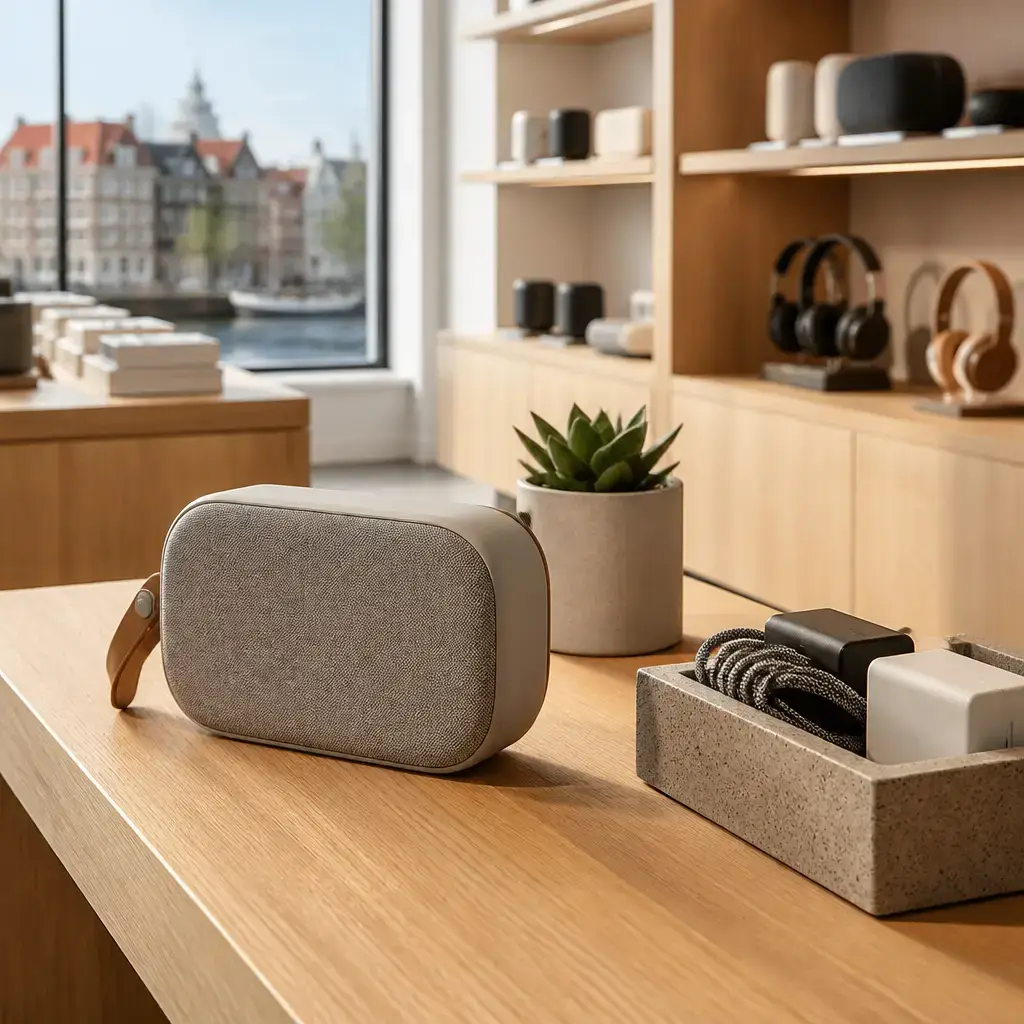
Jeg overvejer at købe denne lille højttaler.
yai oh-vair-air uh KUR-buh DEN-uh LIL-uh HOY-tay-luh I'm thinking about buying this small speaker.Jeg kan forklare garantien, før du beslutter dig.
yai kan for-KLAIR-uh gah-ran-TEE-uhn, fur doo beh-SLOO-dah sai I can explain the warranty before you decide.Hvad dækker garantien?
vah DEK-ah gah-ran-TEE-uhn? What does the warranty cover?Den dækker produktfejl ved normal brug.
den DEK-ah proh-DOOGT-fail veh nor-MAHL broo It covers product faults during normal use.Hvad med skader ved et uheld?
vah meh SKAY-ah veh ed oo-HEL? What about accidental damage?Det er ikke dækket.
deh air IK-uh DEK-uhd That would not be included.Hvor skal jeg gå hen, hvis den holder op med at virke?
voh skal yai goh hen, vis den HOL-uh op meh uh VEER-kuh? Where should I go if it stops working?Tag kvitteringen og æsken med til kundeservice.
tay kvee-TEH-reng-en oh ES-kuhn meh til KOON-uh-SAIR-viss Bring the receipt and the box to customer service.De kan tjekke den.
dee kan CHEK-uh den They can check it.Sentence explanations
Jeg overvejer at købe denne lille højttaler.
I'm thinking about buying this small speaker.
- overvejer
- am considering
- at købe
- to buy
- denne
- this
- lille
- small
- højttaler
- speaker
More detail
overvejer is the present-tense form of overveje, “to consider” or “to think about.” Here it describes the subject’s current consideration: “am considering.” Danish verbs generally do not change form for person or number, so the present form is not specially marked for jeg, “I.” Example: Jeg overvejer tilbuddet. — “I am considering the offer.” at købe means “to buy.” købe is the infinitive, and at marks the infinitive here. The construction overvejer at købe is a reusable way to say that someone is considering doing something. Example: Hun overvejer at vente. — “She is considering waiting.” denne means “this” and is a singular demonstrative determiner for a common-gender noun. It identifies the intended salient item; the fixed translation identifies that item as the speaker’s small speaker. Danish uses dette with neuter singular nouns and disse with plural nouns. The choice depends on the noun’s grammatical gender and number, not on the person of the speaker. lille means “small” here. It is the singular form of the adjective; its plural form is små, as in små højttalere — “small speakers.” In this sentence, lille describes the singular noun højttaler. The form lille is used with both common-gender and neuter singular nouns; the plural contrast is the useful distinction here. højttaler means “speaker,” in the sense of an audio device. Its plural form is højttalere: to højttalere means “two speakers.” It is a common-gender singular noun, which supports the demonstrative denne; the adjective lille is singular as well. Together, denne lille højttaler means “this small speaker.” The sequence overvejer at købe says that the subject is considering buying something, and jeg supplies the subject: Jeg overvejer at købe denne lille højttaler. means “I’m thinking about buying this small speaker.”
Jeg kan forklare garantien, før du beslutter dig.
I can explain the warranty before you decide.
- Jeg
- I
- kan
- can
- forklare
- explain
- garantien
- the warranty
- før
- before
- du
- you
- beslutter dig
- decide
More detail
Jeg means “I” here and is the first-person singular subject pronoun. Danish uses jeg for the speaker regardless of the speaker’s gender. Example: Jeg kommer. — “I’m coming.” kan is the present form of kunne, “can / be able to.” With a subject such as jeg, it is followed by an infinitive: Jeg kan forklare — “I can explain.” Kan expresses ability or possibility here; it does not itself mean “know.” forklare is the infinitive “to explain.” After a modal such as kan, Danish uses the infinitive without an English-style marker: kan forklare, not a separately inflected present-tense verb. Example: Hun kan forklare reglen. — “She can explain the rule.” garantien means “the warranty” in this sentence. The ending -en marks the common-gender definite singular form of garanti: en garanti — “a warranty,” garantien — “the warranty.” The definite form refers to a specific warranty understood in the situation. Example: Garantien gælder i to år. — “The warranty is valid for two years.” før means “before” and introduces the time relation between the two clauses. Here it places the deciding event after the speaker’s possible explanation: før du beslutter dig — “before you decide.” Example: Ring, før du kommer. — “Call before you come.” du is the second-person singular subject pronoun, “you.” It is the subject of the clause introduced by før. Danish du does not mark the listener’s gender. Example: Du kan vælge. — “You can choose.” beslutter dig means “decide” in this sentence. The verb is beslutte, “to decide,” and beslutter is its present form with the subject du. Danish commonly uses the reflexive pronoun dig with this verb: literally, the construction presents the person as making a decision for themself. The pattern is at beslutte sig — “to decide”; with du: du beslutter dig. Example: Hun beslutter sig i morgen. — “She decides tomorrow.” Together, Jeg kan forklare garantien means “I can explain the warranty.” The subordinate clause før du beslutter dig adds the time condition “before you decide.” Thus the complete utterance means: “I can explain the warranty before you decide.”
Hvad dækker garantien?
What does the warranty cover?
- Hvad
- what
- dækker
- covers
- garantien
- the warranty
More detail
Hvad means “what” and asks for the thing affected by the action. In this question, it is the object of dækker, not the actor. A useful contrast is Hvem...? for “Who...?” when asking about a person. dækker is the present-tense form of dække, “to cover.” Danish present-tense verbs generally do not change according to the subject’s person or number, so the same form can be used with different subjects. Example: Garantien dækker skaden. — “The warranty covers the damage.” garantien means “the warranty.” Its base form is garanti; the ending -en marks the definite singular form for this common-gender noun: “the warranty.” This is a noun inflection, not an inflection of dækker. Together, Hvad dækker garantien? forms a question in which hvad asks for the object, dækker expresses present-time coverage, and garantien is the subject. The word order places the question word first, followed by the verb and then the subject, giving “What does the warranty cover?”
Den dækker produktfejl ved normal brug.
It covers product faults during normal use.
- Den
- it
- dækker
- covers
- produktfejl
- product faults
- normal
- normal
- brug
- use
- ved normal brug
- during normal use
More detail
Den means “it” here and refers to the warranty mentioned in the preceding question. In Danish, den is the singular pronoun used with a common-gender referent; det is used with a neuter-gender referent. The pronoun itself does not identify a referent without context. dækker is the present-tense form of dække, “to cover.” Danish present-tense verbs generally do not change for person or number: jeg dækker, du dækker, and garantien dækker all use dækker. Example: Forsikringen dækker skaden. — “The insurance covers the damage.” produktfejl means “product faults” in this sentence. It is a compound of produkt (“product”) and fejl (“fault” or “error”). Danish can use the same form for an indefinite singular and an indefinite plural with some nouns; here the fixed translation establishes the plural meaning. The singular would be en produktfejl, while the plural can be produktfejl. normal means “normal” here. It is the common-gender singular form modifying brug; the neuter form is normalt, and the plural form is normale. Example: Det er normalt. — “It is normal.” brug means “use” here and is a common-gender noun: en brug. In normal brug, it refers to ordinary use as an activity or condition, not to a particular individual use. Example: Ved daglig brug slides den. — “With daily use, it wears down.” ved normal brug is a reusable prepositional phrase meaning “during normal use.” The preposition ved can introduce the circumstance under which something happens; here it is followed by the noun phrase normal brug. The adjective comes before the noun, as in the pattern ved + adjective + noun. Together, Den dækker gives “It covers,” produktfejl gives “product faults,” and ved normal brug specifies the circumstance: “during normal use.” The whole utterance therefore means, “It covers product faults during normal use.”
Hvad med skader ved et uheld?
What about accidental damage?
- Hvad med
- What about
- skader
- damage
- ved et uheld
- by accident
More detail
Hvad med is a reusable Danish question construction meaning “What about …?” or “How about …?” It introduces a topic the speaker wants considered. For example: Hvad med bilen? — “What about the car?” The construction does not itself specify whether the topic is included, covered, or acceptable; the surrounding words provide that content. skader means “damage” here. It is the plural form of skade, which can refer to damage or an injury depending on context. In this insurance-related context, the intended meaning is damage. The singular/plural contrast is en skade — “one instance of damage/an injury” — and skader — “damage/injuries” in plural form. The word skader itself does not identify who or what caused the damage. ved et uheld means “by accident” or “as a result of an accident.” uheld is the noun “accident” or “misfortune,” and et is the indefinite article used with this neuter noun. Here, et does not by itself assert a numerical count; it forms the indefinite noun phrase “an accident.” The preposition ved links the damage to the circumstance or cause expressed by the following phrase. Together, skader and ved et uheld form “damage caused by an accident” or “accidental damage.” The question pattern Hvad med then asks whether that type of damage is considered. Thus the whole utterance means: “What about accidental damage?”
Det er ikke dækket.
That would not be included.
- Det
- that; it
- er
- is
- ikke
- not
- dækket
- covered; included
More detail
Det is a neuter singular pronoun meaning “that” or “it.” Its exact referent is not identified by the supplied sentence, but it functions here as the subject. Danish pronouns must match the grammatical features of what they replace; det is the neuter singular form, contrasted with den for common gender singular referents. er is the present-tense form of være, “to be.” The pattern det er ... can introduce a statement about something: Det er vigtigt. — “That is important.” ikke is the ordinary negation word “not.” In this sentence it negates the following predicate, so er ikke ... means “is not ...” rather than merely describing ikke as a separate object or quality. dækket is the past participle of dække, “to cover.” The useful form chain is dække — dækkede — dækket (“cover” — “covered” in the past tense — “covered” as a participle). With er, the participle describes a resulting state or coverage status: Bogen er dækket. — “The book is covered.” In this utterance, dækket has the intended sense “covered/included,” not every possible sense of dække. Together, Det er ikke dækket. follows the reusable pattern Det er ikke + past participle: “That/it is not covered,” with the fixed translation expressing the intended meaning as “That would not be included.” In the supplied context, the statement addresses whether the matter being discussed is included in the relevant coverage.
Hvor skal jeg gå hen, hvis den holder op med at virke?
Where should I go if it stops working?
- Hvor
- where
- skal jeg
- should I
- gå hen
- go there
- hvis
- if
- den
- it
- holder op med at virke
- stops working
More detail
Hvor means “where” and asks about a place. It is a question word, not a word for a person or thing. For example: Hvor bor du? — “Where do you live?” skal jeg combines skal, the present form of skulle, with jeg, “I”. Here skal expresses what the speaker should or is expected to do, so the combination means “should I”. Danish skal can also express a plan or requirement in other contexts; the intended meaning here is given by the fixed translation. gå hen means “go” with a directional sense. gå is the base form “to go”, while hen adds the idea of going to or toward a place. In a question, Hvor skal jeg gå hen? is a reusable pattern meaning “Where should I go?” hvis introduces a condition and means “if”. It connects a possible situation with what should happen in that situation. For example: Ring, hvis du har brug for hjælp. — “Call if you need help.” den is a singular common-gender pronoun meaning “it” here. Its grammatical form identifies the referent as singular and common gender, but the supplied sentence and translation do not identify exactly which item it refers to. Den can also be the common-gender definite article before a noun, but here it stands on its own as a pronoun. holder op med at virke is the construction “stops working”. holder is the present form of holde, “to hold”; in holde op the combination means “to stop” or “to cease”. med at introduces the activity that stops, and virke means “to work” or “to function” in this context. The pattern holde op med at + verb is reusable: Maskinen holder op med at køre. — “The machine stops running.” Together, Hvor skal jeg gå hen asks for the place the speaker should go to. hvis den holder op med at virke adds the condition “if it stops working”. The whole utterance therefore means: “Where should I go if it stops working?”
Tag kvitteringen og æsken med til kundeservice.
Bring the receipt and the box to customer service.
- Tag
- bring; take
- kvitteringen
- the receipt
- æsken
- the box
- med til
- along to
- kundeservice
- customer service
More detail
Tag is the imperative of tage (“to take”). In this sentence, the fixed translation makes the intended meaning “bring”: the speaker instructs the listener to bring the items. Danish imperatives do not mark the subject’s person or number. Example: Tag bogen. — “Take the book.” kvitteringen means “the receipt” here. Its base form is kvittering; the ending -en marks the definite singular form for this noun: en kvittering (“a receipt”) → kvitteringen (“the receipt”). æsken means “the box” here. The base form is æske; its definite singular form is æsken: en æske (“a box”) → æsken (“the box”). The definite ending is attached to the noun rather than expressed by a separate word. med til is a reusable combination meaning that something is taken or brought along to a destination: “along to” or “with [someone/something] to.” Here it connects the two objects with their destination. Example: Tag nøglerne med til kontoret. — “Bring the keys along to the office.” kundeservice is a compound noun meaning “customer service.” It names the destination in this sentence. Danish commonly forms compounds as one written word; the word is not split into separate written words here. Together, Tag kvitteringen og æsken med til kundeservice forms an imperative instruction: “Bring the receipt and the box to customer service.” og joins the two objects, while med til kundeservice specifies where they should be brought.
De kan tjekke den.
They can check it.
- De
- they
- kan
- can
- tjekke
- check
- den
- it
More detail
De means “they” here. It is the Danish third-person plural subject pronoun. Unlike singular pronouns, it does not identify one particular person; the fixed translation establishes a plural group as the actor. kan means “can” here and expresses ability or possibility. It is the present-tense form of kunne; kan is used with different subjects, so it does not change to show this plural subject. A modal such as kan is followed directly by an infinitive: De kan komme means “They can come.” tjekke means “check.” This is the infinitive form, used after kan without at: kan tjekke, “can check.” The same verb can be used for checking an item, information, or a condition, depending on context. den means “it” here. It is a third-person singular object pronoun for a common-gender referent in Danish. The supplied texts do not uniquely identify which previously mentioned item it refers to, so the form should be learned as “it” with this grammatical class rather than tied to a specific noun. Danish contrasts den with det, used for a neuter-gender singular referent. Together, De kan tjekke den has the pattern [subject] + [modal verb] + [infinitive] + [object]: “They can check it.”
Grammar Points
holde op med at + infinitiv
Højttaleren holder op med at virke.
HOY-tay-luh-run HOL-uh op meh uh VEER-kuhThe speaker stops working.
Danish uses med at before the infinitive in this fixed construction.
beslutte sig
Du beslutter dig.
doo beh-SLOO-dah saiYou decide.
Beslutte sig is reflexive, so the pronoun changes with the subject: dig means yourself for du.
Danish Vocabulary
Jeg kan forklare garantien, før du beslutter dig.
Den dækker produktfejl ved normal brug.
Hvad dækker garantien?
Jeg kan forklare garantien, før du beslutter dig.
Jeg kan forklare garantien, før du beslutter dig.
Jeg overvejer at købe denne lille højttaler.
Jeg overvejer at købe denne lille højttaler.
Jeg overvejer at købe denne lille højttaler.
Den dækker produktfejl ved normal brug.
Jeg overvejer at købe denne lille højttaler.
Den dækker produktfejl ved normal brug.
Hvad med skader ved et uheld?
Quiz
Word Order
Arrange the words in the correct order.
What does the warranty cover?
Show Answer
Hvad dækker garantien?It covers product faults during normal use.
Show Answer
Den dækker produktfejl ved normal brug.What about accidental damage?
Show Answer
Hvad med skader ved et uheld?Spelling
Tap the letters to spell the word.
cover
Show Answer
dækkerconsider
Show Answer
overvejerwarranty
Show Answer
garantienproduct faults