10 minutes free every day
Continue audio lessons in the app
Word explanations appear automatically in sync with the audio.
No login required · synced translations · playback with the screen locked
Choose your learning language and open this lesson in the app.

About This Lesson
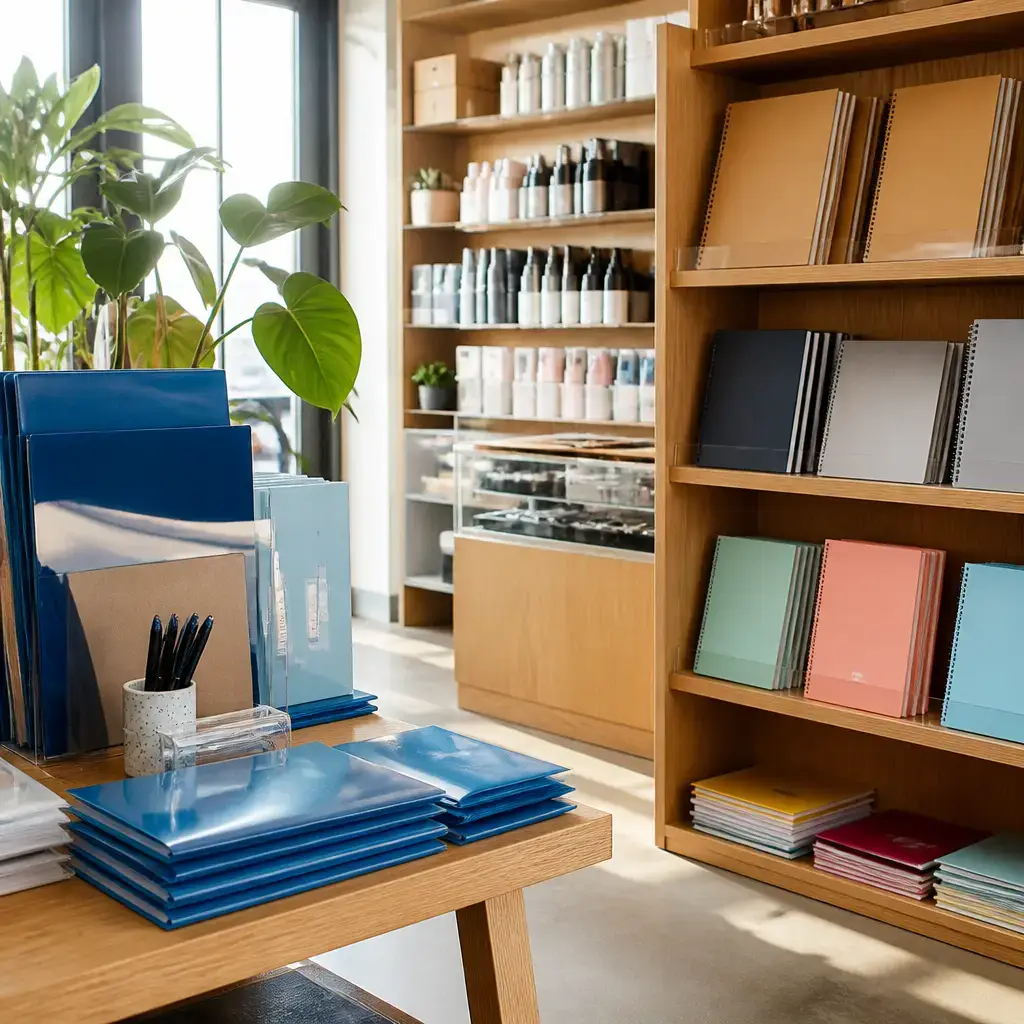
Use Finding blue folders in a shop to practice Danish conversation, pronunciation, vocabulary, grammar, and quizzes.
Dialogue
Undskyld, hvor er afdelingen med kontorartikler?
oon-SGILL, vohr air af-DAY-ling-un meh kon-TOHR-ar-TEE-gluh? Excuse me, where is the stationery section?Den ligger forbi udstillingen med notesbøger på højre side.
dehn LEG-uh for-BEE oo-STEL-ling-un meh NOHDS-bur-uh poh HOY-uh SEE-thuh. It's past the notebook display on the right.Jeg leder efter blå mapper.
yai LAY-uh EF-tuh bloh MAB-uh. I'm looking for blue folders.Lad mig se, om de stadig er på lager.
lah my SAY, ohm dee STAY-lee air poh LAY-uh. Let me check if they are still available.Er der nogen på lager i dag?
air dair NOH-un poh LAY-uh ee DEH? Are there any in stock today?Vi har nogle på lager i baglokalet.
vee hahr NOH-luh poh LAY-uh ee beh-loh-KAH-luh. We have some in the back room.Kan du hente en pakke til mig?
kan doo HEN-duh uhn PAG-uh teel my? Could you bring one pack for me?Jeg kommer med en pakke.
yai KUM-uh meh uhn PAG-uh. I'll bring a pack over.Vent venligst ved denne udstilling.
VEND VEN-list veh DEN-uh oo-STEL-ling-un. Please wait near this display.Sentence explanations
Undskyld, hvor er afdelingen med kontorartikler?
Excuse me, where is the stationery section?
- Undskyld
- Excuse me
- hvor er
- where is
- afdelingen
- the section
- kontorartikler
- stationery
More detail
Undskyld means “excuse me” here. It is also used as “sorry” in other contexts; the surrounding question gives it the attention-getting, polite meaning here. The form is related to the verb undskylde, but this fixed form is the conventional short expression used before a request. hvor er asks for the location of something: hvor means “where,” and er is the present form of være (“to be”). A reusable pattern is Hvor er ...? (“Where is ...?”). For example: Hvor er toilettet? — “Where is the restroom?” afdelingen means “the section” here. Its base form is afdeling (“section” or “department”); the ending -en marks the definite singular form, “the section.” This is a noun form, not an adjective inflection. The plural is afdelinger, while definite plural is afdelingerne (“the sections”). kontorartikler means “stationery” in this sentence. It is the plural form of kontorartikel (“office or stationery item”); Danish commonly uses this plural as a category term without a separate article. The compound combines kontor (“office”) with artikler (“items/articles”). For example: Jeg køber kontorartikler. — “I am buying stationery.” The phrase med kontorartikler identifies which section is meant: med means “with” or, in this naming pattern, “that contains or sells.” Thus afdelingen med kontorartikler is “the section with stationery.” Together with the question pattern, the utterance asks: “Excuse me, where is the stationery section?”
Den ligger forbi udstillingen med notesbøger på højre side.
It's past the notebook display on the right.
- Den
- it
- ligger
- is located
- forbi
- past
- udstillingen
- the display
- med
- with
- notesbøger
- notebooks
- på
- on
- højre
- right
- side
- side
More detail
Den is the Danish pronoun used here for “it.” It is the common-gender singular form; the fixed sentence does not identify exactly what it refers to. Danish also has det for neuter singular “it,” while de is plural “they.” ligger comes from ligge, “to lie” or “be located.” In this sentence it describes a place or thing as being situated somewhere. ligger is present tense, and Danish verbs do not change their form for different subjects in the present: jeg ligger, du ligger, and de ligger all use ligger. forbi means “past” or “beyond” in this location expression. It can be used before a landmark: Gå forbi døren. — “Go past the door.” Here it places the location beyond the display when moving along the relevant route. udstillingen means “the display” here. Its base form is the noun udstilling; udstillingen is its singular definite form, marked by -en. The definite form presents the display as an identifiable landmark, rather than simply “a display.” med means “with.” It links udstillingen to what the display contains or presents: udstillingen med notesbøger means “the display with notebooks.” notesbøger means “notebooks.” Its singular indefinite form is notesbog, and its plural indefinite form is notesbøger. The form notesbøger therefore refers to notebooks in general here, not to a specified set marked as “the notebooks.” på means “on” in the location phrase på højre side, “on the right-hand side.” Danish uses different prepositions in different spatial expressions, so this phrase is best learned as a reusable location pattern. højre means “right-hand” in this phrase. It describes the side, specifically distinguishing the right side from the left side. In højre side, højre is the form used before this noun; it is not the noun’s base form or an inflection of side. side means “side.” The phrase på højre side literally refers to the right-hand side and is a common way to give directional information. For example, Toilettet er på venstre side. means “The toilet is on the left-hand side.” Together, Den ligger says that the relevant place or thing is located somewhere. forbi udstillingen med notesbøger places it past the display containing notebooks, and på højre side specifies the side of the route. The whole utterance therefore means: “It’s past the notebook display on the right.”
Jeg leder efter blå mapper.
I'm looking for blue folders.
- Jeg
- I
- leder efter
- look for
- blå
- blue
- mapper
- folders
More detail
Jeg means “I” here: the speaker is the person carrying out the search. It is the Danish first-person singular subject pronoun. For example, Jeg ser means “I see.” leder efter is the reusable Danish construction for “look for” or “search for.” The verb is lede (“to lead” or, in this construction, “to look/search”), and leder is its present-tense form. efter is part of the construction here, so lede efter + noun means “look for + noun.” For example, Jeg leder efter nøgler means “I’m looking for keys.” blå means “blue.” It is the adjective modifying mapper in this sentence. Danish adjectives can show forms according to the noun phrase, but blå has the same written form with plural nouns such as mapper; the plural marking is carried by the noun here. For example, blå bøger means “blue books.” mapper means “folders” here. Its singular base form is mappe, and mapper is the indefinite plural. The definite plural is mapperne, meaning “the folders.” For example, to mapper means “two folders.” Together, Jeg leder efter supplies the subject and the present-tense “look for” construction. blå mapper is its object: the things being sought, described as blue folders. The complete utterance therefore means “I’m looking for blue folders.”
Lad mig se, om de stadig er på lager.
Let me check if they are still available.
- Lad mig se
- Let me see
- de
- they
- stadig
- still
- er
- are
- på lager
- in stock; available
More detail
Lad mig se is a reusable Danish way to say “let me see” or, as here, “let me check.” Lad is the imperative of lade (“let; allow”), followed by the object pronoun mig (“me”) and the infinitive se (“see”). Pattern: Lad + pronoun + infinitive, as in Lad hende komme. — “Let her come.” om introduces an indirect yes/no question: “whether” or “if.” It links the checking action to the question that follows. This is different from a conditional “if” in a sentence such as Hvis de er på lager, køber jeg dem. — “If they are in stock, I’ll buy them.” de means “they” here. The fixed translation and the context identify it as a plural subject referring to the folders being sought, rather than a singular formal “you.” Danish de can have other grammatical uses, so its referent must come from context. stadig means “still”: the situation continues to hold. It commonly appears with a present-tense verb, as in Er varen stadig tilgængelig? — “Is the item still available?” er is the present-tense form of være (“be”). Danish uses er with all persons and numbers: jeg er, du er, de er — “I am,” “you are,” “they are.” The plural meaning here comes from de, not from a different form of er. på lager is a fixed expression meaning “in stock” or “available for purchase.” It is useful for asking or stating whether goods can currently be obtained: Mapperne er på lager. — “The folders are in stock.” Together, om de stadig er på lager means “if/whether they are still in stock.” The complete utterance therefore means “Let me check if they are still available,” with the speaker saying that they will check the folders’ current availability.
Er der nogen på lager i dag?
Are there any in stock today?
- Er der
- is/are there
- nogen
- any
- på lager
- in stock
- i dag
- today
More detail
Er der is a reusable Danish way to ask whether something exists or is present: “is/are there …?” The verb er is the present form of være (“to be”). Danish uses this question order, with er before der; der is the existential subject-like element, not the English word “there” in every possible use. Example: Er der kaffe? — “Is there coffee?” nogen means “any” here, referring to an unspecified quantity of the relevant items. In questions, it commonly introduces an open question about whether one or more such items exist or are available. The specific items are not identified by the sentence. Compare noget for an unspecified thing or uncountable substance in a suitable context: Er der noget kaffe? — “Is there any coffee?” på lager is the fixed expression “in stock” or “held in inventory.” lager is the noun “stock/inventory,” while på is the preposition used in this expression. The same expression can occur in a statement: De er på lager. — “They are in stock.” i dag means “today.” It is a time expression made from i (“in/on”) and dag (“day”); together, it specifies the current day. Example: Vi åbner i dag. — “We are open today.” Together, Er der asks whether something is present, nogen asks about any relevant items, på lager specifies that they are available in stock, and i dag limits the question to today. Thus the complete utterance means: “Are there any in stock today?”
Vi har nogle på lager i baglokalet.
We have some in the back room.
- har
- have
- nogle
- some
- på lager
- in stock
- baglokalet
- the back room
More detail
har is the present-tense form of have (“to have”). Danish uses har for all persons in the present: jeg har, vi har, and de har; the subject, rather than the verb ending, shows who has something. Here it expresses possession or availability. nogle means “some” here and refers to an unspecified plural amount of the items being discussed. It does not state an exact number. In an affirmative statement, nogle is commonly used before or instead of a plural noun: Vi har nogle. — “We have some.” In questions and negative clauses, Danish often uses nogen instead: Er der nogen? — “Are there any?” på lager is the reusable expression “in stock” or “available in inventory.” på is part of this expression; it should not be translated here as a literal physical position on top of something. For example, Varen er på lager. means “The item is in stock.” baglokalet means “the back room.” Its base noun is baglokale, an -et noun; the definite singular form adds -t: baglokale → baglokalet. The definite form presents the room as an identifiable place in the situation. The compound’s first part, bag-, means “back” in this noun. Taken together, Vi har nogle means “We have some,” på lager specifies that they are in stock, and i baglokalet gives their location: “in the back room.” The complete utterance therefore means “We have some in the back room,” with the understood plural items supplied by the surrounding situation.
Kan du hente en pakke til mig?
Could you bring one pack for me?
- Kan du
- Could you
- hente
- fetch or bring
- pakke
- pack or package
- til mig
- for me
More detail
Kan du combines kan (“can”) with du (“you”). kan is the present form of kunne; in a request, this combination asks about a possible action and is naturally translated “Could you …?” du is the second-person singular subject. After kan, the following verb is in the infinitive. Example: Kan du vente? — “Could you wait?” hente is the infinitive of hente, meaning “fetch,” “get,” or, in this context, “bring.” After the modal kan, it remains in the infinitive. Example: Kan du hente nøglerne? — “Could you fetch the keys?” pakke is the noun “pack” or “package.” In en pakke, en is the indefinite article used with this common-gender noun. Here the fixed translation renders the phrase as “one pack”; Danish en can be an indefinite article or have the numerical sense “one,” with the intended reading determined by context. Example: Jeg har en pakke. — “I have a package.” til mig means “for me” here. til is a preposition, and mig is the stressed first-person singular pronoun “me.” A useful contrast is til dig (“for you”), where dig is the stressed second-person singular form. Together, Kan du hente en pakke til mig? is a request asking whether the listener can fetch or bring one pack/package for the speaker. A reusable pattern is Kan du + infinitive + item + til + recipient: Kan du hente bogen til mig? — “Could you fetch the book for me?”
Jeg kommer med en pakke.
I'll bring a pack over.
- Jeg
- I
- kommer med
- bring ... along
- pakke
- pack
More detail
Jeg means “I” here: the speaker is the person who will bring the item. It is the first-person singular pronoun. Compare du (“you,” singular) in a sentence such as Jeg kommer — “I am coming” — versus Du kommer — “You are coming.” kommer med combines the present form kommer of komme (“come”) with med (“with”). In this construction, it means bringing something along, rather than simply moving toward a place. The form kommer is used with jeg in the present tense; the same form also occurs with several other subjects, for example Hun kommer — “She is coming.” A reusable pattern is Jeg kommer med X — “I’ll bring X along.” en pakke means “a pack” here. pakke is the noun’s indefinite form; its definite singular form is pakken, and its plural is pakker. The article en marks an indefinite common-gender noun; it does not by itself state a numerical count. For example, Jeg har en pakke means “I have a pack.” Together, Jeg + kommer med + en pakke gives “I’ll bring a pack over.” The utterance presents the speaker as the person who will bring the pack, using the present-tense Danish form kommer for this intended future action. The wording is a direct, neutral way to say that the speaker will bring the item along.
Vent venligst ved denne udstilling.
Please wait near this display.
- Vent
- wait
- venligst
- please
- ved
- near; by
- denne
- this
- udstilling
- display; exhibition
More detail
Vent is the imperative of vente, “to wait.” It is the form used to tell one or more people to wait; the subject is normally understood rather than stated. Example: Vent her. — “Wait here.” venligst means “please” and softens the request. It can follow an imperative, as here: Vent venligst. — “Please wait.” ved is a preposition meaning “by” or “near” in this use. It introduces the place beside which the waiting should happen. Example: Hun står ved døren. — “She is standing by the door.” denne means “this” and is the singular form used with a common-gender noun. Danish also has dette with a neuter singular noun and disse for plural nouns. Here, denne agrees with udstilling, not with the nearby preposition. Example: denne stol — “this chair.” udstilling is a common-gender noun meaning “display” or “exhibition.” Its indefinite singular form is udstilling; the definite singular is udstillingen, “the display” or “the exhibition.” Example: Vi ser en udstilling. — “We are looking at an exhibition.” Together, ved denne udstilling means “near this display,” with denne specifying the display referred to. The imperative Vent gives the instruction, and venligst makes it a polite request. The whole utterance means: “Please wait near this display.”
Grammar Points
lede efter + genstand
Jeg leder efter en blå mappe.
yai LAY-uh EF-tuh uhn bloh MAB-uh.I am looking for a blue folder.
Danish uses the fixed expression "lede efter" for “look for”; efter stays after the verb.
stadig + på lager
Er den blå mappe stadig på lager?
air den bloh MAB-uh STAY-lee poh LAY-uh?Is the blue folder still in stock?
"Stadig" comes before the fixed phrase "på lager" to express that availability continues.
Danish Vocabulary
- Gender
- common
Undskyld, hvor er afdelingen med kontorartikler?
Jeg leder efter blå mapper.
Den ligger forbi udstillingen med notesbøger på højre side.
Undskyld, hvor er afdelingen med kontorartikler?
Den ligger forbi udstillingen med notesbøger på højre side.
- Gender
- common
Undskyld, hvor er afdelingen med kontorartikler?
Jeg leder efter blå mapper.
- Gender
- common
Jeg leder efter blå mapper.
- Gender
- common
Den ligger forbi udstillingen med notesbøger på højre side.
Lad mig se, om de stadig er på lager.
- Gender
- common
Den ligger forbi udstillingen med notesbøger på højre side.
Undskyld, hvor er afdelingen med kontorartikler?
Quiz
Word Order
Arrange the words in the correct order.
Excuse me, where is the stationery section?
Show Answer
Undskyld, hvor er afdelingen med kontorartikler?I'm looking for blue folders.
Show Answer
Jeg leder efter blå mapper.I'll bring a pack over.
Show Answer
Jeg kommer med en pakke.Spelling
Tap the letters to spell the word.
where
Show Answer
hvorsection; department
Show Answer
afdelingendisplay; exhibition
Show Answer
udstillingenpast; beyond