10 minutes free every day
Continue audio lessons in the app
Word explanations appear automatically in sync with the audio.
No login required · synced translations · playback with the screen locked
Choose your learning language and open this lesson in the app.

About This Lesson
Use Shopping for groceries with a list to practice Danish conversation, pronunciation, vocabulary, grammar, and quizzes.
Dialogue
Lad os holde os til indkøbslisten.
LAH uhss HOHL-uh uhss till EN-kurbs-LES-duhn. Let's stick to the grocery list.Det burde hjælpe os med ikke at købe for meget.
deh BOO-uh YEL-buh uhss meh IK-uh eh KOOR-buh foh MAY-uhdh. That should keep us from buying too much.Hvor er pastaen og risen?
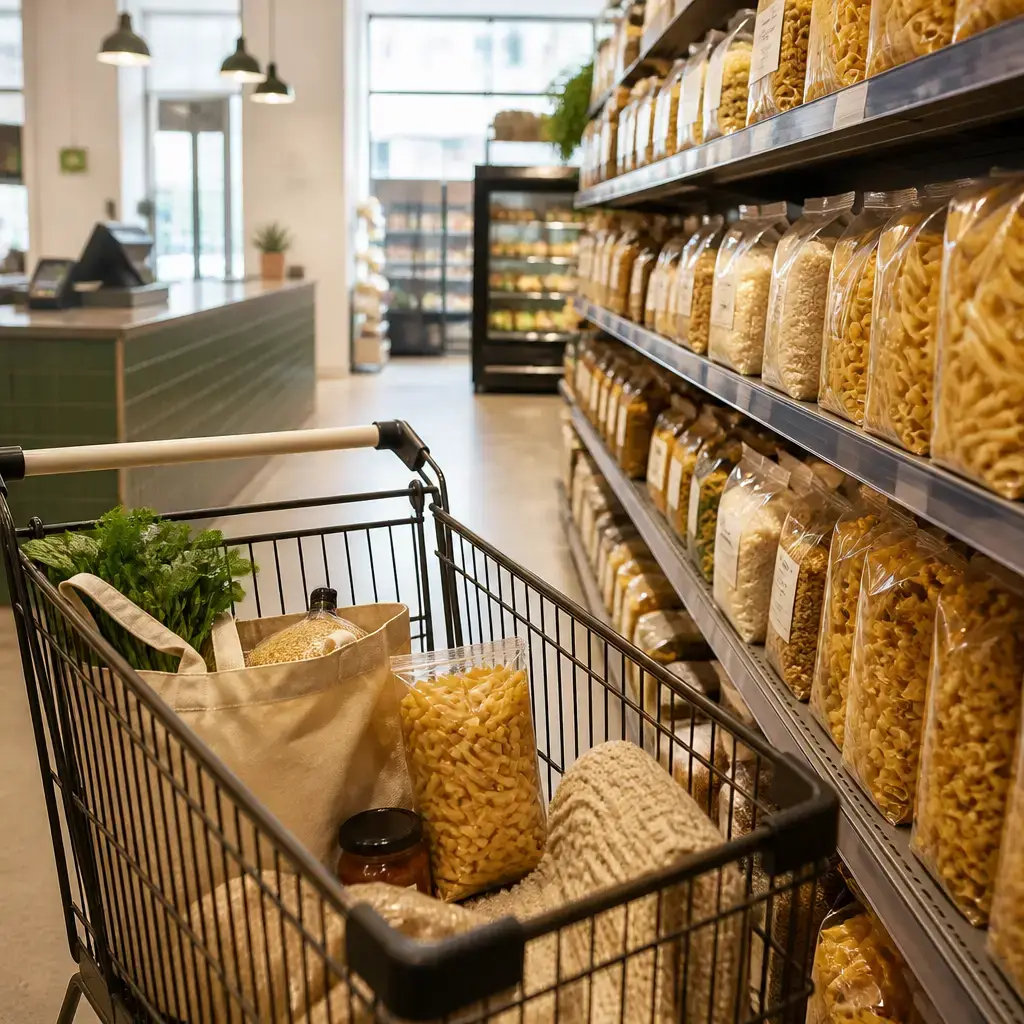
VOHR air PAS-duhn uh REE-suhn? Where are the pasta and rice?De står i tørvaregangen.
dee STOR ee TUR-vair-uh-geng-uhn. They are in the dry food aisle.Det er den pasta, vi købte sidst.
deh air den PAS-duh, vee KURB-duh SIST. This is the pasta we bought last time.Lad os lægge en pakke i indkøbsvognen.
LAH uhss LEG-uh en PAK-uh ee EN-kurbs-VOHN-uhn. Let's put one pack in the cart.Bagefter mangler vi kun mælk.
BAY-uhf-duh MANG-luh vee KOON MELK. After that, we only need milk.Så kan vi gå direkte til kassen.
SOH kan vee GOH dee-REK-duh till KAS-uhn. Then we can head straight to checkout.Sentence explanations
Lad os holde os til indkøbslisten.
Let's stick to the grocery list.
- Lad os
- let’s
- holde os til
- stick to
- indkøbslisten
- the grocery list
More detail
Lad os is the Danish pattern for “let’s”: lad is the imperative of lade (“let”), followed by os (“us”). It introduces a suggestion or invitation involving the speaker and others. Compare Lad os gå. — “Let’s go.” holde os til is the reusable expression holde sig til (“stick to” or “adhere to”). Here holde is the infinitive of holde (“hold/keep”), required after lad; os is the first-person plural reflexive form (“ourselves/us”) in this expression. The form changes with the subject: holde mig til means “stick to” with “I,” while holde sig til is used with a third-person subject. The whole expression is more than the literal meanings of its individual words. indkøbslisten means “the grocery list” here. It is the definite singular form of indkøbsliste (“shopping/grocery list”): the definite ending -en marks one specific common-gender list. The definite form identifies the list as an understood specific item; it does not itself state a numerical quantity. Example: Jeg skriver det på indkøbslisten. — “I write it on the grocery list.” Together, Lad os + holde os til + indkøbslisten gives “Let’s stick to the grocery list.” The sentence is a direct, everyday suggestion to follow that list rather than depart from it.
Det burde hjælpe os med ikke at købe for meget.
That should keep us from buying too much.
- Det
- that
- burde
- should; ought to
- hjælpe
- help
- os
- us
- ikke
- not
- købe
- buy
- for meget
- too much
More detail
Det is the subject pronoun meaning “that” here. Danish det is a neuter singular form, but the supplied sentence does not identify exactly what “that” refers to, so learn the reusable pattern Det + verb for “That/It ...”. burde expresses what is expected or advisable: “should” or “ought to”. It is the past-tense form of bør, but in this use it does not simply place the event in the past; it gives the prediction or recommendation a slightly less direct form. After burde, Danish uses the infinitive: burde hjælpe = “should help”. hjælpe is the infinitive “to help”. A useful pattern is hjælpe nogen med at gøre noget, “help someone to do something”; here the following med-phrase identifies what the help concerns. os means “us”. It is the first-person plural object form, contrasting with subject vi (“we”): Vi hjælper os would mean “We help ourselves,” while Det hjælper os means “It/That helps us.” ikke is the negation word “not”. In this sentence it negates the following action phrase: med ikke at købe = “with not buying” / “from buying”. The construction med at introduces the activity concerned, and ikke comes before at plus the infinitive when that activity is negated. købe is the infinitive “to buy”. Its form does not show person or number; the modal burde is what makes the earlier verb phrase finite. Example: Vi prøver ikke at købe mere. — “We are trying not to buy more.” for meget means “too much”. meget means “much/a lot”, while for meget marks an excessive amount. Here it describes the amount bought, not the number of separate items. For countable plural items, Danish commonly uses for mange (“too many”) instead. Together, Det burde hjælpe os med ikke at købe for meget means “That should keep us from buying too much.” The structure is Det burde (“That should”) + hjælpe os (“help us”) + med ikke at købe (“with not buying”) + for meget (“too much”).
Hvor er pastaen og risen?
Where are the pasta and rice?
- Hvor er
- where is/are
- pastaen
- the pasta
- og
- and
- risen
- the rice
More detail
Hvor er is the question pattern meaning “where is/are …?”. Hvor asks about location. er is the present form of være (“to be”); Danish uses this same form with singular and plural subjects, so it does not by itself show whether the subject is one thing or several. pastaen means “the pasta” here. pasta is the noun’s base form, and the ending -en marks the definite form: pasta = “pasta”, pastaen = “the pasta”. Danish commonly marks definiteness by a suffix attached to the noun rather than by a separate word before it. og connects the two coordinated nouns and means “and”. It does not show number or definiteness itself. risen means “the rice” here. Its base form is ris, and -en gives the definite form risen. This is the noun’s form in the fixed sentence; the ending belongs to ris, not to pastaen. Together, Hvor er pastaen og risen? asks for the location of two definite food items: “Where are the pasta and rice?” The present form er is compatible with the coordinated subject pastaen og risen, while the two nouns identify the items being located.
De står i tørvaregangen.
They are in the dry food aisle.
- De
- they
- står
- stand; are located
- i
- in
- tørvaregangen
- dry food aisle
More detail
De means “they” here. It is a third-person plural personal pronoun. Danish personal pronouns change according to grammatical role; compare de (“they”) with dem (“them”) when the pronoun is the object of a verb. Example: De kommer. — “They are coming.” står is the present-tense form of stå, “to stand.” In this sentence, stå describes location rather than only a physical standing position, so De står ... means “They are located ...” or “They are ...” in the specified place. The present form står is used for a current situation. Example: Bøgerne står på hylden. — “The books are on the shelf.” i is the preposition “in.” It introduces the place containing or occupied by the people referred to by De. Example: Hun er i butikken. — “She is in the shop.” tørvaregangen means “the dry food aisle.” It is a compound noun: tørvare refers to dry goods or dry food, and gangen is the definite form of gang, “aisle” or “passage.” The ending in gangen marks the noun as definite; Danish often puts definiteness on the noun itself rather than using a separate word equivalent to “the.” Example: Vi mødes i gangen. — “We meet in the aisle/passage.” Together, De står gives “they are located,” i gives the relation “in,” and tørvaregangen names the definite location. The whole utterance therefore means: “They are in the dry food aisle.”
Det er den pasta, vi købte sidst.
This is the pasta we bought last time.
- Det er
- This is
- den
- the
- pasta
- pasta
- vi
- we
- købte
- bought
- sidst
- last time
More detail
Det er is a reusable Danish pattern meaning “This is” or “That is.” Here er is the present form of være (“to be”), and det er introduces what is being identified. Example: Det er min bog — “This is my book.” den is a common-gender singular determiner. In this sentence it contributes the meaning “the” before pasta; it is not a number word. Danish also has noun definiteness marked by an ending, as in bog (“book”) and bogen (“the book”). The choice between a determiner and a noun ending depends on the noun phrase’s structure and use; do not treat den as a general substitute for every definite noun ending. pasta is the noun “pasta.” Here it names the food being identified. Together with den, it forms the noun phrase den pasta, “the pasta.” vi means “we.” It is the subject pronoun for a group that includes the speaker. The singular counterpart is jeg, “I.” købte means “bought” here. It is the past-tense form of købe (“to buy”). This past form does not change for the subject: jeg købte means “I bought,” and vi købte means “we bought.” Example: Vi købte brød — “We bought bread.” sidst means “last time” here, referring to the previous relevant occasion. It is different from sidste, which appears before a noun in expressions such as sidste uge (“last week”). Together, den pasta identifies the pasta, and vi købte sidst is a relative clause describing it: “the pasta that we bought last time.” The complete sentence is therefore “This is the pasta we bought last time.”
Lad os lægge en pakke i indkøbsvognen.
Let's put one pack in the cart.
- Lad os
- Let's
- lægge
- put; place
- pakke
- pack; package
- indkøbsvognen
- the shopping cart
More detail
Lad os is the Danish pattern for “let’s,” used to suggest a shared action. It is followed here by the infinitive lægge. Example: Lad os gå. — “Let’s go.” lægge means “to put” or “to place” something somewhere. It is the infinitive form; the related verb ligge means “to lie” or “to be located,” so lægge describes placing something, while ligge describes its position. Example: Jeg lægger bogen på bordet. — “I put the book on the table.” en pakke means “a pack” or “a package.” pakke is a common-gender noun, and en is its indefinite article. In this sentence, the fixed translation identifies the intended quantity as one pack. The definite form is pakken, “the pack.” indkøbsvognen means “the shopping cart.” Its indefinite singular base form is en indkøbsvogn; the ending -en marks the definite singular form. The compound contains indkøb (“shopping”) and vogn (“cart”), but the complete noun is used as one word. Together, Lad os lægge en pakke i indkøbsvognen means “Let’s put one pack in the cart.” i introduces the destination or location, so the sentence proposes that the speaker and listener place the pack inside the shopping cart.
Bagefter mangler vi kun mælk.
After that, we only need milk.
- Bagefter
- after that
- mangler
- need
- vi
- we
- kun
- only
- mælk
- milk
More detail
Bagefter means “after that” and refers back to an earlier point or action. It is a useful time adverb and does not change form. Example: Bagefter går vi hjem. — “After that, we go home.” mangler is the present-tense form of mangle. In this sentence, vi mangler X means “we need X” in the sense that X is still missing; it does not express a general wish for X. Danish present-tense verbs do not change form for the subject, so mangler is also used with other subjects, such as jeg mangler (“I need”) and de mangler (“they need”). Example: Jeg mangler en billet. — “I need a ticket.” vi means “we” and is the subject pronoun for a group that includes the speaker. Danish subject pronouns contrast vi with jeg (“I”) and de (“they”), but the exact members of the group are not specified by this sentence. kun means “only” and limits what is still needed. Here it says that milk is the sole remaining need; it does not mean that there is only one unit of milk. mælk means “milk”. It is ordinarily used as a mass noun when referring to milk generally, so no article is needed here. If a specific container or quantity is meant, Danish can instead use a countable noun, for example en liter mælk — “a litre of milk.” The structure is Bagefter + mangler + vi + kun + mælk: “After that, need we only milk.” Danish places the finite verb before the subject in this main clause because the time adverb occupies the first position. In natural English, the result is “After that, we only need milk.” Together with the preceding plan, the sentence identifies milk as the only remaining item needed before going directly to checkout.
Så kan vi gå direkte til kassen.
Then we can head straight to checkout.
- Så
- then
- kan vi
- we can
- gå
- go
- direkte
- straight
- kassen
- checkout
More detail
Så means “then” here, linking this step to the earlier one. Danish can also use it as “so” in other contexts, but the fixed sentence uses the time/order meaning. kan vi expresses “we can.” kan is the present-tense form of kunne (“can; be able to”), and vi is the first-person plural pronoun “we.” In a main clause, Danish commonly places the finite verb before the subject when another element comes first: Så kan vi ... literally has “Then can we ...” in that word order. Example: I dag kan vi blive hjemme. — “Today we can stay home.” gå means “go” here. It is the infinitive after the modal kan; Danish uses the bare infinitive after this modal, without at. direkte means “directly” or “straight,” describing the route or manner of going. Example: Gå direkte hjem. — “Go straight home.” kassen is the definite singular form of kasse, meaning “the checkout” in this shopping context. The ending -en marks definite singular for this noun; kasse can also mean a box or cash desk in other contexts, but the fixed translation establishes the checkout meaning here. Together, Så kan vi gå direkte til kassen means “Then we can head straight to checkout.” til means “to,” and til kassen gives the destination, while kan gå expresses the possibility or ability to go there. The sentence presents this as the next possible step after the earlier shopping step.
Grammar Points
Lad os + infinitiv
Lad os holde os til indkøbslisten.
LAH uhss HOHL-uh uhss till EN-kurbs-LES-duhn.Let's stick to the grocery list.
Use “Lad os” followed by the infinitive to suggest doing something together.
Hvor + verb + subject?
Hvor står pastaen?
VOHR STOR PAS-duhn?Where is the pasta?
In Danish questions with “Hvor”, the verb comes before the subject.
Danish Vocabulary
Lad os holde os til indkøbslisten.
- Gender
- common
Lad os holde os til indkøbslisten.
Quiz
Word Order
Arrange the words in the correct order.
Let's stick to the grocery list.
Show Answer
Lad os holde os til indkøbslisten.Where are the pasta and rice?
Show Answer
Hvor er pastaen og risen?They are in the dry food aisle.
Show Answer
De står i tørvaregangen.Spelling
Tap the letters to spell the word.
help
Show Answer
hjælpebuy
Show Answer
købenot
Show Answer
ikkewhere