10 minutes free every day
Continue audio lessons in the app
Word explanations appear automatically in sync with the audio.
No login required · synced translations · playback with the screen locked
Choose your learning language and open this lesson in the app.

About This Lesson
Use Finding the conference room to practice Danish conversation, pronunciation, vocabulary, grammar, and quizzes.
Dialogue
Kan du fortælle mig, hvor konferencerummet er?
Kan doo fuh-TEL-uh my, voh kon-feh-REN-seh-room-uhd air? Could you tell me where the conference room is?Gå forbi lobbyen. Det er tæt på elevatorerne.
Goh for-BEE LOB-ee-uhn. Deh air tehd poh eh-leh-vah-TOH-nuh. Go past the lobby. It's near the elevators.Skal jeg tage elevatoren herfra?
Skel yai TAY eh-leh-vah-TOH-uhn hair-FRAH? Should I take the elevator from here?Tag den én etage op.
TAY den ayn eh-TAY-shuh ohp. Take it up one floor.Drej så til venstre ind på gangen.
Dry soh til VEN-streh en poh GAN-uhn. Then turn left into the hallway.Er der et kort, jeg kan bruge?
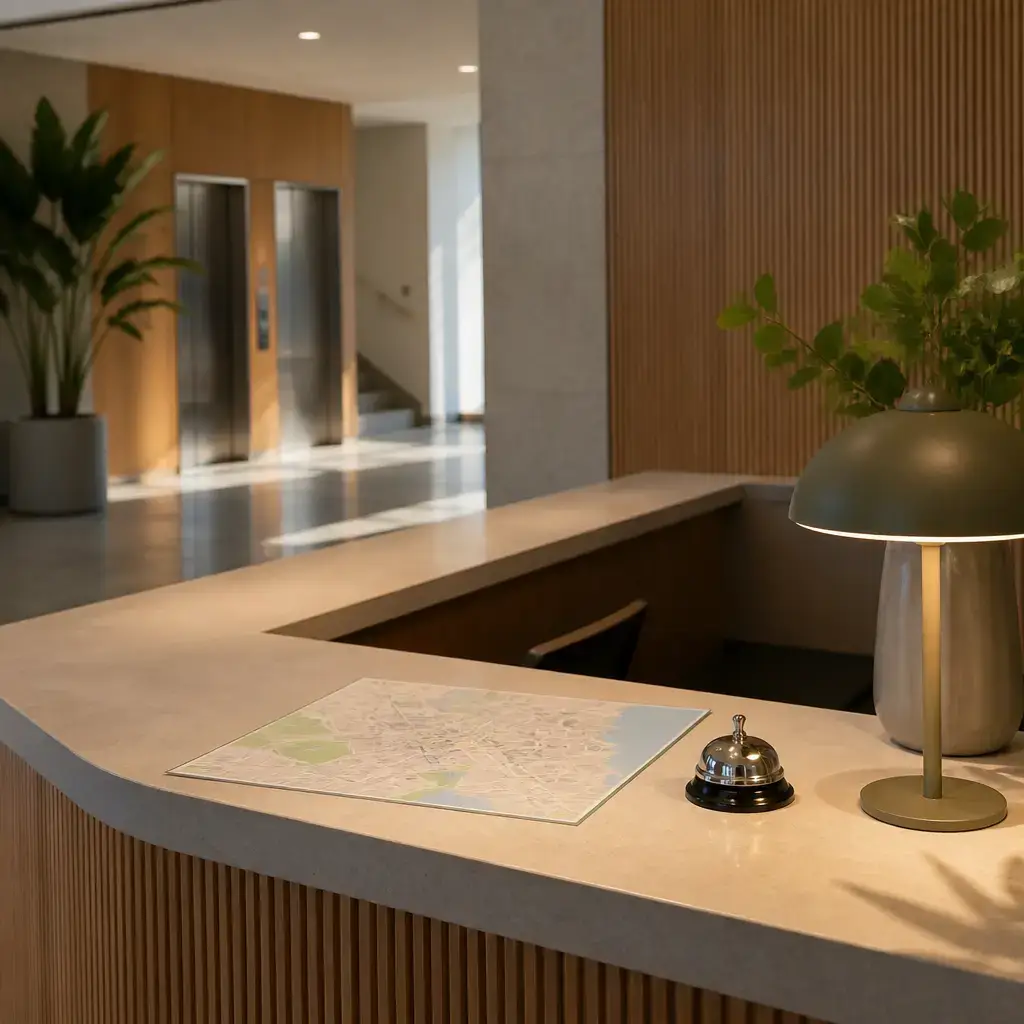
Air dair ehd koht, yai kan BROO-uh? Is there a map I can use?Der er et ved receptionsskranken.
Dair air ehd vay reh-SEP-shohns-SKRANG-uhn. There's one by the reception desk.Det hjælper. Det er første gang, jeg er i denne bygning.
Deh YEL-puh. Deh air FER-stuh gang, yai air ee DEN-uh BEW-ning. That helps. It's my first time in this building.Konferencerummet er markeret nær enden af gangen.
Kon-feh-REN-seh-room-uhd air mah-GEH-ud nair EN-uhn ah GAN-uhn. The room is marked near the end of the hall.Sentence explanations
Kan du fortælle mig, hvor konferencerummet er?
Could you tell me where the conference room is?
- Kan du
- Could you
- fortælle
- tell
- mig
- me
- hvor
- where
- konferencerummet
- the conference room
- er
- is
More detail
Kan du is a reusable polite question pattern meaning “Could you…?” Here kan is the present-tense form of kunne (“can, be able to”), and du is the second-person singular pronoun “you.” In requests, this combination commonly softens the question; it does not necessarily assert a literal ability. After kan, the next verb is normally in the infinitive without at. fortælle means “tell” in this sentence. It is the infinitive of fortælle; the form stays infinitive because it follows the modal kan. For example, Kan du hjælpe? means “Could you help?” mig means “me.” It is the object form of the first-person pronoun; compare subject jeg (“I”) with object mig (“me”). In fortælle mig, it identifies the person who is to receive the information. hvor means “where” and introduces the embedded question asking for a location. A useful pattern is hvor + clause, as in Jeg ved, hvor hun bor. — “I know where she lives.” konferencerummet means “the conference room.” It is the definite form of the compound noun konferencerum (“conference room”): konferencerummet marks one identified conference room. The final -et belongs to the noun form, not to konference separately. er means “is” here. It is the present form of være (“to be”). In the embedded question, konferencerummet er keeps the subject before the verb: hvor konferencerummet er (“where the conference room is”). Together, Kan du fortælle mig asks someone politely to provide information, and hvor konferencerummet er specifies that the information concerns the conference room’s location. The whole utterance therefore means “Could you tell me where the conference room is?”
Gå forbi lobbyen. Det er tæt på elevatorerne.
Go past the lobby. It's near the elevators.
- Gå forbi
- go past
- lobbyen
- the lobby
- Det er
- it is
- tæt på
- near
- elevatorerne
- the elevators
More detail
Gå forbi is an instruction to move past something. Gå is the imperative of gå (“to go”); for this verb, the imperative has the same form as the infinitive. Danish imperatives commonly begin a direct instruction: Vent! means “Wait!” Here, forbi supplies the path relation “past,” so gå forbi + noun is a reusable pattern for “go past + noun.” lobbyen means “the lobby.” The base noun is lobby; lobbyen is its definite singular form, marked by -en. This ending marks “the” for this noun; it does not by itself state a numerical count. For example, indgangen means “the entrance,” from indgang. Together, Gå forbi lobbyen. gives the complete instruction “Go past the lobby.” Det er means “it is.” Det is a singular neuter pronoun, and er is the present-tense form of være (“to be”). The pronoun’s exact referent comes from the situation rather than from its form; here it refers to the place being located in the directions. A reusable pattern is Det er ... for describing that place or thing: Det er her. means “It is here.” tæt på expresses physical closeness: “near” or “close to.” Tæt is the adjective “close,” and på introduces what the location is close to. The reusable pattern is X er tæt på Y (“X is near Y”). In this sentence, tæt på does not mean “past”; it gives the destination’s proximity. elevatorerne means “the elevators.” Its base noun is elevator; elevatorer is the plural, and elevatorerne is the definite plural, marked by -ne. Thus the form identifies multiple elevators as a definite group. For comparison, en elevator means “an elevator,” while elevatorerne means “the elevators.” The second sentence assembles these parts as Det er tæt på elevatorerne: “It’s near the elevators.” The two sentences together give a route instruction followed by the location of the place under discussion: go past the lobby; that place is near the elevators.
Skal jeg tage elevatoren herfra?
Should I take the elevator from here?
- Skal jeg
- should I
- tage
- take
- elevatoren
- the elevator
- herfra
- from here
More detail
Skal jeg is a reusable Danish question pattern meaning “should I …?” Here, skal is the present form of skulle, used with jeg to ask about what the speaker ought to do or is expected to do. The following verb stays in the infinitive: Skal jeg vente? means “Should I wait?” This pattern asks about the speaker’s action; it does not itself say that the action will happen. tage means “take” here, as in taking a means of transport or using a route. It is the infinitive after skal; the present form is tager, as in Jeg tager elevatoren (“I take the elevator”). The same verb can have other context-dependent uses, such as “take” an object, but its meaning here is determined by elevatoren. elevatoren means “the elevator.” The noun elevator is singular indefinite, while elevatoren is singular definite: the ending -en marks “the” for this noun. The plural definite form is elevatorerne, as in the preceding context’s “the elevators”; that plural form is a different number and ending from the singular elevatoren here. herfra means “from here.” It combines the place word her (“here”) with fra (“from”) into a compact word indicating the starting point. A useful contrast is derfra (“from there”), used when the starting point is elsewhere. Together, Skal jeg asks whether the speaker should perform the action, tage elevatoren specifies taking the elevator, and herfra gives the starting point. The whole utterance therefore means “Should I take the elevator from here?”
Tag den én etage op.
Take it up one floor.
- Tag
- take
- den
- it
- én
- one
- etage
- floor
- op
- up
More detail
Tag is the imperative of tage, “to take.” The imperative gives a direct instruction; for this verb, the form is tag, without the infinitive ending -e. Example: Tag bogen. — “Take the book.” den means “it” here. It is a singular common-gender object pronoun, and the fixed translation identifies the object as “it.” The pronoun’s grammatical form is separate from the identity of the object; this sentence does not specify that identity further. én means “one” and is written with an accent here to emphasize the exact number. Danish uses én with common-gender nouns and ét with neuter nouns; the noun etage is common gender. Example: én etage — “one floor.” etage means “floor” in this directional sense. Its indefinite singular form is en etage; the plural is etager. Example: Der er tre etager. — “There are three floors.” op means “up.” With a movement verb such as tage, it indicates upward movement or a higher position. The combination tage noget op can therefore mean “take something up,” while the exact destination or distance is supplied by the surrounding words. Together, Tag den gives the instruction “Take it,” én etage specifies the distance as exactly one floor, and op specifies upward movement. The complete utterance means “Take it up one floor.” The sentence is a direct instruction, and the imperative form suits that use.
Drej så til venstre ind på gangen.
Then turn left into the hallway.
- Drej
- turn
- så
- then
- til venstre
- to the left
- ind på
- into
- gangen
- the hallway
More detail
Drej is the imperative of dreje (“to turn”). It addresses one or more people directly; the imperative gives the instruction to turn. Example: Drej til højre. — “Turn right.” så means “then” here. It places this instruction after the preceding action, rather than describing how the turning is performed. The reusable sequence pattern is først ..., så ... — “first ..., then ...”. til venstre is the directional phrase “to the left.” venstre means “left” in this fixed direction expression; the opposite direction is til højre, “to the right.” Example: Gå til venstre. — “Go to the left.” ind på expresses movement inward onto or into a place. In ind på gangen, it combines the inward-motion element ind with på to describe entering the hallway. This is different from simply being located there: på gangen means “in/on the hallway” as a location, while ind på gangen presents movement into it. gangen means “the hallway” here. It is the definite singular form of the noun gang: en gang is “a hallway,” and gangen is “the hallway.” The ending -en marks definiteness for this common-gender noun; it does not itself assert a numerical count. Gang can have other meanings in other contexts, but the fixed translation identifies the hallway sense here. Together, Drej så til venstre gives the ordered instruction “Then turn to the left,” and ind på gangen specifies the destination of that movement: “into the hallway.” The whole utterance is therefore “Then turn left into the hallway.”
Er der et kort, jeg kan bruge?
Is there a map I can use?
- Er der
- Is there
- et kort
- a map
- jeg
- I
- kan
- can
- bruge
- use
More detail
Er der is a reusable Danish pattern for asking whether something exists or is available: “Is there …?” Here, er is the present form of være (“be”), while der belongs to the existential pattern and does not identify a specific location by itself. Example: Er der en café her? — “Is there a café here?” et kort means “a map” here. kort is the noun “map”; its definite singular form is kortet (“the map”), and its indefinite plural is kort (“maps”). The article et marks the neuter noun class in Danish. It introduces an indefinite noun but does not by itself state a numerical count. jeg means “I” and is the first-person singular subject pronoun. Example: Jeg læser. — “I am reading.” kan is the present form of the modal verb kunne, meaning “can” or “be able to.” In this utterance it expresses ability or possibility. A Danish modal is followed by an infinitive without at, so the pattern is kan bruge, not kan at bruge. Example: Jeg kan finde det. — “I can find it.” bruge is the infinitive of “use.” After kan, it stays in the infinitive and does not take a personal ending. Example: Jeg vil bruge kortet. — “I will use the map.” Together, Er der et kort asks whether a map is available. The clause jeg kan bruge identifies the map as one that the speaker can use; it does not by itself express wanting. The complete utterance means: “Is there a map I can use?”
Der er et ved receptionsskranken.
There's one by the reception desk.
- Der er
- there is / there are
- et
- one
- ved
- by / at
- receptionsskranken
- the reception desk
More detail
Der er is the standard Danish existential construction for saying that something exists or is present: “there is” or “there are.” Der is part of this construction here, not a reference to a particular place. Er is the present form of være (“to be”); it does not change between singular and plural subjects. Example: Der er to stole. — “There are two chairs.” Here, et stands alone for “one,” with the understood item supplied by the context: the map mentioned in the preceding question. It is the neuter singular form associated with a neuter noun such as kort (“map”). Danish also uses et as the neuter indefinite article before a neuter singular noun, while en is used with common-gender nouns; in this sentence, however, the intended meaning is the standalone “one,” not an explicit count asserted by an article. Example: Der er et her. — “There is one here.” Ved is a preposition meaning “by” or “at” when locating something near a place or object. Example: Hun står ved døren. — “She is standing by the door.” Receptionsskranken means “the reception desk.” It is a compound noun made from reception and skranke (“desk” or “counter”). The ending -en is attached to the final noun skranke and marks its definite singular form: skranke → skranken, “desk/counter” → “the desk/counter.” Example: Jeg går hen til receptionsskranken. — “I am walking over to the reception desk.” Together, Der er et says that one understood item is present, and ved receptionsskranken places it by the reception desk. The complete meaning is: “There’s one by the reception desk.”
Det hjælper. Det er første gang, jeg er i denne bygning.
That helps. It's my first time in this building.
- Det
- That
- hjælper
- helps
- er
- is
- første
- first
- gang
- time; occasion
- jeg
- I
- denne
- this
- bygning
- building
More detail
Det means “That” in the first sentence, referring to something understood from the situation. In the later clause, the same form is used as “it” in Det er; Danish pronouns can have different English translations according to their role and context. hjælper means “helps” here. It is the present-tense form of hjælpe (“to help”). Danish present-tense verbs do not change for person, so hjælper can be used with different subjects. Example: Det hjælper meget. — “That helps a lot.” er means “is” here. It is the present-tense form of være (“to be”), and it does not take a different person ending with jeg: jeg er means “I am.” Example: Det er vigtigt. — “It is important.” første means “first.” It is the ordinal form related to “one,” whereas en can be used to count “one.” A useful contrast is første (“first”) and sidste (“last”). gang means “time” as an occasion or instance, especially in første gang (“first time”). This is not the general word for every meaning of clock time or duration. Example: Det er anden gang. — “It is the second time.” jeg means “I,” the first-person singular pronoun. With the present form er, jeg er means “I am.” Example: Jeg er hjemme. — “I am at home.” denne means “this.” It is the singular common-gender form of the Danish demonstrative determiner; other forms include dette with a singular neuter noun and disse in the plural. In this sentence it modifies bygning; the form alone does not establish physical distance. bygning means “building.” Its definite form is bygningen (“the building”), while en bygning means “a building.” In denne bygning, denne supplies the meaning “this,” so no indefinite article appears. Together, første gang means “first time,” and jeg er i denne bygning means “I am in this building.” The complete second sentence is therefore “It is the first time I am in this building,” naturally expressed in the fixed translation as “It’s my first time in this building.” The first sentence, Det hjælper., independently means “That helps.”
Konferencerummet er markeret nær enden af gangen.
The room is marked near the end of the hall.
- Konferencerummet
- the conference room
- markeret
- marked
- nær
- near
- enden
- the end
- gangen
- the hall
More detail
Konferencerummet means “the conference room” here. It is a compound: konference + rum (“room”), with the definite singular ending -et on rum, giving konferencerummet. Danish uses this ending with definite singular neuter nouns; it does not itself say how many rooms exist. markeret is the past participle of markere (“to mark”). With er in er markeret, it forms the meaning “is marked” here. The participle expresses the marking, while er supplies the present-tense “is.” nær means “near” and introduces a location that is close to, but not necessarily at, the place named next. For example, Huset ligger nær stationen means “The house is near the station.” enden is the definite singular form of ende (“end”): ende → enden, “the end.” The definite form refers to a particular end within the relevant place. gangen is the definite singular form of gang, meaning “hall” or “corridor” in this context: gang → gangen, “the hall.” The ending -en is the definite singular ending used with this noun; it is different from the -et ending in konferencerummet. The location chunk nær enden af gangen means “near the end of the hall.” Here af links enden to the place it belongs to, so enden af gangen is “the end of the hall.” Together with er markeret, the utterance says that the conference room is marked and that its location is near the end of the hall: “The conference room is marked near the end of the hall.”
Grammar Points
Imperativ: verbets stamme
Gå forbi lobbyen.
Goh for-BEE LOB-ee-uhn.Go past the lobby.
Danish commands often use the verb stem without a subject: gå, tag, drej.
Bestemt form: substantiv + endelse
Tag elevatorerne herfra.
TAY eh-leh-vah-TOH-nuh hair-FRAH.Take the elevators from here.
Danish often marks definiteness with a suffix: lobbyen means “the lobby”, and elevatorerne means “the elevators”.
Danish Vocabulary
- Gender
- common
- Definite
- true
elevatorerne
- Gender
- common
- Definite
- false
én etage
Gå forbi lobbyen.
Kan du fortælle mig ...?
Gå forbi lobbyen.
Skal jeg tage elevatoren herfra?
- Gender
- common
- Definite
- true
konferencerummet
- Gender
- common
- Definite
- true
lobbyen
én etage op
Tag den én etage op.
tage elevatoren
Det er tæt på elevatorerne.
Quiz
Word Order
Arrange the words in the correct order.
Should I take the elevator from here?
Show Answer
Skal jeg tage elevatoren herfra?Take it up one floor.
Show Answer
Tag den én etage op.There's one by the reception desk.
Show Answer
Der er et ved receptionsskranken.Spelling
Tap the letters to spell the word.
take
Show Answer
tagelobby
Show Answer
lobbyentell
Show Answer
fortælleelevator