10 minutes free every day
Continue audio lessons in the app
Word explanations appear automatically in sync with the audio.
No login required · synced translations · playback with the screen locked
Choose your learning language and open this lesson in the app.

About This Lesson
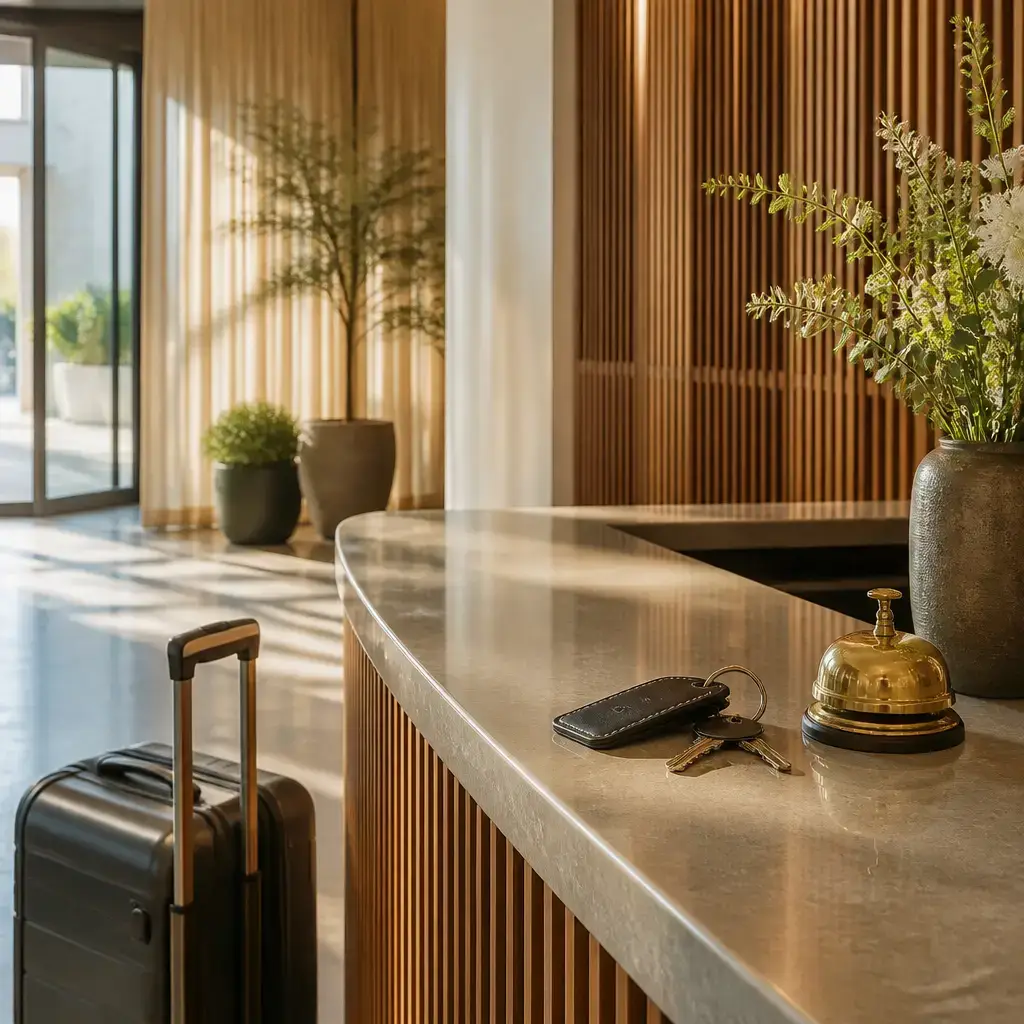
Use Checking out and returning a hotel key to practice Danish conversation, pronunciation, vocabulary, grammar, and quizzes.
Dialogue
Jeg vil gerne tjekke ud, tak.
yai vel YAIR-nuh CHEH-guh ooth, tahg. I'd like to check out, please.Har du din værelsesnøgle med?
hah doo deen VAIR-uhls-uhs-NUHR-luh meh? Do you have your room key with you?Ja, her er den.
yeh, hair air den. Yes, here it is.Jeg tjekker dig ud nu.
yai CHEH-guh dai ooth noo. I'll check you out now.Kan nogen hjælpe mig med min taske?
kan NOH-en YEL-buh mai meh meen TAS-guh? Could someone help me with my bag?Jeg kan bede nogen om at møde dig ved skranken.
yai kan BAY-thuh NOH-en om uh MUHR-thuh dai veh SGRANG-un. I can ask someone to meet you at the desk.Værelset var meget behageligt.
VAIR-ls-uhd vah MAY-uhth buh-HAI-uh-liht. The room was very comfortable.Det er jeg glad for at høre.
deh air yai glah fohr uh HUR-uh. I'm glad to hear that.Jeg håber, du får en sikker rejse.
yai HOH-buh, doo fohr en SEH-guh RIGH-suh. Have a safe trip.Sentence explanations
Jeg vil gerne tjekke ud, tak.
I'd like to check out, please.
- Jeg vil gerne
- I would like to
- tjekke ud
- check out
- tak
- please
More detail
Jeg vil gerne is a reusable Danish way to express a polite wish: “I would like to …”. Jeg means “I”. Vil is the present form of ville, which can express wanting or willingness; gerne adds the sense of gladly or willingly. Together, jeg vil gerne is followed by an infinitive: Jeg vil gerne lære dansk. — “I would like to learn Danish.” tjekke ud means “to check out”. Tjekke is the infinitive of tjekke, “to check”; ud is a particle that forms the meaning “check out” in this construction. Keep the particle with the verb when using this expression: Vi vil gerne tjekke ud. — “We would like to check out.” Tak literally means “thanks” or “thank you”, but in this position it is a brief polite addition corresponding to “please” in the fixed translation. The utterance combines the polite-wish pattern Jeg vil gerne with the infinitive phrase tjekke ud, then adds tak: “I would like to check out, please.”
Har du din værelsesnøgle med?
Do you have your room key with you?
- Har du
- do you have
- din
- your
- værelsesnøgle
- room key
- med
- with you
More detail
Har du is a yes/no question pattern: har is the present form of have, and du means “you.” Danish normally places the verb before the subject in this kind of question. Compare Du har ... (“You have ...”) with Har du ...? (“Do you have ...?”). Example: Har du tid? — “Do you have time?” din means “your” here. It is the possessive form used with one singular common-gender noun, as in en nøgle (“a key”); with a neuter noun, the corresponding form is dit, and with plural nouns it is dine. The form agrees with the possessed noun, not with the person who possesses it. værelsesnøgle means “room key.” It is a compound noun: værelse means “room,” and nøgle means “key.” The -s- links the parts in the compound; it is not a separate word meaning “is.” Danish compounds are written as one word. Example: hotelværelse — “hotel room.” med means “with.” At the end of this question, have ... med expresses having something with you or carrying it along. It does not mean that the key is merely physically together with someone in an unspecified way. Example: Jeg har min telefon med. — “I have my phone with me.” Together, Har du din værelsesnøgle med? asks whether the listener has their room key with them: “Do you have your room key with you?”
Ja, her er den.
Yes, here it is.
- Ja
- yes
- her
- here
- er
- is
- den
- it
More detail
Ja means “yes” and confirms the preceding question. It is a standalone affirmative word and does not change for person or number. her means “here,” referring to the place of the speaker or the place being indicated. Example: Bogen er her. — “The book is here.” er is the present-tense form of være (“to be”). In Danish, er is used with all persons in the present: jeg er (“I am”), du er (“you are”), and de er (“they are”). Example: Nøglen er her. — “The key is here.” den means “it” here. It is a third-person singular pronoun used for a common-gender referent; in the supplied context, it refers to the room key, værelsesnøgle. The corresponding neuter-gender pronoun is det, but the choice depends on the referent’s grammatical gender, not simply on its physical nature. Example: Jeg har bogen. Den er her. — “I have the book. It is here.” Together, Ja, her er den. forms the reusable pattern “Yes, here is it” in Danish word order, naturally translated as “Yes, here it is.” The location word her comes before er, and den identifies the previously requested item. In this exchange, the complete utterance confirms that the room key is present and indicates it to the other person.
Jeg tjekker dig ud nu.
I'll check you out now.
- tjekker … ud
- check ... out
- dig
- you
- nu
- now
More detail
tjekker ... ud is the present-tense form of the Danish verb construction tjekke nogen ud, meaning “check someone out.” The verb tjekke has the present form tjekker; Danish present-tense verbs do not change for subject person or number. ud is the particle that completes this construction, so it is best learned together with tjekker here. Example: Jeg tjekker ham ud. — “I’m checking him out.” dig is the object pronoun “you” for one person. It is used for both singular informal and formal “you” in modern Danish and does not mark the addressee’s gender. Example: Jeg ser dig. — “I see you.” nu means “now” and places the action at the present moment. It is an adverb, so it does not change form. Example: Jeg kommer nu. — “I’m coming now.” Together, Jeg tjekker dig ud nu. means “I’ll check you out now.” Jeg is “I,” tjekker ... ud expresses the action, dig identifies the person receiving that action, and nu specifies when it happens. In this fixed utterance, the present-tense Danish form is translated with “I’ll ...” because the action is presented as about to happen now.
Kan nogen hjælpe mig med min taske?
Could someone help me with my bag?
- Kan nogen
- Could someone
- hjælpe
- help
- mig
- me
- med
- with
- min
- my
- taske
- bag
More detail
Kan nogen is a reusable way to ask whether a person is able and willing to do something: “Could someone …?” Here kan is the present-tense form of kunne (“can/could”), and nogen means “someone” in this question. After the modal kan, the next verb is the infinitive without at. Example: Kan nogen åbne vinduet? — “Could someone open the window?” hjælpe means “to help.” It is the infinitive form used after kan; the same form also appears after other modal verbs. Example: Jeg kan hjælpe dig. — “I can help you.” mig means “me.” It is the object form corresponding to jeg (“I”): Jeg hjælper dig means “I help you,” while Du hjælper mig means “You help me.” In this utterance, mig is the person receiving the help. med means “with.” The pattern hjælpe nogen med noget means “help someone with something.” Example: Hun hjælper ham med arbejdet. — “She helps him with the work.” min means “my” before a singular common-gender noun. It agrees with the possessed noun, not with the possessor. Danish also uses mit before a singular neuter noun and mine before plural nouns: min taske, mit brev, mine tasker. taske means “bag.” Its common-gender indefinite form is en taske, and its plural is tasker. In the utterance, min taske means “my bag”; min identifies the bag as belonging to the speaker. Together, Kan nogen hjælpe mig med min taske? uses the question pattern [modal] [person] [infinitive] [recipient] med [thing] to ask whether someone could help the speaker with the speaker’s bag. The complete meaning is: “Could someone help me with my bag?”
Jeg kan bede nogen om at møde dig ved skranken.
I can ask someone to meet you at the desk.
- Jeg kan
- I can
- bede … om at
- ask ... to
- nogen
- someone
- møde
- meet
- dig
- you
- ved
- at
- skranken
- the desk
More detail
Jeg kan means “I can.” kan is the present-tense form of kunne (“can/be able to”) and is a modal verb. After a Danish modal such as kan, the next verb normally appears in the infinitive without at: Jeg kan hjælpe = “I can help.” Here Jeg is the first-person singular subject, “I.” bede means “ask” or “request” here. It is the infinitive of bede; the present form is beder. The reusable pattern is bede nogen om at + infinitive: “ask someone to do something.” In this sentence, om at introduces the requested action; it does not mean that the speaker is asking “about” something. nogen means “someone” in this sentence. It is an indefinite pronoun referring to an unspecified person. For example, Jeg spørger nogen means “I ask someone.” møde means “meet.” It is the infinitive after at in om at møde. The same form can be used after other modal verbs, but after a modal the at is normally absent: Jeg kan møde dig = “I can meet you.” dig means “you” as the object of the action. The Danish subject form is du, while the object form is dig: Du møder mig = “You meet me”; Jeg møder dig = “I meet you.” The fixed sentence does not specify anything further about the person addressed. ved is the spatial preposition “at” here. It locates the meeting at the desk. This is different from the verb vide, whose present form ved means “know”; the surrounding location phrase makes the prepositional use clear. skranken means “the desk” or “the counter.” It is the definite singular form of skranke (“desk/counter”): en skranke = “a desk/counter,” skranken = “the desk/counter.” The definite form presents the location as an identifiable desk or counter in the situation. Together, Jeg kan bede nogen om at møde dig ved skranken means “I can ask someone to meet you at the desk.” The structure is subject + modal + infinitive + someone + om at + requested action + object + location: “I can ask someone to meet you at the desk.”
Værelset var meget behageligt.
The room was very comfortable.
- Værelset
- the room
- var
- was
- meget
- very
- behageligt
- comfortable
More detail
Værelset means “the room” here. It is the definite singular form of værelse (“room”); et værelse is the corresponding indefinite form. The noun is neuter, and the definite suffix -t is added to form værelset. var is the past form of være (“to be”), so it means “was” here. This past form is used across grammatical persons and numbers: for example, jeg var means “I was” and de var means “they were.” meget means “very” when it intensifies an adjective. It comes before the adjective it strengthens, as in meget stor (“very big”). Here it increases the degree of behageligt. behageligt means “comfortable” here. It is the neuter singular form of the adjective behagelig, agreeing with the neuter singular subject værelse in this clause. With a common-gender singular noun, the form is behagelig; with a plural noun, it is behagelige. Example: En stol er behagelig. — “A chair is comfortable.” Together, Værelset is the subject, var places the description in the past, and meget behageligt describes the room with strong intensity. The whole utterance therefore means: “The room was very comfortable.”
Det er jeg glad for at høre.
I'm glad to hear that.
- Det
- that
- er
- is/am
- jeg
- I
- glad for
- glad about
- at høre
- to hear
More detail
Det means “that” here: it refers to the content being heard, as confirmed by the fixed translation. Grammatically, it is the object of høre, placed at the beginning of the sentence for emphasis; it is not the subject of er. Danish det can have other roles, so its exact function depends on the construction. er is the present-tense form of være, “to be.” The present form presents the speaker’s current reaction. A useful basic contrast is er “is/am/are” versus var “was/were”; er itself does not identify the person or number in this sentence. jeg means “I” and is the subject of the state described by glad. Danish subject pronouns include jeg “I,” du “you,” and han/hun “he/she.” For example, Jeg er glad means “I am glad,” while Du er glad means “You are glad.” glad means “glad” or “happy” here. It is an adjective used after er to describe the speaker’s state. Its comparative is gladere “happier/more glad,” and its superlative is gladest “happiest/most glad.” The following for completes the relevant pattern: glad for means “glad about” or “pleased about.” for is the preposition in glad for, linking the feeling to what the speaker is pleased about. With an infinitive, glad for at høre ... naturally means “glad to hear ...”. This for is not the separate conjunction meaning “because,” and it does not mean “for” in every other context. at høre means “to hear.” høre is the base form, and at marks the infinitive here. For example, Jeg kan høre musik means “I can hear music”; after the modal kan, the infinitive appears without at. The verb høre can also mean “listen to” in suitable contexts, but “hear” is the intended meaning here. Together, Det er jeg glad for at høre has the natural English meaning “I’m glad to hear that.” The fronted Det is the “that” content and functions as the object of høre; jeg er glad expresses the speaker’s present feeling, and for at høre links that feeling to hearing the content. This is a natural, reusable way to express pleasure about information just received.
Jeg håber, du får en sikker rejse.
Have a safe trip.
- håber
- hope
- får
- get / have
- sikker
- safe
- rejse
- trip
More detail
håber is the present-tense form of håbe (“to hope”) for jeg (“I”). The present form is used for a current hope: Jeg håber, du kommer. — “I hope you are coming.” får is the present-tense form of få (“to get; to have”). Here, in du får en sikker rejse, it means “you have” in the sense of experiencing a safe trip, not necessarily receiving an object. Du får en god dag. — “Have a good day.” sikker means “safe” here. It is an adjective describing rejse; because rejse is a common-gender singular noun introduced by en, the form is sikker. A useful contrast is usikker (“unsafe; uncertain”), but the appropriate meaning depends on what is being described. rejse is the common-gender noun en rejse, meaning “a trip” or “journey.” Its plural is rejser, and its definite singular form is rejsen (“the trip”). Jeg planlægger en rejse. — “I am planning a trip.” Together, Jeg håber means “I hope,” and du får en sikker rejse means “you have a safe trip.” The complete utterance is therefore “I hope you have a safe trip,” which is naturally used as a good wish before someone travels.
Grammar Points
tjekke nogen ud
tjekker dig ud
CHEH-guh dai oothchecks you out
I denne faste vending står objektet dig mellem verbet og partiklen ud.
værelse → værelset
Værelset
VAIR-ls-uhdthe room
Et intetkønsord får ofte endelsen -et i bestemt ental: værelse bliver værelset.
Danish Vocabulary
Jeg kan bede nogen om at møde dig ved skranken.
Jeg vil gerne tjekke ud, tak.
Har du din værelsesnøgle med?
Ja, her er den.
Kan nogen hjælpe mig med min taske?
Har du din værelsesnøgle med?
Jeg kan bede nogen om at møde dig ved skranken.
Jeg tjekker dig ud nu.
Jeg vil gerne tjekke ud, tak.
Kan nogen hjælpe mig med min taske?
Jeg vil gerne tjekke ud, tak.
Har du din værelsesnøgle med?
Quiz
Word Order
Arrange the words in the correct order.
I'd like to check out, please.
Show Answer
Jeg vil gerne tjekke ud, tak.Do you have your room key with you?
Show Answer
Har du din værelsesnøgle med?Yes, here it is.
Show Answer
Ja, her er den.Spelling
Tap the letters to spell the word.
to help
Show Answer
hjælpewould like to; gladly
Show Answer
gerneto meet
Show Answer
mødebag