10 minutes free every day
Continue audio lessons in the app
Word explanations appear automatically in sync with the audio.
No login required · synced translations · playback with the screen locked
Choose your learning language and open this lesson in the app.

About This Lesson
Use Packing a Bag for an Outing to practice Danish conversation, pronunciation, vocabulary, grammar, and quizzes.
Dialogue
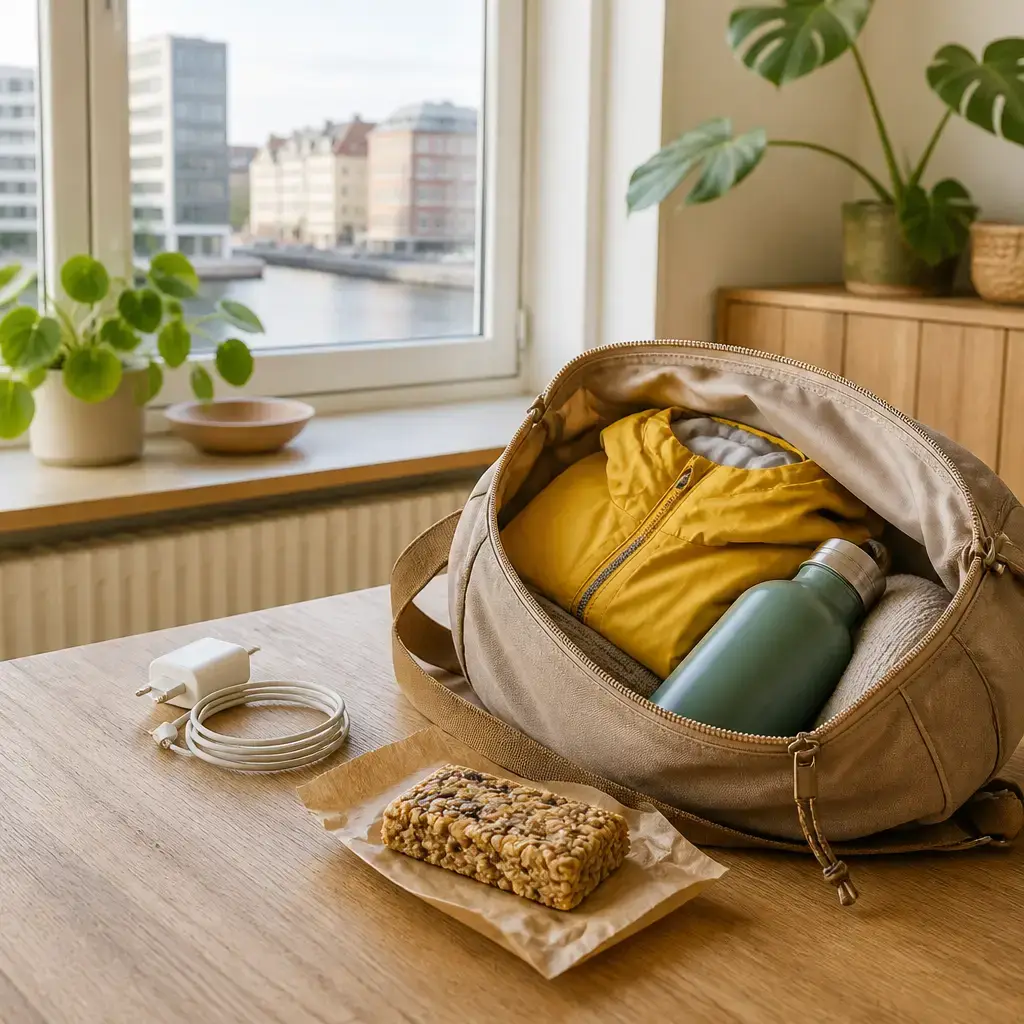
Jeg pakker min taske til udflugten.
yai PAH-guh min DES-guh teel OOTH-flook-den I'm packing my bag for the outing.Hvad mangler du stadig at tage med?
vath MAN-gluh doo STAY-thee eh TAY-uh MAY What do you still need to bring?Jeg har en oplader, en snack og en regnjakke.
yai hah en oh-PLAY-thuh, en SNEG oh en RAIN-YAH-guh I have a charger, a snack, and a raincoat.Det burde være nok, hvis vejret skifter.
deh BOO-thuh VAIR-uh NUHG, ves VAI-uh SGEEF-duh That should cover you if the weather changes.Skal jeg tage en ekstra flaske vand med?
sgal yai TAY-uh en EK-strah FLES-guh van MAY Should I bring an extra bottle of water?Tag en med, hvis gåturen tager længere tid end forventet.
TAI en MAY, ves GOH-too-uh TAY-uh LENG-uh teel en for-VEN-duhd Bring one in case the walk takes longer than expected.Min taske er fuld.
min DES-guh air fool My bag is full.Den er ikke for tung.
den air EG-uh for toong It isn't too heavy.Så er du klar til at tage af sted.
soh air doo glahr teel eh TAY-uh eh STAY Then you're ready to head out.Sentence explanations
Jeg pakker min taske til udflugten.
I'm packing my bag for the outing.
- Jeg
- I
- pakker
- pack; am packing
- min
- my
- taske
- bag
- til
- for; to
- udflugten
- the outing
More detail
Jeg means “I” here: the speaker is the subject. It is the first-person singular subject pronoun. For example, Jeg læser. means “I read” or “I am reading,” depending on context. pakker is the present-tense form of pakke, “to pack.” Danish present tense can describe an action happening now, so the fixed translation naturally uses “I’m packing.” The form does not itself mark a separate progressive tense. Example: Jeg pakker en kuffert. — “I am packing a suitcase.” min means “my” before a singular common-gender noun. It agrees with the possessed noun, not with the possessor: min taske uses min because taske is a common-gender noun. With a singular neuter noun, Danish uses mit, and with a plural noun, mine; for example, mit hus — “my house” and mine tasker — “my bags.” taske means “bag.” Its base form is singular and indefinite. The definite singular form is tasken, “the bag,” and the plural is tasker, “bags.” Example: Jeg har en taske. — “I have a bag.” til is a preposition that can connect something with its purpose or destination. In til udflugten, it gives the purpose or occasion: the bag is being packed for the outing. The following noun is definite in this expression, as shown by udflugten. udflugten means “the outing.” Its base form is udflugt, “outing” or “excursion”; the ending -en marks singular definite form: udflugt → udflugten. Example: Vi glæder os til udflugten. — “We are looking forward to the outing.” Together, Jeg pakker states that the speaker is packing now, min taske identifies the item as the speaker’s bag, and til udflugten gives the purpose. The complete meaning is: “I’m packing my bag for the outing.”
Hvad mangler du stadig at tage med?
What do you still need to bring?
- Hvad
- what
- mangler
- need / lack
- du
- you
- stadig
- still
- tage med
- bring / take along
More detail
Hvad asks for the thing being brought: “what.” It is the object of the question, not the person doing the action. For a person, Danish uses hvem (“who”): Hvem kommer? — “Who is coming?” mangler is the present-tense form of mangle, meaning “to lack” or, in this context, “to still need.” Danish commonly uses mangle with an infinitive phrase to express an outstanding need: Jeg mangler at pakke min taske. — “I still need to pack my bag.” The form mangler is present tense; the subject is identified by the following du. du means “you” and is the subject here. In this question, mangler du shows Danish question word order: the question word comes first, followed by the verb and then the subject. Compare the statement Du mangler ... — “You still need ...” with the question Hvad mangler du ...? — “What do you still need ...?” stadig means “still.” It indicates that the need remains at the relevant time. It modifies the situation of needing, not the item itself. For example, Jeg mangler stadig en oplader. means “I still need a charger.” tage med is a two-word verb meaning “take or bring along.” Its base form is tage; med adds the idea of taking something with oneself. Here it appears as an infinitive after at: at tage med. In another perspective, Jeg tager en regnjakke med. means “I am bringing a raincoat.” The form tage is the infinitive, while tager is the present tense. Together, Hvad mangler du stadig at tage med? asks which item the addressee still needs to bring along. The pattern is Hvad + present-tense verb + subject + stadig + at + infinitive + med. In the supplied packing context, it asks about an additional item that has not yet been included, without specifying what that item is.
Jeg har en oplader, en snack og en regnjakke.
I have a charger, a snack, and a raincoat.
- Jeg har
- I have
- oplader
- charger
- snack
- snack
- regnjakke
- raincoat
More detail
Jeg har means “I have” here: jeg is the first-person singular pronoun “I,” and har is the present-tense form of have for this subject. Danish uses har for possession in the present. Example: Jeg har en billet. — “I have a ticket.” oplader means “charger.” It is a noun, and the form used here is singular with the indefinite article en: en oplader, “a charger.” The article marks an unspecified singular countable item; it does not by itself state a particular number beyond the singular noun form. Example: Jeg har en oplader. — “I have a charger.” snack means “snack.” In this sentence it is also a singular noun with en: en snack. The word is used for a small item of food between meals. Example: Hun køber en snack. — “She buys a snack.” regnjakke means “raincoat.” It is a compound noun: regn refers to rain and jakke to a jacket, while the complete word names the garment. As a singular noun, it appears with en: en regnjakke. Example: Jeg tager en regnjakke med. — “I am bringing a raincoat.” Together, Jeg har en oplader, en snack og en regnjakke. means “I have a charger, a snack, and a raincoat.” The pattern Jeg har [item], [item] og [item] lists several things possessed by the speaker; og joins the final item to the preceding list. In the supplied context, these are the things the speaker has available to bring.
Det burde være nok, hvis vejret skifter.
That should cover you if the weather changes.
- Det burde
- that should
- være
- be
- nok
- enough
- hvis
- if
- vejret
- the weather
- skifter
- changes
More detail
Det burde combines the subject det (“that/it”) with the modal verb burde. Here det is the subject expressed as “that”; the sentence itself does not specify exactly what “that” refers to. Burde is the form commonly related to bør (“should/ought to”). Although it has a past-form shape, it does not necessarily refer to past time; here it expresses an expectation or assessment: “should.” Example: Det burde være let. — “That should be easy.” være is the infinitive of at være, “to be.” It follows the modal burde, as in the reusable pattern burde være (“should be”). Example: Det burde være nok. — “That should be enough.” nok means “enough” here, describing sufficiency. In this position after være, it says that something should be sufficient; it is not the separate use of nok meaning “probably.” hvis introduces a condition and means “if.” The clause after it states the condition under which the assessment applies. Example: Jeg går, hvis det regner. — “I’ll go if it rains.” vejret means “the weather.” Its base form is vejr; vejret is the definite form, with the neuter definite ending -et. The form identifies the weather as the definite topic in this context. skifter is the present-tense form of skifte, “to change” or “to shift.” The subject is vejret, so the clause literally says “if the weather changes.” Danish present tense can be used in an hvis clause for a possible or general condition; it does not by itself force a past or future reading. Example: Vejret skifter hurtigt. — “The weather changes quickly.” Together, Det burde være nok means “That should be enough,” and hvis vejret skifter adds the condition “if the weather changes.” The complete utterance therefore means “That should cover you if the weather changes,” with “cover you” expressing the contextual idea that the available preparation should be sufficient. The wording is neutral and reusable for assessing whether something will be sufficient under a condition.
Skal jeg tage en ekstra flaske vand med?
Should I bring an extra bottle of water?
- Skal jeg
- Should I
- tage … med
- bring along
- ekstra
- extra
- flaske
- bottle
- vand
- water
More detail
Skal jeg combines skal with jeg. Here skal is the present form of skulle and expresses what the speaker should or is expected to do; with jeg, it forms a first-person question: “Should I …?” In a yes/no question, skal comes before the subject: Skal jeg ...? Compare the statement order Jeg skal ... (“I should / am going to ...”). tage ... med is the reusable expression “bring/take along.” The verb is tage, the infinitive used after skal; med completes the expression and appears after the object here. The form tage is the infinitive/base form of tage; its past form is tog, as in Jeg tog en flaske med (“I brought a bottle along”). ekstra means “additional” or “extra.” It is an adjective placed before the noun it describes. For example, en ekstra stol means “an extra chair.” flaske means “bottle.” With the indefinite article, the singular phrase is en flaske (“a bottle”); the definite singular form is flasken (“the bottle”). vand means “water.” It is normally used as a mass noun when referring to water generally. en flaske vand means “a bottle of water”: vand specifies what the bottle contains, rather than naming a second bottle. Together, Skal jeg tage en ekstra flaske vand med? asks whether the speaker should bring along one additional bottle of water. The indefinite article en marks flaske as singular and indefinite, while ekstra describes that bottle. The question pattern is reusable as Skal jeg tage ... med? (“Should I bring ... along?”).
Tag en med, hvis gåturen tager længere tid end forventet.
Bring one in case the walk takes longer than expected.
- Tag
- bring; take
- en
- one
- med
- along
- hvis
- if; in case
- gåturen
- the walk
- tager
- takes
- længere
- longer
- tid
- time
- end
- than
- forventet
- expected
More detail
Tag is the imperative of tage, “to take.” With med, it forms tage med, meaning to take or bring something along. The imperative addresses the listener directly: Tag ... = “Bring ...” or “Take ...”. en means “one” here: one unspecified item of the relevant kind. In this sentence, the item is understood from the situation rather than named. En can also be the indefinite article before a singular common-gender noun, but here it stands on its own as a pronoun-like replacement for that noun. It does not by itself state a numerical count in every use. med means “along” in the construction tage med. It contributes the idea that the item should accompany the person, rather than merely be taken somewhere. hvis introduces a condition and can be translated “if” or, in this warning-like context, “in case.” A reusable pattern is X, hvis Y = “X if/in case Y.” gåturen means “the walk.” It is the definite form of gåtur (“walk”), so gåtur refers to a walk in general and gåturen to the particular walk meant here. The ending -en marks definiteness for this noun; it is part of the observed noun form, not a separate word. tager is the present form of tage (“take”). Danish present-tense verbs do not change for the subject’s person in the way English verbs do, so the same form can occur with different subjects. Here, in gåturen tager ..., it means “takes” because the walk is the subject. længere means “longer.” It is the comparative form of lang (“long”): lang → længere (“long” → “longer”). The comparison here concerns duration, because it modifies the phrase længere tid (“longer time,” naturally “longer” or “more time” in English). tid means “time.” In længere tid, it refers to an amount or duration of time. The compact pattern tage længere tid means “take longer.” end introduces the second side of a comparison and means “than.” Thus længere ... end ... corresponds to “longer ... than ...”. forventet means “expected.” It is the form used in the shortened comparison længere tid end forventet, literally “longer time than expected.” The omitted comparison is understood from context: the duration is longer than what was expected, without the sentence specifying who expected it. Together, Tag en med means “Bring one along,” and hvis gåturen tager længere tid end forventet means “if the walk takes longer than expected.” The complete utterance is therefore: “Bring one in case the walk takes longer than expected.”
Min taske er fuld.
My bag is full.
- Min
- my
- taske
- bag
- er
- is
- fuld
- full
More detail
Min means “my” and marks possession by the speaker. It is used with a common-gender singular possessed noun; mit is used with a neuter singular noun, and mine with a plural noun. Example: min bog means “my book,” while mit hus means “my house.” taske means “bag.” Its plural is tasker. Here it is the possessed noun in min taske (“my bag”). Er is the present-tense form of være, “to be.” It links the subject to a description. Example: Bogen er ny means “The book is new.” Fuld means “full.” It is the common-gender singular form of the adjective. With a neuter singular noun it becomes fuldt, and with plural or definite forms it becomes fulde. Example: Glasset er fuldt means “The glass is full.” Together, min taske identifies the bag as belonging to the speaker, and er fuld states its condition. The complete utterance means “My bag is full.”
Den er ikke for tung.
It isn't too heavy.
- Den
- it
- er
- is
- ikke
- not
- for
- too
- tung
- heavy
More detail
Den means “it” here and refers to the singular common-gender noun already mentioned in context: taske (“bag”). Danish pronouns agree with the grammatical gender and number of the noun they replace: den is used for singular common-gender nouns, while det is used for singular neuter nouns. This agreement is separate from the thing’s real-world identity. er is the present form of at være, “to be.” The pattern den er ... can describe the current state or property of something. Example: Tasken er fuld. — “The bag is full.” ikke negates the clause. In this sentence, it makes the statement “it is not too heavy” rather than “it is too heavy.” for means “too” before an adjective when a property exceeds an acceptable or intended degree. This is different from meget, “very”: for tung means “too heavy,” while meget tung means “very heavy.” tung means “heavy.” It is the base form of the adjective, used here after er to describe the singular subject. Its comparative form is tungere, “heavier,” and its superlative is tungest, “heaviest.” Example: Tasken er tungere. — “The bag is heavier.” Together, Den er identifies the previously mentioned bag and describes its current weight, ikke reverses the statement, and for tung expresses that its weight does not exceed the relevant acceptable degree. The complete meaning is: “It isn’t too heavy.”
Så er du klar til at tage af sted.
Then you're ready to head out.
- Så
- then
- er du
- you are
- klar
- ready
- til at
- to
- tage af sted
- head out
More detail
Så means “then” here and links this statement to what has just been established. At the beginning of this Danish main clause, it occupies the first position, so the finite verb comes before the subject: Så er du .... er du contains er, the present-tense form of være (“to be”), and du, the second-person singular pronoun (“you”). Danish uses the same present form er with different subjects: jeg er (“I am”), du er (“you are”), and de er (“they are”). Here er du is not by itself a question; the initial Så gives the main clause verb–subject order, while the period and the fixed translation support a statement. klar is an adjective meaning “ready” in this sentence. The observed form is the common-gender singular form; Danish also has the neuter singular form klart and the plural form klare. The pronoun du is second-person singular and does not itself identify a grammatical gender. Example: Jeg er klar. — “I am ready.” til at introduces an infinitive phrase after an adjective such as klar. The reusable pattern is klar til at + infinitive, meaning “ready to ...”. The at here is the infinitive marker, not the English preposition “at”. tage af sted is a fixed verb phrase meaning “to head out” or “to leave”. Its verb is tage, whose basic meaning is “take” in many contexts; together with af sted, it has the movement meaning used here. In the present tense, the verb is tager: Jeg tager af sted. — “I’m heading out.” Together, Så + the verb–subject order er du + klar til at + tage af sted produces: “Then you’re ready to head out.”
Grammar Points
hvis + sætning
Hvis vejret skifter, tager vi en regnjakke med.
ves VAI-uh SGEEF-duh, TAY-uh vee en RAIN-YAH-guh MAYIf the weather changes, we bring a raincoat along.
hvis introduces a condition. In a sentence-initial hvis-clause, the verb comes before the subject in the main clause.
at + infinitiv
at tage af sted
eh TAY-uh eh STAYto head out
at comes before the infinitive when a Danish verb is used in its basic “to…” form.
Danish Vocabulary
- Gender
- common
Jeg pakker min taske
- Gender
- common
- Gender
- common
- Gender
- common
- Gender
- common
- Gender
- neuter
Quiz
Word Order
Arrange the words in the correct order.
I'm packing my bag for the outing.
Show Answer
Jeg pakker min taske til udflugten.My bag is full.
Show Answer
Min taske er fuld.It isn't too heavy.
Show Answer
Den er ikke for tung.Spelling
Tap the letters to spell the word.
outing
Show Answer
udflugtenpack
Show Answer
pakkerbag
Show Answer
taskestill