10 minutes free every day
Continue audio lessons in the app
Word explanations appear automatically in sync with the audio.
No login required · synced translations · playback with the screen locked
Choose your learning language and open this lesson in the app.

About This Lesson
Use Reporting a Lost Wallet to practice Danish conversation, pronunciation, vocabulary, grammar, and quizzes.
Dialogue
Jeg tror, jeg har glemt min pung.
yai TRAW, yai ha GLEM'd min PONG. I think I left my wallet behind.Lad os gå tilbage til receptionen og melde det.
lah oss GOH til-BAI-uh tel reh-sep-SHŌ-nən aw MEL-də deh. Let's go back to the front desk and report it.Den er brun med en lille sølvknap.
den air broon meh en LIH-lə SUHL-knab. It's brown with a small silver button.Den detalje vil hjælpe dem med at tjekke hittegodset.
den deh-TAIL-yuh vel YEL-bə dem meh CHEK-ə HED-uh-goss-uh. That detail will help them check lost property.Hvad skal jeg sige, hvis de spørger om detaljer?
vah SGAL yai SEE-uh, vess dee SPUHR-ər om deh-TAIL-yər. What should I say if they ask for details?Beskriv pungen, men hold personlige oplysninger private.
bə-SKREE-oo PONG-ən, men HULL per-SOHN-lee-uh OP-loos-ning-er pree-VAH-də. Describe the wallet, but keep personal information private.Jeg kan skrive en kort note til dem.
yai ken SKREE-oo en KOR'd NOH-də tel dem. I can write a short note for them.Det vil gøre rapporten tydelig.
deh vel GUH-uh rah-POHR-dən TEW-thuh-lee. That will make the report clear.Sentence explanations
Jeg tror, jeg har glemt min pung.
I think I left my wallet behind.
- Jeg
- I
- tror
- think; believe
- jeg har
- I have
- glemt
- forgotten
- min
- my
- pung
- wallet
More detail
Jeg means “I” and is the subject pronoun here. The same form is used for the speaker whether the speaker is one person of any gender. Example: Jeg kommer. — “I am coming.” tror is the present-tense form of tro, “to think” or “to believe.” In this sentence it introduces the speaker’s uncertain belief: “I think …” Example: Jeg tror, det regner. — “I think it is raining.” jeg har combines the subject jeg (“I”) with har, the present form of have. Together with a following past participle, har forms a perfect construction: it presents a past event as relevant now. Here, the repeated jeg is the subject of the following clause, not a new participant. glemt is the past participle of glemme, “to forget.” The form har glemt means “have forgotten.” In this context, with min pung, it conveys that the speaker has left the wallet behind or forgotten it, matching the fixed translation. Example: Jeg har glemt min nøgle. — “I have forgotten my key.” min means “my” before a singular common-gender noun. Its form is selected by the possessed noun, not by the speaker: min is used with a common-gender singular noun, mit with a neuter singular noun, and mine with a plural noun. Example: min bog — “my book”; mit hus — “my house.” pung means “wallet.” It is a common-gender singular noun, which is why the possessive form is min in min pung. Example: Hvor er min pung? — “Where is my wallet?” The utterance is assembled as Jeg tror (“I think”) + the comma-separated clause jeg har glemt min pung (“I have forgotten my wallet”). Thus the whole meaning is: “I think I left my wallet behind.”
Lad os gå tilbage til receptionen og melde det.
Let's go back to the front desk and report it.
- Lad os
- let’s
- gå
- go
- til
- to
- tilbage
- back
- receptionen
- the front desk
- melde
- report
- det
- it
More detail
Lad os is the reusable Danish pattern for suggesting a joint action: literally an imperative form of lade (“let”) plus os (“us”). It is followed by an infinitive, so Lad os gå means “Let’s go.” The same pattern can introduce another coordinated action: Lad os spise. — “Let’s eat.” gå means “go” here. Its base form is gå; after Lad os, Danish uses this infinitive without an extra word meaning “to.” The form is also used in many movement expressions, such as gå hjem (“go home”). til marks the destination or endpoint “to.” It is a preposition, so til receptionen means “to the front desk.” This differs from i (“in”) when the focus is being inside a place rather than moving toward it. tilbage means “back” or “back again.” In gå tilbage, it specifies movement back toward an earlier place or situation. For example, Hun går tilbage. — “She goes back.” receptionen means “the front desk” in this context. The noun is reception, and -en marks its definite singular form: reception (“a reception/front desk”) → receptionen (“the reception/front desk”). Danish definite forms are attached to the noun rather than normally expressed by a separate word before it. melde means “report” here. It is the infinitive form, coordinated with gå after Lad os: Lad os gå ... og melde ... means “Let’s go ... and report ... .” A useful related expression is melde noget (“report something”); the object follows the verb. det means “it” here. It is a Danish neuter singular pronoun, but the fixed sentence does not grammatically identify a more specific referent. The translation establishes the intended object as “it”; det can also refer to a neuter noun or to a situation, depending on context. For example, Jeg ser det. — “I see it.” Together, Lad os gå tilbage til receptionen proposes that the speaker and the addressee go back to the front desk. og melde det adds a second coordinated action, “and report it,” with the same understood joint subject. The whole utterance is therefore: “Let’s go back to the front desk and report it.”
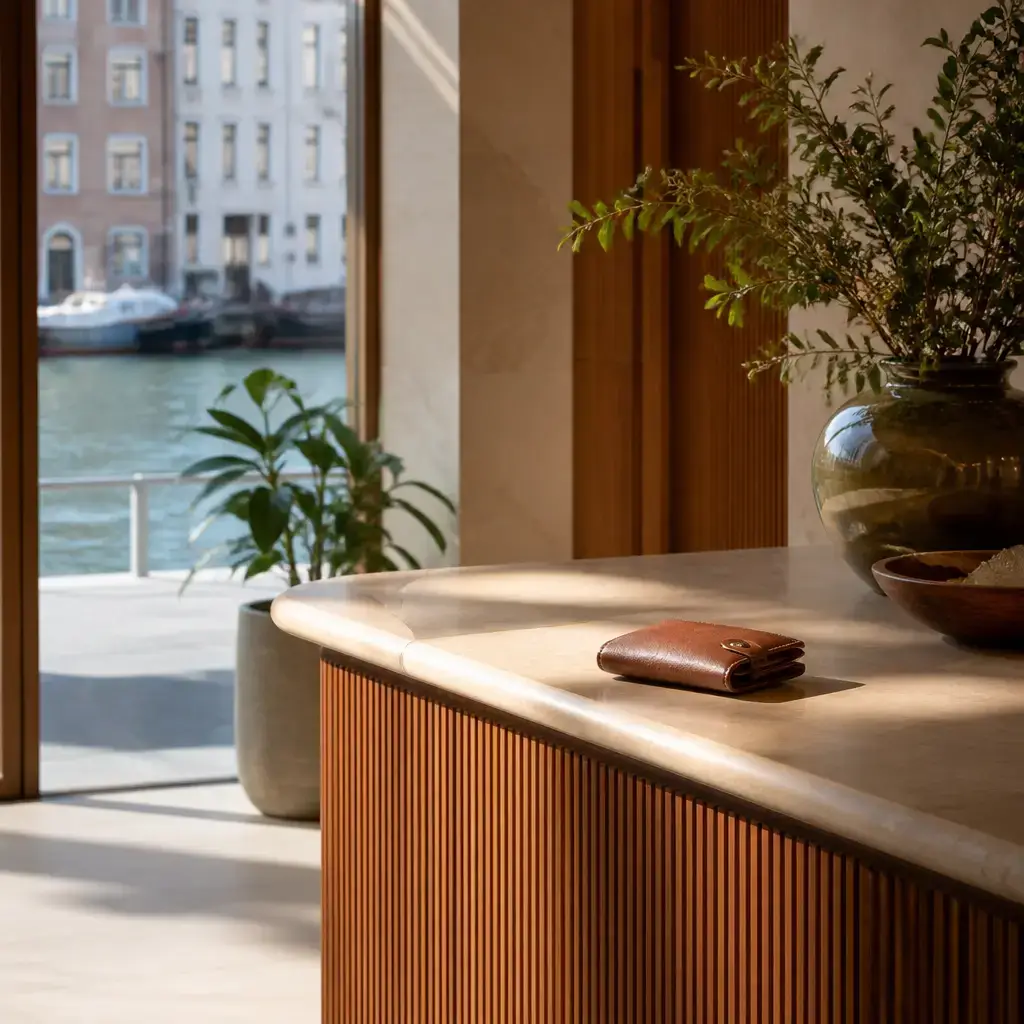
Den er brun med en lille sølvknap.
It's brown with a small silver button.
- Den er
- It is
- brun
- brown
- med
- with
- lille
- small
- sølvknap
- silver button
More detail
Den er means “it is” here. Den is a Danish third-person singular pronoun used with a common-gender noun or an understood common-gender referent. Its exact referent is supported by the fixed translation as “it,” while the sentence describes that item. Er is the present-tense form of være (“to be”): jeg er, du er, den er, and so on. brun means “brown.” It is the adjective in its common-gender singular form. With a neuter singular noun, the form is brunt, and with a plural noun it is brune: en brun taske, et brunt mærke, brune tasker. In this sentence, brun is a predicate adjective after er, describing the item’s color. med means “with.” It introduces something that accompanies or is present on the item. For example: Hun kommer med en taske. — “She is coming with a bag.” lille means “small” in the form used with a common-gender singular indefinite noun: en lille .... Its neuter singular form is et lille ..., and its plural form is små: små knapper — “small buttons.” sølvknap means “silver button.” It is a compound noun: sølv (“silver”) + knap (“button”). The compound is singular and indefinite here; the preceding article en makes the whole noun phrase “a silver button.” Useful forms are sølvknappen (“the silver button”) and sølvknapper (“silver buttons”). Together, Den er brun says that the item is brown. med en lille sølvknap adds that it has or is accompanied by a small silver button. The complete meaning is: “It’s brown with a small silver button.”
Den detalje vil hjælpe dem med at tjekke hittegodset.
That detail will help them check lost property.
- Den
- that
- detalje
- detail
- vil
- will
- hjælpe
- help
- dem
- them
- med at
- with/to
- tjekke
- check
- hittegodset
- lost property
More detail
Den means “that” here and points to the singular noun detalje. Danish uses den with common-gender singular nouns and det with neuter singular nouns; plural forms use de. The form agrees with the noun it identifies, not with the people mentioned later. detalje means “detail.” Its plural is detaljer. In this sentence it is the subject of the clause: “that detail” is the thing expected to provide help. vil is the modal verb ville, used here before an infinitive to express what will happen: “will.” Danish normally uses the infinitive without at after this modal. For example, Det vil hjælpe. means “It will help.” hjælpe is the infinitive of hjælpe, “to help.” The pattern vil hjælpe means “will help.” The person receiving the help can follow as an object, as in Det vil hjælpe mig (“It will help me”). dem is the object form meaning “them.” The corresponding subject form is de: De hjælper means “They help,” while Det hjælper dem means “It helps them.” med at introduces an activity that the help makes easier or supports. In the pattern hjælpe nogen med at + infinitive, the meaning is “help someone to do something.” tjekke is the infinitive “to check.” After med at, it names the activity being helped: hjælpe dem med at tjekke means “help them check.” hittegodset means “the lost property” in this sentence. It is the definite form of the noun hittegods; the ending -et marks the definite singular form. The definite form presents the property as identifiable in the situation, rather than making a general statement about lost property. Together, Den detalje is the subject, vil hjælpe says that it will provide help, dem identifies the people receiving that help, and med at tjekke hittegodset specifies the activity. The complete meaning is: “That detail will help them check lost property.”
Hvad skal jeg sige, hvis de spørger om detaljer?
What should I say if they ask for details?
- Hvad
- what
- skal jeg
- should I
- sige
- say
- hvis
- if
- spørger
- ask
- detaljer
- details
More detail
Hvad means “what” here: it asks for the content of what should be said. Danish also uses hvem for “who” and hvornår for “when”, but those ask about different information. skal jeg combines skal with jeg. In this sentence, skal expresses what the speaker ought to do, so the reusable pattern is Hvad skal jeg + infinitive? — “What should I …?” The subject jeg means “I”. sige is the infinitive “to say”. After the modal skal, Danish uses the infinitive without an infinitive marker: jeg skal sige means “I should say”. The present-tense form is siger, as in jeg siger — “I say” or “I am saying”. hvis introduces a condition and means “if”. It can introduce a clause such as hvis de spørger — “if they ask”. spørger is the present-tense form of spørge, “to ask”. Danish present-tense verbs do not change according to the subject’s person or number, so de spørger means “they ask”, while jeg spørger means “I ask”; the pronoun identifies the subject here. detaljer is the plural indefinite form of detalje, “detail”. The singular indefinite form is en detalje, and the plural definite form is detaljerne, “the details”. In this utterance, om detaljer means “about details”; om connects the verb “ask” with the topic being asked about. Together, Hvad skal jeg sige asks what the speaker ought to say, and hvis de spørger om detaljer sets the condition “if they ask about details”. The complete meaning is: “What should I say if they ask for details?”
Beskriv pungen, men hold personlige oplysninger private.
Describe the wallet, but keep personal information private.
- Beskriv
- describe
- pungen
- the wallet
- hold
- keep
- personlige
- personal
- oplysninger
- information
- private
- private
More detail
Beskriv is the imperative of beskrive, “to describe.” The imperative gives a direct instruction and commonly uses the verb stem without the infinitive ending: beskriv. Example: Beskriv billedet. — “Describe the picture.” pungen means “the wallet.” It is the definite singular form of pung (“wallet”): en pung → pungen. The ending -en marks a definite common-gender singular noun here; it does not itself express a separate meaning such as “one.” hold is the imperative of holde, “to keep” or “to hold.” In this sentence it means “keep” in the sense of maintaining something in a certain state. Example: Hold døren lukket. — “Keep the door closed.” personlige means “personal” here. It is the form of personlig used with oplysninger, which is plural. Danish adjectives commonly take -e with a definite noun phrase or with a plural noun: personlig information is singular indefinite, while personlige oplysninger is plural. oplysninger means “information” here, specifically information or details. It is a plural form of oplysning; Danish often uses this plural noun when referring to pieces or kinds of information. Example: Jeg mangler flere oplysninger. — “I need more information.” private means “private.” It is the plural form used with oplysninger; after holde it describes the state that the information should remain in. Compare privat with a singular common-gender noun, as in privat information, and private with plural oplysninger. Together, Beskriv pungen gives the direct instruction “Describe the wallet.” men connects this with a contrasting instruction, and hold personlige oplysninger private means “keep personal information private.” The complete utterance is therefore: “Describe the wallet, but keep personal information private.”
Jeg kan skrive en kort note til dem.
I can write a short note for them.
- Jeg kan
- I can
- skrive
- write
- kort
- short
- note
- note
- til dem
- for them
More detail
Jeg kan means “I can” here. Jeg is the first-person singular subject pronoun, “I”. kan is the present form of kunne, “can/be able to”. A modal such as kan is followed by an infinitive: Jeg kan skrive = “I can write”. skrive is the infinitive “to write”. After kan, Danish uses this bare infinitive without at. Compare the present form skriver: Jeg skriver en note. = “I am writing a note.” kort describes note as “short”. Its form agrees with the noun phrase: en kort note uses kort with a common-gender singular noun; with a neuter noun, the corresponding form is kort, and with plural or definite noun phrases, the form is commonly korte, as in korte noter = “short notes”. note is the noun “note”. Its indefinite singular form is en note; useful related forms are noten = “the note” and noter = “notes”. In this sentence it is the thing being written. til dem means “for them” in this sentence. til is the preposition “to/for”, and dem is the object form used for “them”. For a single person, Danish may use ham (“him”) or hende (“her”), while dem refers to multiple people here according to the fixed translation. Together, Jeg kan skrive expresses the ability or possibility “I can write”. en kort note is the object, “a short note”, and til dem identifies the intended recipients: “for them”. The complete utterance therefore means “I can write a short note for them.”
Det vil gøre rapporten tydelig.
That will make the report clear.
- Det
- that
- vil
- will
- gøre
- make
- rapporten
- the report
- tydelig
- clear
More detail
Det means “that” here and functions as the subject. In this sentence, the fixed translation identifies it as referring to the action or situation under discussion, rather than naming a new participant. Danish det is also used in other constructions, so its specific reference comes from context. vil expresses what is expected to happen in the future: “will.” It is the present-tense form of ville, which can also express “would” or “wanted to” in other contexts. Here, vil is followed by the infinitive gøre, without an infinitive marker. gøre means “make” here. Its base form is gøre; after a modal such as vil, Danish uses this infinitive form. A reusable pattern is vil + infinitive: Det vil hjælpe. — “That will help.” rapporten means “the report.” The noun is rapport, and the ending -en marks singular definite form: rapport “a report” → rapporten “the report.” The ending belongs to the noun, not to the adjective. Danish definite marking is often attached to the noun rather than expressed by a separate word. tydelig means “clear.” It is the adjective tydelig used after gøre to describe the resulting state of rapporten. In this use, gøre X tydelig means “make X clear.” The adjective agrees with the noun it describes: en tydelig rapport “a clear report,” but et tydeligt svar “a clear answer” and tydelige rapporter “clear reports.” Together, Det vil gøre rapporten tydelig. has the pattern subject + vil + infinitive + object + adjective: “That will make the report clear.” The sentence presents the report as becoming clear as a result of the action referred to by Det. In a more general example, God belysning vil gøre teksten tydelig. means “Good lighting will make the text clear.”
Grammar Points
Bestemt form: substantiv + -en/-et
pung → pungen; rapport → rapporten; hittegods → hittegodset
PONG → PONG-ən; rah-POHR → rah-POHR-dən; HED-uh-goss → HED-uh-goss-uhthe wallet; the report; the lost property
Danish often marks “the” by adding -en to common-gender nouns and -et to neuter nouns.
Adjektiv i flertal: -e
personlige oplysninger
per-SOHN-lee-uh OP-loos-ning-erpersonal information
Before a plural noun, the adjective usually takes -e: personlig becomes personlige.
Danish Vocabulary
Den er brun
- Gender
- common
Den detalje
har glemt
Lad os gå tilbage
vil hjælpe dem
en lille sølvknap
melde det
- Gender
- common
min pung
- Gender
- common
til receptionen
- Gender
- common
en lille sølvknap
tjekke hittegodset
Jeg tror
Quiz
Word Order
Arrange the words in the correct order.
That will make the report clear.
Show Answer
Det vil gøre rapporten tydelig.Spelling
Tap the letters to spell the word.
wallet
Show Answer
pungreport
Show Answer
meldethink
Show Answer
trorforgotten; left behind