10 minutes free every day
Continue audio lessons in the app
Word explanations appear automatically in sync with the audio.
No login required · synced translations · playback with the screen locked
Choose your learning language and open this lesson in the app.

About This Lesson
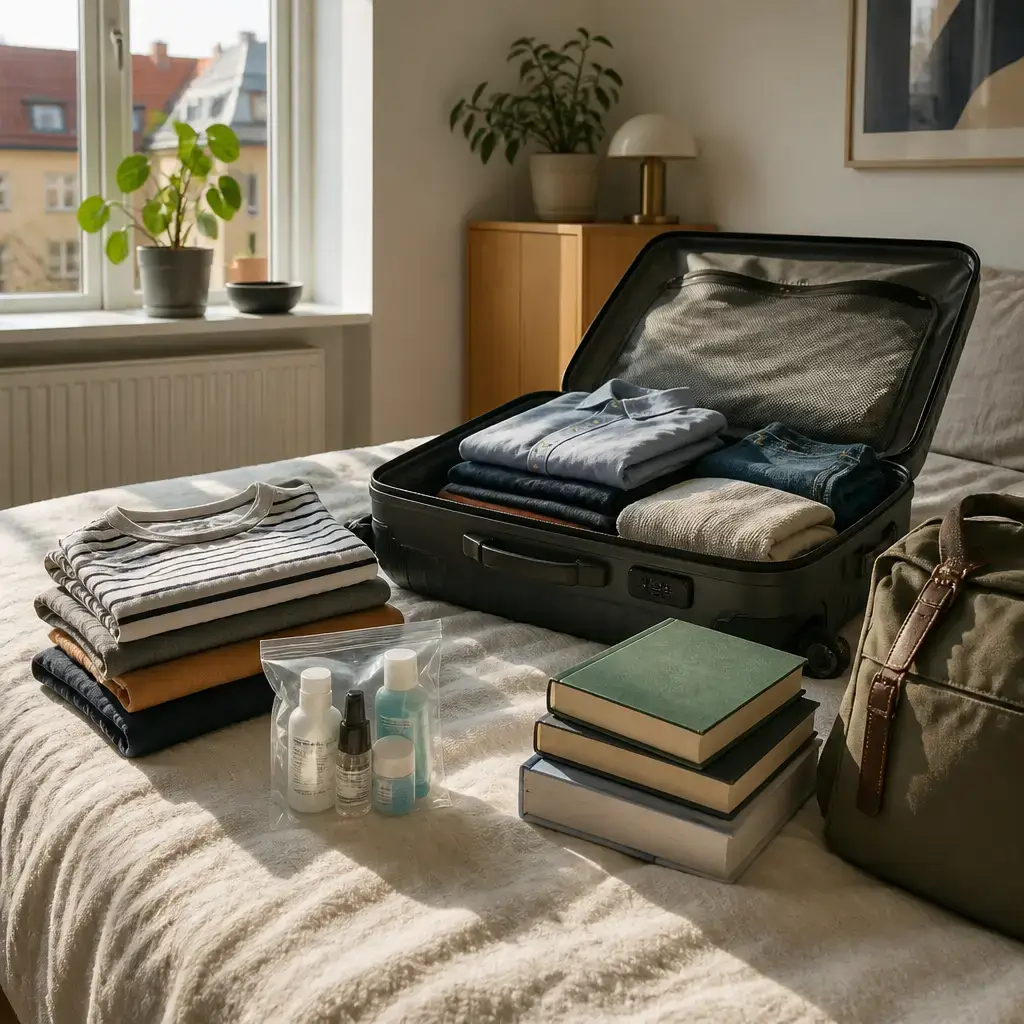
Use Organizing a suitcase to practice Danish conversation, pronunciation, vocabulary, grammar, and quizzes.
Dialogue
Min kuffert er rodet, og vi rejser i morgen.
men KOO-fud air ROH-thuh, oh vee RYE-suh ee MOR-n. My suitcase is messy, and we leave tomorrow.Fold skjorterne først for at spare plads.
FOHL SHUR-dnuh FUHST fohr uh SPAIR plass. Fold the shirts first to save space.Skal jeg skille væsker fra tøjet?
sgel yai SGEH-luh VES-guh frah TUH-th? Should I separate liquids from clothes?Læg væsker i en plastikpose, før du pakker dem.
lay VES-guh ee en plahs-DEEG-poh-suh, fuhr doo PAH-guh dem. Put liquids in a plastic bag before you pack them.Det føles, som om kufferten er tæt på vægtgrænsen.
deh FUH-lus, som om KOO-fudn air ted poh VEG-gren-sun. The suitcase feels close to the weight limit.Så flyt de tunge bøger over i din rygsæk.
saw FLOOED dee TONG-uh BUH-uh OH-vuh ee deen RUHK-say. Then move heavy books to your backpack.Det gør kufferten nemmere at lukke.
deh GUH KOO-fudn NEM-uh uh LOO-guh. That makes the suitcase easier to close.Nu burde den være klar til turen.
noo BOO-thuh den VAIR-uh klah tehl TOO-un. It should be ready for the trip now.Sentence explanations
Min kuffert er rodet, og vi rejser i morgen.
My suitcase is messy, and we leave tomorrow.
- Min
- my
- kuffert
- suitcase
- er
- is
- rodet
- messy
- vi
- we
- rejser
- leave
- i morgen
- tomorrow
More detail
Min means “my” here and is the possessive form used with a singular common-gender noun. Compare mit with a singular neuter noun and mine with plural nouns: min kuffert, mit værelse, mine kufferter. kuffert means “suitcase.” It is a singular, indefinite noun; the definite form is kufferten (“the suitcase”). The possessive min identifies it as belonging to the speaker. er is the present form of være (“to be”). Danish uses it to link a subject with a description: Kufferten er tung. — “The suitcase is heavy.” rodet means “messy” or “untidy” here. The form rodet is used with a singular noun in the indefinite pattern, including both common-gender and neuter nouns: en rodet kuffert and et rodet værelse. With a definite noun, the adjective commonly appears as rodede: den rodede kuffert — “the messy suitcase.” vi means “we,” the first-person plural pronoun. It is the subject of the second clause. The corresponding object form is os (“us”), as in Hun ser os. — “She sees us.” rejser is the present form of rejse (“to travel” or “to leave/depart”). In this sentence, with i morgen, it means that the group will leave tomorrow. Danish can use the present form for a planned or scheduled future event when a future-time expression makes the timing clear: Vi rejser på mandag. — “We leave on Monday.” i morgen means “tomorrow.” It is a time expression made from i (“in/on”) and morgen (“morning”), but the complete expression means “tomorrow”; it should be learned as a fixed time phrase. The connector og means “and” and joins the two clauses. The first clause, Min kuffert er rodet, says that the speaker’s suitcase is messy. The second, vi rejser i morgen, says that the group will leave tomorrow. Together, the utterance means: “My suitcase is messy, and we leave tomorrow.”
Fold skjorterne først for at spare plads.
Fold the shirts first to save space.
- Fold
- fold
- skjorterne
- the shirts
- først
- first
- for at
- in order to
- spare
- save
- plads
- space
More detail
Fold is the imperative of folde (“to fold”). In this sentence it is a direct instruction. Danish imperatives commonly use the verb stem, so the same form can address one or more people. Compare at folde (“to fold”) as the infinitive. skjorterne means “the shirts” here. Its base noun is skjorte (“shirt”); skjorterne is the definite plural, with -ne marking “the” for a plural noun. The form therefore refers to shirts as a definite group, without specifying how many. først means “first” and places the folding before the other packing actions. It is an adverb and does not change for number or gender. Compare sidst (“last”) when an action comes at the end. for at introduces a purpose clause, meaning “in order to.” The verb after this construction is in the infinitive: for at spare (“in order to save”). This is a useful pattern for expressing the aim of an action: Jeg går ud for at købe brød. — “I am going out to buy bread.” spare is the infinitive of spare, meaning “to save” in the sense of avoiding the use of something or making something last longer. In spare plads, it means to use less space. This is different from gemme, which commonly means “to store” or “to keep” something. Example: Vi sparer plads. — “We save space.” plads means “space” here, specifically room available inside the suitcase. It is commonly used as an uncountable noun in this meaning. The same noun can also mean “place” in other contexts, so the surrounding verb phrase determines the intended sense here. Together, Fold skjorterne gives the instruction “fold the shirts,” først says to do this first, and for at spare plads gives the purpose: “in order to save space.” The complete utterance is therefore “Fold the shirts first to save space.”
Skal jeg skille væsker fra tøjet?
Should I separate liquids from clothes?
- Skal jeg
- Should I
- skille
- separate
- væsker
- liquids
- fra
- from
- tøjet
- the clothes
More detail
Skal jeg means “Should I …?” Here, skal is the present form of skulle, followed by the subject jeg in a question. This pattern can ask whether the speaker ought to do something or should proceed: Skal jeg åbne vinduet? — “Should I open the window?” skille means “separate.” It is the infinitive form after skal; Danish modal verbs such as skal are followed by an infinitive without at. The pattern skille A fra B means “separate A from B.” væsker means “liquids.” Its base form is væske; væsker is the plural form. The sentence refers to liquids as a category, without specifying a number. fra means “from” and marks what something is separated away from. In skille væsker fra tøjet, it introduces the material being separated from the liquids. tøjet means “the clothes.” The base noun is tøj; tøjet is its definite singular form, literally referring to the clothing as a whole. Danish uses the suffix -et here to mark definiteness for this noun. Together, Skal jeg + infinitive forms a question about whether the speaker should perform the action. skille væsker fra tøjet specifies that the action is to separate liquids from the clothes. The complete meaning is: “Should I separate liquids from clothes?”
Læg væsker i en plastikpose, før du pakker dem.
Put liquids in a plastic bag before you pack them.
- Læg
- put
- væsker
- liquids
- plastikpose
- plastic bag
- før
- before
- pakker
- pack
- dem
- them
More detail
Læg is the imperative of lægge, meaning to put or place something somewhere. The imperative addresses the listener directly and has no expressed subject: Læg bogen her. — “Put the book here.” Do not confuse lægge (“put/place,” an action) with ligge (“lie/be situated,” a state). væsker is the plural of væske, “liquid.” The plural form refers here to the liquids being placed in the bag. The singular/plural contrast is en væske / væsker. plastikpose is a compound noun meaning “plastic bag”: plastik describes the material and pose means “bag.” In the sentence, en plastikpose is an indefinite noun phrase, “a plastic bag.” The article en marks the noun as a common-gender singular noun; it does not by itself assert a numerical count beyond introducing an unspecified bag. A reusable example is en papirpose — “a paper bag.” før introduces a time relation meaning “before.” It connects the placing action with the later action in før du pakker dem: first put the liquids in the bag, and only afterward pack them. This is a useful pattern: før + clause, as in Vask hænderne, før du spiser. — “Wash your hands before you eat.” pakker is the present-tense form of pakke, “pack.” Here it is used with the subject du, “you”: du pakker means “you pack.” Danish present tense generally does not change for different subjects, so jeg pakker, du pakker, and de pakker all use pakker; the subject identifies who acts. The form can also describe an action in progress or a scheduled action depending on context. dem is the third-person plural object pronoun, “them.” In this sentence, the fixed translation identifies its referent as the liquids: du pakker dem means “you pack them.” As an object pronoun, dem contrasts with the subject form de: De pakker dem. — “They pack them.” The sentence combines the imperative Læg væsker i en plastikpose — “Put liquids in a plastic bag” — with the time clause før du pakker dem — “before you pack them.” Together, it instructs the listener to place the liquids in a plastic bag before packing the liquids.
Det føles, som om kufferten er tæt på vægtgrænsen.
The suitcase feels close to the weight limit.
- føles
- feels
- som om
- as if
- kufferten
- the suitcase
- tæt på
- close to
- vægtgrænsen
- the weight limit
More detail
føles means “feels” here. It is the form of føle used with det in the impersonal expression Det føles ...; the -s form gives the sentence its “feels/seems” wording. Danish present-tense verb forms generally do not change with the subject’s person, so føler is not the form used in this construction. Example: Det føles koldt. — “It feels cold.” som om introduces a comparison or impression: “as if.” It is a useful fixed connector for describing how something seems, without asserting that the comparison is literally true. Example: Det ser ud, som om bussen er forsinket. — “It looks as if the bus is late.” kufferten means “the suitcase” in this sentence. Its base form is kuffert, “suitcase”; the ending -en marks the common-gender singular definite form. For an indefinite singular reference, Danish uses en kuffert (“a suitcase”), while kufferten identifies a particular suitcase in the situation. tæt på means “close to” or “near.” tæt describes a small distance or gap, and på is the preposition used in this expression. Here the phrase describes the suitcase’s position relative to a limit, not physical contact. Example: Vi er tæt på målet. — “We are close to the goal.” vægtgrænsen means “the weight limit.” The base noun is vægtgrænse, formed from vægt (“weight”) and grænse (“limit” or “boundary”); the final -en marks its common-gender singular definite form. The definite form suits a specific relevant limit, such as the applicable baggage limit. Example: Tasken er over vægtgrænsen. — “The bag is over the weight limit.” Together, Det føles, som om presents an impression, kufferten supplies the thing being assessed, and er tæt på vægtgrænsen says that it is near the weight limit. The complete meaning is: “The suitcase feels close to the weight limit.”
Så flyt de tunge bøger over i din rygsæk.
Then move heavy books to your backpack.
- Så
- then
- flyt
- move
- tunge
- heavy
- bøger
- books
- over i
- over into
- din
- your
- rygsæk
- backpack
More detail
Så means “then” here and places the instruction in sequence with something that has just happened or been said. It is also used in other contexts with meanings such as “so,” but this sentence uses the time/sequence meaning. flyt is the imperative of flytte, “to move.” The imperative gives a direct instruction: Flyt bogen. = “Move the book.” Danish imperatives commonly use this short verb form without a subject, so the person being addressed is understood from the situation. tunge means “heavy” here. Its base form is tung; tunge is the form used with plural bøger. Compare en tung bog (“a heavy book”) with tunge bøger (“heavy books”). The adjective describes the books, not the backpack. bøger means “books.” It is the plural of bog: en bog = “a book,” bøger = “books.” The surrounding phrase de tunge bøger means “the heavy books”; de marks the noun phrase as definite, while tunge agrees with the plural noun. over i expresses movement over or across into a destination. It is different from a phrase describing a location without movement: Bøgerne er i rygsækken. = “The books are in the backpack.” With flyt, over i presents the backpack as the destination of the moving. din means “your” in this phrase. Danish possessive forms agree with the possessed noun: din is used with a singular common-gender noun, dit with a singular neuter noun, and dine with plural nouns. Here din agrees with rygsæk; it does not indicate the number of the person who owns it. rygsæk means “backpack.” Its plural is rygsække: en rygsæk = “a backpack,” rygsække = “backpacks.” Together, flyt gives the direct instruction, de tunge bøger identifies the books to be moved, and over i din rygsæk gives the destination. Thus Så flyt de tunge bøger over i din rygsæk. means “Then move the heavy books into your backpack.”
Det gør kufferten nemmere at lukke.
That makes the suitcase easier to close.
- Det gør
- that makes
- kufferten
- the suitcase
- nemmere
- easier
- at lukke
- to close
More detail
Det gør means “that makes” here. gør is the present-tense form of gøre (“to do” or “to make”); in this sentence it expresses that an earlier action or situation produces the result that follows. Det is the neuter singular pronoun used here for the intended “that,” as established by the fixed translation. kufferten means “the suitcase.” The base noun is kuffert (“suitcase”), and the ending -en marks the definite singular form: kuffert → kufferten. Danish definite forms are often formed by adding an ending to the noun rather than using a separate word corresponding to “the.” nemmere means “easier.” It is the comparative form of nem (“easy”): nem → nemmere (“easier”) → nemmest (“easiest”). The comparative describes the suitcase as easier to close than it was, or than another relevant possibility, without stating an explicit comparison. at lukke means “to close.” lukke is the infinitive (“close”), and at marks the infinitive in this construction. For example, Det er svært at lukke døren. means “It is difficult to close the door.” Together, Det gør kufferten nemmere at lukke says that the intended earlier action or situation makes the suitcase easier to close. The structure is reusable as Det gør [something] [comparative adjective] at [verb]: “That makes [something] easier to [verb].”
Nu burde den være klar til turen.
It should be ready for the trip now.
- Nu
- now
- burde
- should; ought to
- den
- it
- være
- be
- klar
- ready
- til
- for
- turen
- the trip
More detail
Nu means “now” and places the expected state in the present time. It can also appear elsewhere in a Danish sentence, but here it sets the time for the whole statement. burde is the modal verb form meaning “should” or “ought to” here. It is the past-tense form associated with bør, but in this use it expresses an expectation rather than a simple past event. Danish commonly puts a modal such as burde directly before an infinitive: burde være = “should be.” Compare bør være = “should be” in a more direct or present-oriented form. den is the singular common-gender pronoun “it” in this sentence. The preceding context identifies its referent as kufferten (“the suitcase”), which is common gender in Danish. Danish uses det for a singular neuter referent, so the pronoun is selected according to the referent’s grammatical gender, not simply its meaning as an object. være is the infinitive “be.” After burde, it remains in the infinitive rather than taking a person or number ending. For example, Jeg burde være klar means “I should be ready.” klar means “ready” here. It is an adjective used after være to describe the state of the suitcase. The adjective is not a form of the noun turen; it is the suitcase’s current state. A reusable pattern is være klar til ... = “be ready for ...”: Hun er klar til mødet means “She is ready for the meeting.” til links klar to what the suitcase is ready for: klar til ... means “ready for ...” in this context. 'turen means “the trip.” Its base form is tur (“trip”), and turen is the singular definite form, formed with the definite ending -en. The indefinite form is en tur; the definite form is turen. Here, til turen` means “for the trip,” referring to the trip identified by the fixed translation. Together, Nu sets the time, burde expresses an expectation, and den være klar says that the suitcase should be in a ready state. til turen specifies what it is ready for. The whole utterance therefore means: “It should be ready for the trip now.”
Grammar Points
Imperativ: Fold, læg, flyt, gør
Fold tøjet først.
FOHL TUH-th FUHST.Fold the clothes first.
Danish commands often use the verb stem without a subject, as in Fold for 'fold'.
Komparativ: nem → nemmere
Det gør turen nemmere.
deh GUH TOO-un NEM-uh.It makes the trip easier.
The ending -mere forms the comparative of nem: nemmere means 'easier'.
Danish Vocabulary
- Gender
- common
- Gender
- common
- Gender
- common
- Gender
- neuter
- Gender
- common
Quiz
Word Order
Arrange the words in the correct order.
Should I separate liquids from clothes?
Show Answer
Skal jeg skille væsker fra tøjet?That makes the suitcase easier to close.
Show Answer
Det gør kufferten nemmere at lukke.Spelling
Tap the letters to spell the word.
space
Show Answer
pladsto save
Show Answer
sparesuitcase
Show Answer
kuffertenshirt