10 minutes free every day
Continue audio lessons in the app
Word explanations appear automatically in sync with the audio.
No login required · synced translations · playback with the screen locked
Choose your learning language and open this lesson in the app.

About This Lesson
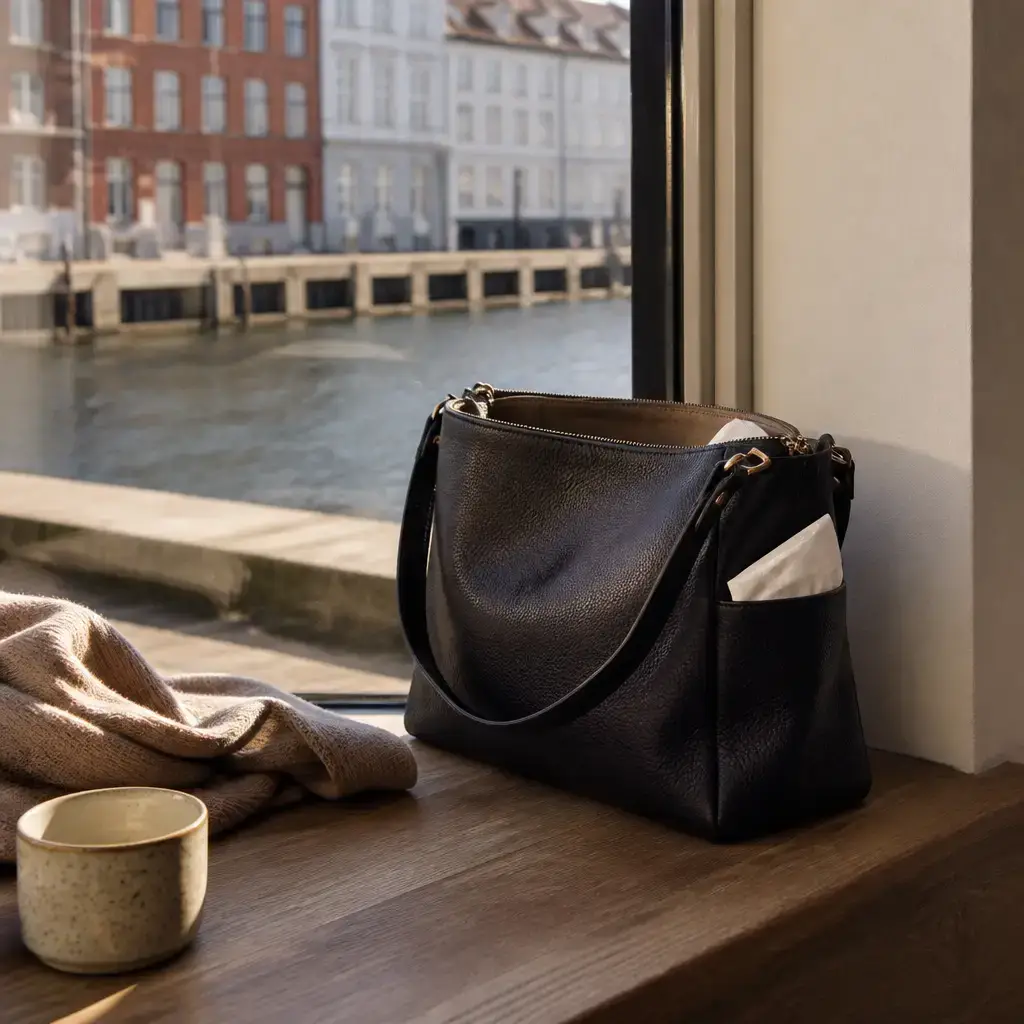
Use Borrowing a tissue from a bag to practice Danish conversation, pronunciation, vocabulary, grammar, and quizzes.
Dialogue
Må jeg låne et lommetørklæde fra din taske?
moh yai LOH-nuh ed LOM-muh-TER-klay-thuh frah deen TAS-kuh? Could I borrow a tissue from your bag?De ligger i sidelommen.
dee LIG-uh ee SEE-duh-LOM-men. They're in the side pocket.Må jeg åbne den?
moh yai OH-bnuh den? May I open it?Vil du hellere hente et?
veel doo HEL-uh-ruh HEN-tuh ed? Would you rather get one?Du må gerne åbne den.
doo moh GAIR-nuh OH-bnuh den. You can open it.Jeg har et nu.
yai hah ed noo. I've got one now.Luk venligst lommen, når du er færdig.
look VEN-ligst LOM-men, nair doo air FAIR-dee. Please close the pocket when you're done.Jeg lukker den forsigtigt.
yai LOOK-uh den for-SIG-duh. I'll close it carefully.Hav et ekstra med dig, hvis du får brug for det.
hah ed EX-struh mehth thai, vis doo foh broo for deh. Keep another with you if you need it.Sentence explanations
Må jeg låne et lommetørklæde fra din taske?
Could I borrow a tissue from your bag?
- Må jeg
- May I? / Could I?
- låne
- borrow
- et lommetørklæde
- a tissue
- fra
- from
- din
- your
- taske
- bag
More detail
Må jeg is a reusable way to ask for permission: “May I…?” or, naturally here, “Could I…?” Må is the present form of måtte; with jeg it begins a permission question. Compare Kan jeg ...?, which more directly asks whether something is possible or whether the speaker is able to do it. låne means “borrow”: receive something temporarily with the expectation of returning it. After the modal må, the following verb is in the infinitive, so the pattern is Må jeg låne ...? (“Could I borrow ...?”). Example: Må jeg låne din pen? — “Could I borrow your pen?” et lommetørklæde means “a tissue” in this utterance. Lommetørklæde is a compound noun, and et marks its neuter singular form. Its plural is lommetørklæder; the indefinite singular pattern is et lommetørklæde. fra means “from” and introduces the source or starting point of something. Here it connects the tissue with the bag as its source: fra din taske, “from your bag.” din means “your” and agrees with a singular common-gender noun. Danish possessive forms include din with a common-gender singular noun, dit with a neuter singular noun, and dine with plural nouns. In this sentence, din modifies taske. taske means “bag.” Its plural is tasker. Example: Min taske er her. — “My bag is here.” Together, Må jeg låne et lommetørklæde fra din taske? asks the other person for permission to borrow one tissue from that person’s bag: “Could I borrow a tissue from your bag?”
De ligger i sidelommen.
They're in the side pocket.
- De
- they
- ligger
- are located
- i
- in
- sidelommen
- the side pocket
More detail
De means “they” here: a third-person plural pronoun, matching the fixed translation. The specific plural referent is not identified beyond the sentence’s meaning. Danish uses de for a plural group regardless of gender. For singular things, the relevant forms are often den or det; han and hun are singular forms used for people in contexts where “he” or “she” is appropriate. Danish De can also be a formal “you” in other contexts, but that is not the reading here. ligger is the present-tense form of ligge, “to lie” or “to be situated.” Here it describes the location of the plural referent. Danish commonly uses ligge for something located or resting in a place, whereas står is used for something standing and sidder for something sitting or fitted in a place. Example: Bogen ligger på bordet. — “The book is on the table.” i is the preposition meaning “in” here. Together with the following location phrase, it places the referent inside that location. Example: Nøglerne er i tasken.` — “The keys are in the bag.” sidelommen means “the side pocket.” It is the definite singular form of sidelomme, “side pocket”: sidelomme → sidelommen. The noun is a compound of side (“side”) and lomme (“pocket”); the definite ending -en marks this common-gender noun as “the …”. Example: Jeg finder den i sidelommen. — “I find it in the side pocket.” Together, De ligger says “they are situated,” and i sidelommen specifies the location. The complete utterance therefore means “They’re in the side pocket.”
Må jeg åbne den?
May I open it?
- Må jeg
- May I
- åbne
- open
- den
- it
More detail
Må jeg is the reusable Danish pattern for asking permission: “May I …?” Here må is the present form of måtte (“may / be allowed to”), and jeg means “I.” The modal comes before the subject in this question. For example, Må jeg komme ind? means “May I come in?” åbne means “to open.” It is the infinitive form of åbne, and it follows the modal må without an extra infinitive marker: Må jeg åbne ...? The same pattern works with another verb, such as Må jeg sidde her? (“May I sit here?”). den means “it” here. It is a third-person singular pronoun used for a common-gender noun; the form itself does not identify which object is meant. Danish also has det for a neuter-gender singular referent, while plural “they/them” is de. Together, Må jeg + åbne forms a permission question, and den is the object of åbne: “May I open it?”
Vil du hellere hente et?
Would you rather get one?
- Vil du
- Would you?
- hellere
- rather
- hente
- get
- et
- one
More detail
Vil du combines the finite verb vil (“would/want to” here) with the subject du (“you”). In a Danish main-clause question, the finite verb comes before the subject: Vil du ...? = “Would you ...?” The preference meaning is supplied by the following hellere; vil itself is not the word meaning “rather.” hellere means “rather” or “preferably” here. It is the comparative form related to gerne (“gladly” or “willingly”); the corresponding stronger preference form is helst (“preferably/most gladly”). For example: Jeg vil hellere blive. — “I would rather stay.” hente means “get,” “fetch,” or “pick up,” with the idea of obtaining or bringing something. It is an infinitive after the modal verb vil, so Danish uses vil hente without at between them. For example: Jeg henter kaffen. — “I’ll get the coffee.” et is a standalone neuter singular form meaning “one” in this sentence. It refers to an understood item without naming that item. The same form can also be the indefinite article before a neuter singular noun, as in et brev — “a letter,” but in the fixed utterance it stands alone rather than introducing a following noun. As a standalone pronoun, et contrasts with en when the understood noun has the other Danish noun gender. Together, Vil du hellere hente et? asks, “Would you rather get one?” Vil du forms the question, hellere marks the preference, hente names the proposed action, and et is the singular neuter “one” representing an understood item. The question does not itself name which item is meant.
Du må gerne åbne den.
You can open it.
- Du
- you
- må gerne
- can; may
- åbne
- open
- den
- it
More detail
Du is the Danish second-person singular pronoun: “you” when addressing one person. It does not itself identify the person by name. må gerne is a common permission pattern meaning “may” or “be allowed to.” Here må is the modal verb and gerne makes the permission affirmative. The pattern is [subject] må gerne [infinitive]: Du må gerne vente. — “You may wait.” This expresses permission, not necessarily physical ability. åbne is the infinitive “to open.” After the modal må, Danish uses the infinitive without an infinitive marker equivalent to English “to”: må åbne means “may open.” The form åbne is also the form used after other modal verbs, such as kan åbne (“can open”). den is a standalone third-person singular pronoun for a common-gender referent, translated here as “it.” Its grammatical form gives information about the referent’s gender class, but the supplied sentence does not identify exactly what the referent is. As a separate use, den can also function as the definite article before a common-gender noun, but that is not its role here. Together, Du må gerne åbne den. follows the reusable pattern Du må gerne + infinitive + pronoun: “You may open it,” or naturally, “You can open it.” The final den is the object of åbne, and the sentence grants the addressee permission to perform that action.
Jeg har et nu.
I've got one now.
- Jeg
- I
- har
- have / have got
- et
- one
- nu
- now
More detail
Jeg means “I.” It is the first-person singular pronoun used for the speaker. Danish also has du for “you,” as in the surrounding sentence, but Jeg identifies the speaker as the subject here. har is the present-tense form of have, meaning “have” or, in this sentence, “have got.” The present form is used for a current possession or situation. For example: Jeg har tid. — “I have time.” et is the neuter singular indefinite form of the Danish indefinite article, and it can also stand on its own for “one” when the noun is omitted. Here, the fixed translation establishes that it means “one”; the particular item is not named in this sentence. Compare the noun-attached use et hus — “a house.” The form en is used with common-gender singular nouns, whereas et is used with neuter singular nouns. nu is an adverb meaning “now.” It places the having in the present moment. For example: Jeg forstår det nu. — “I understand it now.” Together, Jeg har et nu means “I’ve got one now.” The pattern is Jeg har ... nu — “I have ... now,” with et independently representing “one” and nu specifying that this is true at the present time.
Luk venligst lommen, når du er færdig.
Please close the pocket when you're done.
- Luk
- close
- venligst
- please
- lommen
- the pocket
- når
- when
- du er
- you are
- færdig
- done
More detail
Luk is the imperative of lukke, “to close.” The imperative gives a direct instruction and normally has no expressed subject. For example: Luk døren. — “Close the door.” venligst is a polite marker meaning “please.” It can soften a request or instruction: Vent venligst. — “Please wait.” lommen means “the pocket.” Its base form is lomme (“pocket”); the ending -en marks the singular definite form, “the pocket.” Compare en lomme — “a pocket” and lommen — “the pocket.” når introduces a time clause meaning “when.” It connects an event with the time or condition for another event: Ring, når du kommer. — “Call when you arrive.” du er means “you are.” du is the second-person singular pronoun “you,” and er is the present form of være, “to be.” The form er is used with du in the present tense: Du er klar. — “You are ready.” færdig means “done” or “finished” here. It is a predicative adjective after er: Du er færdig. — “You are done.” In Danish, the adjective agrees with the subject where relevant: færdig is the common-singular form, færdigt is neuter singular, and færdige is used for plural or definite contexts. In this sentence, færdig describes du. Together, Luk lommen is the instruction “Close the pocket.” Når du er færdig adds the time condition “when you are done,” so the complete utterance means: “Please close the pocket when you’re done.”
Jeg lukker den forsigtigt.
I'll close it carefully.
- Jeg
- I
- lukker
- close
- den
- it
- forsigtigt
- carefully
More detail
Jeg means “I” and is the first-person singular subject pronoun. It does not change for grammatical gender. For example: Jeg læser. — “I am reading.” lukker is the present-tense form of lukke, “to close.” In this sentence, the present form is used for the intended future action “I’ll close it”; Danish can use the present tense for a planned or immediate action when the context makes the time clear. The same form can also mean “close” or “am closing” in other contexts. Example: Jeg lukker døren. — “I’m closing the door.” den means “it” here and is a singular pronoun for a common-gender referent in Danish. The pronoun’s grammatical form does not by itself identify the object; the fixed translation establishes the intended meaning as “it.” Danish contrasts den with det, which is used for a neuter-gender singular referent. Example: Jeg ser den. — “I see it.” forsigtigt means “carefully” and modifies the action of closing. It is an adverb formed from the adjective forsigtig, “careful”; the adverb tells how the action is performed. Example: Hun åbner den forsigtigt. — “She opens it carefully.” Together, Jeg lukker den forsigtigt. means “I’ll close it carefully.” The structure is subject (Jeg) + present-tense verb (lukker) + object pronoun (den) + manner adverb (forsigtigt).
Hav et ekstra med dig, hvis du får brug for det.
Keep another with you if you need it.
- Hav
- keep; have
- ekstra
- extra; additional
- med dig
- with you
- hvis
- if
- får brug for
- need
- det
- it
More detail
Hav is the imperative of have (“to have”): have → hav. Here it gives a direct instruction to keep or carry something. Example: Hav en paraply med. — “Keep an umbrella with you.” ekstra means “extra” or “additional.” In et ekstra it describes an understood neuter item, while et is the indefinite article; the wording does not by itself specify a number beyond identifying an additional item. Ekstra is commonly unchanged in this use. Example: Jeg tager en ekstra med. — “I’ll bring an extra one.” med dig means “with you.” dig is the object form of the second-person pronoun corresponding to du (“you”); after the preposition med, this object form is used. Together with hav, the phrase describes keeping something in your possession or company. hvis introduces a condition and means “if.” It begins the conditional clause hvis du får brug for det, which states the circumstance under which the instruction is relevant. Example: Ring, hvis du har tid. — “Call if you have time.” får brug for is the Danish expression “need” in this context. Its verb is får, the present form of få; the expression is built as få brug for and is followed by what is needed. Example: Jeg får brug for hjælp. — “I will need help.” det means “it” here and refers to the item being kept. It is a third-person singular neuter pronoun; its grammatical form does not identify the item more specifically. The sentence combines the imperative Hav with et ekstra and med dig: “Keep an extra one with you.” The conditional clause hvis du får brug for det adds the condition “if you need it.” Together, the fixed utterance means: “Keep another with you if you need it.”
Grammar Points
Luk venligst + [noun]
Luk venligst lommen.
look VEN-ligst LOM-men.Please close the pocket.
A polite request can use the imperative followed by venligst (“please”).
Når + subject + verb
Når du har det, luk venligst lommen.
nair doo hah deh, look VEN-ligst LOM-men.When you have it, please close the pocket.
Når (“when”) introduces a subordinate clause with the subject before the verb.
Danish Vocabulary
- Gender
- neuter
- Gender
- common
- Gender
- common
Quiz
Word Order
Arrange the words in the correct order.
They're in the side pocket.
Show Answer
De ligger i sidelommen.May I open it?
Show Answer
Må jeg åbne den?Would you rather get one?
Show Answer
Vil du hellere hente et?Spelling
Tap the letters to spell the word.
bag
Show Answer
taskeside pocket
Show Answer
sidelommenborrow
Show Answer
lånebe located; lie