10 minutes free every day
Continue audio lessons in the app
Word explanations appear automatically in sync with the audio.
No login required · synced translations · playback with the screen locked
Choose your learning language and open this lesson in the app.

About This Lesson
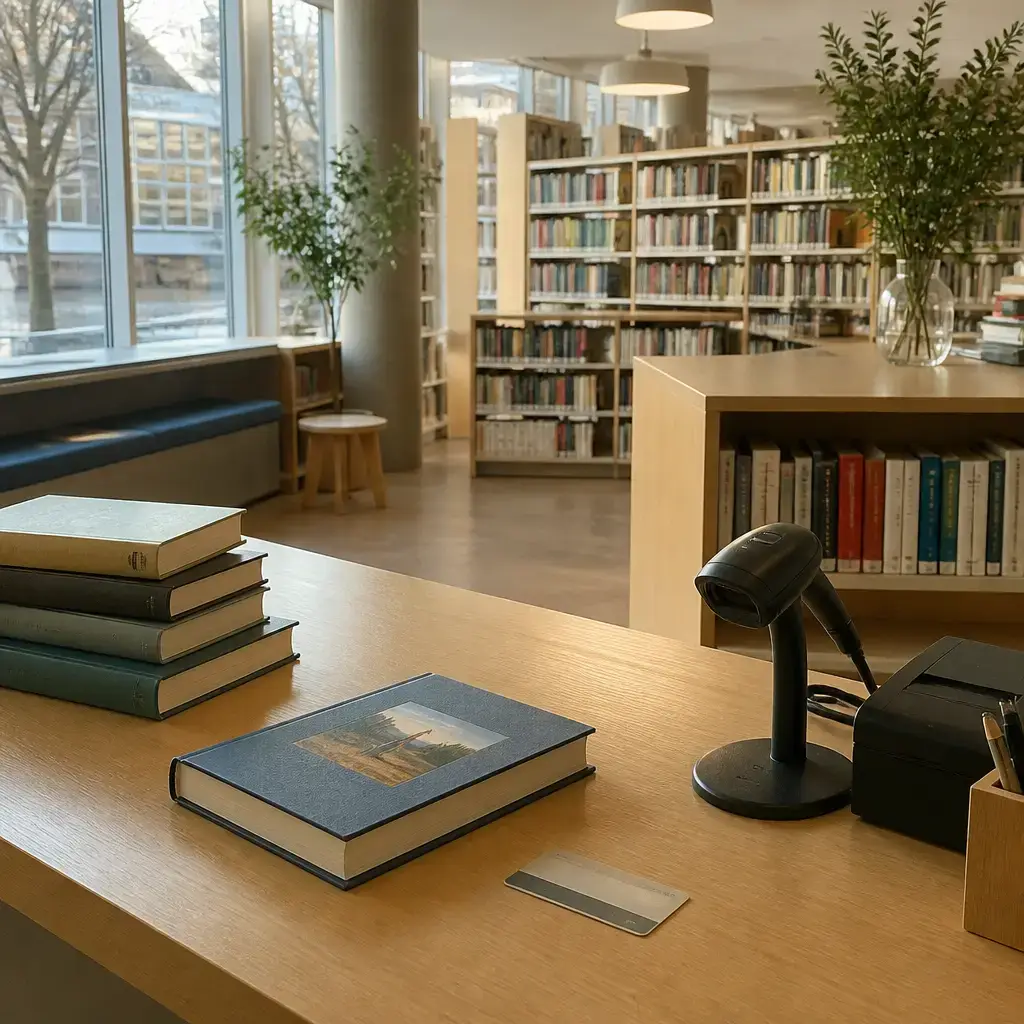
Use Asking for a library book recommendation to practice Danish conversation, pronunciation, vocabulary, grammar, and quizzes.
Dialogue
Kan du anbefale en bog til sprogstuderende?
kan doo an-beh-FAIR-leh uhn boh tehl SPROH-stoo-uh-ren-uh? Could you recommend a book for language learners?Leder du efter lette historier eller korte artikler?
LEH-uh doo EF-ter LET-uh his-TOH-uh uh-ler KOR-thuh ar-TEE-gul? Are you looking for easy stories or short articles?Jeg vil gerne have korte historier med enkle ord.
yai vel GAIR-nuh HEH-vuh KOR-thuh his-TOH-uh meh ENG-luh ohr. I want short stories with simple words.Denne bog har historier, der er nemme at forstå, og nyttige billeder.
DEN-uh boh hah his-TOH-uh, dair air NEM-uh ed faw-STOH, oh NUH-thee-uh BELL-uh-thuh. This book has easy-to-understand stories and helpful pictures.Må jeg tage den med hjem i dag?
moh yai TAY-uh den meh YEM ee day? Can I take it home today?Vis venligst dit lånerkort ved skranken.
vees VEN-leest deeth LOH-nuh-kort veh SGRANG-un. Please show your library card at the desk.Jeg låner den nu.
yai LOH-nuh den noo. I will check it out now.Kom tilbage efter en anden anbefaling, når du er færdig med den.
kom teh-BAY-uh EF-ter uhn AN-un an-beh-FAIR-leeng, naw doo air FAIR-dee meh den. Come back for another recommendation after you finish it.Sentence explanations
Kan du anbefale en bog til sprogstuderende?
Could you recommend a book for language learners?
- Kan du
- could you
- anbefale
- recommend
- bog
- book
- til
- for
- sprogstuderende
- language learners
More detail
Kan du is a reusable Danish way to ask whether someone can or would be willing to do something. kan is the present form of kunne (“can,” “be able to”); du is the singular informal second-person pronoun “you.” In a question, the finite verb comes before the subject: Kan du ...? Example: Kan du hjælpe? — “Can you help?” anbefale means “recommend” here. It is the infinitive, used after the modal verb kan: kan + infinitive. The infinitive also appears in a request such as Jeg vil anbefale ... — “I want to recommend ...” bog means “book.” The form here is singular, and en bog is the common-gender singular indefinite form. The article presents an unspecified book as the requested item; it does not by itself assert a numerical count as a separate fact. The definite form is bogen (“the book”), while the plural is bøger (“books”). til is a preposition that can introduce the intended users or purpose of something. In en bog til sprogstuderende, it connects the book with the people it is for: “a book for language learners.” Example: en stol til børn — “a chair for children.” sprogstuderende means “language learners” here. It is a compound noun referring to people who study languages: sprog means “language,” and studerende means “student” or “learner” in this compound. The form sprogstuderende does not itself show singular versus plural; the context and intended meaning here are plural. With til, it identifies the intended audience of the book. Together, Kan du + anbefale forms a polite ability/request question, and en bog til sprogstuderende specifies the kind of item being requested and its intended audience. The complete utterance therefore means: “Could you recommend a book for language learners?”
Leder du efter lette historier eller korte artikler?
Are you looking for easy stories or short articles?
- Leder … efter
- look for
- lette
- easy
- historier
- stories
- korte
- short
- artikler
- articles
More detail
Leder ... efter is the Danish construction for “look for” or “be looking for.” The verb is lede; leder is its present-tense form. In this question, du is the subject, and the verb and efter are separated by that subject: Leder du efter ...? Danish commonly places the verb before the subject in a yes/no question. The preposition efter is part of this construction, so do not translate leder alone as “look for” in every context. lette means “easy” here and describes historier. Its base form is let; lette is the form used with a plural noun here. For example: en let tekst — “an easy text”; lette tekster — “easy texts.” historier means “stories.” It is the plural of historie: en historie — “a story”; historier — “stories.” The form is plural because it refers to more than one story in the sentence. korte means “short” here and describes artikler. Its base form is kort, and korte is the plural form in this sentence. For example: en kort artikel — “a short article”; korte artikler — “short articles.” artikler means “articles.” It is the plural of artikel: en artikel — “an article”; artikler — “articles.” The question has two alternatives joined by eller, meaning “or”: lette historier (“easy stories”) and korte artikler (“short articles”). Together, Leder du efter lette historier eller korte artikler? means “Are you looking for easy stories or short articles?”
Jeg vil gerne have korte historier med enkle ord.
I want short stories with simple words.
- Jeg
- I
- vil gerne
- would like to
- have
- have
- korte
- short
- historier
- stories
- med
- with
- enkle
- simple
- ord
- words
More detail
Jeg means “I” and is the first-person singular subject pronoun. It identifies the speaker as the person making the request. Compare jeg with du (“you”) when the subject is the person being addressed. vil gerne is a common Danish way to express that someone wants or would like something. vil is the present form of ville; gerne softens or frames the desire as a willing request. The fixed phrase is therefore useful for polite wants, not just for stating a future plan. Example: Jeg vil gerne lære dansk. — “I would like to learn Danish.” have means “have” here and is the infinitive after vil gerne. In the reusable pattern Jeg vil gerne have ..., the speaker says what they would like to receive or possess. Example: Jeg vil gerne have en bog. — “I would like to have a book.” korte means “short” here. It is the plural form of the adjective kort, agreeing with the plural noun historier. The comparison chain is kort (“short”), kortere (“shorter”), kortest (“shortest”). Example: en kort tekst — “a short text”; korte tekster — “short texts.” historier means “stories.” It is the plural of the noun historie; the singular indefinite form is en historie, and the plural form is historier. Example: Jeg læser historier. — “I read stories.” med means “with.” It introduces something included with, accompanying, or characterizing the preceding noun. In this sentence, med enkle ord describes the stories as being with simple words. enkle means “simple” here. It is the plural form of the adjective enkel, agreeing with the plural noun ord. Example: enkle sætninger — “simple sentences.” ord means “words.” In this sentence it is the plural of ord; Danish uses the same written form ord for the singular indefinite neuter noun and the plural, while the article distinguishes the singular: et ord means “a word,” and ord can mean “words.” Here the adjective enkle and the meaning of the sentence show the plural reading. Together, Jeg vil gerne have means “I would like to have,” korte historier means “short stories,” and med enkle ord adds the description “with simple words.” The whole utterance is therefore: “I want short stories with simple words.”
Denne bog har historier, der er nemme at forstå, og nyttige billeder.
This book has easy-to-understand stories and helpful pictures.
- Denne
- this
- bog
- book
- har
- has
- historier
- stories
- der er
- that are
- nemme
- easy
- at forstå
- to understand
- nyttige
- helpful
- billeder
- pictures
More detail
Denne means “this” and points to a singular common-gender noun here: bog. Danish demonstratives agree with the noun’s gender and number; for example, dette hus means “this house,” while disse bøger means “these books.” The form itself does not identify any additional referent beyond the book in this sentence. bog means “book.” Its plural is bøger, while the observed form is singular. A useful example is Jeg læser en bog. — “I am reading a book.” har is the present-tense form of have, “to have,” used with a third-person singular subject such as denne bog. In this sentence it expresses possession or content: the book has stories and pictures. have is also used with other subjects, for example Jeg har en bog. — “I have a book.” historier means “stories.” It is the plural of historie; the singular is historie. The plural marks more than one story, but the word itself does not specify an exact number. der er introduces a relative clause describing the stories. Here der means “that/which” as a relative marker, and er is the present-tense form of være, “to be.” The clause applies to historier, not to the book as a whole. A reusable pattern is en film, der er god — “a film that is good.” nemme means “easy” here, specifically easy to understand. It is the plural form of nem, matching plural historier. Danish adjectives also show forms such as en nem bog (“an easy book”) and et nemt spørgsmål (“an easy question”); the form depends on the noun’s number and, for singular nouns, its grammatical gender. at forstå means “to understand.” forstå is the base verb, and at marks the infinitive. In nemme at forstå, the infinitive completes the description “easy to understand.” For example, Teksten er svær at forstå. means “The text is difficult to understand.” nyttige means “helpful” here. It is the plural form of nyttig, matching plural billeder. A singular common-gender example is en nyttig bog — “a helpful book”; with a neuter singular noun, the adjective is nyttigt, as in et nyttigt råd — “a helpful piece of advice.” billeder means “pictures.” It is the plural of billede; the singular is billede. A useful example is Bogen har et billede. — “The book has a picture.” The sentence is built as Denne bog har (“This book has”), followed by two coordinated objects: historier, der er nemme at forstå (“stories that are easy to understand”) and nyttige billeder (“helpful pictures”). Together, the utterance means: “This book has easy-to-understand stories and helpful pictures.”
Må jeg tage den med hjem i dag?
Can I take it home today?
- Må jeg
- May I…?
- tage
- take
- den
- it
- med
- along
- hjem
- home
- i dag
- today
More detail
Må jeg is a permission question: må is the present form of the modal verb måtte, and jeg means “I.” Together, they form the reusable pattern Må jeg + infinitive ...? (“May I ...?”). Danish places the modal verb before the subject in this question. Example: Må jeg sidde her? — “May I sit here?” Må asks about permission; kan can also be used in some contexts, but more literally concerns ability. tage means “take.” It is the infinitive form, used after the modal må without at. Example: Jeg vil tage bussen. — “I want to take the bus.” den is the standalone object pronoun “it” here. It refers to a singular noun of the grammatical common gender; the exact item is supplied by the surrounding situation rather than identified by this word alone. In this sentence, it is the thing being taken. med means “along” in the construction tage ... med, showing that the object is taken along. The construction can be separated because other words may occur between tage and med. Example: Jeg tager bogen med. — “I am taking the book along.” hjem means “home.” Here it is an adverb expressing the destination, so Danish uses it directly after med in med hjem (“along home” / “home with me”), without a separate word meaning “to.” Example: Hun går hjem. — “She is going home.” i dag is the fixed time phrase “today.” It identifies the day on which the requested action would happen. Example: Jeg arbejder i dag. — “I am working today.” The parts combine as Må jeg + tage + den med + hjem + i dag?: “May I take it along home today?” In natural English, this is “Can I take it home today?” The question asks for permission to take the item home on the current day.
Vis venligst dit lånerkort ved skranken.
Please show your library card at the desk.
- Vis
- show
- venligst
- please
- dit
- your
- lånerkort
- library card
- ved
- at; by
- skranken
- the desk
More detail
Vis is the imperative of vise, “to show.” It addresses one or more people directly and gives an instruction. The present-tense form is viser; the imperative is shorter: Vis kortet! — “Show the card!” venligst means “please” and makes the instruction polite. It is a separate politeness word, not part of the verb form. For example, Vent venligst. means “Please wait.” dit means “your” before an et-word. Here it agrees with lånerkort, which is et lånerkort; the possessive form is therefore dit lånerkort. Compare din before an en-word, as in din bog — “your book.” The form dit does not itself express a numeric quantity. lånerkort means “library card” here. It is a compound noun: the first part, låner, refers to a borrower and is related to the verb låne (“to borrow”), while kort means “card.” The complete word is the reusable noun to learn. Its indefinite form is et lånerkort, and its definite form is lånerkortet — “the library card.” ved is a preposition meaning “at” or “by” for a location. In ved skranken, it introduces the place where the showing takes place. For example, Hun står ved døren. means “She is standing by the door.” skranken means “the desk” here. It is the definite form of skranke: en skranke is “a desk/counter,” while skranken is “the desk/counter.” The definite ending is part of the noun, so the separate word “the” is not used here. Together, the instruction is formed as Vis + venligst + dit lånerkort + ved skranken: “Please show your library card at the desk.” The understood subject is the person or people being addressed, as is normal with an imperative. The location phrase specifies where to show the card, while dit links the card to the person being addressed.
Jeg låner den nu.
I will check it out now.
- Jeg
- I
- låner
- check out
- den
- it
- nu
- now
More detail
Jeg means “I” and is the Danish first-person singular subject pronoun. It is used for the person speaking, regardless of the speaker’s gender. For example: Jeg læser. — “I am reading.” låner is the present-tense form of låne, “to borrow” or, in a library context, “to check out.” The ending -r marks the ordinary present form here: jeg låner — “I borrow / I am borrowing.” Danish present tense can also describe an action that is about to happen, which fits the fixed translation “I will check it out now.” In this sentence, låne describes the speaker taking the item temporarily. Danish also uses låne ... ud for lending something out; the direction and construction distinguish that use. For example: Jeg låner bogen. — “I borrow the book.” den is a third-person singular direct-object pronoun. In this sentence it means “it,” referring to the item being checked out, without the supplied texts identifying that item more specifically. The form den is used for a singular common-gender referent; it is distinct from det, which is used for a singular neuter-gender referent. For example: Jeg køber den. — “I buy it.” nu means “now” and places the action at the present moment. It can also help make a present-tense Danish clause describe an immediate action or intention. Together, Jeg låner den nu means “I will check it out now”: the speaker is the person performing the action, den is the item being borrowed, and nu specifies when this happens.
Kom tilbage efter en anden anbefaling, når du er færdig med den.
Come back for another recommendation after you finish it.
- Kom tilbage
- come back
- efter
- for; to get
- anden
- another
- anbefaling
- recommendation
- når
- when
- færdig
- finished; done
- med
- with
- den
- it
More detail
Kom tilbage is an imperative meaning “come back.” Kom is the imperative of komme (“to come”); the subject is understood as “you.” Tilbage adds the meaning of returning to an earlier place or situation. Example: Kom tilbage i morgen. — “Come back tomorrow.” efter has a few uses. In this sentence, komme tilbage efter noget means “come back for something,” so efter en anden anbefaling means “for another recommendation.” The separate word når later in the sentence carries the time meaning “when,” so this efter is not the time expression “after you finish.” anden means “another” here. Its form agrees with the noun phrase en anden anbefaling: anden is used with a common-gender singular noun, while et andet is used with a neuter singular noun and andre with plural nouns. The phrase presents the recommendation as an additional, different one, without itself stating a numerical count. anbefaling is a noun meaning “recommendation.” Its definite singular form is anbefalingen, and its plural is anbefalinger. In the fixed sentence it is indefinite because it follows en: en anden anbefaling means “another recommendation.” når introduces a time clause meaning “when.” It links the condition or time of finishing with the return: the return is to happen when the finishing is complete. Example: Jeg ringer, når jeg er færdig. — “I will call when I am finished.” færdig means “finished” or “done” in er færdig med ..., a common pattern meaning “be finished with ...” or “have finished ...”. The adjective form is færdig in the observed phrase; related forms include færdigt for neuter singular agreement and færdige for plural agreement. Example: Hun er færdig med arbejdet. — “She is finished with the work.” med means “with.” Together, færdig med specifies the thing or activity that someone has completed. It is not the same as saying only that someone is generally finished; the following phrase identifies what they are finished with. den means “it” here. It is the Danish common-gender singular object pronoun. The fixed translation identifies it as the thing the listener is to finish, but the supplied sentence does not specify that referent more precisely. Den is distinct from neuter singular det and plural dem; the choice depends on the grammatical properties and number of the referent, not simply on its English translation. Putting the parts together: Kom tilbage gives the request to return; efter en anden anbefaling says to return for an additional recommendation; and når du er færdig med den sets the time, namely when the listener has finished with it. The complete meaning is: “Come back for another recommendation after you finish it.”
Grammar Points
Leder du efter ...?
Leder du efter enkle historier?
LEH-uh doo EF-ter ENG-luh his-TOH-uh?Are you looking for simple stories?
In Danish questions, the verb comes before the subject: Leder du, not Du leder.
Adjektiv i flertal: -e
enkle ord
ENG-luh ohrsimple words
Adjectives take -e before plural nouns: enkel becomes enkle with ord.
Danish Vocabulary
Kan du anbefale en bog?
- Gender
- common
korte artikler
- Gender
- common
en bog
enkle ord
Jeg vil gerne have
Jeg vil gerne have korte historier
- Gender
- common
korte historier
korte artikler
Leder du efter lette historier?
lette historier
- Gender
- neuter
enkle ord
til sprogstuderende
Quiz
Word Order
Arrange the words in the correct order.
Please show your library card at the desk.
Show Answer
Vis venligst dit lånerkort ved skranken.I will check it out now.
Show Answer
Jeg låner den nu.Spelling
Tap the letters to spell the word.
gladly; would like to
Show Answer
gernearticle
Show Answer
artiklerstory
Show Answer
historierrecommend