10 minutes free every day
Continue audio lessons in the app
Word explanations appear automatically in sync with the audio.
No login required · synced translations · playback with the screen locked
Choose your learning language and open this lesson in the app.

About This Lesson
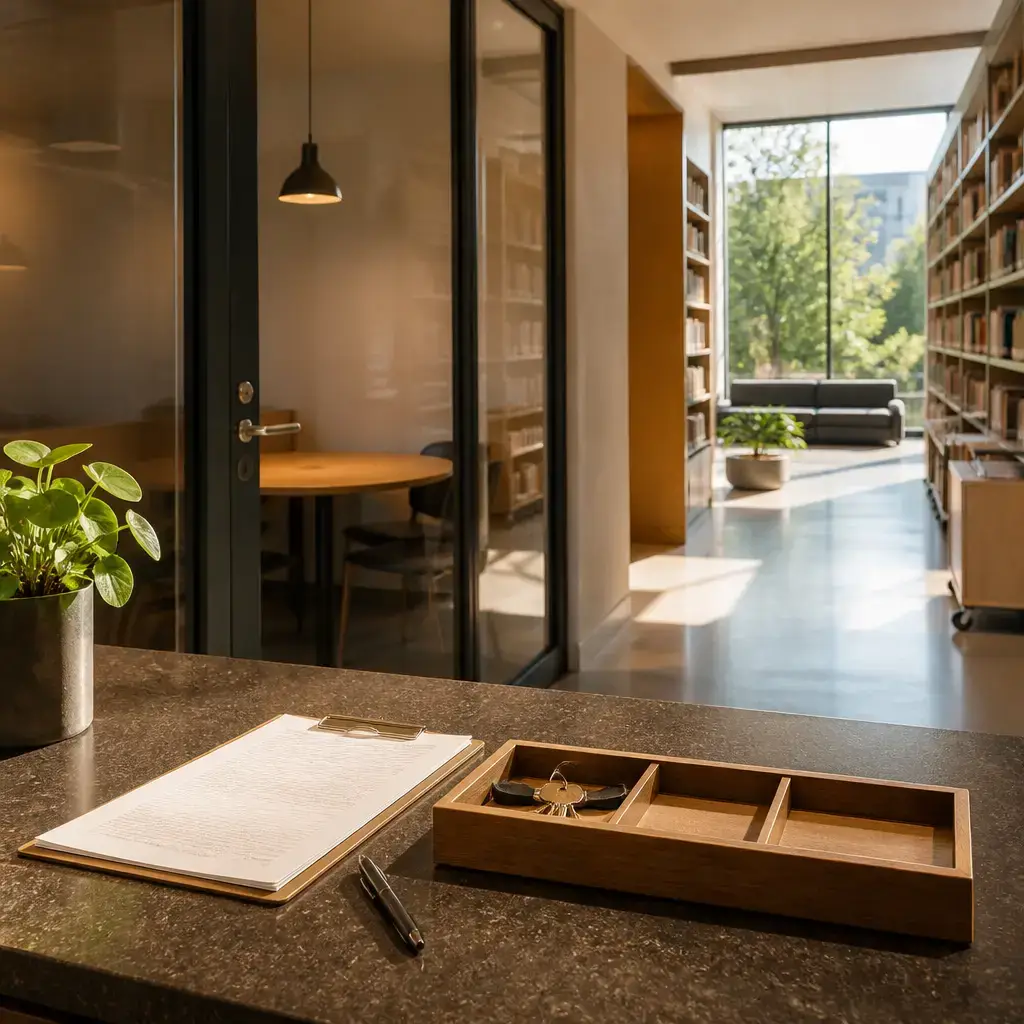
Use Reserve a Study Room to practice Danish conversation, pronunciation, vocabulary, grammar, and quizzes.
Dialogue
Jeg vil gerne reservere et studierum.
yai veel YAIR-nuh reh-seh-VAIR-uh ehd stoo-dee-uh-ROOM I would like to reserve a study room.Lad mig se, hvilke rum der er ledige i dag.
lath my SAY, VEL-guh room dair air LAY-thee ee DAY Let me check which rooms are open today.Jeg har brug for et roligt sted, hvor jeg kan læse med en klassekammerat.
yai hahr BROO fohr ehd ROH-lee STAYTH, voh yai kan LAY-suh meh en KLAH-seh-kah-meh-RAHT I need a quiet place to study with a classmate.Et lille rum er ledigt i eftermiddag.
ehd LIL-leh room air LAY-thee ee EF-ter-METH-eye A small room is free this afternoon.Kan jeg reservere det ved skranken?
kan yai reh-seh-VAIR-uh deh vay SKRAHNG-en Can I book it at the service desk?Udfyld venligst formularen her.
OOD-fill VEN-lest fohr-MAH-len hair Please fill in the request form here.Skal jeg aflevere nøglen ved denne skranke?
skel yai af-LAY-vuh-ruh NUHR-len veth DEN-uh SKRAHNG-en Do I return the key to this service desk?Aflever den før lukketid.
af-LAY-ver den fur LOH-guh-TEE Bring it back before closing.Sentence explanations
Jeg vil gerne reservere et studierum.
I would like to reserve a study room.
- Jeg vil gerne
- I would like to
- reservere
- reserve
- studierum
- study room
More detail
Jeg vil gerne is a reusable Danish way to express a polite wish: “I would like to …”. vil is the present form of ville (“to want; will”), and gerne adds the sense of being willing or pleased to do something. Together they are followed by an infinitive: Jeg vil gerne ... — “I would like to ...”. Example: Jeg vil gerne lære dansk. — “I would like to learn Danish.” reservere means “to reserve” and is the infinitive form. After vil gerne, Danish uses the infinitive without an added infinitive marker: Jeg vil gerne reservere — “I would like to reserve”. Example: Vi vil gerne reservere et bord. — “We would like to reserve a table.” studierum is the noun “study room”. It is a compound formed from studie (“study”) and rum (“room”); the compound as a whole names a room intended for studying. In the utterance, et before it marks an indefinite singular noun: et studierum — “a study room”. Together, Jeg vil gerne + reservere + et studierum gives: “I would like to reserve a study room.” The speaker states a polite desire to make that reservation. The pattern is reusable as Jeg vil gerne + infinitive + object.
Lad mig se, hvilke rum der er ledige i dag.
Let me check which rooms are open today.
- Lad mig
- let me
- se
- check / see
- hvilke
- which
- rum
- rooms
- der er
- there are
- ledige
- available / open
- i dag
- today
More detail
Lad mig is a reusable way to say “let me …”. Lad is the imperative of lade (“to let/allow”), and mig is the object form meaning “me”. The construction is followed by an infinitive: Lad mig se = “Let me see/check.” se is the infinitive of se (“to see”). In this utterance, “see” naturally means checking information, as reflected by the fixed translation. After Lad mig, the verb remains in the infinitive: Lad mig + infinitive. hvilke means “which” when the thing being selected is plural. The corresponding singular forms are hvilken with a common-gender noun and hvilket with a neuter noun. Here, hvilke is plural because it modifies rum. rum means “rooms” here. Its singular form is et rum, and its plural form is rum; the plural has the same written form as the singular. The phrase hvilke rum therefore means “which rooms.” der er literally contains der (“there”) and er, the present form of være (“to be”). Together, this is the Danish existential pattern “there are” when introducing or identifying things: der er .... In the embedded question, hvilke rum der er ledige asks which rooms are available. ledige means “available/open” here. It is the plural form of ledig, and it agrees with plural rum. A useful contrast is singular et ledigt rum (“an available room”) versus plural ledige rum (“available rooms”). i dag means “today”. It is a fixed time expression that places the availability in the current day. Putting the parts together, Lad mig se gives “Let me check,” and hvilke rum der er ledige i dag gives “which rooms are available today.” The complete utterance is therefore: “Let me check which rooms are open today.”
Jeg har brug for et roligt sted, hvor jeg kan læse med en klassekammerat.
I need a quiet place to study with a classmate.
- Jeg har brug for
- need
- roligt
- quiet
- sted
- place
- hvor
- where
- kan
- can; be able to
- læse
- read; study
- med
- with
- klassekammerat
- classmate
More detail
Jeg har brug for is the fixed Danish construction for “I need.” Its form here is first-person singular present: har is the present form of have, while brug for belongs to the construction and is not best translated word by word. For example: Jeg har brug for hjælp. — “I need help.” roligt means “quiet” here. Its base form is rolig; the -t form agrees with the neuter noun sted, as in et roligt sted. This is an adjective inflection, not a change to the noun. For comparison, roligere means “quieter” and roligst means “quietest.” sted means “place.” It is a neuter noun, so its indefinite article is et: et sted — “a place.” In this sentence, the adjective and noun together form et roligt sted, “a quiet place.” hvor introduces the clause that specifies the place: “where.” It connects sted with the information about what can happen there. Danish can use hvor in this way before a clause, as in et sted, hvor jeg kan arbejde — “a place where I can work.” kan is the present form of the modal verb kunne, meaning “can” or “be able to.” It is followed by the infinitive without a separate “to”: kan læse — “can read/study.” læse is the infinitive of “read.” In this context, the fixed translation supports the activity meaning “study”; the same Danish verb can also refer more literally to reading text. After a modal such as kan, the infinitive remains læse: Jeg kan læse. — “I can read/study.” med means “with” and marks accompaniment here. It links the activity to en klassekammerat, so the meaning is “with a classmate.” klassekammerat means “classmate.” It is a singular common-gender noun; the indefinite phrase in the sentence is en klassekammerat. Its plural is klassekammerater — “classmates.” The article en marks an indefinite singular noun phrase; it does not by itself assert a numerical count as a separate emphasis. Putting the parts together: Jeg har brug for et roligt sted gives “I need a quiet place.” The relative clause hvor jeg kan læse med en klassekammerat specifies that this is a place where the speaker can study with a classmate. The complete meaning is: “I need a quiet place to study with a classmate.”
Et lille rum er ledigt i eftermiddag.
A small room is free this afternoon.
- lille
- small
- rum
- room
- er ledigt
- is available
- i eftermiddag
- this afternoon
More detail
lille means “small” here. Its base form is lille in this singular noun phrase: et lille rum. Danish adjectives can change with the noun’s form; for example, små is the plural form: små rum (“small rooms”). rum means “room.” It is a neuter noun, shown by the article et in et rum. Its plural is also rum, as in to rum (“two rooms”); the form of the article or another determiner helps show the singular/plural distinction. er ledigt expresses that something is available or free. er is the present-tense form of være (“to be”). ledig is the adjective meaning “available/free,” and ledigt is its neuter singular form, agreeing with rum, rather than being a form of the noun. Compare Rummet er ledigt (“The room is available”) with Pladsen er ledig (“The space is available”), where the adjective agrees differently with the noun. i eftermiddag means “this afternoon” in this sentence. The time expression uses i (“in/on”) with eftermiddag (“afternoon”). A reusable example is Vi mødes i eftermiddag. — “We are meeting this afternoon.” Together, Et lille rum means “a small room”; er ledigt says that the room is available; and i eftermiddag places that availability in this afternoon. The complete utterance therefore means: “A small room is free this afternoon.”
Kan jeg reservere det ved skranken?
Can I book it at the service desk?
- Kan jeg
- Can I
- reservere
- book; reserve
- det
- it
- skranken
- the service desk
More detail
Kan jeg is a reusable way to ask for permission or possibility: kan is the present-tense form of kunne (“can”), and jeg means “I”. In this question, kan expresses “may/can I,” rather than a statement about a general ability. Example: Kan jeg komme ind? — “May I come in?” reservere means “to reserve” or “to book.” It is the infinitive form, used here after kan; after a modal such as kan, Danish normally uses the infinitive without at. Example: Jeg vil reservere et bord. — “I want to reserve a table.” det is the singular neuter object pronoun meaning “it” here. The fixed translation identifies it as the thing being booked, but does not specify that thing further. In this sentence it is an object of reservere, not a dummy subject. Example: Jeg kan se det. — “I can see it.” skranken means “the service desk” or “the counter.” Its base noun is en skranke (“a service desk/counter”); skranken is the definite singular form. The preposition ved before it creates ved skranken, meaning “at the service desk.” Example: Hun arbejder ved skranken. — “She works at the service desk.” The sentence follows the reusable question pattern Kan + subject + infinitive + object + place: Kan jeg + reservere + det + ved skranken. Together, these parts mean “Can I book it at the service desk?”
Udfyld venligst formularen her.
Please fill in the request form here.
- Udfyld
- fill in
- venligst
- please
- formularen
- the form
- her
- here
More detail
Udfyld is the imperative of udfylde, “to fill in” or “to complete.” It is the form used to give a direct instruction to one or more people; the subject is normally understood rather than stated. Compare udfylder (“fills in / is filling in”) in a statement. Example: Udfyld feltet. — “Fill in the field.” venligst means “please.” In this sentence it softens the direct instruction, while the imperative still clearly gives the action requested. It is a useful polite marker in instructions and requests. formularen means “the form” here. The base noun is formular (“form”), and the ending -en marks the definite singular in this common-gender noun: en formular (“a form”) → formularen (“the form”). The ending belongs to the noun, not to udfyld. her is the adverb “here,” identifying the relevant place. It can be used independently of the noun phrase: Skriv her. — “Write here.” Together, Udfyld + formularen gives the instruction “fill in the form”; venligst adds “please,” and her specifies “here.” The complete utterance therefore means, “Please fill in the request form here,” as given by the fixed translation. The pattern Udfyld venligst [definite noun] her can be reused for a polite instruction to complete or enter something at the indicated place.
Skal jeg aflevere nøglen ved denne skranke?
Do I return the key to this service desk?
- Skal jeg
- Shall I …?
- aflevere
- return; hand in
- nøglen
- the key
- denne
- this
- skranke
- service desk; counter
More detail
Skal jeg begins a yes/no question. skal is the modal verb corresponding here to “shall/am I to,” and jeg is “I.” In a Danish main-clause question, the finite verb comes before the subject: Skal jeg ...? Compare the reusable pattern Skal jeg + infinitive? — “Shall I ...?” Example: Skal jeg vente? — “Shall I wait?” aflevere is the infinitive “to hand in, return, or deliver.” It follows the modal skal without an infinitive marker. In this utterance, the intended action is returning or handing in the key. Example: Jeg skal aflevere formularen. — “I have to hand in the form.” nøglen means “the key.” Its base form is nøgle (“key”); nøglen is the singular definite form, formed with the ending -en. The ending marks that the speaker has a specific key in mind; it does not itself explain who owns it. Example: Jeg finder nøglen. — “I find the key.” denne means “this” and is the singular demonstrative used with a common-gender noun such as skranke. The corresponding neuter singular form is dette, while the plural form is disse. The demonstrative identifies the desk as the one indicated by “this” in the situation. Example: denne formular — “this form.” skranke means “service desk” or “counter.” Its indefinite singular form is en skranke, while denne skranke is a definite demonstrative phrase meaning “this service desk.” Here, denne determines the noun phrase; the noun itself does not take the separate definite ending in this construction. The prepositional chunk ved denne skranke means “at/by this service desk.” Together, aflevere nøglen ved denne skranke expresses returning or handing in the key at that desk. The question structure Skal jeg ...? asks whether the speaker is to perform that action. Thus the whole utterance means: “Do I return the key to this service desk?”
Aflever den før lukketid.
Bring it back before closing.
- Aflever
- hand in; return
- den
- it
- før
- before
- lukketid
- closing time
More detail
Aflever is the imperative of aflevere, meaning “to hand in” or “to return.” The imperative addresses one person directly: Aflever ... = “Hand ... in” or “Return ...”. Example: Aflever nøglen. means “Return the key.” den is a singular common-gender object pronoun meaning “it” here. In the supplied exchange, the item being returned is understood as the key mentioned in the preceding question. Danish uses den for a singular common-gender referent and det for a singular neuter-gender referent; the pronoun’s form reflects the referent’s grammatical gender and number. før means “before.” In før lukketid, it introduces the time limit: the return must happen earlier than closing time. Example: Kom før frokost. means “Come before lunch.” lukketid means “closing time.” It is a noun used here without a separate article in the time expression før lukketid. It is related in form to lukke, “to close,” and tid, “time,” but lukketid is the complete noun used in this sentence. Together, Aflever den means “Return it,” and før lukketid adds the deadline “before closing time.” The whole utterance is: “Bring it back before closing.”
Grammar Points
have brug for + substantiv
Jeg har brug for et roligt sted.
yai hahr BROO fohr ehd ROH-lee STAYTHI need a quiet place.
På dansk bruger man den faste vending "have brug for" for at sige, at man behøver noget.
Adjektiv efter et-ord
et roligt sted
ehd ROH-lee STAYTHa quiet place
Ved et-ord får adjektivet ofte endelsen -t: rolig bliver til roligt.
Danish Vocabulary
- Gender
- common
- Gender
- neuter
- Gender
- neuter
Quiz
Word Order
Arrange the words in the correct order.
I would like to reserve a study room.
Show Answer
Jeg vil gerne reservere et studierum.Can I book it at the service desk?
Show Answer
Kan jeg reservere det ved skranken?Please fill in the request form here.
Show Answer
Udfyld venligst formularen her.Spelling
Tap the letters to spell the word.
study room
Show Answer
studierumavailable; free
Show Answer
ledigewhich
Show Answer
hvilkewould like to