10 minutes free every day
Continue audio lessons in the app
Word explanations appear automatically in sync with the audio.
No login required · synced translations · playback with the screen locked
Choose your learning language and open this lesson in the app.

About This Lesson
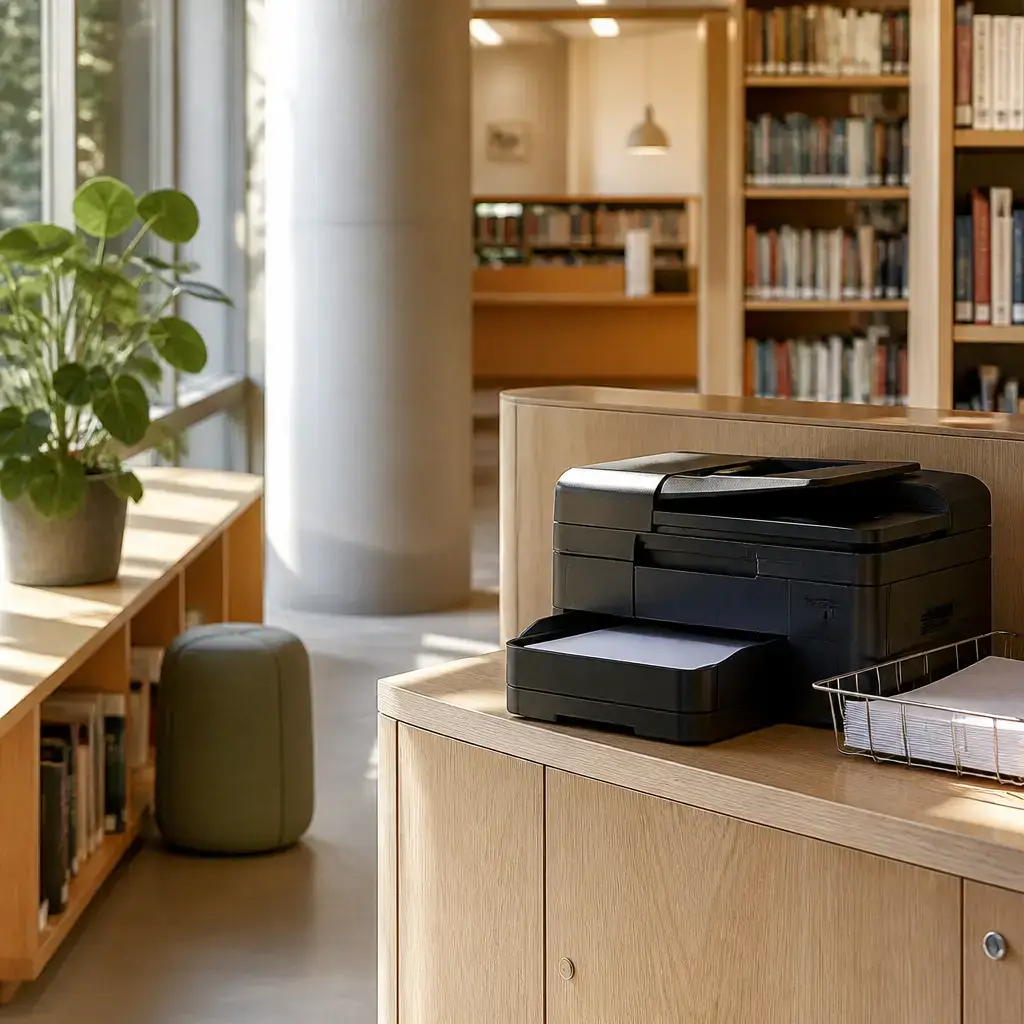
Use Using the Library Printer to practice Danish conversation, pronunciation, vocabulary, grammar, and quizzes.
Dialogue
Hvordan bruger jeg printeren på biblioteket?
VOH-dan BROO-uh yai PREN-uh-n poh blee-oh-TEH-guth? How do I use the printer in the library?Først skal du vælge printeren på denne skærm.
FURST sgale doo VEL-guh PREN-uh-n poh DEN-uh sgairm. First, choose the printer on this screen.Kan jeg vælge at printe på begge sider?
Kan yai VEL-guh uhd PREN-duh poh BEL-uh SEE-uh? Can I choose double-sided printing?Skift indstillingen, før du printer.
SGIFT en-STEL-ling-un, fur doo PREN-duh. Change the setting before you print.Jeg skal kun printe et kort dokument.
Yai sgale koon PREN-duh ud KORT doh-koo-MENT. I only need to print a short document.Så tjek forhåndsvisningen, før du starter.
Soh CHEK for-HOHNS-vees-ning-un, fur doo STAH-duh. Then check the preview before you start.Hvor kommer de printede sider ud?
VOH-uh KOM-uh dee PREN-duh SEE-uh ooth? Where do the printed pages come out?De kommer ud i bakken nedenunder.
Dee KOM-uh ooth ee BAH-gun NAY-thun-or. They come out in the tray below.Sentence explanations
Hvordan bruger jeg printeren på biblioteket?
How do I use the printer in the library?
- Hvordan
- how
- bruger
- use
- jeg
- I
- printeren
- the printer
- på
- in
- biblioteket
- the library
More detail
Hvordan asks about the way or method: “how.” In this question it introduces the information the speaker wants about using something. Compare hvad (“what”) when asking about an object or action itself. bruger means “use” here. It is the present-tense form of bruge; Danish present tense does not change for person, so the same form can occur with jeg, du, or other subjects. Example: Jeg bruger computeren. — “I use the computer.” jeg is the first-person singular pronoun “I,” referring to the speaker. In the question, it is the subject of bruger. printeren means “the printer.” It is the definite singular form of printer: en printer is “a printer,” while printeren identifies a particular printer. The ending -en marks definite singular for this noun; it is part of the observed noun form, not a separate word. på is a location preposition. With a place, it can correspond to “in,” “at,” or “on” depending on the target-language expression and the intended location. Here, together with biblioteket, it gives the location “in the library.” biblioteket means “the library.” It is the definite singular form of bibliotek: et bibliotek is “a library,” and biblioteket is “the library.” The ending -et marks definite singular for this neuter noun. The reusable question pattern is Hvordan + present-tense verb + subject ...? Danish places the verb before the subject in this wh-question: Hvordan bruger jeg ...? The location phrase på biblioteket specifies where the printer is, so the complete utterance means “How do I use the printer in the library?”
Først skal du vælge printeren på denne skærm.
First, choose the printer on this screen.
- Først
- first
- skal du
- you should / need to
- vælge
- choose
- printeren
- the printer
- på
- on
- denne
- this
- skærm
- screen
More detail
Først means “first” here and places the instruction’s action at the beginning of the sequence. It is an adverb. A useful contrast is først “first” versus sidst “last.” skal du is the reusable pattern “you should/must” or “you need to,” with skal as the modal verb and du as the subject. In this instruction, skal expresses what the user is expected to do; it is not the future meaning of skal. Danish modal verbs are followed by an infinitive: Du skal vælge means “You should choose.” vælge is the infinitive “to choose.” Its present-tense form is vælger: Du vælger printeren means “You choose the printer.” After skal, Danish uses the infinitive without an infinitive marker such as English “to.” printeren means “the printer.” The noun’s base form is printer; printeren is its singular definite form, formed with the suffix -en. The definite form identifies a particular printer in the situation, rather than introducing one as en printer (“a printer”). på means “on” in this location expression. Danish uses på with a surface or display: på skærmen means “on the screen.” Its meaning depends on the relation being described; it is not interchangeable with every Danish preposition for location. denne means “this” and agrees with the noun it determines. With a singular common-gender noun such as skærm, the form is denne; with a singular neuter noun, Danish uses dette, and with plural nouns, disse. Here denne signals a nearby or currently relevant screen. skærm means “screen.” Its definite singular form is skærmen, and its plural is skærme; the definite plural is skærmene. In denne skærm, the demonstrative already makes the noun phrase definite, so the noun appears in its unmarked form rather than as skærmen. Together, skal du vælge gives the instruction “you should/need to choose,” while printeren supplies what is to be chosen. på denne skærm specifies that the choice is made on this screen. With Først at the beginning, the complete utterance means: “First, choose the printer on this screen.”
Kan jeg vælge at printe på begge sider?
Can I choose double-sided printing?
- Kan jeg
- Can I …?
- vælge
- choose
- at printe
- to print
- begge
- both
- sider
- sides
More detail
Kan jeg asks for permission or possibility: “Can I …?” Here kan is the present form of kunne for the subject jeg; it does not itself indicate a past or future time. A reusable pattern is Kan jeg + infinitive?, for example: Kan jeg vælge? — “Can I choose?” vælge means “choose.” It is the infinitive form used after the modal verb kan. The present-tense form is vælger: Jeg vælger — “I choose / I am choosing.” at printe means “to print.” at marks the infinitive, and printe is the infinitive of the verb “print.” In vælge at printe, the first action is choosing, and the chosen action is printing. Example: Jeg vælger at printe. — “I choose to print.” begge means “both.” It indicates the two items considered together; it is not the same as alle, which means “all” for a larger or unspecified group. Here it modifies sider. sider means “sides” in this context. Its singular form is side, and its plural form is sider: en side — “one side,” to sider — “two sides.” In the fixed utterance, the sides are the two surfaces used for double-sided printing. Together, Kan jeg vælge at printe på begge sider? means “Can I choose double-sided printing?” More literally, it asks whether the speaker can choose to print on both sides. på begge sider expresses the surfaces involved: på means “on,” begge means “both,” and sider means “sides.” The whole utterance is a question about whether that printing option can be selected.
Skift indstillingen, før du printer.
Change the setting before you print.
- Skift
- change
- indstillingen
- the setting
- før
- before
- du
- you
- printer
More detail
Skift is the imperative of skifte, “to change/switch.” It tells the listener to perform the action. The present-tense form is skifter; the imperative is skift, without a subject: Skift indstillingen. = “Change the setting.” indstillingen means “the setting.” It is the definite singular form of indstilling: en indstilling = “a setting,” indstillingen = “the setting.” The ending -en marks common-gender singular definiteness here; it does not itself express a numerical count in the way an English numeral would. før means “before” and introduces the event that must happen later in the stated sequence. A reusable pattern is før + a clause: Læs teksten, før du svarer. = “Read the text before you answer.” du is the second-person singular pronoun “you.” It is the subject of the clause after før. Danish du is used for one person; the plural “you” is I in standard Danish. printer means “print” here, in the clause “you print.” It is the present-tense form of the borrowed verb printe. Danish present-tense verbs generally do not change for the subject, so jeg printer and du printer both use printer; the pronoun identifies the subject. The infinitive is at printe: Jeg skal printe. = “I need to print.” Together, før du printer means “before you print”: du supplies the subject and printer supplies the present-tense action. The complete utterance is an imperative followed by a time clause: Skift indstillingen + før du printer = “Change the setting before you print.” It instructs the listener to change the setting first, with printing as the later event.
Jeg skal kun printe et kort dokument.
I only need to print a short document.
- Jeg skal
- I need to
- kun
- only
- printe
- kort
- short
- dokument
- document
More detail
Jeg skal combines jeg (“I”) with skal, the present form of skulle. Here skal expresses the speaker’s need or intended obligation, so the useful pattern is Jeg skal + infinitive = “I need to / I am going to …” depending on context. In this sentence, the fixed translation supports “I need to.” For example: Jeg skal arbejde. — “I need to work.” kun means “only” and limits what follows: the speaker needs to print, but the sentence does not say that other actions are excluded. Its position before the verb phrase gives the sentence the scope “only print.” For example: Jeg skal kun læse. — “I only need to read.” printe is the infinitive “to print.” It follows skal without an additional infinitive marker in this construction. The form is a Danish verb used for the printing action; its base/infinitive form here is printe. For example: Hun skal printe filen. — “She needs to print the file.” kort means “short” here and describes the document’s length. It is an adjective. In the fixed phrase, it appears before the noun and has the form kort with dokument; this form is also used with a common-gender singular indefinite noun, so the adjective’s form must be learned from the relevant noun phrase rather than from dokument as its base. A useful contrast is et kort dokument — “a short document” and et langt dokument — “a long document.” dokument means “document.” It is a neuter noun, shown by the indefinite article et: et dokument. The article marks an indefinite singular noun phrase; by itself, it does not assert a numerical count as a separate meaning. For example: Jeg åbner et dokument. — “I open a document.” Together, Jeg skal expresses the speaker’s need, kun restricts the needed action, and printe et kort dokument specifies that action and its object. The complete utterance therefore means: “I only need to print a short document.”
Så tjek forhåndsvisningen, før du starter.
Then check the preview before you start.
- Så
- then
- tjek
- check
- forhåndsvisningen
- the preview
- før
- before
- starter
- start
More detail
Så means “then” here and links this instruction to what should happen next. It is also commonly used as “so” in other contexts, but the fixed sentence uses the time/order meaning. tjek is the imperative of tjekke, “to check.” The imperative gives a direct instruction and does not state who the listener is; Danish commonly leaves the subject out in this form. Compare tjek “check!” with tjekker “check/checks” in a present-tense statement. forhåndsvisningen means “the preview.” Its base noun is forhåndsvisning; the ending -en marks the definite singular form, “the preview.” The word is built from forhåndsvisning, “preview,” not from the verb vise alone. For example, Åbn forhåndsvisningen. means “Open the preview.” før introduces the time clause “before …”. In this sentence, the clause after it specifies the action that must happen later than the checking instruction. Danish uses før both in such subordinate clauses and in shorter time expressions, for example før mødet “before the meeting.” du is the second-person singular subject pronoun, “you.” It identifies the person who performs the action in the clause after før; its grammatical role is independent of what noun may have been mentioned earlier. starter is the present-tense form of starte, “to start.” With du, it means “you start.” Danish present-tense verbs generally do not change form for the subject, so starter can also occur with other subjects; the pronoun or noun supplies the subject information. For example, Jeg starter nu. means “I am starting now.” Together, Så tjek forhåndsvisningen forms the instruction “Then check the preview.” før du starter adds the time condition “before you start,” so the complete utterance is: “Then check the preview before you start.”
Hvor kommer de printede sider ud?
Where do the printed pages come out?
- Hvor
- where
- kommer
- come
- de
- they
- printede
- printed
- sider
- pages
- ud
- out
More detail
Hvor asks for a place or location. In a reusable question pattern, Hvor ...? can mean “Where ...?” For example, Hvor bor du? means “Where do you live?” kommer is the present-tense form of komme, “to come.” Danish uses kommer with all subjects in the present tense; it does not change for singular versus plural. Here it combines with ud to form komme ud, “come out” or “emerge.” de means “they” here and refers to the printed pages. It is a plural pronoun; its specific reference is supplied by the sentence’s meaning and the surrounding context, not by the form itself. printede describes the pages as printed. It is the plural form of the adjective-like participle printet, related to the verb printe, “to print.” Compare en printet side (“a printed page”) with printede sider (“printed pages”); the adjective has -e in the plural form. sider means “pages” here. Its singular form is side, and its plural form is sider. The form sider is therefore the noun carrying the plural meaning in this noun phrase. ud means “out.” With komme, it completes the reusable expression komme ud, describing something emerging or being produced at an outlet. Together, Hvor places the question word first, and kommer comes before the subject de, which is the usual verb-before-subject order in this type of Danish question. de printede sider is the subject, while kommer ud expresses the pages emerging. The whole utterance asks: “Where do the printed pages come out?”
De kommer ud i bakken nedenunder.
They come out in the tray below.
- De
- they
- kommer ud
- come out
- bakken
- the tray
- nedenunder
- below
More detail
De means “they” here and refers to the printed pages mentioned in the preceding question. In Danish, de is the third-person plural pronoun; it does not show the gender of the people or things referred to. Compare den for a singular common-gender referent and det for a singular neuter referent. kommer ud is the present-tense form of the reusable expression komme ud, “to come out” or “to emerge.” kommer is the present form of komme; ud adds the outward-direction meaning. Example: Vandet kommer ud. — “The water comes out.” bakken means “the tray.” Its base form is bakke, “tray” or “hill,” and bakken is the definite singular form: en bakke → bakken. The ending marks one specific common-gender noun as definite; it does not itself assert a numerical count beyond the singular grammatical form. nedenunder means “below” or “underneath.” It is an adverb and can identify the lower position of something already understood from context. Here it specifies which tray: the one below. Example: Bogen ligger nedenunder. — “The book is below.” Together, De kommer ud says “They come out,” while i bakken nedenunder places the endpoint in the lower tray: “in the tray below.” The complete utterance therefore means, “They come out in the tray below.”
Grammar Points
printeren / biblioteket
printeren
PREN-uh-n / blee-oh-TEH-guththe printer
Danish often marks the definite article “the” by adding a suffix to the noun: printer + en.
Skift + noun
Skift indstillingen
SGIFT en-STEL-ling-unChange the setting
The imperative uses the verb stem without a subject: skifte becomes Skift.
Danish Vocabulary
- Gender
- neuter
- Gender
- common
- Gender
- common
- Gender
- common
- Gender
- common
Quiz
Word Order
Arrange the words in the correct order.
How do I use the printer in the library?
Show Answer
Hvordan bruger jeg printeren på biblioteket?Change the setting before you print.
Show Answer
Skift indstillingen, før du printer.Then check the preview before you start.
Show Answer
Så tjek forhåndsvisningen, før du starter.Spelling
Tap the letters to spell the word.
library
Show Answer
biblioteketscreen
Show Answer
skærmpage; side
Show Answer
siderprinter