10 minutes free every day
Continue audio lessons in the app
Word explanations appear automatically in sync with the audio.
No login required · synced translations · playback with the screen locked
Choose your learning language and open this lesson in the app.

About This Lesson
Use Borrowing a screwdriver to practice Danish conversation, pronunciation, vocabulary, grammar, and quizzes.
Dialogue
Må jeg låne din skruetrækker til en lille reparation?
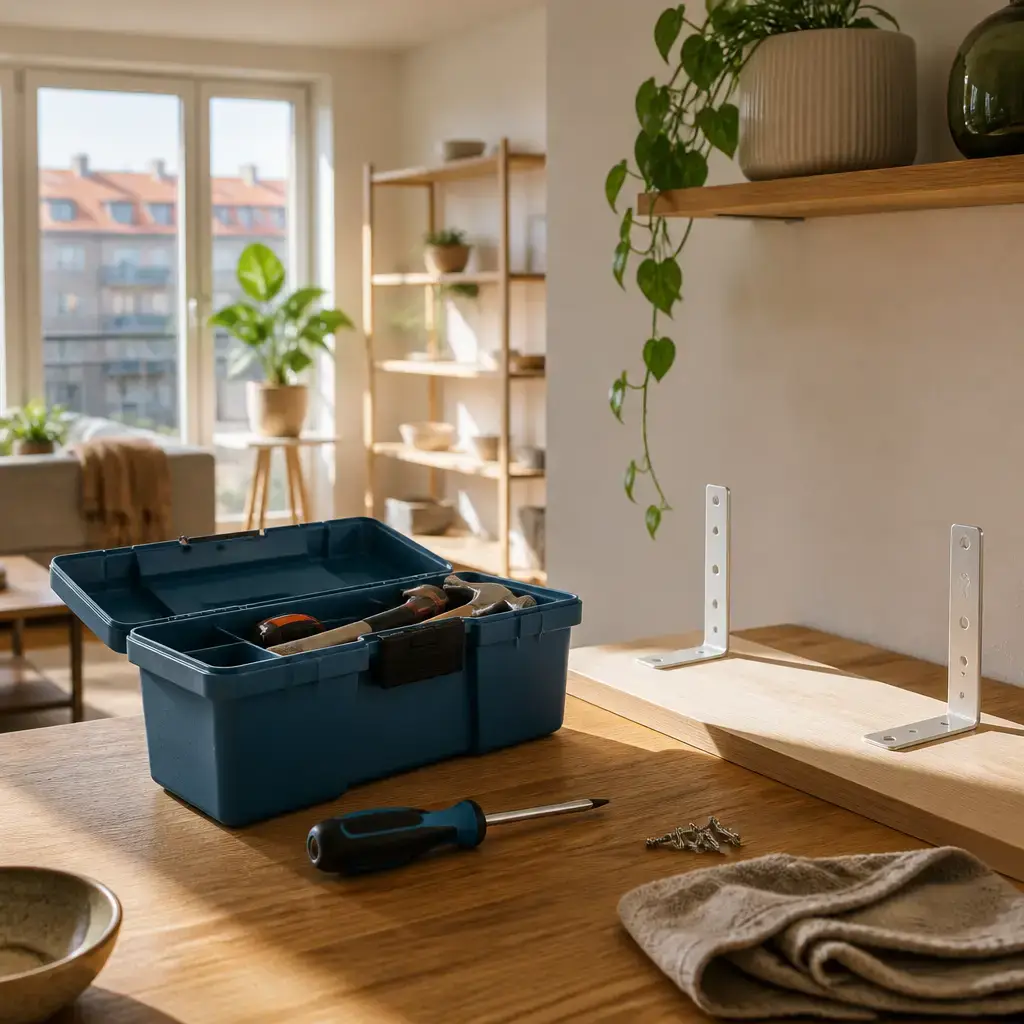
moh yai LOH-nuh deen SKROO-uh-TREK-uh tehl uh LEL-uh reh-pah-rah-SHOHN? Could I borrow your screwdriver for a small repair?Den er i den blå værktøjskasse.
dehn air ee dehn bloh VAIR-toy-KAS-uh. It is in the blue toolbox.Jeg skal stramme hyldebeslagene.
yai sgel STRAH-muh HUL-duh-beh-SLAY-uh-nuh. I need to tighten the shelf brackets.Brug den mellemstore skruetrækker.
broo dehn MEL-uhm-STOH-uh SKROO-uh-TREK-uh. Use the medium screwdriver.Den passer bedre til de beslag.
dehn PAS-uh BEDH-ruh tehl dee beh-SLAY. It fits those brackets better.Hvornår skal jeg aflevere den?
vuh-NOHR sgel yai AHF-lay-vuh dehn? When should I return it?Aflever den før aftensmaden, tak.
AHF-lay-vair dehn fuh AF-dens-MAY-thn, tahk. Please bring it back before dinner.Hvis den bliver støvet, tørrer jeg den først af.
ves dehn BLEE-vuh STUH-vuhth, TUR-uh yai dehn FURST ahf. If it gets dusty, I'll wipe it off first.Det hjælper med at holde værktøjerne i god stand.
deh YEL-buh meth uh HOL-uh VAIR-toy-YOHR-nuh ee goh stahn. That helps keep the tools in good shape.Sentence explanations
Må jeg låne din skruetrækker til en lille reparation?
Could I borrow your screwdriver for a small repair?
- Må jeg
- Could I
- låne
- borrow
- din
- your
- skruetrækker
- screwdriver
- til
- for
- en
- a
- lille
- small
- reparation
- repair
More detail
Må jeg introduces the request. Må is the present form of måtte, used here for permission or possibility; in this question it corresponds naturally to “could I,” rather than asserting past time. Danish questions can place this modal before the subject: Må jeg ...? means “Could/May I ...?” Jeg is the first-person singular pronoun “I.” låne means “borrow,” with the sense of taking something temporarily and intending to return it. It is the infinitive after the modal må; the modal carries the finite verb position, so the lexical verb remains låne rather than taking a present-tense ending. For example: Jeg låner en bog. — “I am borrowing a book.” din means “your” here. It is a possessive form that agrees with the possessed noun, not with the person who owns it. With a common-gender singular noun such as skruetrækker, the form is din; with a neuter singular noun, the corresponding form is dit, and with plural nouns it is dine. skruetrækker means “screwdriver.” Its useful noun pattern is en skruetrækker (indefinite singular), skruetrækkeren (definite singular), and skruetrækkere (plural). The noun is the item being borrowed; din skruetrækker means “your screwdriver.” til means “for” in this phrase and introduces the purpose of the borrowing. Here it connects the borrowed item with the intended activity, not with a recipient. For example: Jeg bruger den til arbejdet. — “I use it for the work.” en is the indefinite article used with a common-gender singular noun. In en lille reparation, it marks the noun phrase as indefinite; it does not by itself state a numerical count. The following noun is reparation, not the adjective. lille describes reparation as “small.” Its base form is lille in common-gender singular, as here; a useful contrast is et lille problem (“a small problem”), while plural forms use små, as in små problemer (“small problems”). reparation means “repair” or “repair job.” It is a common-gender noun: en reparation, with definite singular reparationen and plural reparationer. Together, Må jeg låne din skruetrækker asks permission to borrow the listener’s screwdriver. til en lille reparation gives the purpose: for a small repair. The complete utterance is therefore: “Could I borrow your screwdriver for a small repair?”
Den er i den blå værktøjskasse.
It is in the blue toolbox.
- Den
- it
- er
- is
- i
- in
- den
- the
- blå
- blue
- værktøjskasse
- toolbox
More detail
Den is a standalone Danish pronoun meaning “it” here. It is the common-gender singular form; the neuter singular counterpart is det. The sentence itself does not identify what Den refers to, so this form should be learned as a grammatical “it,” not as a uniquely identified object. er is the present-tense form of være (“to be”). It is used with singular and plural subjects: jeg er (“I am”), den er (“it is”), and de er (“they are”). Example: Bogen er her. — “The book is here.” i means “in” and introduces the location. Example: Den er i skabet. — “It is in the cupboard.” The second den is not the pronoun from the beginning of the sentence. It is the common-gender singular definite article used before an adjective: den blå ... means “the blue ...”. Danish commonly uses this pattern when an adjective comes before a definite common-gender noun. Without the adjective, definiteness is normally attached to the noun instead, as in værktøjskassen (“the toolbox”). blå means “blue.” The form is the same in this phrase and in several other adjective environments, including plural use: en blå kasse (“a blue box”), et blåt skab (“a blue cupboard”), and blå kasser (“blue boxes”). The -t in blåt is the form used with a neuter singular noun; blå here agrees with the common-gender noun phrase. værktøjskasse means “toolbox.” It is a compound noun, and its indefinite singular form is værktøjskasse; useful related forms are værktøjskasser (“toolboxes”) and værktøjskassen (“the toolbox”). Example: Jeg har en værktøjskasse. — “I have a toolbox.” Together, Den er i gives “It is in,” and den blå værktøjskasse gives “the blue toolbox.” Thus the complete utterance means “It is in the blue toolbox.”
Jeg skal stramme hyldebeslagene.
I need to tighten the shelf brackets.
- Jeg skal
- I need to
- stramme
- tighten
- hyldebeslagene
- the shelf brackets
More detail
Jeg skal means “I need to” here. Jeg is the first-person singular pronoun “I”. Skal is the present-tense form of skulle; with an infinitive, it forms a construction for a present need or intended action in this sentence. The infinitive follows without an equivalent of English “to”: Jeg skal stramme = “I need to tighten.” stramme is the infinitive “to tighten”. The same form can be reused after other Danish verbs or modal constructions that take an infinitive, for example: Hun vil stramme skruen. — “She will tighten the screw.” hyldebeslagene means “the shelf brackets”. It is a definite plural form. The noun hyldebeslag means “shelf bracket”; hylde means “shelf”, and beslag means a bracket or fitting. The ending -ene marks plural definiteness in this form, giving “the ...” plural rather than an indefinite plural such as hyldebeslag (“shelf brackets”). Danish commonly combines nouns into compounds, as in hyldebeslag. Together, Jeg skal + stramme expresses the speaker’s need to perform the action, and hyldebeslagene identifies the objects receiving that action. The complete meaning is: “I need to tighten the shelf brackets.”
Brug den mellemstore skruetrækker.
Use the medium screwdriver.
- Brug
- use
- den
- the
- mellemstore
- medium-sized
- skruetrækker
- screwdriver
More detail
Brug is the imperative of bruge, “to use.” It gives a direct instruction to the person addressed. Compare the reusable forms at bruge (“to use”) and jeg bruger (“I use”). Example: Brug denne nøgle. — “Use this key.” den means “the” here and is the definite article used with a singular common-gender noun. In this phrase it belongs to the noun phrase den mellemstore skruetrækker; it is not the separate pronoun seen in the following sentence, Den passer bedre ... (“It fits better ...”). mellemstore means “medium-sized” here. Its base form is mellemstor; the ending -e is used with a definite noun phrase such as den mellemstore ..., and also in plural contexts. This adjective is not a comparative form meaning “more medium-sized.” Example: en mellemstor kasse — “a medium-sized box”; den mellemstore kasse — “the medium-sized box.” skruetrækker means “screwdriver.” It is a common-gender noun: en skruetrækker is “a screwdriver,” while the definite form without a preceding adjective is skruetrækkeren, “the screwdriver.” Its plural forms are skruetrækkere and skruetrækkerne (definite plural). Together, den mellemstore skruetrækker is “the medium-sized screwdriver.” The adjective is placed before the noun, with den marking the definite singular noun phrase. With the imperative Brug, the complete utterance is: “Use the medium screwdriver.”
Den passer bedre til de beslag.
It fits those brackets better.
- Den
- it
- passer
- fits
- bedre
- better
- til
- to
- de
- those
- beslag
- brackets
More detail
Den is the Danish common-gender singular pronoun used here for “it.” In the supplied context, it refers to the screwdriver mentioned just before. Danish pronouns must match the relevant noun’s grammatical gender and number; den is not the form used for a neuter singular noun, and plural “they/them” uses other forms. passer comes from passe, “to fit” or “to suit.” It is the present-tense form, and Danish present tense does not change for the subject’s person or number: jeg passer, du passer, and den passer all use passer when the meaning is “fit/suit.” In passer til, the preposition introduces what something fits or suits: Det passer til låsen. — “It fits the lock.” bedre means “better” here and compares the fit with another possible fit. It is the comparative form related to god/godt (“good/well”); the form bedre is used for both the adjective and the adverb in relevant contexts. For example, Denne passer bedre. means “This one fits better.” til is the preposition “to” or “for.” With passer, the pattern passe til + noun means “fit/suit + noun.” It does not itself identify the object being compared; bedre supplies the comparison. de means “those” in this sentence and stands before the plural noun it determines. Danish also uses de as the plural definite article, often corresponding to “the”; here the fixed translation shows the demonstrative meaning “those.” beslag means “brackets” here. It is a noun whose plural form is also beslag; the form does not add a visible plural ending in this use. A definite plural form would be beslagene, “the brackets.” Together, Den passer bedre means “It fits better,” til links the fit to its object, and de beslag means “those brackets.” The complete utterance is therefore “It fits those brackets better.”
Hvornår skal jeg aflevere den?
When should I return it?
- Hvornår
- when
- skal jeg
- should I
- aflevere
- return; hand in
- den
- it
More detail
Hvornår asks about time: “when.” It is a question adverb and can be reused in questions such as Hvornår kommer du? — “When are you coming?” skal jeg combines the present-tense modal skal, from skulle, with the subject pronoun jeg, “I.” Here skal expresses what the speaker should or is expected to do. In a Danish question beginning with a question word, the finite verb comes before the subject: Hvornår skal jeg ...? The modal is followed by an infinitive without at, as in Skal jeg vente? — “Should I wait?” aflevere is the infinitive meaning “return” or “hand in.” Its useful forms include aflevere (infinitive), afleverer (present), afleverede (past), and afleveret (past participle). In this utterance it is governed by skal, so the infinitive is used: Jeg skal aflevere ... — “I should return ...” den is the object pronoun “it” here. It is the singular common-gender form used for the already mentioned item; the surrounding context identifies that the item is to be returned, without specifying its type. Danish also uses den in other grammatical roles, so its exact function comes from its position here as the object of aflevere. Together, Hvornår asks for the time, skal jeg asks what the speaker should do, aflevere names the action, and den names the item being returned. Thus the whole utterance means “When should I return it?”`
Aflever den før aftensmaden, tak.
Please bring it back before dinner.
- Aflever
- return; hand in
- den
- it
- før
- before
- aftensmaden
- dinner
- tak
- please
More detail
Aflever is the imperative of aflevere, meaning “return” or “hand in.” The imperative gives a direct request and normally has no stated subject: Aflever den. = “Return it.” Here, the object den follows the verb. den is a singular common-gender object pronoun meaning “it.” In this utterance, it refers to the item being returned, as supported by the fixed translation and the surrounding context. Danish uses den for a singular common-gender noun; the corresponding neuter form is det. før means “before.” It can introduce a time expression: før aftensmaden = “before dinner.” In this utterance it expresses time, not physical position. aftensmaden means “dinner” or “the evening meal.” It is the definite form of aftensmad: aftensmad = “dinner,” aftensmaden = “the dinner.” The ending -en marks definiteness in this noun form. tak means “thanks.” After a request, it can function as a polite “please,” as it does here. Together, Aflever den means “Return it” or “Hand it in,” før aftensmaden sets the deadline as before dinner, and tak adds politeness. The complete utterance means: “Please bring it back before dinner.”
Hvis den bliver støvet, tørrer jeg den først af.
If it gets dusty, I'll wipe it off first.
- Hvis
- if
- den
- it
- bliver
- gets; becomes
- støvet
- dusty
- tørrer … af
- wipe off
- jeg
- I
- først
- first
More detail
Hvis introduces a condition: “if …”. It is reusable at the start of a conditional clause, for example: Hvis det regner, bliver jeg hjemme. — “If it rains, I’ll stay home.” In the fixed sentence, the condition is the clause that follows it. den means “it” here. It is a third-person singular pronoun used for a common-gender singular referent; its exact referent is not identified by the supplied texts. Danish contrasts den with det and plural de in contexts where the referent’s grammatical form calls for those pronouns. The same pronoun appears again as the object of the wiping action later in the sentence. bliver is the present-tense form of blive, “become” or “get”. Here it combines with the adjective støvet to mean “gets dusty”: blive describes a change into a state. For example: Maden bliver kold. — “The food gets cold.” støvet means “dusty” in this sentence. It describes the state reached by the referent of den; it is not the verb “dust”. A useful contrast is ren — “clean”: Bordet bliver støvet. — “The table gets dusty.” tørrer ... af is the present-tense form of the separable verb construction tørre af, “wipe off”. The verb is tørre; af is placed later in this construction. For example: Jeg tørrer bordet af. — “I wipe the table off.” The fixed sentence places the object den between the verb and af. jeg means “I” and is the subject of tørrer. Danish uses jeg for the first-person singular subject; it does not change according to the object’s grammatical form. først means “first” and shows the order of the action. Here it says that the wiping happens before any other relevant action, without itself specifying what that other action is. Together, Hvis den bliver støvet means “If it gets dusty”. The main clause tørrer jeg den først af means “I’ll wipe it off first”: Danish present tense can express a planned or expected future action when the context makes that time clear. The complete utterance is therefore: “If it gets dusty, I’ll wipe it off first.”
Det hjælper med at holde værktøjerne i god stand.
That helps keep the tools in good shape.
- Det
- That
- hjælper
- helps
- holde
- keep
- værktøjerne
- the tools
- god
- good
- stand
- condition; shape
- i god stand
- in good condition
More detail
Det is the Danish pronoun used here for “that.” Its form is neuter singular; the fixed translation identifies its intended meaning, while the sentence itself does not need a more specific noun referent. Danish also uses det in other roles, so its exact function must be learned from context. hjælper is the present-tense form of hjælpe, “to help.” The ending here marks present time, and the subject is Det. A useful pattern is hjælpe med at + infinitive: “help with doing something” or “help to do something.” holde is the infinitive form of holde, “to keep” or “to hold.” After at, Danish uses the infinitive: at holde. In this sentence, holde means maintaining something in a particular condition, not physically holding it. værktøjerne means “the tools.” It is the definite plural form of værktøj (“tool”): værktøj → værktøjer (tools) → værktøjerne (the tools). The definite ending is part of the word, rather than a separate word for “the.” god means “good” here and describes stand. It is the common-gender singular form of the adjective; god has the comparison forms bedre (“better”) and bedst (“best”). In god stand, it contributes the idea that the condition is favorable. stand means “condition” or “state” here. In the reusable expression i god stand, it refers to being in good working condition. The noun is common gender, which is why the adjective appears as god in this phrase. i god stand is the construction “in good condition” or “in good shape.” Together with holde, it forms holde noget i god stand, “keep something in good condition.” The sentence assembles as Det hjælper (“That helps”) + med at holde (“with keeping”) + værktøjerne (“the tools”) + i god stand (“in good condition”). Its complete meaning is: “That helps keep the tools in good shape.”
Grammar Points
tørre ... af
Jeg tørrer værktøjerne af først.
yai TUR-uh VAIR-toy-YOHR-nuh ahf FURST.I wipe the tools off first.
The particle af is separated from tørre in the present tense and comes after the object.
i god stand
Værktøjerne er i god stand.
VAIR-toy-YOHR-nuh air ee goh stahn.The tools are in good condition.
Danish uses the fixed expression i god stand to describe something that is well maintained.
Danish Vocabulary
- Gender
- neuter
- Gender
- common
- Gender
- common
- Gender
- common
- Gender
- common
Quiz
Word Order
Arrange the words in the correct order.
It is in the blue toolbox.
Show Answer
Den er i den blå værktøjskasse.I need to tighten the shelf brackets.
Show Answer
Jeg skal stramme hyldebeslagene.Use the medium screwdriver.
Show Answer
Brug den mellemstore skruetrækker.Spelling
Tap the letters to spell the word.
tighten
Show Answer
strammesmall
Show Answer
lillescrewdriver
Show Answer
skruetrækkerrepair