10 minutes free every day
Continue audio lessons in the app
Word explanations appear automatically in sync with the audio.
No login required · synced translations · playback with the screen locked
Choose your learning language and open this lesson in the app.

About This Lesson
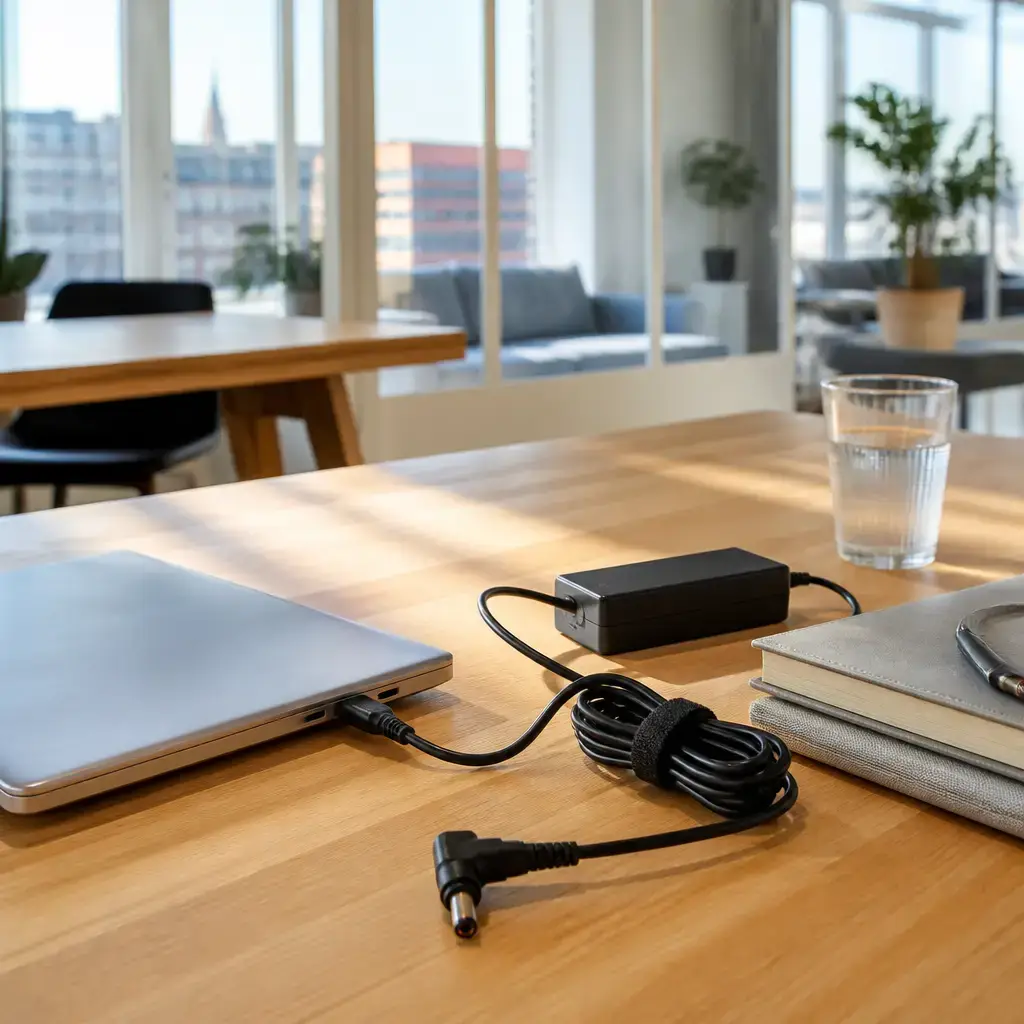
Use Borrowing a laptop charger at work to practice Danish conversation, pronunciation, vocabulary, grammar, and quizzes.
Dialogue
Batteriet i min laptop er næsten tomt.
BAH-deh-ree-uhd ee meen LAP-tub air NESS-den tuhm'd. My laptop battery is almost empty.Du kan låne min oplader indtil mødet.
doo kan LOH-nuh meen oh-PLAY-thuh EN-del MUR-eth. You can borrow my charger until the meeting.Er den kompatibel med min laptop?
air den kohm-pah-TEE-buhl med meen LAP-tub? Is it compatible with my laptop?Det burde den være, men tjek stikket først.
deh BOO-uh-thuh den VAIR-uh, men chek STEG-uhd FURST. It should be, but check the connector first.Den passer, og batteriet lader nu.
den PASS-uh, oh BAH-deh-ree-uhd LAY-thuh noo. It fits, and the battery is charging now.Læg den tilbage på mit skrivebord, når du er færdig.
LEH den teh-BAH-leh poh meet SKREE-vuh-bohrd, NAWR doo air FAIR-dee. Put it back on my desk when you finish.Jeg lægger den tilbage, før du går.
yai LEH-guh den teh-BAH-leh, FUR doo gohr. I'll put it back before you leave.Så har jeg tid nok, før jeg skal bruge den igen.
soh hah yai teeth nohk, FUR yai sgal BROO-uh den ee-GAIN. That gives me enough time before I need it again.Sentence explanations
Batteriet i min laptop er næsten tomt.
My laptop battery is almost empty.
- Batteriet
- the battery
- i
- in
- min
- my
- laptop
- laptop
- er
- is
- næsten
- almost
- tomt
- empty
More detail
Batteriet means “the battery” here. It is the definite singular form of batteri: et batteri means “a battery,” while batteriet means “the battery.” The ending -et marks definiteness for this neuter noun. i means “in” and introduces the location relationship between the battery and the laptop. min means “my.” It is the possessive form used with a singular common-gender noun, as in min laptop (“my laptop”). Danish uses mit with a singular neuter noun and mine with plural nouns; the form agrees with the possessed noun, not the possessor. laptop means “laptop.” In min laptop, it identifies the laptop containing the battery. Example: Min laptop er ny. — “My laptop is new.” er is the present-tense form of være, “to be.” It can connect a subject with a description or state: Batteriet er tomt. — “The battery is empty.” næsten means “almost” or “nearly.” It makes the following description approximate: the battery is close to empty, rather than being stated as completely empty. tomt means “empty” here. Its base form is the adjective tom; tomt is the neuter singular form agreeing with the neuter noun batteriet. The adjective has the comparison forms tommere (“emptier”) and tommest (“emptiest”). Together, Batteriet i min laptop means “the battery in my laptop,” and er næsten tomt describes that battery as nearly empty. The complete utterance is therefore “My laptop battery is almost empty.”
Du kan låne min oplader indtil mødet.
You can borrow my charger until the meeting.
- Du kan
- you can
- låne
- borrow
- min
- my
- oplader
- charger
- indtil
- until
- mødet
- the meeting
More detail
Du kan addresses one person with du and uses the present-tense modal kan, from kunne, meaning “can” here. Danish modal verbs are followed by an infinitive without at: Du kan låne means “You can borrow.” Du is the second-person singular pronoun; the plural form is I. låne is the infinitive “to borrow.” In this sentence, the person addressed receives temporary use of the charger. Example: Jeg vil låne en bog. — “I want to borrow a book.” min means “my” before a singular common-gender noun. It agrees with oplader, whose indefinite form is en oplader. Compare mit before a singular neuter noun and mine before plural nouns; the possessive form is chosen by the possessed noun, not by the owner. oplader means “charger.” Its indefinite singular form is en oplader, and its definite singular form is opladeren, “the charger.” indtil means “until” and marks the endpoint of a time period. It can introduce a noun phrase, as here, or a clause. Example: Vi bliver her indtil fredag. — “We are staying here until Friday.” mødet means “the meeting.” The base noun is møde; mødet is its singular definite form, formed with the ending -t. The indefinite form is et møde, because møde is neuter. Example: Mødet begynder klokken ni. — “The meeting starts at nine.” Together, Du kan låne expresses permission or ability to borrow, min oplader identifies the object as the speaker’s charger, and indtil mødet sets the endpoint of the borrowing period. The complete utterance means: “You can borrow my charger until the meeting.”
Er den kompatibel med min laptop?
Is it compatible with my laptop?
- Er den
- Is it
- kompatibel
- compatible
- min
- my
- laptop
- laptop
More detail
Er den is a reusable Danish yes/no-question pattern: er is the present-tense form of være (“to be”), and den is a singular common-gender pronoun meaning “it” here. In a question, the finite verb comes before the subject: Er den ...? = “Is it ...?” The pronoun’s grammatical form is clear, but the utterance itself does not name the object it refers to. kompatibel is an adjective meaning “compatible.” Here it is the predicative form agreeing with the common-gender singular subject den. The useful form chain is kompatibel (common-gender singular), kompatibelt (neuter singular), and kompatible (plural or definite forms). A useful pattern is være kompatibel med ... (“be compatible with ...”), where med introduces what something works with. Example: Denne oplader er kompatibel med telefonen. — “This charger is compatible with the phone.” min means “my” before a singular common-gender noun. Danish possessives agree with the possessed noun, not with the owner: min is used with common-gender singular nouns, mit with neuter singular nouns, and mine with plural nouns. Example: min telefon — “my phone”; mit kabel — “my cable.” laptop is the noun “laptop.” In this sentence it follows min, so it is a singular common-gender noun: min laptop. The preposition med (“with”) connects it to kompatibel: the question asks whether the item is compatible with the laptop. Together, Er den makes the yes/no question, kompatibel describes the item, and med min laptop identifies what it must work with. The complete meaning is: “Is it compatible with my laptop?”
Det burde den være, men tjek stikket først.
It should be, but check the connector first.
- Det
- it; that
- burde
- should; ought to
- den
- it
- være
- be
- tjek
- check
- stikket
- the connector; the plug
- først
- first
More detail
Det is a neuter form used here in the fixed construction Det burde den være. In this sentence it contributes to the meaning “it should be,” while den is the pronoun referring to the item being discussed. Danish pronoun forms are chosen partly by the grammatical properties of what they refer to; the exact real-world referent is not named here. burde is the modal verb form meaning “should” or “ought to” here. It is the past-tense form of bør, but in this use it expresses a present expectation or judgment rather than simply past time. A useful pattern is burde + infinitive, as in Du burde ringe — “You should call.” den is a common-gender singular pronoun, here meaning “it” for the item under discussion. It is the grammatical subject of være; Det is a separate pronoun in the construction and should not be treated as the same word repeated. The form den can also refer to a singular common-gender noun in other contexts, but the fixed sentence does not identify that noun by name. være is the infinitive “be.” After the modal burde, Danish uses the infinitive without an infinitive marker: burde være means “should be.” The sentence leaves the property after “be” understood from the preceding question, so the intended meaning is “It should be [compatible].” tjek is the imperative of tjekke, “to check.” It directly tells the listener to perform the action: Tjek døren means “Check the door.” The imperative is a verb form, not the noun “check.” stikket means “the connector” or “the plug” here. It is the definite singular form of stik; the ending -et marks definite singular for this noun. The appropriate English choice depends on the object involved, and the fixed translation specifies “connector.” først means “first,” indicating that checking the connector should happen before the other implied actions. It can also occur in time-order instructions such as Læs først — “Read first.” Together, Det burde den være gives the expected assessment “It should be,” with the understood property supplied by the preceding compatibility question. men means “but,” and tjek stikket først is an imperative clause: “check the connector first.” The complete utterance is therefore: “It should be, but check the connector first.”
Den passer, og batteriet lader nu.
It fits, and the battery is charging now.
- Den
- it
- passer
- fits
- batteriet
- the battery
- lader
- is charging
- nu
- now
More detail
Den is the Danish singular pronoun used here for “it.” It has the common-gender form; the corresponding neuter form is det. The fixed sentence does not identify exactly what den refers to, so its grammatical form is the useful point here. passer is the present form of passe, “to fit” in this context. The present form can describe a current state: Den passer. — “It fits.” Passe can also mean “suit” or “match” in other contexts, but the fixed translation supports the fitting meaning here. og connects two coordinated statements: “and.” It does not change the tense or person of either statement. batteriet means “the battery.” The base noun is batteri; the ending -et marks the definite singular form for this neuter noun: et batteri — “a battery,” batteriet — “the battery.” The definite form identifies the battery as an already relevant one, without stating how many batteries exist. lader is the present form of lade. Here it means “is charging.” Danish commonly uses the present tense where English uses a present progressive, so Batteriet lader. can be translated as “The battery is charging.” In other contexts, lade can mean “let” or “allow”; the battery context selects the charging meaning. nu means “now” and places the charging in the present time. It modifies the situation described by batteriet lader rather than changing the form of lader. Together, Den passer means “It fits.” The conjunction og links that statement to batteriet lader nu, “the battery is charging now.” The complete utterance is therefore: “It fits, and the battery is charging now.”
Læg den tilbage på mit skrivebord, når du er færdig.
Put it back on my desk when you finish.
- Læg
- put; lay
- den
- it
- tilbage
- back
- på
- on
- mit
- my
- skrivebord
- desk
- når
- when
- du
- you
- er færdig
- are finished
More detail
Læg is the imperative of lægge (“to put” or “to lay”). It addresses one person directly and gives an instruction: “Put …”. Compare the present form lægger: Jeg lægger den tilbage means “I put it back” or “I am putting it back.” den is a third-person singular pronoun meaning “it” here. Its specific referent is not identified by the supplied sentence, but the form is compatible with a common-gender singular referent. Danish also has det for a neuter singular referent; the choice depends on the referent’s grammatical gender, not on the object’s physical characteristics. tilbage means “back,” indicating a return to an earlier place or position. Together, lægge ... tilbage is a reusable pattern for “put ... back.” Example: Jeg lægger bogen tilbage. — “I put the book back.” på means “on” in this location phrase. It introduces the surface or place where something is put. Example: Koppen står på bordet. — “The cup is on the table.” mit means “my” and agrees with the possessed noun here, not with the person who owns it. Skrivebord is a neuter singular noun (et skrivebord), so the corresponding form is mit: mit skrivebord — “my desk.” With a common-gender singular noun, the form is min, as in the example min stol — “my chair.” skrivebord means “desk.” Its base noun is et skrivebord; the indefinite article et shows that this noun is neuter, while skrivebordet is the definite form “the desk.” når means “when” and introduces the time clause that specifies when the instruction applies. It is used for a time or condition expected to occur, as in the example Ring, når du kommer hjem. — “Call when you get home.” du is the second-person singular pronoun “you.” It is the person being addressed in the instruction and the subject of the following clause. Danish uses I for second-person plural “you,” so du does not by itself indicate multiple addressees. er færdig means “are finished” here. er is the present form of være (“to be”), and færdig is an adjective meaning “finished” or “done.” In this context, the clause refers to the addressee being done with the relevant activity; it does not specify what that activity is. The adjective has the same form with du in this sentence; its form is not an inflection of er. The sentence first gives the instruction Læg den tilbage på mit skrivebord — “Put it back on my desk.” The location phrase says where the object should be returned. The time clause når du er færdig adds “when you finish” or, more literally, “when you are finished,” so the complete meaning is: “Put it back on my desk when you finish.”
Jeg lægger den tilbage, før du går.
I'll put it back before you leave.
- Jeg
- I
- lægger
- put
- den
- it
- tilbage
- back
- før
- before
- du
- you
- går
- leave
More detail
Jeg means “I” here. It is the first-person singular pronoun. In Danish, the subject pronoun identifies the person carrying out the action; for example, Jeg kommer. means “I am coming.” lægger is the present-tense form of lægge, “to put” or “to place.” The present form can describe an action happening now or an intended action in the immediate situation. Example: Jeg lægger bogen her. — “I put the book here.” den is the object pronoun “it” in this sentence. It is a third-person singular object form for a common-gender referent; the form itself does not identify the exact object. Danish uses det for a singular neuter referent. Example: Jeg ser den. — “I see it.” tilbage means “back.” With lægger, it expresses returning something to an earlier or usual place: lægger den tilbage means “put it back.” The word is an adverb here, not part of the verb’s inflection. før introduces a time relation meaning “before.” It connects the main action with the later event in the subordinate clause. A reusable pattern is før + subject + verb: før jeg går — “before I leave.” du is the second-person singular pronoun “you.” It is the subject of the subordinate clause. Danish uses du for this grammatical person without changing it for gender. går is the present-tense form of gå, “to go” or “to walk.” In this sentence, the fixed translation establishes the intended sense “leave.” Example: Hvornår går du? — “When are you leaving?” Together, Jeg lægger den tilbage means “I’ll put it back,” and før du går adds the time condition “before you leave.” The whole utterance therefore means “I’ll put it back before you leave.” Danish uses the present tense here for both actions; the English future meaning is understood from the situation and intention rather than from a separate future verb form.
Så har jeg tid nok, før jeg skal bruge den igen.
That gives me enough time before I need it again.
- Så
- so; then
- har jeg
- I have
- tid
- time
- nok
- enough
- før
- before
- skal
- need to; have to
- bruge
- use
- den
- it
- igen
- again
More detail
Så means “so” here and links the result to what came before. In this sentence it is followed by inverted word order: har jeg, literally “have I,” rather than the ordinary statement order jeg har. The subject is jeg (“I”), and har is the present form of have. tid means “time.” It is a noun, and nok follows it to mean “enough”: tid nok = “enough time.” This placement is a useful Danish pattern for expressing sufficiency. For example, Jeg har penge nok. means “I have enough money.” før introduces a clause meaning “before.” The clause after it has its own subject and verb: jeg skal bruge den = “I need to use it.” skal is the present form of skulle. Here it expresses a need or obligation, so skal bruge means “need to use” in this context. The infinitive bruge means “use.” In another context, skal can express a planned or expected action, but the fixed translation supports the need reading here. den is a singular object pronoun meaning “it” here. Its grammatical form is used for a singular common-gender noun; the pronoun’s form does not itself identify a particular object. The fixed translation establishes the intended object reading, and the preceding context also uses den for the established item. igen means “again.” It shows that the using is repeated, rather than being a first use. Together, har jeg tid nok means “I have enough time,” with inversion after Så. The subordinate clause før jeg skal bruge den igen means “before I need to use it again.” The complete utterance therefore means: “That gives me enough time before I need it again.”
Grammar Points
Et-ordets bestemte form: substantiv + -et
Batteriet er næsten tomt.
BAH-deh-ree-uhd air NESS-den tuhm'd.The battery is almost empty.
Neutrale substantiver får ofte endelsen -et i bestemt form: batteri → batteriet.
Imperativ med objektpronomen
Læg den tilbage.
LEH den teh-BAH-leh.Put it back.
I en imperativ står objektpronomenet den efter verbet: Læg den tilbage.
Danish Vocabulary
- Gender
- neuter
- Gender
- common
- Gender
- neuter
- Gender
- common
- Gender
- neuter
- Gender
- neuter
Quiz
Word Order
Arrange the words in the correct order.
Is it compatible with my laptop?
Show Answer
Er den kompatibel med min laptop?It fits, and the battery is charging now.
Show Answer
Den passer, og batteriet lader nu.Spelling
Tap the letters to spell the word.
until
Show Answer
indtilcharger
Show Answer
opladeralmost
Show Answer
næstencompatible