10 minutes free every day
Continue audio lessons in the app
Word explanations appear automatically in sync with the audio.
No login required · synced translations · playback with the screen locked
Choose your learning language and open this lesson in the app.

About This Lesson
Use Borrowing cleaning supplies from a neighbor to practice Danish conversation, pronunciation, vocabulary, grammar, and quizzes.
Dialogue
Må jeg bruge noget rengøringsspray?
MOH yai BROO-uh NOH-eth RAHNG-GUR-ings-SPRAY? Can I use some cleaning spray?Det står under vasken. Er der spildt noget?
deh STOR OON-uh VAHS-ken. air dair SPILT NOH-eth? It is under the sink. Did something spill?Der er spildt juice på køkkengulvet.
dair air SPILT YOOS poh KUR-gən-GOOL-vuh. Juice spilled on the kitchen floor.Tag også den lille spand, så du kan skylle moppen.
TAH OWS-goh den LIL-uh SPAN, soh doo kan SKUUL-uh MOP-en. Take the small bucket too, so you can rinse the mop.Det hjælper. Jeg tager dem begge med tilbage, når jeg er færdig.
deh YEL-bər. yai TAH-er dem BEG-uh med tə-BAIR, nair yai air FAIR-dee. That helps. I will bring both back when I finish.Stil dem ved min dør, når alt er tørt.
STEL dem vay min DUR, nair alt air TURT. Leave them by my door once everything is dry.Jeg sætter pris på din hjælp med det her rod.
yai SET-er preese poh deen YELP med deh hair ROH. I appreciate your help with this mess.Bare sørg for, at gulvet ikke er glat bagefter.
BAH SUR for, eh GOO-lvuh IK-uh air GLAHT BAH-ef-ter. Just make sure the floor is not slippery afterward.Sentence explanations
Må jeg bruge noget rengøringsspray?
Can I use some cleaning spray?
- Må jeg
- May I …? / Can I …?
- bruge
- use
- noget
- some
- rengøringsspray
- cleaning spray
More detail
Må jeg is a reusable Danish permission question: må expresses that the speaker is allowed to do something, and jeg means “I.” The pattern is Må jeg + infinitive ...? (“May I ...?” / “Am I allowed to ...?”). For example: Må jeg komme ind? — “May I come in?” bruge means “use.” Its base form is bruge, and it is the infinitive used after må: må jeg bruge ...? Danish modal verbs such as må are followed by an infinitive without an English-style “to.” For example: Må jeg tage den? — “May I take it?” noget means “some” here, referring to an unspecified amount of the substance. It does not state an exact quantity. In other contexts, noget can also mean “something,” so its interpretation depends on the expression around it. Here it introduces the unspecified amount of cleaning spray. rengøringsspray is a noun meaning “cleaning spray.” It is a compound: rengøring relates to cleaning, and spray identifies the sprayed product. Danish commonly forms compounds like this as one written word; the whole compound is the noun used here. Together, Må jeg bruge noget rengøringsspray? asks permission to use an unspecified amount of cleaning spray: “Can I use some cleaning spray?”
Det står under vasken. Er der spildt noget?
It is under the sink. Did something spill?
- Det står
- it is located
- under
- under
- vasken
- the sink
- Er der
- is there
- spildt
- spilled
- noget
- something
More detail
Det står gives the location statement “it is located.” står is the present form of stå, whose basic meaning is “stand”; with a place phrase, it can describe where something is positioned or located. Here, det is a neuter singular pronoun. The supplied texts do not identify the specific thing to which it refers. under is a preposition meaning “under” and introduces the location of the item. For example, Bogen står under stolen. means “The book is under the chair.” vasken means “the sink.” It is the definite form of vask: en vask means “a sink,” and vasken means “the sink.” The ending -en marks definiteness for this common-gender noun; it is part of the noun form, not a separate word. Er der is a reusable question pattern meaning “is there ...?” or, in a construction describing an event, “has there been ...?” der is the existential word used to present something as existing or occurring. For example, Er der kaffe? means “Is there coffee?” Here, its exact meaning is completed by the following words and the fixed translation. spildt is the past participle of spilde, “to spill.” In Er der spildt noget?, it forms an impersonal/passive event construction with er: the question asks whether something has been spilled, naturally rendered here as “Did something spill?” The participle spildt is the form used for the completed spilling event; it is not the present-tense form of the verb. In the context sentence, Der er spildt juice ... uses the same construction to state that juice has been spilled. noget means “something” here. In a question about whether an unspecified thing was spilled, English may naturally use “anything,” but the fixed translation presents the intended meaning as “something.” noget can also be used in statements for an unspecified thing, as in Jeg har noget. — “I have something.” Together, Det står under vasken. means “It is located under the sink.” The second sentence, Er der spildt noget?, asks whether something has been spilled. The two sentences therefore form the complete meaning: “It is under the sink. Did something spill?”
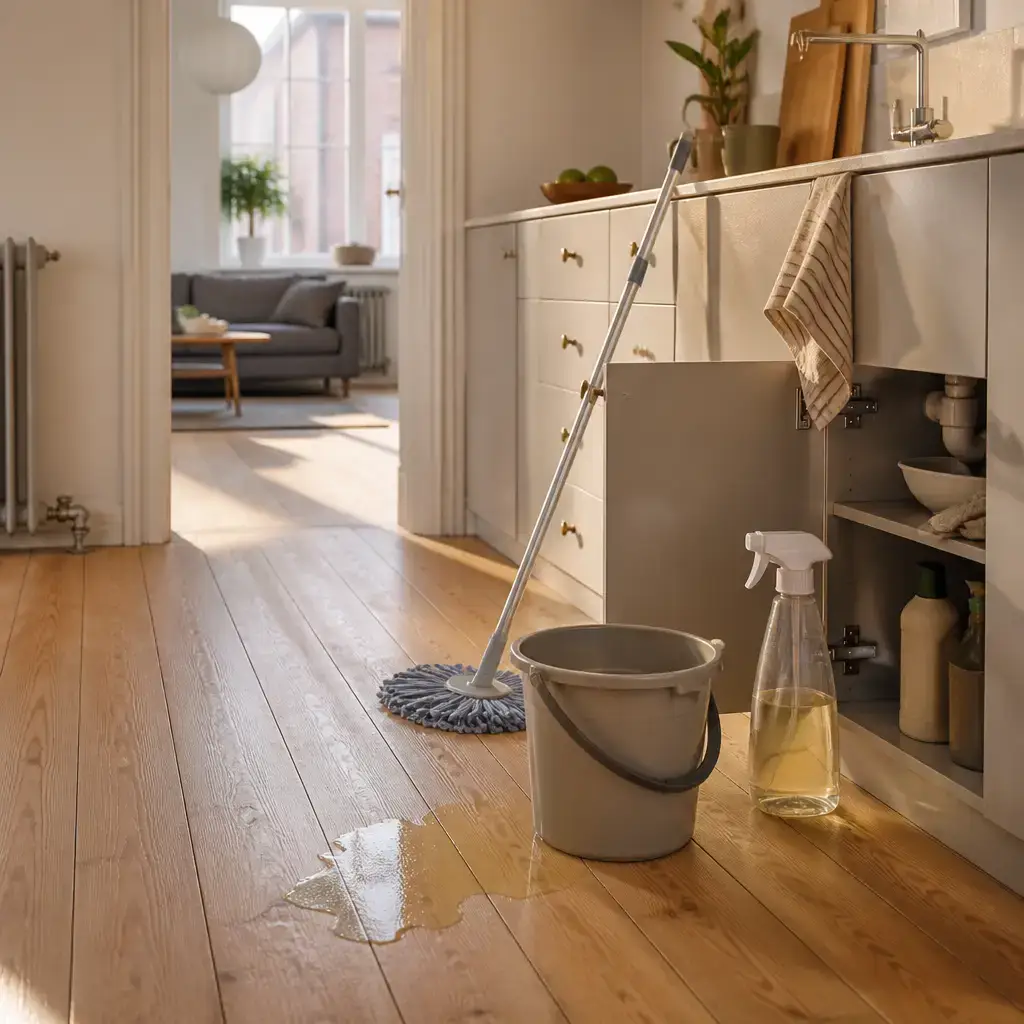
Der er spildt juice på køkkengulvet.
Juice spilled on the kitchen floor.
- Der er
- there is/are
- spildt
- spilled
- juice
- juice
- på
- on
- køkkengulvet
- the kitchen floor
More detail
Der er is a reusable Danish frame for presenting that something exists or has happened, often translated “there is/are” or, in an impersonal event description, “there has been …”. Here it does not identify an actor who caused the spill. Compare the same frame in Er der spildt noget? (“Did something spill?”), where noget means “something.” spildt is the past participle of spilde (“to spill”). The useful form chain is spilde → spildte (past tense) → spildt (past participle). In this sentence, spildt combines with er in an impersonal/result-focused construction: the fact that juice has been spilled is presented, while the person responsible is left unspecified. Example: Der er spildt mælk. — “Milk has been spilled.” juice names the substance that was spilled. Danish can use this loanword as a noun in the same way as other substance nouns; the sentence does not state how much juice there was. Example: Jeg drikker juice. — “I am drinking juice.” på is the preposition “on,” used here for the surface where the juice is located. Example: Bogen ligger på bordet. — “The book is on the table.” køkkengulvet means “the kitchen floor.” It is a compound built from køkken (“kitchen”) and gulv (“floor”), with the definite singular ending -et on the compound: køkkengulv → køkkengulvet. The ending makes this a specific floor, not an indefinite “a kitchen floor.” Example: Gulvet er vådt. — “The floor is wet.” Together, Der er spildt presents a completed spill without naming its actor, juice identifies what was spilled, and på køkkengulvet gives the surface where it happened. The complete meaning is: “Juice spilled on the kitchen floor.”
Tag også den lille spand, så du kan skylle moppen.
Take the small bucket too, so you can rinse the mop.
- Tag
- take
- også
- too; also
- den
- the
- lille
- small
- spand
- bucket
- så du kan
- so you can
- skylle
- rinse
- moppen
- the mop
More detail
Tag is the imperative of tage, “to take.” The imperative gives a direct instruction, with the addressee “you” understood rather than stated. Compare the useful forms tage (infinitive), tager (present), and tog (past). Example: Tag bogen. — “Take the book.” også means “too” or “also.” Here it adds the bucket to something already relevant, rather than introducing it as the only item. Its position after the imperative is common and keeps this additive meaning clear. den lille spand means “the small bucket.” spand is a common-gender noun: en spand means “a bucket,” while spanden means “the bucket.” den is the definite singular form used with a common-gender noun when it comes before an adjective. lille is the adjective “small”; its form here is used with a singular noun in this definite noun phrase. Example: den lille bil — “the small car.” så du kan introduces the purpose or intended result: “so you can.” du is the second-person singular pronoun “you.” kan is the present form of kunne, “to be able to/can,” and it is followed by an infinitive without an equivalent of English “to.” Example: så du kan hvile — “so you can rest.” skylle is the infinitive “to rinse.” It names the action made possible by kan; the person who performs it is understood to be du. Example: Jeg vil skylle koppen. — “I want to rinse the cup.” moppen means “the mop.” The base noun is mop, and the definite ending -en gives moppen, “the mop,” for this common-gender noun. The form refers to the object being rinsed, not to the person who can rinse it. Together, the utterance is an instruction to take the small bucket as an additional item, with the purpose that the addressee can use it to rinse the mop: “Take the small bucket too, so you can rinse the mop.”
Det hjælper. Jeg tager dem begge med tilbage, når jeg er færdig.
That helps. I will bring both back when I finish.
- Det hjælper
- That helps
- tager
- take
- dem
- them
- begge
- both
- med
- along
- tilbage
- back
- når
- when
- færdig
- finished
More detail
Det hjælper means “That helps” here. Det is a neuter third-person pronoun used here for the relevant situation or action; the supplied sentence does not identify a more specific referent. Hjælper is the present form of hjælpe (“help”). Danish verbs do not change for person in the present: jeg hjælper, du hjælper, and det hjælper all use hjælper. Tager comes from tage (“take”). In this sentence, the following words add the meaning of taking something back. Danish present forms can refer to a future action when the context makes the timing clear: Jeg tager dem med tilbage means “I will bring them back.” Dem is the object form of the third-person plural pronoun, “them.” It does not mark the gender of the people or things referred to. Begge means “both” and identifies the two items together; dem begge means “both of them.” In this context, med contributes the idea of taking something along, while tilbage means “back.” Together with tager, tager ... med tilbage is a reusable way to say “take/bring ... back.” Example: Hun tager bogen med tilbage. — “She takes the book back.” Når introduces a time clause meaning “when.” It links one event to the time at which another event occurs. Færdig means “finished” here. It is the common-gender singular form used in jeg er færdig; jeg itself does not display gender. The neuter singular form is færdigt, as in arbejdet er færdigt — “the work is finished.” The full structure is Jeg tager dem begge med tilbage, når jeg er færdig: “I will bring both of them back when I finish.” The main clause states the future-oriented action, and the når-clause states when it will happen.
Stil dem ved min dør, når alt er tørt.
Leave them by my door once everything is dry.
- Stil
- leave; put
- dem
- them
- ved
- by; beside
- min
- my
- dør
- door
- når
- when; once
- alt
- everything
- er
- is
- tørt
- dry
More detail
Stil is the imperative of stille, “to put/place.” It gives a direct instruction to one or more listeners. The imperative is useful in patterns such as Stil X ... (“Put X ...”). In this sentence, the fixed translation makes “leave” the intended context-specific meaning of placing something somewhere. dem means “them” here: it is the third-person plural object pronoun. It can refer to plural people or things, and its form does not show their gender. Compare subject de (“they”) with object dem (“them”): De kommer means “They are coming,” while Jeg ser dem means “I see them.” ved expresses location beside or by something. The reusable pattern ved + place means “by/beside + place”; it is different from a movement expression that would focus on going toward a place. min means “my” and is the possessive form used with a singular common-gender noun. It agrees with the possessed noun, not with the speaker: min dør is “my door,” while mit hus uses mit with the neuter noun hus. With plural nouns, Danish uses mine. dør means “door.” Its base form is singular; the plural is døre. In min dør, it is the place beside which the objects are to be put. når introduces a time clause meaning “when” or “once.” The pattern når + clause places the action in relation to a condition or time: Jeg kommer, når jeg er klar means “I will come when I am ready.” alt means “everything” in this sentence. It is a neuter singular pronoun referring broadly to the relevant things or situation, without naming them individually. Danish also has alle for “everyone” or “all” with plural referents; alt is not the plural form of alle. er is the present-tense form of være, “to be.” It does not change for person or number in the present: jeg er, du er, and de er all use er. Here it links alt with its condition, “is dry.” tørt means “dry” here. Its base form is tør; tørt is the neuter singular form used with alt, while tør is used with a common-gender singular noun and tørre with plural nouns. For example, Håndklædet er tørt means “The towel is dry,” whereas Alt er tørt means “Everything is dry.” Together, Stil dem ved min dør means “Leave them by my door.” The temporal clause når alt er tørt adds the condition “once everything is dry.” The complete instruction is therefore “Leave them by my door once everything is dry.”
Jeg sætter pris på din hjælp med det her rod.
I appreciate your help with this mess.
- sætter pris på
- appreciate
- din
- your
- hjælp
- help
- det her
- this
- rod
- mess
More detail
sætter pris på is the fixed Danish expression meaning “appreciate” or “value.” Its form here is sætter, the present tense of sætte (“put/set”), but the words are not interpreted literally in this expression. The pattern at sætte pris på + noun/pronoun is reusable: Jeg sætter pris på din tid. — “I appreciate your time.” din means “your” and is a possessive determiner. It identifies the owner as the person being addressed; its form agrees with the possessed noun’s grammatical gender and number, not with the owner. Here it accompanies hjælp. A useful contrast is min “my”: min hjælp — “my help.” hjælp is a noun meaning “help.” In this sentence it is the thing that is appreciated. It can also be used in the common expression tak for hjælpen — “thanks for the help”; hjælpen is the definite form of hjælp. det her means “this” and points to something relatively near in the situation. The two-word form is a demonstrative expression; det is neuter singular, while her adds the meaning “here.” In this sentence, the translation identifies the thing being pointed to as the mess. For comparison, det der means “that” or “that there,” referring to something farther away or less immediate. rod is a noun meaning “mess” or “clutter.” With det her, it is the thing described as the current mess. The noun’s definite form is rodet, meaning “the mess”: Jeg rydder rodet. — “I am clearing up the mess.” Together, sætter pris på contributes “appreciate,” din hjælp means “your help,” and med det her rod means “with this mess.” The complete utterance is therefore: “I appreciate your help with this mess.”
Bare sørg for, at gulvet ikke er glat bagefter.
Just make sure the floor is not slippery afterward.
- Bare
- just
- sørg for
- make sure
- gulvet
- the floor
- ikke
- not
- er
- is
- glat
- slippery
- bagefter
- afterward
More detail
Bare means “just” here and makes the instruction sound limited to this one point. It is an adverb; compare kun (“only”) when you want to emphasize restriction more strongly. Sørg for is the reusable Danish construction “make sure [that]”. Sørg is the imperative form of sørge, and for belongs to this construction. It is followed here by at and a clause: sørg for, at ... = “make sure that ...”. Example: Sørg for, at døren er lukket. — “Make sure the door is closed.” gulvet means “the floor” in this sentence. Its base noun is gulv (“floor”); gulvet is the definite singular form, formed with -et. Danish uses et gulv for an indefinite singular floor and gulvet for the definite form. ikke is the ordinary negation “not”. In this clause it negates the description that follows: the floor is not slippery. er is the present-tense form of være (“to be”). Danish uses er across persons and numbers in the present tense, so the form itself does not show whether the subject is singular or plural. Here it links gulvet with the adjective glat. glat means “slippery” here. Its base form is also glat. As a predicative adjective, it describes the subject after er; in this sentence it describes gulvet. Example: Gulvet er glat. — “The floor is slippery.” In Danish, glat is also the form used with a neuter singular noun; plural forms use glatte, as in Gulvene er glatte. — “The floors are slippery.” Bagefter is the temporal adverb “afterward” or “afterwards”. It places the condition at a later time, without specifying exactly how much later. Example: Vi rydder op bagefter. — “We will tidy up afterward.” Together, sørg for, at ... introduces the condition to be checked. ikke er glat says that the floor must not be slippery, and bagefter places that condition afterward. Thus the whole utterance means: “Just make sure the floor is not slippery afterward.”
Grammar Points
sørg for at + infinitiv
Sørg for at bruge rengøringsspray.
SUR for eh BROO-uh RAHNG-GUR-ings-SPRAY.Make sure to use cleaning spray.
The fixed phrase sørg for at is followed by the infinitive to express making sure something happens.
Imperativ: verbstamme
Tag også den lille spand.
TAH OWS-goh den LIL-uh SPAN.Also take the small bucket.
Danish commands often use the verb stem without a subject, as in Tag.
Danish Vocabulary
Må jeg bruge noget rengøringsspray?
Der er spildt juice.
- Gender
- neuter
på køkkengulvet
den lille spand
Tag også den lille spand.
noget rengøringsspray
- Gender
- common
den lille spand
Er der spildt noget?
Det står under vasken.
Tag også den lille spand.
under vasken
- Gender
- common
under vasken
Quiz
Word Order
Arrange the words in the correct order.
Can I use some cleaning spray?
Show Answer
Må jeg bruge noget rengøringsspray?Juice spilled on the kitchen floor.
Show Answer
Der er spildt juice på køkkengulvet.Spelling
Tap the letters to spell the word.
stand; be located
Show Answer
stårspill
Show Answer
spildtuse
Show Answer
brugejuice