10 minutes free every day
Continue audio lessons in the app
Word explanations appear automatically in sync with the audio.
No login required · synced translations · playback with the screen locked
Choose your learning language and open this lesson in the app.

About This Lesson
Use Borrowing and using a bicycle pump to practice Danish conversation, pronunciation, vocabulary, grammar, and quizzes.
Dialogue
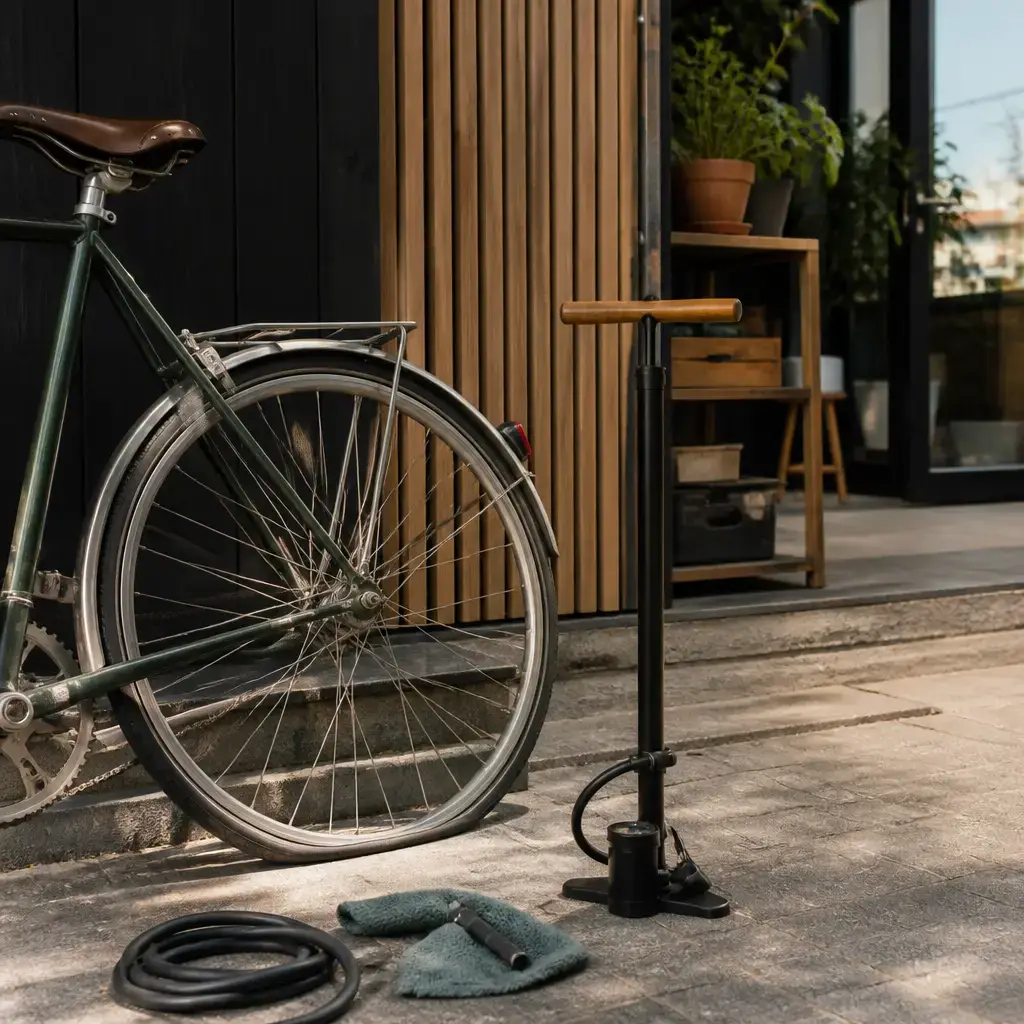
Mit bagdæk er næsten fladt.
mit BAG-dehk air NAY-sten flad. My back tire is almost flat.Jeg har en pumpe, du kan låne.
yai har uhn POM-buh, doo kan LOH-nuh. I have a pump you can borrow.Skal jeg først tjekke, om der er en lækage?
skahl yai FURST CHEK-uh, om dair air uhn LAY-guh? Should I check for a leak first?Se langs dæksiden, før du fylder luft i.
say longs DEK-see-uh, fur doo FILL-uh LOHFT ee. Look along the sidewall before adding air.Kan du vise mig, hvordan jeg sætter den på?
kan doo VEE-suh my, voh-DAN yai SET-uh den paw? Can you show me how to attach it?Tryk denne del ned over ventilen, og pump langsomt.
TRUHG DEN-uh dayl naydh OH-vuh VEN-tee-luhn, ow POM LANG-som. Press this part onto the valve and pump slowly.Dækket føles fast nok nu.
DEK-uh FUHL-uss fast nok noo. The tire feels firm enough now.Tag pumpen med tilbage, når du er færdig.
tay POM-buhn may tuh-BAI-luh, nair doo air FAIR-dee. Bring the pump back when you finish.Sentence explanations
Mit bagdæk er næsten fladt.
My back tire is almost flat.
- Mit
- my
- bagdæk
- back tire
- er
- is
- næsten
- almost
- fladt
- flat
More detail
Mit means “my” here and is the possessive form used with a singular neuter noun. Danish contrasts min with common-gender singular nouns and mine with plural nouns: min bil, mit dæk, mine dæk. The possessive marks the relation to the speaker; it does not itself state who owns the object in any broader sense. bagdæk means “back tire.” It is a compound noun: bag means “back” and dæk means “tire,” but the complete compound is the useful noun for this meaning. Its grammatical gender is neuter, which is why the sentence uses mit and the neuter adjective form fladt. er is the present-tense form of være, “to be.” Danish uses er with all subjects in the present tense; it does not change for person or number. For example, Jeg er klar means “I am ready,” while Vi er klar means “We are ready.” næsten means “almost” or “nearly.” It places the condition close to, but not fully at, the stated degree. In this sentence it modifies fladt, so the tire is close to being flat, rather than completely flat. fladt means “flat” here. The base form is flad; fladt is the neuter singular form used with the neuter subject bagdæk in this predicative description. Compare en flad cykel (“a flat bicycle” or “a flat bike,” with common-gender agreement) and et fladt dæk (“a flat tire,” with neuter agreement). In the fixed sentence, næsten fladt means “almost flat.” Together, Mit bagdæk means “my back tire,” er links that noun phrase to its condition, and næsten fladt describes the condition as nearly flat. The whole utterance therefore means “My back tire is almost flat.”
Jeg har en pumpe, du kan låne.
I have a pump you can borrow.
- Jeg
- I
- har
- have
- pumpe
- pump
- du kan
- you can
- låne
- borrow
More detail
Jeg means “I” here: the speaker presents themself as the possessor. Danish personal pronouns distinguish forms such as jeg (“I”) and du (“you”); jeg is the subject form used for the person speaking. har is the present-tense form of have (“to have”). It can express possession in the present: Jeg har en cykel. — “I have a bicycle.” en pumpe means “a pump.” Pumpe is the noun’s base form, and en is the indefinite article used with this noun. The article introduces a pump without asserting a particular number beyond the ordinary singular noun construction. Danish nouns are commonly grouped with en or et; this noun uses en. du kan combines du (“you”) with kan, the present form of kunne (“can; be able to”). Du is the subject form for the person addressed. A modal such as kan is followed by an infinitive without at: Du kan komme. — “You can come.” låne means “borrow” in this sentence. It is the infinitive following the modal kan; the modal carries the finite present-tense marking, so låne itself does not change for the subject here. The same Danish verb can also be used for lending in an appropriate construction, so the intended direction here comes from the sentence’s participants and the fixed translation: the addressee is the one who can borrow the pump. Together, Jeg har en pumpe says “I have a pump,” and du kan låne says “you can borrow.” The complete utterance means: “I have a pump you can borrow.” The relative clause du kan låne identifies the pump by stating what the addressee can do with it; the understood object of låne is the pump mentioned immediately before.
Skal jeg først tjekke, om der er en lækage?
Should I check for a leak first?
- Skal jeg
- Should I
- først
- first
- tjekke
- check
- om der er
- whether there is
- lækage
- leak
More detail
Skal jeg is the Danish question pattern for “should I …?” Here skal is the present form of skulle, used with jeg to ask about a recommended action. In this pattern, the subject comes after the modal verb. The same form skal is used with other subjects as well; the subject identifies who is being asked to act. først means “first” and places the checking before other relevant actions. It can also be placed elsewhere in a Danish sentence when the intended emphasis changes. tjekke is the infinitive “to check.” It follows the modal skal, so Danish uses the infinitive rather than a separately marked English-style form: Jeg skal tjekke means “I should / have to check,” depending on context. The infinitive is also useful after other modal verbs, such as kan (“can”) and vil (“will / want to”), though their meanings differ. om der er introduces an indirect yes/no question, literally asking whether something exists or is present. er is the present form of være (“to be”), and der is the existential placeholder in this construction. For example, Jeg undersøger, om der er luft i dækket. means “I am checking whether there is air in the tire.” lækage means “leak.” With the article in the utterance, en lækage is “a leak.” The noun is common gender, which is why the indefinite article is en; the article marks an indefinite noun phrase, not a particular numeric count. Together, Skal jeg + først + tjekke asks whether the speaker should perform the check before other actions. om der er en lækage specifies what the check concerns: whether a leak is present. The complete meaning is “Should I check for a leak first?”
Se langs dæksiden, før du fylder luft i.
Look along the sidewall before adding air.
- Se
- look
- langs
- along
- dæksiden
- the sidewall
- før
- before
- du
- you
- fylder
- add/fill
- luft
- air
More detail
Se is the imperative of se (“to look/see”). It gives a direct instruction to look. Example: Se her! — “Look here!” langs means “along” and describes movement or attention following the length or side of something. Example: Gå langs vejen. — “Walk along the road.” dæksiden means “the sidewall” here. It is the definite singular form of dækside: en dækside (“a sidewall”) → dæksiden (“the sidewall”). The definite ending identifies a particular sidewall in the situation; it does not itself express a quantity. før introduces an event that must happen earlier: “before”. It can introduce a full clause, as here: før + subject + verb. Example: Vask hænderne, før du spiser. — “Wash your hands before you eat.” du is the second-person singular pronoun, “you”. It is the subject of the clause after før. Danish uses du for one person in ordinary direct address; the form itself does not identify any further participant. fylder is the present-tense form of fylde, “to fill” or, in this context, “to put/add into”. The subject is du, so du fylder means “you add/fill”. Example: Hun fylder vand i glasset. — “She fills the glass with water.” luft means “air”. It is commonly used as a mass noun, so the sentence does not state a particular number of units. In this utterance it is what is added during the filling action. The final i marks what the air is put into; the destination is understood from the situation rather than stated as a separate noun in this sentence. Thus fylder luft i expresses “adds/fills air into [it]”. Together, Se langs dæksiden gives the instruction “Look along the sidewall”. før du fylder luft i places the air-filling action afterward: “before you add air”. The complete utterance therefore means: “Look along the sidewall before adding air.”
Kan du vise mig, hvordan jeg sætter den på?
Can you show me how to attach it?
- Kan du
- Can you
- vise
- show
- mig
- me
- hvordan
- how
- jeg
- I
- sætter
- attach
- den
- it
- på
- on
More detail
Kan du combines the present-tense modal kan (“can”) with the subject pronoun du (“you”). In a Danish yes/no question, the verb comes before the subject: Kan du ...? The modal is followed by an infinitive without at, as in Kan du hjælpe? — “Can you help?” vise is the infinitive of vise, “to show”. After kan, Danish uses this infinitive form: kan vise means “can show”. The form does not change for the subject: jeg viser is “I show”, while jeg kan vise is “I can show”. mig is the object form of the first-person singular pronoun: jeg means “I” as subject, and mig means “me” as object. Here it is the person who should receive the showing. For example, Hun viser mig vejen means “She shows me the way.” hvordan means “how” and introduces the method being asked about. It can introduce an embedded question: Jeg ved, hvordan det virker means “I know how it works.” jeg is the first-person singular subject pronoun, “I”. In the embedded clause, it is the subject of sætter. Unlike the main question pattern Kan du ...?, the embedded clause has ordinary statement order: hvordan jeg sætter ... — “how I attach ...”. sætter is the present-tense form of sætte, “to put, set, or attach”. Danish present-tense verbs do not change according to the person: jeg sætter, du sætter, and de sætter all use sætter. In this sentence, the context and translation support the attaching sense. For example, Jeg sætter låget på means “I put the lid on.” den is a third-person singular pronoun used here as “it”. It can be used for a common-gender noun, and its form does not itself identify the specific item referred to. The supplied sentence does not identify that item. Danish contrasts den with det; the choice depends on the grammatical gender of the noun being referred to. Unlike mig, den is not specifically an object-only form: the same form can occur in subject or object position. på is a particle/preposition meaning “on” or “onto” in this construction. Together with sætter, it forms the reusable pattern sætte noget på, “put or attach something onto a surface or object”; den is the thing being attached. The object can occur between the verb and på, as in sæt dækslet på — “put the cover on.” Taken together, Kan du vise mig means “Can you show me”, and hvordan jeg sætter den på means “how I attach it”. The whole utterance therefore means “Can you show me how to attach it?”
Tryk denne del ned over ventilen, og pump langsomt.
Press this part onto the valve and pump slowly.
- Tryk
- press
- denne
- this
- del
- part
- ned over
- down over/onto
- ventilen
- the valve
- pump
- pump
- langsomt
- slowly
More detail
Tryk is the imperative of trykke (“to press”). It gives a direct instruction to press something. The same pattern is reusable with another object: Tryk på knappen. — “Press the button.” denne means “this” and is the singular demonstrative used here with the common-gender noun del. Danish also has dette with a neuter singular noun and disse for plural nouns. denne del therefore identifies the part being pressed as this particular part. del means “part” here. Its useful forms are en del (“a part”), delen (“the part”), and dele (“parts”). ned over is a directional construction: ned adds downward movement, while over describes movement over or onto the relevant position. In this sentence, the fixed translation makes the intended result “onto the valve,” not merely a static location above it. A reusable example is Skub den ned over røret. — “Push it down over the pipe.” ventilen means “the valve.” The ending -en marks the definite singular form of ventil: en ventil is “a valve,” and ventilen is “the valve.” pump is the imperative of pumpe (“to pump”). Danish imperatives commonly use this shortened verb form. For example, Pump langsomt. means “Pump slowly.” langsomt means “slowly” in this sentence. It is the adverbial form related to the adjective langsom (“slow”); it describes how the pumping should be done. Compare Kør langsomt. — “Drive slowly.” Together, Tryk denne del ned over ventilen instructs the listener to press this part downward onto the valve. The conjunction og connects that instruction with the second imperative, pump langsomt, so the complete utterance means: “Press this part onto the valve and pump slowly.”
Dækket føles fast nok nu.
The tire feels firm enough now.
- Dækket
- the tire
- føles
- feels
- fast
- firm
- nok
- enough
- nu
- now
More detail
Dækket means “the tire” here. It is the definite singular form of dæk (“tire”): et dæk = “a tire,” dækket = “the tire.” Danish marks definiteness on the noun itself rather than using a separate word in this form. føles expresses how something feels or seems when experienced. It is the present-tense form used with the singular subject dækket; the tire is the thing being experienced as firm. A reusable pattern is [thing] føles [description], for example: Stolen føles behagelig. — “The chair feels comfortable.” fast means “firm” in this sentence. It is an adjective describing the tire’s condition. The form fast is also used with a singular definite noun here; the sentence does not require a different adjective form for that noun. Its opposite in this context is blød (“soft”). nok means “enough” and follows the adjective in fast nok, meaning “firm enough.” This pattern expresses that a quality reaches a sufficient degree: varm nok = “warm enough.” It does not mean that the tire is maximally firm, only that its firmness is sufficient for the relevant purpose. nu means “now.” It places the described feeling at the present time. Compare nu (“now”) with senere (“later”): Det føles godt nu. — “It feels good now.” Together, Dækket føles makes the tire the subject of the sensory description, fast nok says that its firmness is sufficient, and nu locates this assessment in the present. The whole utterance is therefore: “The tire feels firm enough now.”
Tag pumpen med tilbage, når du er færdig.
Bring the pump back when you finish.
- Tag
- bring
- pumpen
- the pump
- med tilbage
- back
- når
- when
- du
- you
- færdig
- finished
More detail
Tag is the imperative of tage (“to take”). It gives a direct instruction to the understood subject “you”; the subject is not written with the imperative. In this sentence, med tilbage specifies the intended direction/result, so the complete verb phrase means “bring/take back.” Example: Tag bogen med tilbage. — “Bring the book back.” pumpen means “the pump.” It is the definite singular form of pumpe: en pumpe = “a pump,” pumpen = “the pump.” The ending -en marks common-gender definite singular here; it does not itself express a number beyond the singular definite form. med tilbage is a reusable directional construction: med contributes the idea of taking something along, while tilbage means “back.” Together they commonly express returning an object to a previous place or person. Example: Jeg tager nøglerne med tilbage. — “I’ll take the keys back.” når introduces a time clause and means “when.” It connects an action with the time at which another event happens. A useful contrast is da, which is commonly used for a particular past-time event, whereas når is common for a present, future, repeated, or generally applicable time relation. Example: Ring, når du kommer hjem. — “Call when you get home.” du is the second-person singular pronoun “you.” It is the subject of er færdig in the time clause. Danish uses du for one person in both formal and informal everyday speech; the verb form does not change to show the subject here. færdig is an adjective meaning “finished” or “done.” In er færdig, it describes the state of the subject: “are finished/done.” The adjective has other forms in other grammatical environments, such as færdigt with a neuter singular noun and færdige in plural or definite contexts; du does not make it neuter or plural, so this form is færdig. Example: Arbejdet er færdigt. — “The work is finished.” The sentence assembles as Tag pumpen med tilbage (“Bring the pump back”) plus når du er færdig (“when you are finished”). Its complete meaning is: “Bring the pump back when you finish.”
Grammar Points
Neutrum: flad → fladt
fladt bagdæk
fladht BAG-dehkflat back tire
Adjectives take -t before a neuter noun such as bagdæk.
Imperativ: verbets stamme
Tag pumpen med tilbage
TAY POM-buhn may tuh-BAI-luhTake the pump back.
The imperative uses the verb stem without a subject, as in Tag from tage.
Danish Vocabulary
- Gender
- neuter
Mit bagdæk er næsten fladt.
- Gender
- common
Se langs dæksiden, før du fylder luft i.
- Gender
- neuter
Mit bagdæk er næsten fladt.
Se langs dæksiden, før du fylder luft i.
Skal jeg først tjekke, om der er en lækage?
- Gender
- common
Se langs dæksiden, før du fylder luft i.
- Gender
- common
Skal jeg først tjekke, om der er en lækage?
Jeg har en pumpe, du kan låne.
Mit bagdæk er næsten fladt.
- Gender
- common
Jeg har en pumpe, du kan låne.
Se langs dæksiden, før du fylder luft i.
Skal jeg først tjekke, om der er en lækage?
Quiz
Word Order
Arrange the words in the correct order.
My back tire is almost flat.
Show Answer
Mit bagdæk er næsten fladt.The tire feels firm enough now.
Show Answer
Dækket føles fast nok nu.Spelling
Tap the letters to spell the word.
almost
Show Answer
næstenleak
Show Answer
lækageflat
Show Answer
fladtpump