10 minutes free every day
Continue audio lessons in the app
Word explanations appear automatically in sync with the audio.
No login required · synced translations · playback with the screen locked
Choose your learning language and open this lesson in the app.

About This Lesson
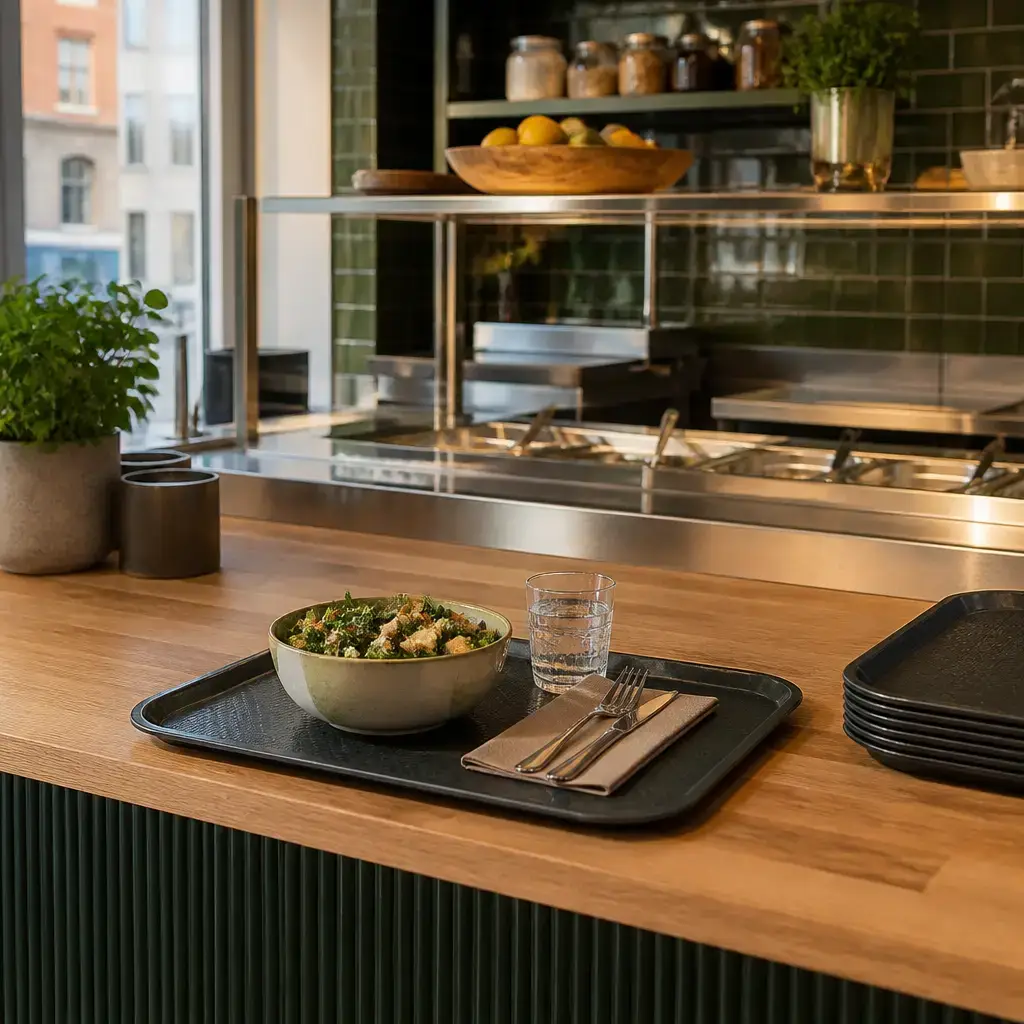
Use Fixing a wrong food order to practice Danish conversation, pronunciation, vocabulary, grammar, and quizzes.
Dialogue
Undskyld, jeg tror, jeg har fået den forkerte bestilling.
oon-SGUUL, yai TROHR, yai hah FOH-uhth dehn fohr-GEH-də beh-STEL-ing. Excuse me, I think I received the wrong order.Lad mig lige tjekke det. Hvad bestilte du?
LATH my LEE-uh CHEG-eh deh. Vah beh-STEL-də doo? Let me check that. What did you order?Jeg bestilte suppe, men der er en salat på denne bakke.
yai beh-STEL-də SAW-buh, men dair air uh sa-LEHdh poh DEH-neh BAH-guh. I ordered soup, but this tray has a salad.Jeg kan bytte den med det samme.
yai kan BUH-də dehn meh dhuh SAH-meh. I can replace it right away.Skal jeg vente her, mens du henter den?
Skahl yai VEH-neh hair, mens doo HEN-də dehn? Should I wait here while you get it?Vent venligst ved disken.
VEHN VEN-leest veh DEHS-gən. Please wait by the counter.Jeg går derover nu.
yai goh deh-ROH-uh noo. I will move over there now.Din suppe bør være klar snart.
Din SAW-buh bohr VEH-ruh klah SNAHdh. Your soup should be ready soon.Sentence explanations
Undskyld, jeg tror, jeg har fået den forkerte bestilling.
Excuse me, I think I received the wrong order.
- Undskyld
- Excuse me
- jeg tror
- I think
- fået
- received
- forkerte
- wrong
- bestilling
- order
More detail
Undskyld is the form used here to get someone's attention politely while also expressing an apology. It is related to undskylde “to excuse/apologize”; as a standalone expression, its exact force depends on the situation. jeg tror means “I think.” jeg is the first-person singular pronoun “I,” and tror is the present-tense form of tro “to think/believe.” Danish uses tro when the speaker presents something as a belief rather than as certain fact. Example: Jeg tror, det regner. — “I think it is raining.” fået is the past participle of få “to get/receive.” In this sentence it means “received,” not simply “got” in an unspecified sense. It occurs with the auxiliary har, forming the perfect construction har fået: “have received.” Example: Jeg har fået en besked. — “I have received a message.” forkerte is an inflected form of the adjective forkert “wrong/incorrect.” Here it is the definite attributive form used in den forkerte ..., meaning “the wrong ...”; the -e ending belongs to the adjective, not to bestilling. Compare en forkert bestilling “a wrong order” with den forkerte bestilling “the wrong order.” bestilling is a common-gender noun meaning “order,” as for food, goods, or a service. Its definite form without a preceding demonstrative is bestillingen “the order.” In the phrase den forkerte bestilling, Danish instead uses den plus the adjective's definite form and the noun's indefinite-looking form. Example: Jeg venter på bestillingen. — “I am waiting for the order.” The functional word den marks definiteness here for a singular common-gender noun in the adjective-plus-noun phrase. It does not by itself identify which particular order is meant. The supplied sentence presents the order as specific in the speaker's context, but does not name it more specifically. The sequence den forkerte bestilling therefore means “the wrong order.” Together, jeg tror introduces the speaker's assessment, while jeg har fået states that the speaker has received something. den forkerte bestilling identifies that received item as the wrong order. The complete utterance is: “Excuse me, I think I received the wrong order.”
Lad mig lige tjekke det. Hvad bestilte du?
Let me check that. What did you order?
- Lad mig
- let me
- lige
- just
- tjekke
- check
- det
- it / that
- Hvad
- what
- bestilte
- ordered
- du
- you
More detail
Lad mig is a reusable “let me …” construction. Lad is the imperative of lade (“let”); mig is the object form of jeg (“I”). Danish uses this pattern before an infinitive: Lad mig vente. — “Let me wait.” lige means “just” here. In this position it is a small conversational softener, so Lad mig lige ... sounds like “Let me just ...”; it does not necessarily describe a precise time. For example, Jeg skal lige spørge. means “I just need to ask.” tjekke is the infinitive “check.” After Lad mig, the next verb remains in the infinitive: Lad mig tjekke ... — “Let me check ...”. The related verb bestille means “order,” as seen later in the question. det is a neuter singular pronoun meaning “it” or “that” in this utterance. Its intended reference is the matter being checked—the order or its correctness—not a newly specified noun. Danish also uses det for some clauses and neuter nouns, so its exact reference must come from context. Hvad is the question word “what.” It asks about an unspecified thing or object. For a person, Danish uses hvem (“who”); for a place, it uses hvor (“where”). Example: Hvad købte du? — “What did you buy?” bestilte is the past-tense form of bestille, “order.” Danish verbs generally do not change form for the subject’s person or number in the past: jeg bestilte, du bestilte, and de bestilte all use bestilte. Example: Jeg bestilte suppe. — “I ordered soup.” du is the second-person singular pronoun “you.” It is the subject of bestilte; Danish does not add a separate person ending to the verb for this subject. Together, Hvad bestilte du? has the question pattern “What ordered you?” in word order, but its natural English meaning is “What did you order?” The past form bestilte places the ordering in the past, while du identifies the person who ordered. The complete utterance first says Lad mig lige tjekke det. (“Let me just check that.”), then asks Hvad bestilte du? (“What did you order?”).
Jeg bestilte suppe, men der er en salat på denne bakke.
I ordered soup, but this tray has a salad.
- Jeg
- I
- bestilte
- ordered
- suppe
- soup
- men
- but
- der er
- there is
- salat
- salad
- på
- on
- denne
- this
- bakke
- tray
More detail
Jeg means “I” here, the first-person singular subject. It is the form used for the speaker as subject; compare du for “you” as subject. Example: Jeg kommer. — “I am coming.” bestilte is the past-tense form of bestille, “to order.” It describes the speaker’s completed ordering action here. The present form is bestiller, while bestilte is used for a past event. Example: Jeg bestilte kaffe. — “I ordered coffee.” suppe means “soup.” It is a noun naming what was ordered. Example: Jeg spiser suppe. — “I am eating soup.” men means “but.” It connects the first statement with a contrasting statement: the ordered item and the item currently on the tray do not match. der er is a reusable construction meaning “there is” or “there are.” In this sentence it presents something as existing or being present: a salad is on the tray. The following noun phrase determines whether the English translation uses singular or plural: Der er en salat. — “There is a salad.” salat means “salad.” Here it is the item that is present on the tray, not the item identified as having been ordered in the first clause. In en salat, en is the indefinite article used with this noun; it does not by itself assert a numerical count as a teaching point beyond introducing an unspecified salad. på means “on” in the location phrase på denne bakke. It indicates that the salad is located on the tray. Example: Bogen er på bordet. — “The book is on the table.” denne means “this” and points to a singular nearby or contextually identified referent. Here it modifies bakke, so the phrase means “this tray.” Danish demonstratives must match the relevant noun’s grammatical form; denne is used with a common-gender singular noun such as bakke. It is not the noun’s form itself. bakke means “tray.” In denne bakke, it is the noun naming the surface on which the salad is located. Example: Bakken er tom. — “The tray is empty.” Together, Jeg bestilte suppe says “I ordered soup.” men introduces the contrast, and der er en salat på denne bakke says that a salad is present on this tray. The complete meaning is: “I ordered soup, but this tray has a salad.” The English “has” expresses the same location or presence relation that Danish states more literally as “there is a salad on this tray.”
Jeg kan bytte den med det samme.
I can replace it right away.
- Jeg kan
- I can
- bytte
- replace
- den
- it
- med det samme
- right away
More detail
Jeg kan combines the subject Jeg (“I”) with kan, the present-tense form of kunne (“can; be able to”). In this pattern, kan is followed by a verb in the infinitive without at: Jeg kan bytte = “I can replace/exchange.” bytte is the infinitive meaning “to exchange” or, in this utterance, “to replace.” The useful pattern is bytte noget (“replace/exchange something”). Example: Kan du bytte den? — “Can you replace it?” The form bytte stays in the infinitive after kan. den is a singular object pronoun used for a common-gender noun. Here it means “it,” as fixed by the translation, but the form itself does not identify the object's concrete identity. Danish uses den as an object form as well as a subject form in relevant contexts; its role here is shown by its position after bytte. med det samme is a fixed time expression meaning “right away” or “immediately.” In this utterance it modifies the replacement action: the action can happen immediately. Example: Jeg kommer med det samme. — “I’m coming right away.” Together, Jeg kan + bytte gives “I can replace,” den gives the object “it,” and med det samme adds the time “right away.” The complete meaning is: “I can replace it right away.”
Skal jeg vente her, mens du henter den?
Should I wait here while you get it?
- Skal jeg
- Should I …
- vente
- wait
- her
- here
- mens
- while
- du
- you
- henter
- get or retrieve
- den
- it
More detail
Skal jeg is the Danish question pattern “Should I …?” Here skal is the present form of skulle, used as a modal, and jeg is “I.” In a yes/no question, the modal comes before the subject: Skal jeg vente? — “Should I wait?” vente is the infinitive “to wait.” After the modal skal, Danish uses the infinitive without an extra infinitive marker: Jeg skal vente — “I should wait.” her means “here,” referring to the place where the waiting is to happen. Example: Vent her. — “Wait here.” mens introduces an action happening at the same time and means “while.” It begins the subordinate clause mens du henter den. du is the second-person singular pronoun “you.” Danish present-tense verbs do not change form for this pronoun, so du henter means “you get/retrieve,” with the verb form supplied by henter rather than by a special ending on du. henter is the present form of hente, meaning “to get,” “fetch,” or “retrieve.” In this sentence it describes the other person’s act of getting the item. Example: Jeg henter den. — “I’ll get it.” den is the singular common-gender object pronoun “it” in this use. Its specific referent is not named in the sentence, but the fixed translation establishes that it refers to the item being retrieved. Danish contrasts this form with det for a neuter-gender singular referent; that grammatical distinction does not identify the item itself. Together, Skal jeg vente her asks whether the speaker should remain at this place, and mens du henter den specifies that this waiting should occur during the other person’s retrieval of the item. The complete meaning is: “Should I wait here while you get it?”
Vent venligst ved disken.
Please wait by the counter.
- Vent
- wait
- venligst
- please
- ved
- by; at
- disken
- the counter
More detail
Vent is the imperative of vente, “to wait.” It gives a direct instruction to the person addressed. The present-tense form is venter: jeg venter means “I wait” or “I am waiting.” Example: Vent her. — “Wait here.” venligst means “please” and makes the instruction more courteous. It is a separate politeness word, not part of the verb’s inflection. Example: Vent venligst et øjeblik. — “Please wait a moment.” ved is a preposition meaning “by,” “at,” or “beside” in a location such as this one. The following noun identifies the place where the waiting should happen. Example: Hun står ved døren. — “She is standing by the door.” disken means “the counter.” It is the definite singular form of disk; the indefinite form is en disk, “a counter,” while disken refers to a specific counter in the situation. The ending belongs to the noun, not to ved. Example: Jeg står ved disken. — “I am standing by the counter.” Together, Vent venligst ved disken. is an imperative: “Please wait by the counter.” Vent supplies the instruction to wait, venligst adds politeness, and ved disken specifies the location. The sentence does not state how long the person should wait.
Jeg går derover nu.
I will move over there now.
- Jeg
- I
- går
- go / move
- derover
- over there
- nu
- now
More detail
Jeg means “I” here: the speaker is the person carrying out the movement. It is the first-person singular subject pronoun. For example, Jeg venter. means “I am waiting.” går is the present-tense form of gå, “to go” or “to walk.” In this utterance, the fixed translation shows movement toward a place, so “move” is the useful meaning. Danish present tense can describe a movement that is about to happen or is planned in the immediate situation; nu makes the timing explicit. For example, Jeg går hjem nu. means “I am going home now.” derover means “over there,” with a directional sense: it indicates the place toward which the movement goes. It is written as one word in the source. The location is treated as already identifiable in the situation; the word itself does not name the place. For example, Gå derover. means “Go over there.” nu means “now” and places the movement at the present moment or immediate time. It can be used with other present-tense verbs as well, for example, Jeg kommer nu. means “I am coming now.” Together, Jeg går derover nu. has the structure “I move/go over there now.” The subject is Jeg, går expresses the movement, derover gives its destination, and nu specifies the timing. In the supplied context, the intended natural meaning is “I will move over there now.”
Din suppe bør være klar snart.
Your soup should be ready soon.
- Din
- your
- suppe
- soup
- bør
- should; ought to
- være
- be
- klar
- ready
- snart
- soon
More detail
Din means “your” here and agrees with the noun suppe: din is used with a singular common-gender noun. Compare dit with a singular neuter noun and dine with plural nouns. The possessive form marks the possessor; it does not by itself say how many soups there are. suppe is the noun “soup.” Its indefinite form is en suppe, while the definite form is suppen (“the soup”). bør is the present-tense form of the modal verb bør, meaning “should” or “ought to.” It can express an expectation or recommendation. The verb after a Danish modal is normally in the infinitive without at, as in Du bør hvile (“You should rest”). The related form burde is the past-tense form and is also commonly used for a more tentative or conditional “should.” være is the infinitive of “be.” After bør, it stays in the infinitive: bør være (“should be”). klar means “ready” in this sentence. As a predicative adjective, it describes the soup after være. Its form agrees with the noun: suppen er klar for a common-gender singular noun, huset er klart for a neuter singular noun, and plural forms commonly use klare. snart is an adverb meaning “soon.” It places the expected state close to the present or another relevant time. For example, Toget kommer snart means “The train is coming soon.” Together, Din suppe identifies the soup as belonging to the person addressed, bør være klar says that it is expected to be ready, and snart places that expectation in the near future. The whole utterance therefore means “Your soup should be ready soon.”
Grammar Points
den + adjektiv i bestemt form
den forkerte bestilling
dehn fohr-GEH-də beh-STEL-ingthe wrong order
After the definite article den, the adjective takes the -e ending: forkert becomes forkerte.
med det samme
bytte med det samme
BUH-də meh dhuh SAH-mehreplace immediately
Med det samme is a fixed expression meaning “immediately” and normally comes after the action.
Danish Vocabulary
- Gender
- common
- Gender
- common
- Gender
- common
Quiz
Word Order
Arrange the words in the correct order.
Please wait by the counter.
Show Answer
Vent venligst ved disken.I will move over there now.
Show Answer
Jeg går derover nu.Your soup should be ready soon.
Show Answer
Din suppe bør være klar snart.Spelling
Tap the letters to spell the word.
to get; to receive
Show Answer
fåetjust; right away
Show Answer
ligewrong; incorrect
Show Answer
forkertewhat