10 minutes free every day
Continue audio lessons in the app
Word explanations appear automatically in sync with the audio.
No login required · synced translations · playback with the screen locked
Choose your learning language and open this lesson in the app.

About This Lesson
Use Cleaning up spilled coffee to practice Danish conversation, pronunciation, vocabulary, grammar, and quizzes.
Dialogue
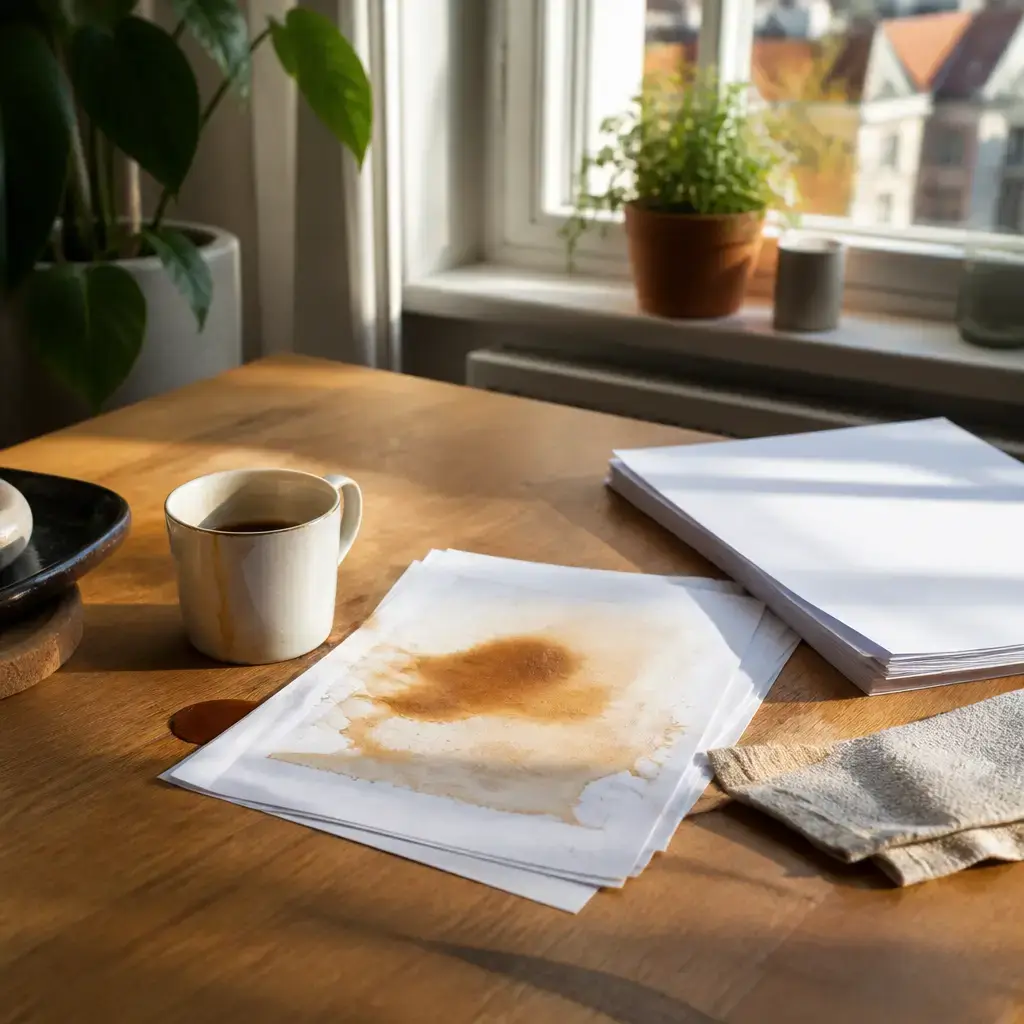
Jeg spildte kaffe på de her dokumenter.
YAI SBEHL-duh KAF-uh PAW dee hair doh-koo-MEN-tuh. I spilled coffee on these documents.Flyt dem væk fra koppen, før pletten breder sig.
FLEWT dem VEK frah KAW-bun, fur PLEH-dun BRAY-thuh SAI. Move them away from the cup before the stain spreads.Den øverste side er allerede gennemblødt.
Den UR-vuh-stuh SEE-thuh air al-uh-RAY-thuh GEH-num-BLURTH. The top page is already soaked.Lad den tørre fladt, før du rører ved den.
LATH den TUR-uh FLAHT, fur doo RUR-uh VEH-th den. Let it dry flat before you handle it.Skal jeg printe en ren kopi af den side?
Skel YAI PREHN-duh en RAYN KOH-pee eh den SEE-thuh? Should I print a clean copy of that page?Det ville være sikrere, fordi teksten kan blive utydelig.
Deh VEL-uh VEH-uh see-KRAY-uh, for-THEE TEHGS-dun kan BLEE-vuh oo-TEW-thuh-lee. That would be safer because the text may blur.Jeg vil skille de tørre sider ad, mens denne tørrer.
YAI vel SKEHL-uh dee TUR-uh SEE-thuh eh, mens DEH-nuh TUR-uh. I will separate the dry pages while this one dries.Stil drikkevarerne på et andet bord næste gang.
Steel DREH-guh-var-nuh PAW ed AH-nuth BOH-uh NEHS-duh gang. Keep the drinks on another table next time.Sentence explanations
Jeg spildte kaffe på de her dokumenter.
I spilled coffee on these documents.
- Jeg
- I
- spildte
- spilled
- kaffe
- coffee
- på
- on
- de her
- these
- dokumenter
- documents
More detail
Jeg is the subject pronoun meaning “I.” Danish uses jeg for the first-person singular subject; the corresponding object form is mig, as in Hun så mig (“She saw me”). spildte is the past-tense form of spilde (“to spill”). In this sentence it describes the completed event of spilling. The past form spildte is used with different subjects, for example Hun spildte vand (“She spilled water”); the subject, rather than the verb ending, identifies who did it. kaffe means “coffee.” Here it is the substance that was spilled. Danish can also use en kaffe in contexts where one serving or cup of coffee is meant, but that serving sense is not asserted here. på means “on” here, marking the surface or object onto which the coffee was spilled. Its meaning is determined by the relation in this sentence; it can have other uses in Danish, but those are not needed for this example. de her is a demonstrative expression meaning “these.” de is the plural form, and her adds the meaning of proximity (“here”), so the expression points to multiple nearby or contextually present items. A singular contrast is den her or det her, depending on the noun’s grammatical form. dokumenter means “documents.” It is the plural of dokument; the singular indefinite form is et dokument, and the plural is dokumenter. The plural form agrees with the demonstrative expression de her in de her dokumenter (“these documents”). Together, Jeg spildte kaffe means “I spilled coffee,” and på de her dokumenter identifies the surface or objects affected: “on these documents.” The complete utterance therefore means “I spilled coffee on these documents.”
Flyt dem væk fra koppen, før pletten breder sig.
Move them away from the cup before the stain spreads.
- Flyt
- move
- dem
- them
- væk fra
- away from
- koppen
- the cup
- før
- before
- pletten
- the stain
- breder sig
- spreads
More detail
Flyt is the imperative of flytte, “to move.” It gives a direct instruction. Danish imperatives commonly use this short form without an expressed subject; flyt is the form used here. dem means “them” as an object pronoun. It is the plural object form, and here the surrounding context supports the documents as the things to move. The form does not itself identify the documents; that reference comes from the context. væk fra is a reusable construction meaning “away from.” væk expresses movement to a more distant position, while fra introduces the point or object being moved away from. For example: Flyt stolen væk fra døren. — “Move the chair away from the door.” koppen means “the cup.” The base noun is kop, “cup”; koppen is its definite singular form, literally the form used for “the cup.” The definite ending is part of the noun form, not a separate word. før means “before” and introduces the event that sets the time limit for the instruction. A reusable pattern is før + clause: Gå, før det bliver mørkt. — “Go before it gets dark.” pletten means “the stain.” Its base noun is plet, “stain”; pletten is the definite singular form. The noun is singular because the form refers to one stain in this sentence. breder sig means “spreads.” The verb is the reflexive expression brede sig, “to spread,” and breder is its present-tense form here. sig shows that the spreading is not directed at a separate object: the stain spreads itself or expands. The present form is suitable for the event that may occur after the moving instruction. Together, Flyt dem væk fra koppen means “Move them away from the cup.” før pletten breder sig adds the time condition “before the stain spreads.” The whole utterance is therefore: “Move them away from the cup before the stain spreads.”
Den øverste side er allerede gennemblødt.
The top page is already soaked.
- Den
- the
- øverste
- top; uppermost
- side
- page
- er
- is
- allerede
- already
- gennemblødt
- soaked
More detail
Den is the definite article for a singular common-gender noun. Here it makes side definite: “the page.” Danish also uses det with singular neuter nouns, while de is used with plural nouns. øverste means “topmost” or “uppermost” here. It is the superlative form related to øverst (“uppermost/topmost”), and its -e form is used before this definite noun phrase: den øverste side. This describes the page’s position, not its condition. side means “page” in this sentence. The same noun can refer to a side or aspect in other contexts, so the fixed translation identifies the intended sense here. A reusable example is en side — “a page”; the indefinite article does not itself state a numeric count. er is the present-tense form of være, “to be.” Danish er is used with singular and plural subjects, so the form itself does not show the subject’s number. For example, Siden er våd means “The page is wet.” allerede means “already.” It places the condition before the relevant reference point in time. In this sentence it modifies the whole state expressed by er gennemblødt: the page is soaked at that point already. gennemblødt means “soaked” or “thoroughly wet” here. It is related to the verb gennembløde, “to soak thoroughly,” and describes the page’s resulting condition. A useful contrast is våd (“wet”), which is broader and does not necessarily suggest that liquid has penetrated thoroughly. Together, Den øverste side identifies the page at the top of the relevant material. er gennemblødt states its condition, and allerede says that this condition has occurred by the relevant time. The complete meaning is: “The top page is already soaked.”
Lad den tørre fladt, før du rører ved den.
Let it dry flat before you handle it.
- Lad den
- let it
- tørre
- dry
- fladt
- flat
- før
- before
- rører ved
- handle; touch
More detail
Lad den uses the imperative lad of lade (“let” or “allow”) followed by the object pronoun den (“it”). Here it introduces what should be allowed to happen. A reusable pattern is Lad + object + infinitive: Lad døren stå åben. — “Leave the door open.” tørre is the infinitive of tørre, “to dry.” After lad, the following verb remains in the infinitive: Lad den tørre — “Let it dry.” The same verb can describe something becoming dry or the act of drying something, depending on the construction; here it means becoming dry. fladt means “flat” in the adverbial phrase tørre fladt, describing the position in which the item should dry. It is related to the adjective flad (“flat”); fladt is the neuter singular form and is also used adverbially here, while flade is used in plural or definite adjective forms. Example: Læg papiret fladt. — “Lay the paper flat.” før introduces a time relation and means “before.” It connects the drying instruction with the later action: the action in the clause after før is to happen later. Example: Vask hænderne, før du spiser. — “Wash your hands before you eat.” rører ved is the construction for “touch” or, in this context, “handle.” rører is the present-tense form of røre; ved is part of the construction, so it is useful to learn røre ved noget as “touch something.” Example: Rør ikke ved glasset. — “Do not touch the glass.” Danish present-tense verbs generally do not change form according to the subject, so rører is not a special form that agrees specifically with du. Lad den tørre fladt gives the instruction to let the item dry while lying flat. før du rører ved den adds the requirement that this drying should happen before you handle the same item. Together, the utterance means: “Let it dry flat before you handle it.”
Skal jeg printe en ren kopi af den side?
Should I print a clean copy of that page?
- Skal jeg
- should I
- printe
- ren
- clean
- kopi
- copy
- den
- that
- side
- page
More detail
Skal jeg combines the modal verb skal with the subject pronoun jeg. In this question, skal asks whether the speaker ought to or should do something; it is not the lexical verb “print.” A reusable pattern is Skal jeg + infinitive?, meaning “Should I …?” For example: Skal jeg vente? — “Should I wait?” printe means “to print” here. It is the infinitive form used after the modal skal; the modal carries the finite verb function, so the following verb does not take a separate person ending. The verb is a Danish loanword, and its infinitive ending is visible in -e. Example: Jeg vil printe siden. — “I want to print the page.” ren describes kopi and means “clean” in this sentence. It is the common-gender singular form agreeing with the indefinite noun phrase en ... kopi. The form changes with the noun phrase: for example, et rent ark means “a clean sheet,” while rene kopier means “clean copies.” kopi is the noun “copy.” It is a common-gender noun, as shown by en kopi; its plural is kopier. In this utterance, it is the thing the speaker proposes printing. Example: Jeg har en kopi. — “I have a copy.” den is a demonstrative determiner meaning “that” here. It is the common-gender singular form used with side in den side. The fixed translation identifies the referent as a particular page, but the word itself mainly marks that page as identifiable or pointed out; it does not independently specify how many pages there are. Compare the neuter form in det ark — “that sheet.” side means “page” here. It is a common-gender noun: en side, plural sider. In den side, the demonstrative comes before the noun and gives the phrase the meaning “that page.” Together, Skal jeg asks for guidance or permission, and printe en ren kopi af den side gives the proposed action: printing a clean copy of that page. Thus the whole utterance means, “Should I print a clean copy of that page?” This is a direct, ordinary way to offer or ask about carrying out an action.
Det ville være sikrere, fordi teksten kan blive utydelig.
That would be safer because the text may blur.
- Det ville være
- That would be
- sikrere
- safer
- fordi
- because
- teksten
- the text
- kan
- may
- blive
- become
- utydelig
- unclear
More detail
Det ville være expresses a hypothetical or conditional result: “that would be.” Here det is a neuter pronoun used as the subject of the evaluation, while ville is the past-tense form of vil used for “would”; være is the infinitive “be.” A reusable pattern is Det ville være + adjective, for example: Det ville være nyttigt. — “That would be useful.” sikrere means “safer” and is the comparative form of sikker (“safe”). The useful comparison chain is sikker → sikrere → sikrest: safe → safer → safest. The comparative says that the situation described is safer than a relevant alternative, without stating what that alternative is. fordi introduces the reason for the preceding statement and means “because.” It connects a main clause with its explanation: Jeg bliver hjemme, fordi det regner. — “I am staying home because it is raining.” teksten means “the text.” It is the definite singular form of tekst: tekst means “a text,” while teksten means “the text.” The ending -en marks definite singular for this noun; it does not express a separate word for “the.” kan is the modal verb “can” or, as here, “may.” It is the present-tense form of kunne. In this sentence it expresses possibility, not ability: the text may become unclear. A modal verb is followed by an infinitive, as in kan blive. blive means “become” in this construction. It is the infinitive after the modal kan. Danish blive can also occur in other constructions with meanings such as “stay” or “become,” so its precise meaning comes from the surrounding words. Here blive utydelig means “become unclear.” utydelig means “unclear” or “indistinct.” It describes teksten, which is a singular common-gender noun, so the adjective has the form utydelig. Compare the forms utydelig for common-gender singular, utydeligt for neuter singular, and utydelige for plural or definite contexts. For example: Billedet bliver utydeligt. — “The picture becomes unclear.” Together, Det ville være sikrere says “That would be safer.” fordi teksten kan blive utydelig gives the reason: “because the text may become unclear.” The complete meaning is: “That would be safer because the text may blur.”
Jeg vil skille de tørre sider ad, mens denne tørrer.
I will separate the dry pages while this one dries.
- Jeg vil
- I will
- skille … ad
- separate apart
- tørre
- dry
- sider
- pages
- mens
- while
- denne
- this one
- tørrer
- dries
More detail
Jeg vil combines the first-person pronoun jeg (“I”) with vil, the present form of ville (“will/want to”). Here vil expresses the speaker’s intention to carry out the action. A reusable pattern is Jeg vil + infinitive: Jeg vil læse. — “I will read.” skille ... ad is a separable verb construction meaning “separate” or “take apart.” The lexical verb is skille; ad is the particle that completes this meaning. In this sentence, the particle comes after the object: skille de tørre sider ad. Keep the two parts in the pattern skille noget ad: Hun skiller kassen ad. — “She takes the box apart.” tørre in de tørre sider is the adjective “dry.” Its base form is tør; tørre is the form used with a plural or definite noun phrase here. The noun carrying the plural meaning is sider, not the adjective. De tørre sider means “the dry pages”: de marks the definite noun phrase, while tørre agrees with the plural noun. sider means “pages” here. Its singular base form is side, and sider is its plural form. The definite plural phrase is de tørre sider, literally “the dry pages,” with de before the adjective and noun. mens introduces a simultaneous subordinate clause and means “while.” A useful pattern is A, mens B: Jeg skriver, mens hun læser. — “I write while she reads.” denne is a demonstrative meaning “this one” here. It is the common-gender singular form; the form itself does not identify a more specific referent beyond the supported “this one.” Demonstratives such as denne can point to a singular item, while disse is used for plural “these.” tørrer means “dries” in this clause. It is the present-tense form of the verb tørre (“to dry”); do not confuse it with the adjective tør (“dry”) or the adjective form tørre in de tørre sider. The pattern denne tørrer means “this one dries” or “this one is drying,” depending on context. Together, Jeg vil skille de tørre sider ad means “I will separate the dry pages,” and mens denne tørrer adds the simultaneous action “while this one dries.” The complete utterance is: “I will separate the dry pages while this one dries.”
Stil drikkevarerne på et andet bord næste gang.
Keep the drinks on another table next time.
- Stil
- keep; place
- drikkevarerne
- the drinks
- andet
- other; another
- bord
- table
- næste gang
- next time
More detail
Stil is the imperative of stille, “to place” or “to put.” Here it gives a direct instruction: “place/keep.” The subject is an understood “you,” as is usual with an imperative. For example, Stil koppen her. means “Place the cup here.” drikkevarerne means “the drinks.” It is the definite plural form of drikkevare, “drink/beverage”: en drikkevare = “a drink/beverage,” drikkevarer = “drinks/beverages,” and drikkevarerne = “the drinks/beverages.” The definite ending identifies the drinks as specific ones in the situation. andet means “another” here. It is the neuter singular form of anden, “other/another,” because it modifies bord, which is an et-word: et bord = “a table,” et andet bord = “another table.” The form agrees with the noun; it is not a plural form. bord means “table.” In et andet bord, the indefinite article et marks the noun’s grammatical form as an et-word; it does not by itself assert a numeric count. næste gang is the reusable expression “next time.” næste means “next,” and gang means “time” in this time-occurrence expression. For example, Næste gang gør vi det langsomt. means “Next time we will do it slowly.” Together, Stil drikkevarerne gives “Place/keep the drinks,” på et andet bord gives “on another table,” and næste gang gives “next time.” The complete instruction is: “Keep the drinks on another table next time.”
Grammar Points
Imperativ: verbstamme uden -e
Flyt koppen væk.
FLEWT KAW-bun VEK.Move the cup away.
Danish commands often use the verb stem without -e: flytte → Flyt, stille → Stil.
brede sig
Pletten breder sig.
PLEH-dun BRAY-thuh SAI.The stain is spreading.
Brede sig is a reflexive expression; sig is required when something spreads.
Danish Vocabulary
Quiz
Word Order
Arrange the words in the correct order.
The top page is already soaked.
Show Answer
Den øverste side er allerede gennemblødt.Spelling
Tap the letters to spell the word.
stain
Show Answer
plettendocument
Show Answer
dokumenterspill
Show Answer
spildtecoffee