10 minutes free every day
Continue audio lessons in the app
Word explanations appear automatically in sync with the audio.
No login required · synced translations · playback with the screen locked
Choose your learning language and open this lesson in the app.

About This Lesson
Use Handling a Broken Umbrella to practice Danish conversation, pronunciation, vocabulary, grammar, and quizzes.
Dialogue
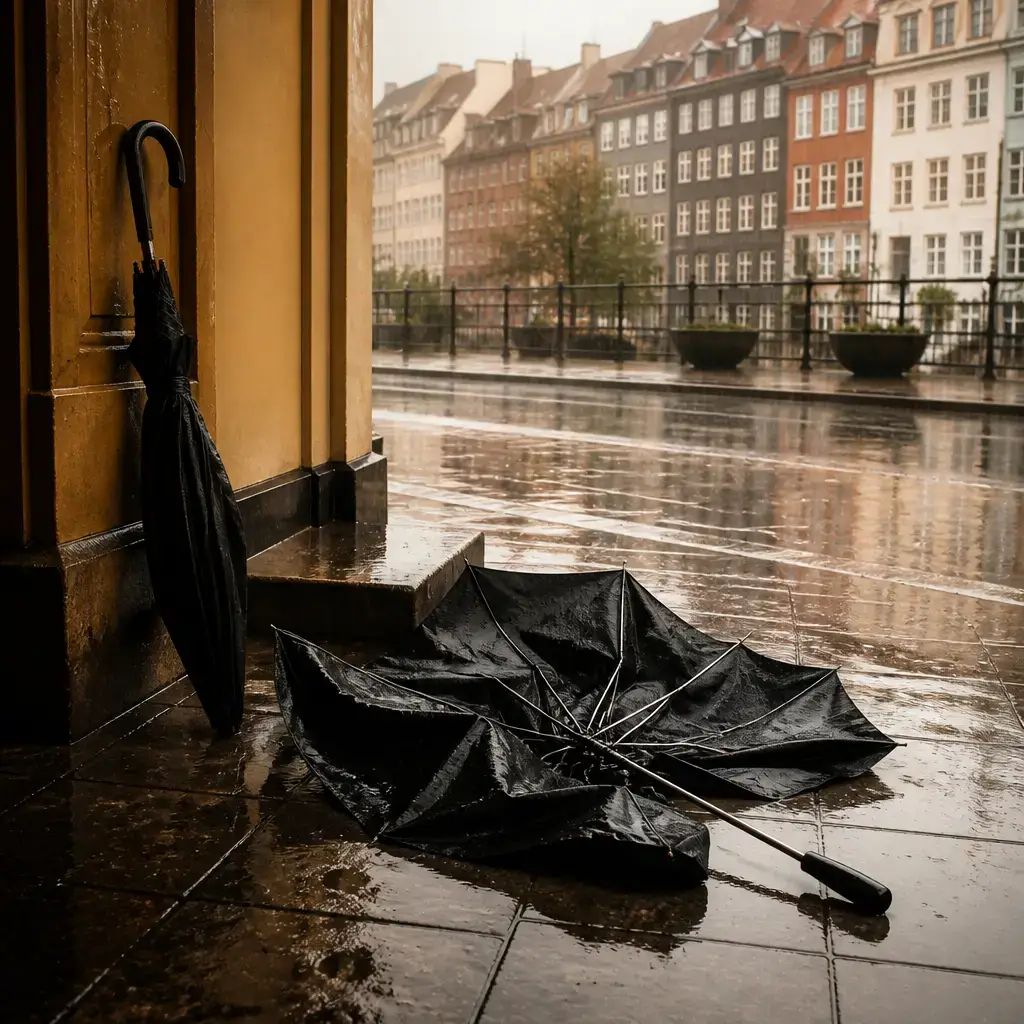
Min paraply gik i stykker i den stærke vind.
men pah-rah-PLOO GEE ee STUH-guh ee den STAIR-guh ven. My umbrella broke in the strong wind.Kom ind i tørvejr, før du bliver gennemblødt.
KOM en ee TUR-vy-uh, fuh doo BLEE-vuh GEN-um-BLUHT. Come under the shelter before you get soaked.Regnen er kraftigere, end den så ud til.
RINE-un air KRAHF-tee-uh-guh, en den soh oo-th tell. The rain is heavier than it looked.Du kan låne min ekstra paraply.
doo kan LOH-nuh men EHK-struh pah-rah-PLOO. You can borrow my extra umbrella.Er du sikker på, at du ikke har brug for den?
air doo SEE-guh poh, ad doo EE-guh har broo faw den? Are you sure you don't need it?Jeg har en regnfrakke, så jeg kan klare mig.
yai har en RINE-frah-guh, soh yai kan KLAH-uh mai. I have a raincoat, so I can manage.Jeg kan aflevere den i morgen.
yai kan ah-FLAY-vuh den ee MOH-un. I can bring it back tomorrow.Bare hold dig tør på vej hjem.
BAH-uh hohl dai tuh poh vai yem. Just stay dry on your way home.Sentence explanations
Min paraply gik i stykker i den stærke vind.
My umbrella broke in the strong wind.
- Min
- my
- paraply
- umbrella
- gik i stykker
- broke
- stærke
- strong
- vind
- wind
More detail
Min means “my” here and is the possessive form used with a singular common-gender noun. Danish contrasts min with mit before a singular neuter-gender noun and mine with plural nouns. Example: Min bog er her. — “My book is here.” paraply is “umbrella.” Its base form is singular; the corresponding indefinite phrase is en paraply, while the plural is paraplyer. In the sentence, Min paraply means “my umbrella.” gik i stykker is the fixed expression “broke” or “became damaged.” The form gik is the past form of gå (“go”), but in this expression it does not mean that the umbrella went somewhere. The reusable pattern is gå i stykker for something breaking. Example: Telefonen gik i stykker. — “The phone broke.” stærke means “strong” in this phrase. Its base form is stærk. The ending -e appears here because the adjective follows the definite element den in den stærke vind; the same form is also used in several plural contexts. Example: den stærke regn — “the heavy/strong rain.” vind means “wind.” It is a singular common-gender noun, with the indefinite form en vind and the definite form vinden. In den stærke vind, den and the adjective together mark the definite noun phrase “the strong wind.” Together, Min paraply identifies the affected object, gik i stykker says that it broke, and i den stærke vind gives the setting or circumstance: “in the strong wind.” The complete meaning is “My umbrella broke in the strong wind.”
Kom ind i tørvejr, før du bliver gennemblødt.
Come under the shelter before you get soaked.
- Kom ind
- come inside
- tørvejr
- shelter; dry conditions
- før
- before
- bliver
- get; become
- gennemblødt
- soaked
More detail
Kom ind combines the imperative Kom (“come”) with ind (“in”). Kom is the imperative of komme; the subject is understood as the person being addressed. This is a reusable way to give a direct instruction: Kom ind! = “Come in!” The phrase does not itself specify what kind of shelter or interior space the person enters. tørvejr is a noun meaning dry conditions or a dry place to stay out of wet weather. In this sentence, the translation supports the contextual sense “under shelter.” Danish commonly uses tørvejr in weather-related expressions; it is not a literal command to find a particular building. The preceding sentence about the broken umbrella supports this sheltered, rain-related reading. før introduces the event that must happen later: the coming inside is requested before the other event occurs. A reusable pattern is før + clause, meaning “before + clause.” Here, du is the second-person singular pronoun “you,” and it is the person who may become soaked. bliver is the present-tense form of blive (“become; get” in this use). Danish present-tense forms do not change for person or number, so bliver can occur with different subjects; the pronoun du identifies the subject here. With an adjective or participle, blive commonly describes entering a state: Hun bliver træt. = “She gets tired.” gennemblødt means “soaked through” or “thoroughly wet.” In bliver gennemblødt, it describes the resulting state after becoming completely wet. The form is related to the verb gennembløde (“soak through”), but here it functions as the state description after bliver; it is not the finite verb carrying the tense. Together, Kom ind i tørvejr gives the instruction to come into dry shelter, and før du bliver gennemblødt sets the deadline: do it before you get soaked. The whole utterance therefore means, “Come under the shelter before you get soaked.”
Regnen er kraftigere, end den så ud til.
The rain is heavier than it looked.
- Regnen
- the rain
- kraftigere
- heavier
- end
- than
- den
- it
- så ud til
- looked to / seemed to
More detail
Regnen means “the rain” here. It is the definite singular form of regn (“rain”): the ending -en marks a common-gender singular noun as definite. Danish uses this form when the speaker refers to identifiable rain, as in this utterance. kraftigere means “heavier” here, describing the rain’s greater intensity. It is the comparative form of kraftig (“strong” or “heavy”): kraftig → kraftigere. The comparative ending -ere expresses “more …” or “-er”; the exact English adjective depends on the noun and context. For example, Vinden er kraftigere i dag. means “The wind is stronger today.” end introduces the comparison and corresponds to “than” in this sentence. A reusable pattern is A er [comparative], end B — “A is more … than B.” den means “it” here and refers to the rain identified by Regnen. Danish den is the singular pronoun used with a common-gender referent; it is not itself a marker of the comparison. Its form agrees with the grammatical class and number of its referent, while the specific referent here is fixed by the sentence’s meaning. så ud til is the past form of the construction se ud til (“look/seem to”). så is the past form of se, and ud til completes the construction. In den så ud til ..., it expresses how the rain appeared or seemed. For example, Det så ud til at regne. means “It looked like it was going to rain.” Together, Regnen er kraftigere says that the rain has greater intensity, end introduces the comparison, and den så ud til supplies the earlier appearance being compared with. The full meaning is: “The rain is heavier than it looked.”
Du kan låne min ekstra paraply.
You can borrow my extra umbrella.
- Du kan
- you can
- låne
- borrow
- min
- my
- ekstra
- extra
- paraply
- umbrella
More detail
Du kan is a reusable way to say “you can” or “you are able to.” kan is the present-tense form of kunne (“can, be able to”) and does not change for person or number: jeg kan, du kan, de kan. In this sentence it is followed by an infinitive, so the pattern is subject + kan + infinitive. låne means “borrow,” specifically to take something temporarily with the intention of returning it. After kan, the verb stays in the infinitive: kan låne. Example: Jeg kan låne din cykel. — “I can borrow your bicycle.” min means “my” before a singular common-gender noun. Its form agrees with the possessed noun, not with the possessor: min with common-gender singular, mit with neuter singular, and mine with plural nouns. Example: mit hus — “my house”; mine bøger — “my books.” ekstra means “extra” here, describing an additional umbrella. It is an adjective that normally keeps the same form before singular and plural nouns: en ekstra paraply — “an extra umbrella”; ekstra paraplyer — “extra umbrellas.” paraply means “umbrella.” It is a common-gender noun: en paraply is “an umbrella,” and the definite singular is paraplyen, “the umbrella.” Its plural is paraplyer, “umbrellas.” Together, Du kan låne expresses permission or ability to borrow, while min ekstra paraply identifies the object as the speaker’s additional umbrella. The whole utterance therefore means: “You can borrow my extra umbrella.”
Er du sikker på, at du ikke har brug for den?
Are you sure you don't need it?
- Er du
- are you
- sikker
- sure
- på
- about/of
- ikke
- not
- har brug for
- need
- den
- it
More detail
Er du means “are you.” Er is the present form of være (“to be”) for all persons, while du is the singular informal “you.” In a yes/no question, Danish places the finite verb before the subject: Er du ...? Compare the statement Du er ... (“You are ...”). sikker means “sure” or “certain.” It is an adjective; its basic form is sikker, and it can describe a person’s confidence: Jeg er sikker means “I am sure.” With er, it describes the subject rather than expressing an action. på is the preposition used in the construction være sikker på (“be sure about/of”). Danish prepositions are often part of a reusable expression, so learn sikker på together rather than choosing på from the English preposition alone. ikke means “not.” Here it negates the following idea, har brug for ...: the question asks about not needing something. In Danish, ikke commonly comes after the finite verb and subject in a main-clause question: Er du ikke ...? means “Are you not ...?” har brug for is the fixed expression “need.” Har is the present form of have; the full expression is not translated word-for-word as ordinary English “have use for” in this sentence. For example, Jeg har brug for hjælp means “I need help.” The expression can take a noun or pronoun after for. den means “it” here and refers to the previously mentioned umbrella. Grammatically, den is the singular pronoun used for a common-gender noun in Danish; det is used with a neuter-gender noun. The choice is therefore determined by the grammatical gender and number of the referent, not simply by the English word “it.” The connector at introduces the content of the question: Er du sikker på, at ...? means “Are you sure that ...?” The structure combines the question Er du sikker på ...? with the negated clause du ikke har brug for den (“you do not need it”). Together, Er du sikker på, at du ikke har brug for den? means “Are you sure you don’t need it?”
Jeg har en regnfrakke, så jeg kan klare mig.
I have a raincoat, so I can manage.
- Jeg
- I
- har
- have
- regnfrakke
- raincoat
- så
- so
- kan
- can
- klare mig
- manage; get by
More detail
Jeg means “I” here and is the first-person singular subject form. It is used for the speaker; the object form is mig, as in klare mig later in the sentence. har is the present-tense form of have. In Danish, har is used with all subjects in the present: jeg har (“I have”), du har (“you have”), and de har (“they have”). Here it states possession of the raincoat. regnfrakke means “raincoat.” It is a compound noun: regn (“rain”) + frakke (“coat”). The noun phrase includes the indefinite article en: en regnfrakke, “a raincoat.” The article marks the noun as common gender, not a specific numeric count. så connects a situation with its consequence and means “so” here. The clause after it gives the result or practical consequence of having the raincoat. kan is the present-tense form of kunne, “can; be able to.” It expresses ability or possibility. A modal such as kan is followed by an infinitive without at, as in kan klare (“can manage”). klare mig means “manage” or “get by” in this sentence. klare is the infinitive of klare, “manage; cope with,” and mig is the first-person singular object form of jeg. Together, the reflexive expression klare sig means “manage/get by,” with the reflexive pronoun changing to match the person: jeg kan klare mig (“I can manage”), du kan klare dig (“you can manage”). The sentence assembles as Jeg har en regnfrakke (“I have a raincoat”) + så (“so”) + jeg kan klare mig (“I can manage”). Thus the whole meaning is: “I have a raincoat, so I can manage.”
Jeg kan aflevere den i morgen.
I can bring it back tomorrow.
- Jeg kan
- I can
- aflevere
- return; hand in
- den
- it
- i morgen
- tomorrow
More detail
Jeg kan means “I can.” Jeg is the first-person singular pronoun “I”. kan is the present-tense form of kunne (“can; be able to”). With a following verb, kan expresses ability or possibility, and the following verb remains in its infinitive form. Example: Jeg kan komme. — “I can come.” aflevere means “return” or “hand in,” depending on what is being transferred. It is the infinitive form, used here after the modal verb kan. Example: Jeg skal aflevere nøglen. — “I have to return the key.” den means “it” here. It is a third-person singular pronoun used for a common-gender noun in Danish; the form of the pronoun reflects the grammatical gender and number of its antecedent, not the identity of the object itself. The fixed translation identifies the object as “it,” but does not specify what that object is. i morgen means “tomorrow.” This is a fixed time expression: i is part of the expression rather than a separate meaning to translate as “in” in this sentence. Example: Vi rejser i morgen. — “We are travelling tomorrow.” Together, Jeg kan aflevere den means “I can return it” or “I can hand it in,” and i morgen adds the time. The complete utterance is therefore: “I can bring it back tomorrow.”
Bare hold dig tør på vej hjem.
Just stay dry on your way home.
- Bare
- just
- hold dig
- stay / keep yourself
- tør
- dry
- vej
- way; road
- hjem
- home
More detail
Bare is an adverb meaning “just” here. It limits the instruction: the speaker simply wants the addressee to remain dry. hold dig combines the imperative hold of holde (“keep; hold”) with the reflexive pronoun dig (“yourself,” referring to the person being addressed). Together, hold dig can mean “keep yourself” and is used in the reusable pattern hold dig + adjective, meaning “stay/remain + adjective.” Example: Hold dig varm. — “Stay warm.” tør is the adjective “dry.” In hold dig tør, it describes the addressee’s resulting condition: remain dry. The adjective’s base form is tør; this sentence does not show a separate inflected form for it. vej is the noun “way” or “road.” In the expression på vej, it forms the common phrase “on the way.” Example: Jeg er på vej. — “I am on my way.” hjem is an adverb meaning “home” in the directional sense used here. på vej hjem means “on the way home.” Unlike a noun phrase with an article, hjem here directly indicates the destination. Together, Bare hold dig tør gives the instruction “Just stay dry,” and på vej hjem specifies when or where this should apply: while the addressee is going home. The whole utterance therefore means “Just stay dry on your way home.”
Grammar Points
Imperativ: verbets stamme
Kom ind i tørvejr.
KOM en ee TUR-vy-uh.Come under shelter.
I imperativ står verbet normalt uden subjekt: komme bliver til Kom.
Refleksivt pronomen i imperativ
Hold dig tør.
HOHL dai TUH.Stay dry.
Det refleksive pronomen ændres efter personen: sig bliver dig, når man taler til én person.
Danish Vocabulary
- Gender
- common
- Gender
- common
- Gender
- neuter
- Gender
- common
Quiz
Word Order
Arrange the words in the correct order.
You can borrow my extra umbrella.
Show Answer
Du kan låne min ekstra paraply.I can bring it back tomorrow.
Show Answer
Jeg kan aflevere den i morgen.Spelling
Tap the letters to spell the word.
umbrella
Show Answer
paraplysoaked
Show Answer
gennemblødtrain
Show Answer
Regnenwind