10 minutes free every day
Continue audio lessons in the app
Word explanations appear automatically in sync with the audio.
No login required · synced translations · playback with the screen locked
Choose your learning language and open this lesson in the app.

About This Lesson
Use Preparing for heavy rain to practice Danish conversation, pronunciation, vocabulary, grammar, and quizzes.
Dialogue
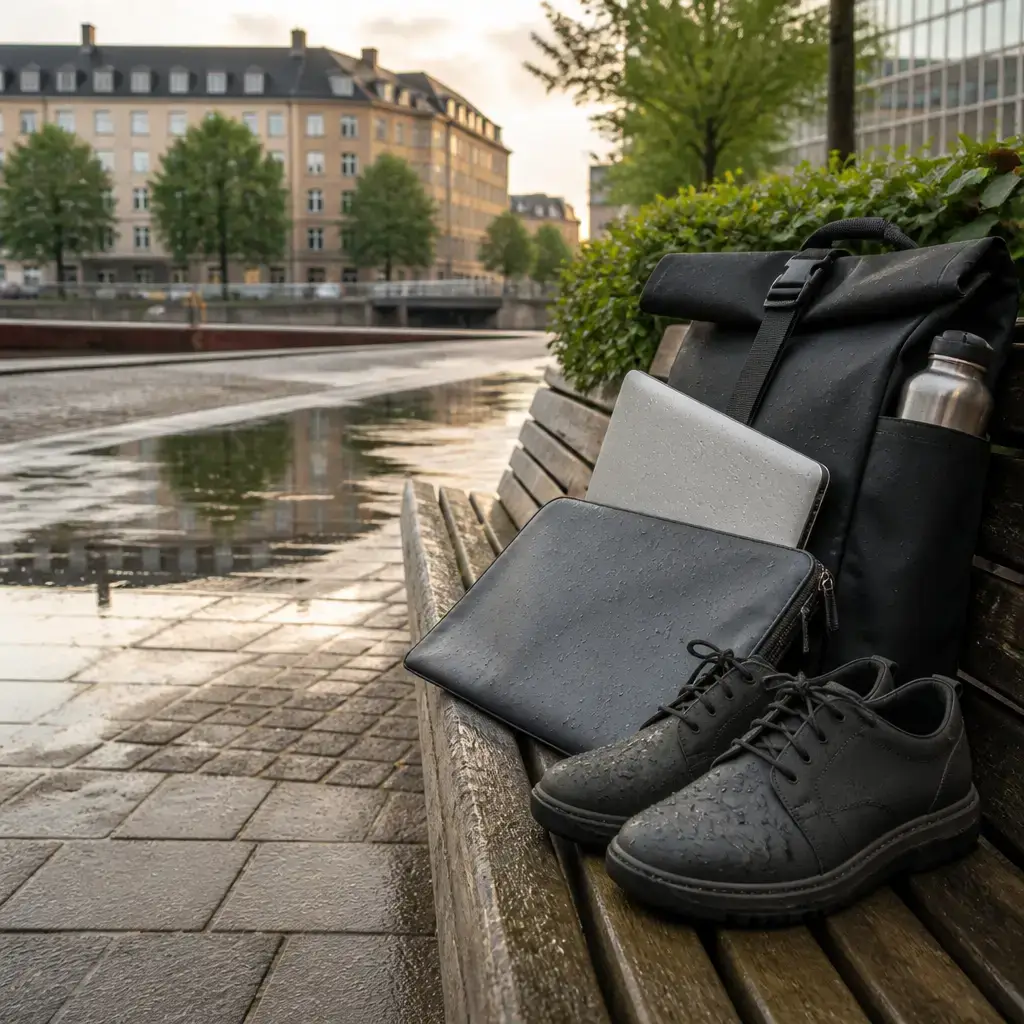
Vejrudsigten siger, at den kraftige regn snart begynder.
VIGH-rooth-SIG-dehn SEE-uh, ed den KRAF-tee RINE SNAHD beh-KURN-uh. The forecast says heavy rain will start soon.Så tag vandtætte sko på i dag.
SOH TEH VON-TEH-duh SGOH POH ee DAY. Then wear waterproof shoes today.Der er altid vandpytter ved stationen.
Dair air AHL-dee VOM-pud-uh vehth STAH-shohn. There are always puddles near the station.Du får måske også brug for ekstra tid på grund af forsinkelser.
Doo fohr MOS-guh AW-suh BROO FOHR EHK-strah TEE poh grohn ah faw-SENG-uhl-suh. You may also need extra time for delays.Skal jeg lægge min bærbare computer i et vandtæt etui?
SGAHL yai LEH-guh min BAIR-BAH-ruh kom-PYOO-duh ee ed VON-ted eh-TOO-ee? Should I put my laptop in a waterproof sleeve?Lad den blive i din taske, hvor den holder sig tør.
LEH dehn BLEE-vuh ee deen TES-guh, vohr dehn HOL-uh sigh TUR. Keep it inside your bag where it stays dry.Så bør jeg tage af sted tidligere end normalt.
SOH BUR yai TEH-uh ah STAY TEE-lee-uh en NAWR-meld. Then I should leave earlier than usual.Det burde gøre turen mindre stressende.
Deh BOO-uh-thuh KUR-uh TOO-uhn MEN-druh STRES-uh-nuh. That should make the trip less stressful.Sentence explanations
Vejrudsigten siger, at den kraftige regn snart begynder.
The forecast says heavy rain will start soon.
- Vejrudsigten
- the forecast
- siger
- says
- at
- that
- kraftige
- heavy
- regn
- rain
- snart
- soon
- begynder
- starts
More detail
Vejrudsigten means “the forecast” here. It is the definite singular form of vejrudsigt (“weather forecast”); the ending -en marks the definite form of this common-gender noun. The compound combines vejr (“weather”) and udsigt (“outlook/forecast”). siger means “says” in this sentence. It is the present-tense form of sige (“to say”): sige → siger. Danish present tense can describe what a source states now, as in this sentence. at introduces the content of what the forecast says. The pattern X siger, at ... corresponds to “X says that ...”; the clause after at gives the stated information. kraftige describes regn as “heavy” here. Its base form is kraftig (“strong/heavy”), and kraftige is the definite attributive form used with den in den kraftige regn. The adjective agrees with the definite noun phrase; it is not a form of the noun regn. regn means “rain.” In den kraftige regn, it refers to rain as a mass or substance rather than stating a numerical count. A reusable noun phrase is kraftig regn (“heavy rain”), while den kraftige regn means “the heavy rain” when the noun phrase is definite. snart means “soon.” It places the beginning of the rain relatively near the time of speaking or the relevant reference time. begynder means “starts” here. It is the present-tense form of begynde (“to begin/start”): begynde → begynder. With snart, the present form describes a beginning expected in the near future. Together, Vejrudsigten siger means “the forecast says,” and at den kraftige regn snart begynder gives the content of that statement: “that the heavy rain will start soon.” Thus the whole utterance is: “The forecast says heavy rain will start soon.”
Så tag vandtætte sko på i dag.
Then wear waterproof shoes today.
- Så
- then
- tag … på
- put on; wear
- vandtætte
- waterproof
- sko
- shoes
- i dag
- today
More detail
Så means “then” here and introduces the instruction that follows. In other contexts, it can also introduce a result or consequence. tag is the imperative form of tage, “to take.” The imperative is used for a direct instruction, with no expressed subject. Here it combines with the later particle på to form the reusable construction tage ... på, meaning “put on” clothing or footwear. på completes tage ... på in this use. The construction is discontinuous because vandtætte sko comes between the verb and particle. With clothing, tage ... på describes putting something on, while have ... på describes wearing or having something on. Example: Tag jakken på. — “Put the jacket on.” vandtætte describes the shoes as waterproof. Its base form is vandtæt. The form vandtætte is used with plural nouns and also in definite adjective forms; in this sentence, the plural reading is supported by the fixed meaning “shoes.” The adjective, not the noun, carries this visible form. Example: vandtætte støvler — “waterproof boots.” sko means “shoes” here. This form can be used for both singular and plural, so the form itself does not always show the number. In this sentence, the plural meaning is explicit in the fixed translation. Example: Jeg køber nye sko. — “I am buying new shoes.” i dag means “today,” a time expression for the current day. Here it specifies when the shoes should be worn. Together, tag ... på gives the action “put on” or, in this instruction, “wear”; vandtætte sko identifies waterproof shoes; and i dag sets the time. Så introduces the instruction. The whole utterance means: “Then wear waterproof shoes today.”
Der er altid vandpytter ved stationen.
There are always puddles near the station.
- Der er
- there is / there are
- altid
- always
- vandpytter
- puddles
- ved
- near / by
- stationen
- the station
More detail
Der er is the Danish existential pattern meaning “there is” or “there are.” It introduces something that exists or is present; the following noun phrase tells what is present. The form er is the present tense of være (“to be”), and der in this pattern is an existential placeholder, not a specific participant. Example: Der er en bog på bordet. — “There is a book on the table.” altid means “always.” It places the situation at all relevant times or occasions. Example: Hun kommer altid tidligt. — “She always arrives early.” vandpytter means “puddles.” Its singular base form is vandpyt; vandpytter is the indefinite plural. Danish commonly uses the indefinite plural when referring to plural things without presenting them as a specific, previously identified set. Example: Der er vandpytter på vejen. — “There are puddles on the road.” ved is a preposition meaning “near,” “by,” or “at,” depending on the relation expressed. Here it places the puddles near the station. Example: Cyklen står ved huset. — “The bicycle is by the house.” stationen means “the station.” The base noun is station; the ending -en marks the definite singular form, “the station.” This is different from the indefinite singular en station, “a station.” Example: Jeg venter ved stationen. — “I am waiting near the station.” Together, Der er introduces what is present, altid says that this is the case consistently, vandpytter identifies the things present, and ved stationen gives their location. The complete utterance means: “There are always puddles near the station.”
Du får måske også brug for ekstra tid på grund af forsinkelser.
You may also need extra time for delays.
- Du
- you
- får … brug for
- need
- måske
- maybe
- også
- also
- ekstra
- extra
- tid
- time
- på grund af
- because of
- forsinkelser
- delays
More detail
Du means “you” here. It is the Danish second-person singular subject pronoun for one person addressed directly; the form does not show gender. Danish uses I for “you” when addressing more than one person. Example: Du har tid. — “You have time.” får brug for is a useful Danish construction meaning “need” or, more literally, “get use for.” The verb får is the present form of få; brug is a noun meaning “use,” and for completes the construction. With måske, this presents the need as a possibility that may arise. Example: Jeg får brug for hjælp. — “I will need help.” måske means “maybe” and marks uncertainty. It comes after the subject here, before the rest of the verb phrase. It applies to the possibility of needing extra time, rather than asserting that the need is certain. også means “also” or “too.” Here it adds this possible need to something already relevant in the situation. In this sentence it naturally belongs with the statement that you may need extra time. ekstra means “extra” or “additional.” It modifies tid and does not itself specify a numerical amount. Example: Vi har brug for ekstra plads. — “We need extra space.” tid means “time.” In this use it refers to an amount of time rather than to a particular clock time or occasion. With får brug for, it is what may be needed. på grund af is a fixed prepositional construction meaning “because of” or “due to.” It introduces the cause of the possible need and is followed here by the noun phrase forsinkelser. forsinkelser means “delays.” Its singular base form is forsinkelse; forsinkelser is the indefinite plural form. Example: Forsinkelser kan ændre planen. — “Delays can change the plan.” Together, Du får måske også brug for says “you may also need,” ekstra tid says “extra time,” and på grund af forsinkelser gives the reason, “because of delays.” The complete meaning is: “You may also need extra time for delays.”
Skal jeg lægge min bærbare computer i et vandtæt etui?
Should I put my laptop in a waterproof sleeve?
- Skal jeg
- should I
- lægge
- put
- min
- my
- bærbare
- portable
- computer
- computer
- i
- in
- et
- a; an
- vandtæt
- waterproof
- etui
- sleeve; case
More detail
Skal jeg asks whether the speaker should do something. skal is the present form of skulle; with an infinitive, it can express an obligation, a planned action, or—as here—a request for advice about what the speaker ought to do. jeg is the first-person singular pronoun, “I.” The pattern Skal jeg + infinitive ...? is reusable for “Should I ...?” lægge means “to put/place” here and is the infinitive after skal. It normally takes an object or destination: Jeg lægger bogen på bordet. — “I put the book on the table.” Do not confuse it with ligge, which describes something being located or lying somewhere rather than someone placing it. min means “my” before a singular common-gender noun. Its forms include min with a common-gender singular noun, mit with a neuter singular noun, and mine with a plural noun. Here it belongs to the speaker and modifies computer; it does not itself state how many computers there are. bærbare is the form of the adjective bærbar, meaning “portable,” used before computer in this noun phrase. With a possessive such as min, the adjective uses the form bærbare here, while the noun remains computer. The adjective describes the computer; it is not the base form of the noun. For comparison, bærbar is “portable,” mere bærbar is “more portable,” and mest bærbar is “most portable.” computer means “computer.” It is a singular common-gender noun; its ordinary indefinite form is en computer, while the definite form is computeren. In this sentence it is the object that may be put somewhere. i means “in” and introduces the container or place entered by the action. lægge ... i ... is a useful pattern for putting something inside something: Hun lægger nøglerne i skuffen. — “She puts the keys in the drawer.” et is the indefinite article used with a singular neuter noun. It marks an unspecified member of the noun category, not a separately stated numerical count. The common-gender counterpart is en; the plural has no indefinite article. vandtæt means “waterproof.” It describes etui, and this form is used with the neuter singular noun here. The adjective is vandtæt; in forms where the adjective takes a plural or definite ending, vandtætte is used, as in det vandtætte etui — “the waterproof case.” etui means “sleeve” or “case” here: a container for the computer. It is a singular neuter noun, shown by et; its definite form is etuiet. The choice of i plus et vandtæt etui presents the sleeve as the destination or container of the placing action. Together, Skal jeg lægge asks whether the speaker should put something somewhere. min bærbare computer identifies that thing as the speaker’s portable computer, and i et vandtæt etui gives the destination: an unspecified waterproof sleeve or case. The complete utterance therefore means, “Should I put my laptop in a waterproof sleeve?”
Lad den blive i din taske, hvor den holder sig tør.
Keep it inside your bag where it stays dry.
- Lad den
- let it
- blive
- stay; remain
- taske
- bag
- hvor
- where
- holder sig
- stays; remains
- tør
- dry
More detail
Lad den is an imperative construction meaning “let it.” Lad is the imperative of lade; with an object followed by an infinitive, lad + object + infinitive tells someone to let that object enter or remain in a state. Here, blive supplies the meaning “remain,” so the larger sequence means “keep it.” Den is a singular common-gender pronoun. Here it refers to the item under discussion, as reflected by “it” in the fixed translation; the pronoun’s form alone does not identify the item. blive is the infinitive “stay” or “remain.” After lad den, it names the state the object should remain in. The infinitive does not change for person or number. Example: Lad døren stå åben. — “Leave the door open.” taske means “bag.” It is the singular indefinite form of the common-gender noun en taske; useful forms are en taske, tasken (“the bag”), and tasker (“bags”). In din taske, din marks possession, so no separate article is used. hvor means “where” and introduces a clause connected with a place. Example: Jeg ved, hvor nøglerne er. — “I know where the keys are.” holder sig means “stays” here. Holder is the present tense of holde, “keep/hold,” and sig is the reflexive pronoun used when the subject and the affected entity are the same. Together, holde sig commonly expresses remaining in a condition. Example: Maden holder sig frisk i køleskabet. — “The food stays fresh in the refrigerator.” tør means “dry.” It is the adjective describing the condition in which the item remains. In this predicate use with singular common-gender den, the form is tør; tørt is the neuter singular form, while tørre is used with plural or definite noun phrases in attributive constructions. Its opposite is våd, “wet.” Example: Jakken er tør. — “The jacket is dry.” The meaningful structure is Lad den blive i din taske (“Keep it in your bag”) followed by hvor den holder sig tør (“where it stays dry”). The clause introduced by hvor links the bag’s location with the item’s remaining dry. Together, the utterance means: “Keep it inside your bag where it stays dry.”
Så bør jeg tage af sted tidligere end normalt.
Then I should leave earlier than usual.
- Så
- Then
- bør jeg
- I should
- tage af sted
- leave
- tidligere
- earlier
- end normalt
- than usual
More detail
Så means “then” here and links the decision to the situation already established. It can also mean “so” in other contexts, but the fixed translation supports the time/sequence meaning here. bør jeg expresses “I should.” bør is the present-tense modal form of burde; it presents the advice or expectation as applying now. The subject jeg means “I,” and its position after the modal is part of the Danish main-clause word order: after an initial element such as Så, the finite verb comes before the subject. For example, Så går jeg nu. means “Then I’ll go now.” tage af sted is a fixed verb expression meaning “leave” or “set off.” Its base form is tage; in a present-tense statement it becomes tager af sted, as in Jeg tager af sted nu. — “I’m leaving now.” The particle expression af sted belongs with the verb here, so the expression should be learned as a whole rather than as a literal word-for-word translation. tidligere means “earlier” in this sentence. It is the comparative form related to the adjective tidlig (“early”): tidlig → tidligere. The comparison is made with the usual time, introduced by end; it does not itself specify an exact departure time. For example, Vi kommer tidligere i morgen. means “We are arriving earlier tomorrow.” end normalt means “than usual.” end introduces the comparison, while normalt means “normally” or “as usual” in this use. Together they provide the standard against which tidligere is measured. As a whole, Så bør jeg tage af sted tidligere end normalt. means “Then I should leave earlier than usual.” The initial Så connects the conclusion to the situation, bør jeg presents it as a current recommendation or expectation, tage af sted names the departure, and tidligere end normalt says that the departure should happen before the usual time.
Det burde gøre turen mindre stressende.
That should make the trip less stressful.
- Det
- that
- burde
- should
- gøre
- make
- turen
- the trip
- mindre
- less
- stressende
- stressful
More detail
Det is a Danish neuter singular pronoun or demonstrative. Here it is the subject meaning “that”; the sentence does not by itself identify a more specific noun-like referent. Its form is not chosen because the referent is necessarily a person or because it is nearby in the sentence. burde is the modal form meaning “should” or “ought to” here. The related present form is bør; burde commonly presents an expected or advisable result. Danish modal verbs do not change for subject person or number. Example: Det bør virke. — “That should work.” gøre is the infinitive “make” in this sentence. After a modal such as burde, the following verb is normally in the infinitive: burde gøre, “should make.” In the pattern gøre + object + adjective, it means causing the object to have the stated quality. Example: Det gør arbejdet lettere. — “That makes the work easier.” turen means “the trip.” It is the definite singular form of tur: en tur — “a trip,” turen — “the trip.” The ending -en marks definite singular for this common-gender noun; it is the noun, not the adjective, that carries this definiteness marking. mindre means “less” here and modifies the adjective that follows. It is a comparative degree form used to express a lower degree: mindre stressende, “less stressful.” Danish also uses mindre in other contexts with the meaning “smaller” or “less,” so its precise role comes from what it modifies. stressende is the adjective “stressful” here, describing the trip after the change. In mindre stressende, it remains in the adjective phrase while mindre supplies the comparison. Adjectives ending in -ende, including stressende, do not take a separate gender or plural ending in this use. Example: Opgaven er stressende. — “The task is stressful.” Together, Det burde gøre gives “That should make,” turen identifies the affected object as “the trip,” and mindre stressende describes the resulting lower degree of stress. The complete meaning is: “That should make the trip less stressful.”
Grammar Points
tage ... på
Tag vandtætte sko på.
TEH VON-TEH-duh SGOH POH.Put on waterproof shoes.
I denne faste vending står genstanden mellem verbet og på. Verbet tage ændres efter tid og person.
Danish Vocabulary
Der er altid vandpytter
regnen begynder
den kraftige regn
den kraftige regn
Vejrudsigten siger
vandtætte sko
snart begynder
Så tag vandtætte sko på
tag vandtætte sko på
vandpytter ved stationen
vandtætte sko
- Gender
- common
Vejrudsigten siger
Quiz
Word Order
Arrange the words in the correct order.
There are always puddles near the station.
Show Answer
Der er altid vandpytter ved stationen.That should make the trip less stressful.
Show Answer
Det burde gøre turen mindre stressende.Spelling
Tap the letters to spell the word.
rain
Show Answer
regnsay
Show Answer
sigerheavy, strong
Show Answer
kraftigewaterproof