10 minutes free every day
Continue audio lessons in the app
Word explanations appear automatically in sync with the audio.
No login required · synced translations · playback with the screen locked
Choose your learning language and open this lesson in the app.

About This Lesson
Use Cancel the Picnic Because of Strong Wind to practice Danish conversation, pronunciation, vocabulary, grammar, and quizzes.
Dialogue
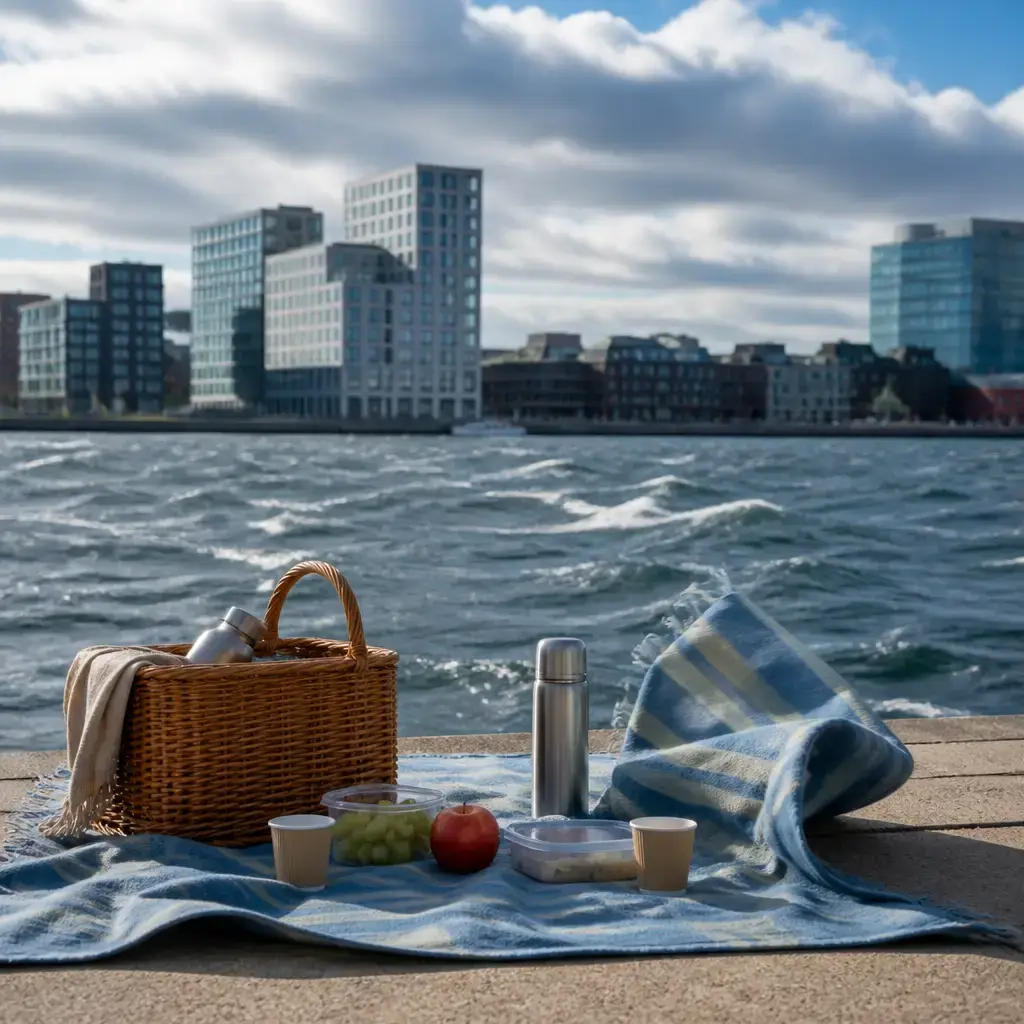
Vinden er meget stærkere end i går.
VEN-ən air MAY-uth STAIR-uh-guh en ee GOHR. The wind is much stronger than yesterday.En picnic er måske ikke behagelig i dag.
en PEEK-nik air MOH-skeh IK-uh beh-HEH-uh-lee ee DAY. A picnic might not be comfortable today.Tæppet ville blive ved med at blæse væk.
TEB-uth VEL-uh BLEE-vuh vay meth uh BLES-uh VEK. The blanket would keep blowing away.Det kunne også være svært at spise udenfor.
deh KOO-nuh OH-soh VAIR-uh SVAIR uh SPEE-suh OO-den-FOHR. Also, eating outside could be difficult.Skal vi aflyse og mødes indenfor i stedet?
SKAL vee ow-FLEE-suh oh MUH-thes IN-den-FOHR ee STEH-thuh? Should we cancel and meet indoors instead?Det ville være mere sikkert og nemmere.
deh VEL-uh VAIR-uh MAY-uh SEH-gut oh NEM-uh-ruh. That would be safer and easier.Lad mig fortælle det til alle i gruppechatten.
LETH MY fuh-TEL-uh deh teel AL-uh ee GROO-buh-CHAT-ən. Let me tell everyone in the group chat.En café nær parken ville være et godt valg.
en ka-FAY NAIR PAR-gən VEL-uh VAIR-uh ed GOHT VALG. A cafe near the park would be a good choice.Sentence explanations
Vinden er meget stærkere end i går.
The wind is much stronger than yesterday.
- Vinden
- the wind
- er
- is
- meget
- much; very
- stærkere
- stronger
- end i går
- than yesterday
More detail
Vinden means “the wind.” It is the definite singular form of vind (“wind”): en vind is “a wind,” while vinden is “the wind.” The definite form identifies the wind intended in this utterance without changing its number. er is the present-tense form of at være (“to be”). Danish uses er with all subjects in the present tense; it does not change for singular versus plural. Example: Vindene er stærke. — “The winds are strong.” meget means “much” here and intensifies the comparison. It comes before the comparative adjective: meget stærkere means “much stronger.” The same word can also mean “very” before a non-comparative adjective, as in meget stærk (“very strong”). stærkere means “stronger.” It is the comparative form of stærk (“strong”): stærk → stærkere (“strong” → “stronger”). The comparative ending -ere marks a comparison between the wind’s strength at the stated time and its strength yesterday. Example: Denne vind er stærkere. — “This wind is stronger.” end i går means “than yesterday.” end introduces the comparison, and i går means “yesterday.” In this sentence, the comparison is elliptical: the wind is stronger than it was yesterday; the omitted repeated idea is understood from the comparison. I går is a fixed time expression and is not changed for number or gender. Together, Vinden er meget stærkere end i går. means “The wind is much stronger than yesterday.” The sentence compares the wind’s present strength with its strength yesterday and emphasizes that the difference is large.
En picnic er måske ikke behagelig i dag.
A picnic might not be comfortable today.
- picnic
- picnic
- er
- is
- måske
- perhaps
- ikke
- not
- behagelig
- comfortable
- i dag
- today
More detail
picnic is a noun meaning “picnic.” Its form is unchanged here; the preceding indefinite article en shows that this is a common-gender singular noun. En is an indefinite article, not by itself a claim that there is exactly one picnic. Example: Vi planlægger en picnic. — “We are planning a picnic.” er is the present-tense form of være, “to be.” It links the subject to a description: Picnicen er behagelig. — “The picnic is comfortable.” The same present form can describe a current state or a general fact; i dag specifies the time here. måske means “perhaps” or “might,” expressing uncertainty. It applies to the proposition that follows rather than asserting it as certain. Example: Det er måske for sent. — “It might be too late.” ikke is the ordinary negation word “not.” In this sentence, måske ikke behagelig means that the picnic may fail to be comfortable: the uncertainty and negation combine, rather than ikke meaning “perhaps.” Example: Bussen er ikke her. — “The bus is not here.” behagelig means “comfortable” or “pleasant” here. It is the common-gender singular indefinite form of the adjective; with a neuter singular noun, the form is behageligt, and with a plural noun it is behagelige. The form agrees with the noun it describes, picnic, not with the nearby adverb. Example: En stol er behagelig. — “A chair is comfortable.” i dag is the fixed time expression “today.” It places the possible condition on the current day. Example: Vi arbejder i dag. — “We are working today.” Together, En picnic supplies the subject, er behagelig describes its condition, ikke negates that description, and måske makes the negative statement uncertain. i dag gives the time. The whole utterance therefore means: “A picnic might not be comfortable today.”
Tæppet ville blive ved med at blæse væk.
The blanket would keep blowing away.
- Tæppet
- the blanket
- ville blive ved med at
- would keep …
- blæse væk
- blow away
More detail
Tæppet means “the blanket” here. The base noun is tæppe; tæppet is its definite singular form, used for a specific blanket. Danish definite forms are often attached to the noun rather than placed in a separate word. ville blive ved med at expresses “would keep …”. ville is the past-tense form of vil and can mark a conditional or future viewed from the past. blive ved med at is a reusable construction meaning “continue to” or “keep” followed by an infinitive: Hun ville blive ved med at læse. — “She would keep reading.” The infinitive after at is blæse, not a conjugated form. blæse væk means “blow away” in this sentence. blæse is the infinitive of “blow”; væk means “away” and indicates movement away from the relevant place. The phrase can describe something being carried away by air even though Danish uses the active-looking verb form. For example: Vinden blæser papiret væk. — “The wind blows the paper away.” Together, Tæppet identifies the blanket, ville blive ved med at presents continued action in a conditional or past-viewed future, and blæse væk describes the blanket being blown away. The complete meaning is: “The blanket would keep blowing away.”
Det kunne også være svært at spise udenfor.
Also, eating outside could be difficult.
- Det kunne
- it could
- også
- also
- være
- be
- svært
- difficult
- spise
- eat
- udenfor
- outside
More detail
Det kunne combines Danish det with kunne. Here det is a formal, non-specific subject for the situation described by the later at spise udenfor; it does not identify a particular person or object. Kunne is the preterite form of kan, but it does not by itself place this situation in past time. With an infinitive, it presents something as possible, often with a conditional or less direct tone. After a modal such as kunne, the following verb stays in the infinitive. Også means “also” and adds this possibility to something else already under discussion. Its position after the modal phrase is natural here; it contributes to the statement as a whole rather than changing the meaning of være alone. Være is the infinitive of er (“is/am/are”), from at være (“to be”). Danish uses the infinitive after kunne: kunne være = “could be.” Example: Det kunne være rigtigt. — “That could be correct.” Svært means “difficult” here. It is the neuter singular form of the adjective svær, because it is the predicative form associated with det; it is not an inflection of være. Useful forms include svær (“difficult,” common gender), svært (“difficult,” neuter singular), and sværere (“more difficult”). Example: Det er svært. — “It is difficult.” Spise is the infinitive “to eat.” In at spise, at marks the infinitive, and the whole phrase describes the activity whose difficulty is being assessed. The infinitive phrase follows the adjective here, while det provides the grammatical subject position. Example: Jeg kan lide at spise ude. — “I like eating out.” Udenfor is an adverb meaning “outside.” In this sentence it modifies spise, specifying where the eating takes place. It is written as one word here; it is not an inflected form of spise. Example: Børnene leger udenfor. — “The children are playing outside.” Together, Det kunne ... være svært means “it could be difficult,” and at spise udenfor identifies the activity being evaluated. The complete utterance therefore means: “Also, eating outside could be difficult.”
Skal vi aflyse og mødes indenfor i stedet?
Should we cancel and meet indoors instead?
- Skal vi
- shall we
- aflyse
- cancel
- mødes
- meet
- indenfor
- indoors
- i stedet
- instead
More detail
Skal vi begins a yes-or-no proposal: skal is the present form of skulle, used here with vi to ask whether the speakers should do something. In this construction, the finite verb comes before the subject. Compare the reusable pattern Skal vi + infinitive? — “Shall we ...?” or “Should we ...?” aflyse is the infinitive “to cancel.” After skal, Danish uses the infinitive without an infinitive marker: Skal vi aflyse? means “Should we cancel?” The infinitive is also the form used after other modal verbs such as kan (“can”) and vil (“will/want to”), though the exact meaning depends on the modal. mødes means “meet” here, specifically meeting one another. Its base form is møde; the ending -s marks the reciprocal/reflexive form in this verb. Thus vi mødes means “we meet each other,” while vi møder ... can mean “we meet ...” or “we are meeting ...” with a direct object, depending on context. Example: Vi mødes klokken otte. — “We’ll meet at eight.” indenfor is an adverb meaning “indoors” or “inside,” describing the place of the meeting. It does not itself identify a particular room or building. Example: Vi spiser indenfor. — “We eat indoors.” i stedet means “instead.” It replaces one proposed option with another. Here it applies to the alternative of meeting indoors rather than carrying out the earlier outdoor plan. Example: Lad os tage toget i stedet. — “Let’s take the train instead.” Together, Skal vi aflyse og mødes indenfor i stedet? asks whether the speakers should cancel the existing plan and meet indoors instead. og joins the two coordinated actions, and i stedet marks the indoor meeting as the replacement option. The whole sentence therefore means: “Should we cancel and meet indoors instead?”
Det ville være mere sikkert og nemmere.
That would be safer and easier.
- Det
- That
- ville være
- would be
- mere
- more
- sikkert
- safe
- nemmere
- easier
More detail
Det is a Danish demonstrative pronoun meaning “that” here. It points to the situation or proposal under discussion, rather than naming a particular person. Danish det is also used for an unspecified situation or state of affairs. Compare det (“that/it”) with dette (“this,” more formal or emphatic in many contexts). ville være combines ville with the infinitive være. In this sentence, ville gives a conditional meaning, “would,” and være means “be.” The pattern det ville være + adjective is reusable for evaluating a possible situation: Det ville være godt. — “That would be good.” Ville is a form of vil; være is the infinitive and does not change for person. mere means “more” and introduces a comparative description. Here it combines with sikkert to form “safer.” Danish can also form some comparisons with the suffix -ere, but mere + adjective is a common way to make a comparative, especially with adjectives for which that construction is preferred or convenient. sikkert is the adjective sikker (“safe” or “secure”) in its neuter form. The -t ending is used because the adjective is predicative with neuter det: Det er sikkert. — “It is safe.” In another use, sikkert can be an adverb meaning “probably,” but that is not its meaning here. The combination mere sikkert means “safer.” nemmere is the comparative of nem, meaning “easy.” The useful chain is nem — nemmere — nemmest: “easy” — “easier” — “easiest.” The comparative form nemmere does not take the neuter -t ending; it remains nemmere in this use. Example: Denne løsning er nemmere. — “This solution is easier.” Together, Det ville være presents an evaluation of a possible situation, and mere sikkert og nemmere gives two coordinated comparative descriptions: “safer and easier.” The complete utterance therefore means: “That would be safer and easier.”
Lad mig fortælle det til alle i gruppechatten.
Let me tell everyone in the group chat.
- Lad mig
- let me
- fortælle
- tell
- det
- it
- til alle
- to everyone
- gruppechatten
- the group chat
More detail
Lad mig is a reusable way to say “let me …”. Lad is the imperative of lade (“to let”); mig is the object form of “I/me”. In this construction, the speaker asks for permission or proposes that they perform the following action. Example: Lad mig hjælpe. — “Let me help.” fortælle means “to tell” and is the infinitive after lad mig. The pattern is Lad mig + infinitive: Lad mig se. — “Let me see.” The infinitive itself does not show the subject here; mig identifies who will carry out the action. det is the pronoun “it” in this sentence, referring to the thing the speaker intends to tell. Danish det is also used for some other grammatical functions, but here it is the object of fortælle. til alle means “to everyone”. til marks the recipients, and alle means “everyone” in this use. Example: Hun skriver til alle. — “She writes to everyone.” gruppechatten means “the group chat”. gruppechat is the base noun, and the ending -en makes it definite: gruppechatten = “the group chat”. The first part identifies the type of chat, while the definite form presents it as a particular chat in the situation. Together, Lad mig fortælle det til alle i gruppechatten means “Let me tell everyone in the group chat.” The structure is Lad mig + fortælle + det + til alle + i gruppechatten: the speaker proposes telling it to everyone who is being addressed through or in the group chat. The wording is natural for making this immediate suggestion.
En café nær parken ville være et godt valg.
A cafe near the park would be a good choice.
- café
- cafe
- nær
- near
- parken
- the park
- ville være
- would be
- godt
- good
- valg
- choice
More detail
café means “cafe” here. It is a noun; the indefinite form is en café, while the definite form is caféen (“the cafe”). Example: Vi mødes på en café. — “We are meeting at a cafe.” nær means “near” and introduces a place or thing used as a reference point. It is a preposition and does not change form here. Example: Skolen ligger nær stationen. — “The school is near the station.” parken means “the park.” The base noun is park; parken is its singular definite form, formed with the ending -en. The definite form refers to a particular park in the intended context, without the sentence specifying any further identifying detail. ville være means “would be.” ville is the past-tense form of ville (“to want” or, in this construction, “would”), and være is the infinitive “to be.” Together they express a hypothetical or tentative assessment. Example: Det ville være praktisk. — “That would be practical.” godt means “good.” It is the neuter form of the adjective god, used because it describes et valg, and valg is a neuter noun. Compare en god café (“a good cafe”) with et godt valg (“a good choice”). valg means “choice.” It is a neuter noun: et valg is “a choice,” and valget is “the choice.” Example: Det er et godt valg. — “It is a good choice.” Together, En café nær parken means “A cafe near the park.” The subject is followed by ville være, “would be,” and the complement et godt valg, “a good choice.” The complete utterance therefore means: “A cafe near the park would be a good choice.”
Grammar Points
stærkere end
Vinden er stærkere end i går.
VEN-ən air STAIR-uh-guh en ee GOHR.The wind is stronger than yesterday.
The comparative form stærkere is followed by end when comparing two things.
blive ved med at + infinitiv
Alle bliver ved med at spise udenfor.
AL-uh BLEE-vuh vay meth uh SPEE-suh OO-den-FOHR.Everyone keeps eating outside.
Use blive ved med at before an infinitive to say that an action continues.
Danish Vocabulary
- Gender
- neuter
- Gender
- common
Quiz
Spelling
Tap the letters to spell the word.
wind
Show Answer
vindennot
Show Answer
ikkevery; much
Show Answer
megetstrong