10 minutes free every day
Continue audio lessons in the app
Word explanations appear automatically in sync with the audio.
No login required · synced translations · playback with the screen locked
Choose your learning language and open this lesson in the app.

About This Lesson
Use Check the weather before leaving to practice Danish conversation, pronunciation, vocabulary, grammar, and quizzes.
Dialogue
Kan du tjekke vejr-appen, før vi går?
Kahn doo CHEH-guh VY-uh AP-en, fuhr vee GOHR? Can you check the weather app before we leave?Der står, at der er en chance for regn.
Dair STOHR, ad dair air en SHAHN-suh fohr RINE. It says there is some chance of rain.Himlen ser allerede overskyet ud.
HEEM-len sair al-RAY-duh OH-vuh-SKOO-et ooth. The sky looks cloudy already.Temperaturen falder også i aften.
tem-peh-rah-TOO-uhn FAL-uh OH-saw ee AF-dn. The temperature will also drop this evening.Skal jeg tage en let jakke med?
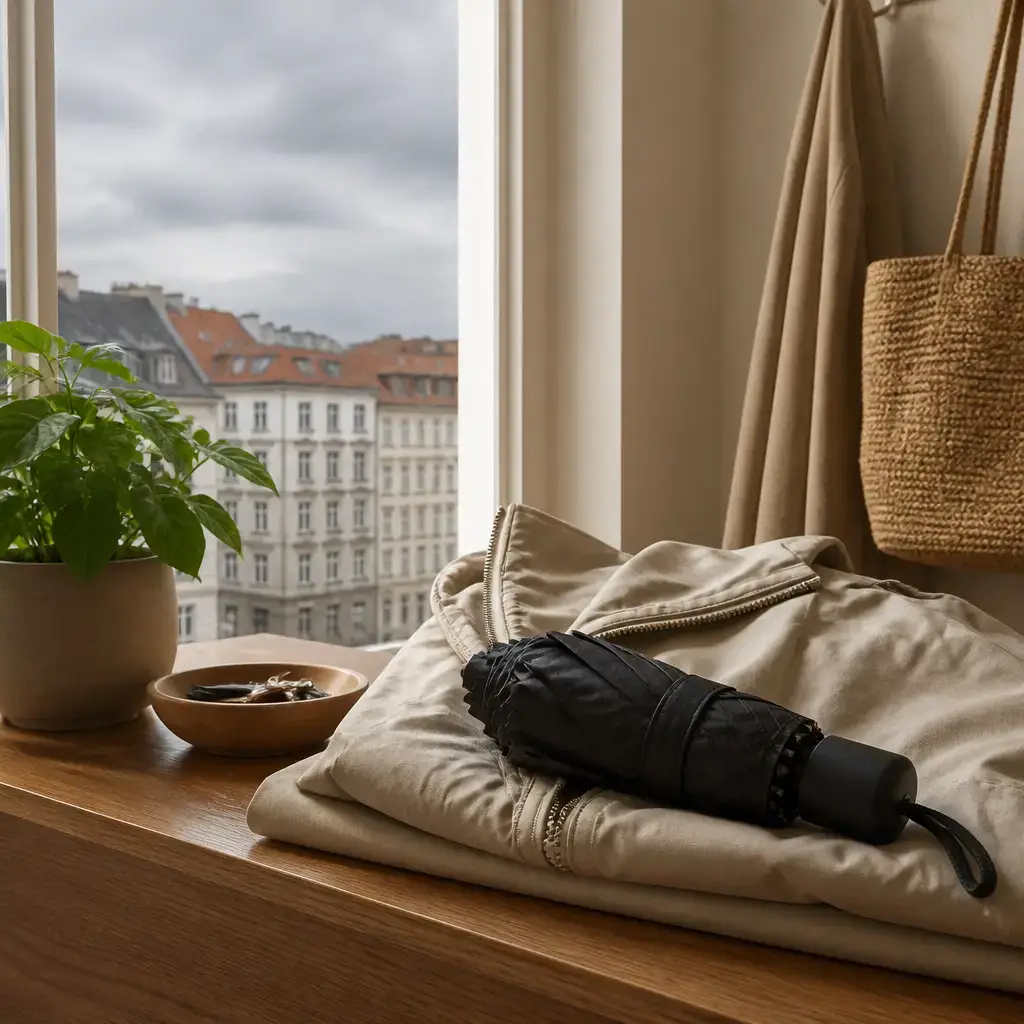
SGAL yigh TAH-uh en LEHD YAH-guh meh? Should I carry a light jacket?En let jakke og en lille paraply ville være en hjælp.
En LEHD YAH-guh ow en LEEL-uh pah-rah-PLOO VIL-uh VAIR-uh en YELP. A light jacket and a small umbrella would help.Så kan jeg lægge begge dele i min taske.
SOH kan yigh LEH-guh BEH-uh DAY-luh ee meen TAS-guh. Then I can put both in my bag.Det burde være nok til regnen og den køligere aften.
Deh BOO-uh VAIR-uh NOHK teel RINE-en ow den KUR-lee-uh-ruh AF-dn. That should be enough for the rain and the cooler evening.Sentence explanations
Kan du tjekke vejr-appen, før vi går?
Can you check the weather app before we leave?
- Kan du
- can you
- tjekke
- check
- vejr-appen
- the weather app
- før
- before
- vi
- we
- går
- leave/go
More detail
Kan du: This is a reusable Danish way to ask whether someone can do something: kan is the present form of kunne (“can/be able to”), followed by the subject pronoun du (“you”). In a question, the finite verb comes before the subject. The following infinitive names the requested action: Kan du hjælpe? = “Can you help?” tjekke: This is the infinitive “to check.” It follows the modal kan; after a modal, Danish uses the infinitive without an English-style “to.” The same form can be reused after other modal verbs: Du skal tjekke det. = “You must check it.” vejr-appen: This compound means “the weather app.” vejr means “weather,” and appen is the definite singular form of app (“app”): en app → appen. The definite ending belongs to app, not to vejr; the hyphen visibly joins the compound parts here. Jeg åbner appen. = “I open the app.” før: This introduces the time relation “before.” It can connect an event to a clause: før vi går = “before we leave.” It can also precede a noun phrase, as in før frokost = “before lunch.” vi: This is the subject pronoun “we.” It is the form used for a first-person plural subject, regardless of the gender of any noun nearby. går: This is the present form of gå (“go/walk”). Here, in vi går, it means “we leave,” matching the fixed translation. The same verb can mean “go” or “walk” in other contexts, so the surrounding time expression determines the intended sense here. Vi går hjem. = “We walk/go home.” Together, Kan du tjekke vejr-appen asks the listener to check the weather app, and før vi går places that requested action before the speaker and listener leave. The complete meaning is: “Can you check the weather app before we leave?”
Der står, at der er en chance for regn.
It says there is some chance of rain.
- Der står
- It says
- der er
- there is
- chance
- chance
- regn
- rain
More detail
Der står is a common Danish way to report what a text, notice, or source says: literally, something “stands” there. In this sentence it introduces the information being reported. The verb is står, the present form of stå (“to stand”); in this reporting use, do not translate it as physical standing. der er is the existential pattern “there is/there are.” Er is the present form of være (“to be”). The form stays er with both singular and plural nouns: der er en chance means “there is a chance,” while der er flere chancer means “there are several chances.” Here the pattern presents en chance as existing, without asserting that the chance is large. chance is a noun meaning “chance” or “possibility.” In Danish it commonly appears with the indefinite article en: en chance; its definite form is chancen (“the chance”). A reusable example is Der er en chance for sne. — “There is a chance of snow.” regn means “rain.” It is commonly used as an uncountable weather noun without an indefinite article when referring to rain as a substance or weather event: chance for regn means “chance of rain.” The related noun regnvejr means “rainy weather,” but it is not the form used here. The sentence is assembled as Der står + at + der er en chance + for regn: “It says that there is a chance of rain.” The first der belongs to the reporting expression, while the second der belongs to the existential pattern; they are not the same grammatical role. In the supplied weather context, the sentence reports information about possible rain, without stating that rain will definitely occur.
Himlen ser allerede overskyet ud.
The sky looks cloudy already.
- Himlen
- the sky
- ser … ud
- looks; seems
- allerede
- already
- overskyet
- cloudy; overcast
More detail
Himlen means “the sky” here. It is the definite singular form of himmel (“sky”): en himmel is “a sky,” while himlen is “the sky.” The ending -en marks definiteness for this noun; it also identifies the noun as common gender, but it does not itself state a numerical count. ser ... ud is a common Danish construction meaning “looks” or “seems” when describing appearance. ser is the present tense of se (“to see”), but with ud it describes how something appears. The two parts are separated here because overskyet comes between them. For example: Det ser svært ud. — “It looks difficult.” allerede means “already.” It marks the described condition as holding by the relevant time, often earlier than expected. It can be reused in Hun er allerede hjemme. — “She is already home.” overskyet means “cloudy” or “overcast” here and describes the sky’s appearance. It is the singular form used in this sentence; this form is the same with common- and neuter-gender singular subjects, while the plural form is overskyede. For example: Vejret ser overskyet ud. — “The weather looks cloudy.” Together, Himlen (“the sky”) + ser ... ud (“looks”) + allerede (“already”) + overskyet (“cloudy”) produce: “The sky looks cloudy already.” The sentence presents cloudiness as the sky’s current appearance and marks that appearance as already the case.
Temperaturen falder også i aften.
The temperature will also drop this evening.
- Temperaturen
- the temperature
- falder
- falls; drops
- også
- also; too
- i aften
- this evening
More detail
Temperaturen means “the temperature” here. It is the definite singular form of temperatur (“temperature”): temperatur is indefinite, while temperaturen refers to a specific temperature in the situation. Danish marks definiteness on the noun itself in this form. falder comes from falde, “to fall” or “to drop.” Falder is the present-tense form; it can describe a current development or a future event when a time expression supplies the future time. Here, i aften makes the intended time future, so the translation uses “will drop.” Example: Prisen falder i morgen. — “The price will drop tomorrow.” også means “also” or “too.” It adds this event to something else that is relevant, without changing who or what falls. Its exact scope can depend on context, but here it indicates that the temperature will drop in addition to another relevant circumstance or event. i aften is the time expression “this evening.” It consists of the preposition i and aften, “evening,” and together forms a reusable expression for the coming evening. Example: Jeg arbejder i aften. — “I am working this evening.” Together, Temperaturen falder gives “the temperature drops,” også adds “also,” and i aften places the event in this evening. The complete utterance means: “The temperature will also drop this evening.”
Skal jeg tage en let jakke med?
Should I carry a light jacket?
- Skal jeg
- should I
- tage … med
- take/carry along
- let
- light
- jakke
- jacket
More detail
Skal jeg combines skal with jeg to form a first-person question about what the speaker should do. Skal is the present form of skulle; in this question it expresses advice, suitability, or a decision to be made, rather than a simple statement of future action. The same pattern is reusable: Skal jeg vente? means “Should I wait?” tage ... med is a separable verb construction meaning to take or carry something along. Tage is the infinitive of tage, and med adds the idea that the item goes along with the person. In a question, the two parts can be separated by the item: Skal jeg tage paraplyen med? means “Should I take the umbrella along?” let describes jakke here as light in weight, not heavy. Its base form is let; with a common-gender singular indefinite noun such as en jakke, this form is used. In other combinations, the adjective can have another form, for example lette jakker for “light jackets.” jakke is the noun “jacket.” Its indefinite singular form is en jakke; the definite singular form is jakken, “the jacket.” For example, Jeg har en jakke med. means “I have a jacket with me.” Together, Skal jeg asks for guidance, tage ... med asks whether the speaker should carry something along, and en let jakke identifies that item as a light jacket. The whole utterance therefore means “Should I carry a light jacket?”
En let jakke og en lille paraply ville være en hjælp.
A light jacket and a small umbrella would help.
- let
- light
- jakke
- jacket
- lille
- small
- paraply
- umbrella
- ville være
- would be
- hjælp
- help
More detail
let means “light” here, describing the jacket’s weight or thickness. It is the adjective’s common-gender singular form, matching jakke; the same adjective also has other context-dependent meanings, such as “easy,” but that is not the meaning here. Example: en let taske — “a light bag.” jakke means “jacket.” Its base form is jakke, and the plural is jakker. Danish commonly uses en with this noun: en jakke — “a jacket.” lille means “small.” It is the singular form used with paraply; Danish adjective forms can change with number and grammatical gender, so the form must be checked against the noun. Its comparative is mindre — “smaller.” Example: en lille taske — “a small bag.” paraply means “umbrella,” with plural paraplyer. Example: Jeg har en paraply. — “I have an umbrella.” ville være is a reusable construction meaning “would be.” ville is the past form of vil used here to express a conditional or hypothetical result, while være is the infinitive “be.” In this sentence, the construction presents the jacket and umbrella as something that would constitute help, rather than asserting that they are already helping. Example: Det ville være godt. — “That would be good.” hjælp means “help.” It can refer to help as a general thing or resource, as it does here. Example: Jeg har brug for hjælp. — “I need help.” Together, En let jakke means “a light jacket,” and en lille paraply means “a small umbrella.” The two noun phrases are joined by og, “and,” so they form the subject. ville være en hjælp says that this combination “would be a help.” The complete utterance therefore means: “A light jacket and a small umbrella would help.”
Så kan jeg lægge begge dele i min taske.
Then I can put both in my bag.
- Så
- then
- kan jeg
- I can
- lægge
- put
- begge dele
- both
- taske
- bag
More detail
Så means “then” here and links this action to what was just mentioned. It can also introduce a consequence in other sentences: Så går vi. — “Then we’ll go.” kan jeg combines the modal verb kan (“can / am able to”) with the subject jeg (“I”). In this sentence, kan is the finite verb and jeg is the subject. Because Så occupies the first position, Danish main-clause word order places the finite verb before the subject: Så kan jeg .... Compare the neutral order Jeg kan ... — “I can ...”. lægge is the infinitive of lægge, meaning “to put or place” something. It follows the modal kan without an infinitive marker. The pattern kan + infinitive is reusable for ability or possibility: Jeg kan lægge bogen her. — “I can put the book here.” begge dele means “both things/items” in this sentence. begge expresses “both,” while dele is the plural of del (“part” or “thing”); together, this construction refers to two relevant items without repeating their names. In the supplied context, those two items are the jacket and the umbrella. For example, Jeg tager begge dele. — “I’ll take both.” taske is the noun “bag.” In the utterance it appears in the singular possessive phrase min taske, “my bag”; min shows possession, while taske names the object. A reusable example is Bogen er i min taske. — “The book is in my bag.” Together, Så kan jeg gives “Then I can,” lægge begge dele gives “put both items,” and i min taske gives “in my bag.” The complete utterance is therefore: “Then I can put both in my bag.”
Det burde være nok til regnen og den køligere aften.
That should be enough for the rain and the cooler evening.
- Det
- that
- burde
- should; ought to
- være
- be
- nok
- enough
- til
- for
- regnen
- the rain
- den
- the
- køligere
- cooler
- aften
- evening
More detail
Det is a neuter singular pronoun. Here it means “that” as the sentence’s subject; the supplied translation does not identify a more specific noun referent. Danish also uses det in other subject patterns, such as Det regner (“It is raining”), so its exact role comes from the construction. burde expresses a recommendation or expectation rendered as “should” here. It is related to bør; burde is followed by an infinitive without at, as in Jeg burde gå nu. — “I should go now.” være is the infinitive of “be.” After the modal burde, Danish uses this infinitive directly: burde være — “should be.” nok means “enough” here. The pattern være nok means “be enough”: Det er nok. — “That is enough.” til means “for” here and introduces what something is enough for. Thus nok til means “enough for.” Its meaning can vary by construction; for example, Jeg går til skolen means “I go to school.” regnen is the definite singular form of regn, “rain”: regn → regnen. The ending marks the noun as definite, “the rain.” Regnen falder. means “The rain is falling.” den is the definite determiner used with a common-gender singular noun when an adjective comes before it. In den køligere aften, it helps mark the noun phrase as definite; it is not the word meaning “evening.” køligere is the comparative of the adjective kølig, “cool.” The useful chain is kølig — “cool,” køligere — “cooler,” and køligst — “coolest.” The comparative says that the evening is cooler than some understood reference point; it does not identify that point by itself. aften means “evening.” It is a common-gender singular noun. Without a preceding adjective, its definite form is aftenen, “the evening”; with the adjective before it, definiteness is expressed by den ..., giving den køligere aften — “the cooler evening.” Together, Det burde være nok means “That should be enough.” til regnen specifies what it is enough for, and og coordinates this with den køligere aften, the second thing it should be enough for. Thus the whole utterance means: “That should be enough for the rain and the cooler evening.”
Grammar Points
tage ... med
tage en paraply med
TAH-uh en pah-rah-PLOO mehto bring an umbrella along
In Danish, med comes after the object in this fixed expression: tage + object + med.
adjektiv + -ere
en køligere aften
en KUR-lee-uh-ruh AF-dna cooler evening
The suffix -ere forms the comparative of many Danish adjectives, such as kølig → køligere.
Danish Vocabulary
Quiz
Word Order
Arrange the words in the correct order.
The sky looks cloudy already.
Show Answer
Himlen ser allerede overskyet ud.The temperature will also drop this evening.
Show Answer
Temperaturen falder også i aften.Spelling
Tap the letters to spell the word.
to say; to state
Show Answer
stårsky
Show Answer
Himlenchance
Show Answer
chancerain