10 minutes free every day
Continue audio lessons in the app
Word explanations appear automatically in sync with the audio.
No login required · synced translations · playback with the screen locked
Choose your learning language and open this lesson in the app.

About This Lesson
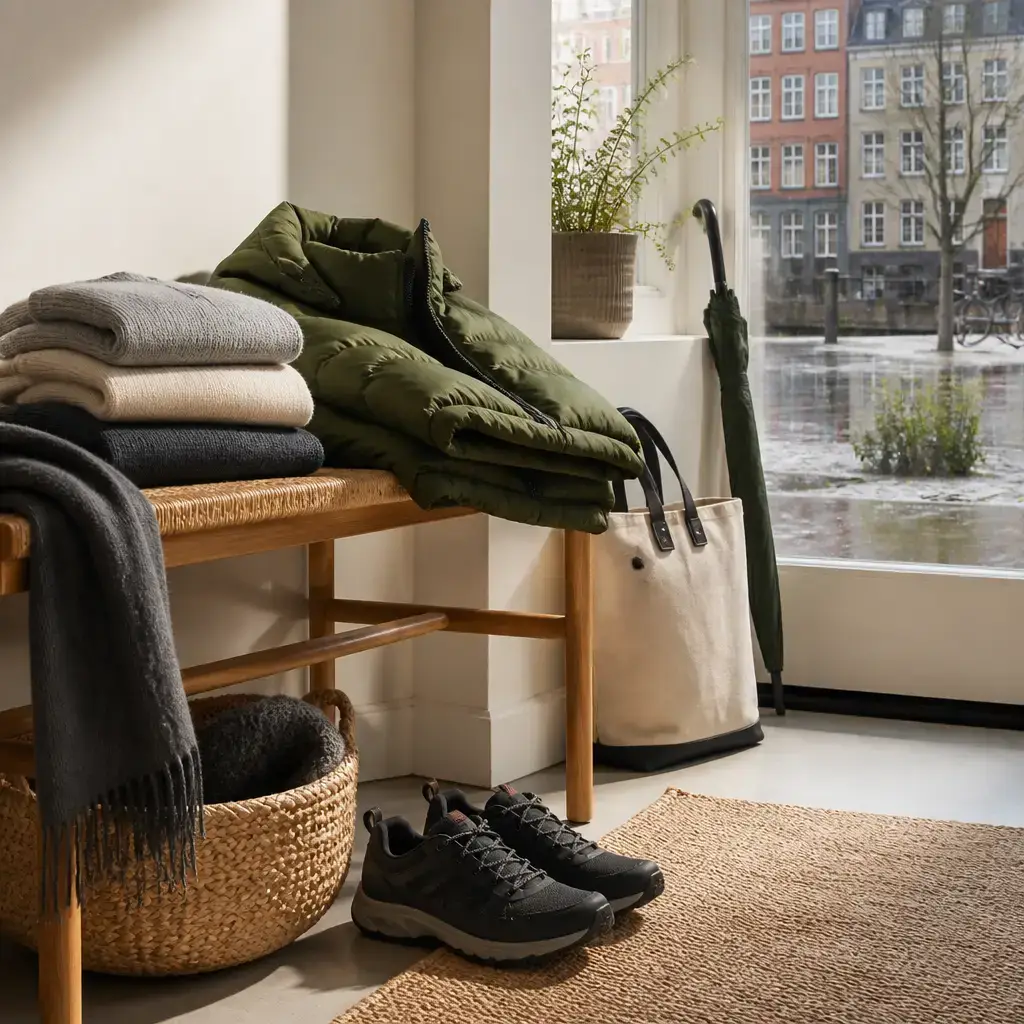
Use Choosing clothes for changing weather to practice Danish conversation, pronunciation, vocabulary, grammar, and quizzes.
Dialogue
Vejret bliver ved med at skifte i denne uge.
VY-uhd BLEE-vuh VEHTH MEHTH ehd SGEF-duh ee DEN-uh OO-uh. The weather keeps changing this week.Tag tøj på i flere lag, så du kan tilpasse det i løbet af dagen.
TAH toy poh ee FLAY-uh LAY, saw doo kan tuh-PASS-uh deh ee LOO-buhd ehv DAY-en. Wear layers so you can adjust during the day.Skal jeg også tage en varm jakke med?
SKAL yai OH-saw TAY-uh en VARM YAH-guh MEHTH? Should I bring a warm jacket too?Tag en med til morgenen.
TAH en MEHTH tehl MOR-nen. Bring one for the morning.Så kan du have den med senere, hvis det bliver varmere.
Saw kan doo HAY-vuh den MEHTH SAY-nuh, vess deh BLEE-vuh VAR-muh-uh. Then carry it later if it gets warmer.Jeg har også brug for sko, som er nemme at gå i.
Yai har OH-saw BROO foh sɡoh, som air NEM-uh ehd GOH ee. I also need shoes that are easy to walk in.Vælg et let par med godt greb, hvis stierne er våde.
VEL ehd LEHTH par MEHTH GUHD GRAYB, vess STEER-nuh air VOH-thuh. Choose a light pair with a solid grip in case the paths are wet.Det burde fungere, hvis det bliver varmere om eftermiddagen.
Deh BOO-uh-thuh fon-GAY-uh, vess deh BLEE-vuh VAR-muh-uh om EF-tuh-MED-day-en. That should work if the afternoon warms up.Så kan du bære jakken, uden at den føles tung.
Saw kan doo BAIR-uh YAH-gun, OO-thun ehd den FUH-luhs TONG. Then you can carry the jacket without feeling weighed down.Sentence explanations
Vejret bliver ved med at skifte i denne uge.
The weather keeps changing this week.
- Vejret
- the weather
- bliver ved med at
- keeps on
- skifte
- change
- i denne uge
- this week
More detail
Vejret means “the weather” here. It is the definite singular form of vejr (“weather”): vejr → vejret. The ending -et marks definiteness for this noun; it does not mean “the” as a separate word. Example: Vejret er koldt. — “The weather is cold.” bliver ved med at is a reusable Danish construction meaning “keeps on” or “continues to.” In this sentence, bliver is the present-tense form of blive, but the full construction—not bliver alone—expresses continued activity. The pattern is blive ved med at + infinitive: Hun bliver ved med at læse. — “She keeps reading.” skifte is the infinitive of skifte, “to change” or “to switch.” After at in bliver ved med at, it stays in the infinitive form. Here it describes the weather changing, rather than identifying a particular switch between named things. i denne uge means “this week.” uge means “week,” and denne is the singular form used with this common-gender noun. In this time expression, i places the situation within the week. Example: Jeg arbejder i denne uge. — “I am working this week.” Together, Vejret bliver ved med at skifte i denne uge. means “The weather keeps changing this week.” The subject is vejret; bliver ved med at skifte says that its changing continues; and i denne uge gives the time period.
Tag tøj på i flere lag, så du kan tilpasse det i løbet af dagen.
Wear layers so you can adjust during the day.
- Tag
- wear; put on
- tøj
- clothes
- flere
- several; more
- lag
- layers
- så du kan
- so you can
- tilpasse
- adjust; adapt
- det
- it
- i løbet af dagen
- during the day
More detail
Tag is the imperative of tage (“to take”). In tage ... på, it means putting on or wearing something, so the command is addressed directly to one person. Example: Tag en jakke på. — “Put on a jacket.” This is an action pattern; bære is a different verb often used for wearing or carrying something rather than putting it on. tøj means “clothing” and is a neuter noun: et tøj is possible in some specific uses, but ordinary clothing as a mass noun commonly appears without an article, as here. The sentence presents the clothing as what is worn in layers. flere is the plural quantifier “several” or “more.” It is the comparative form related to mange (“many”): mange — “many,” flere — “more/several,” flest — “most.” In flere lag, it indicates multiple layers without stating an exact number. Example: Vi har flere muligheder. — “We have several options.” lag means “layer.” Its singular indefinite form is et lag, while its plural form is also lag; the definite plural is lagene. Thus flere lag is “several layers.” så du kan introduces the purpose or result “so that you can.” kan is the present form of the modal verb kunne (“can/be able to”), and a modal is followed by an infinitive: du kan tilpasse — “you can adjust.” Here du is the second-person singular subject. tilpasse means “adjust” or “adapt.” It is an infinitive, required after kan; the present form is tilpasser, as in Du tilpasser tøjet. — “You adjust the clothing.” det is a neuter singular object pronoun meaning “it.” Here it refers to the clothing as a whole, rather than to the plural lag, which would require a plural pronoun. Danish uses den for a common-gender singular noun and dem for a plural object, so the pronoun form reflects the intended neuter singular reference to tøj. i løbet af dagen is the time expression “during the day” or “over the course of the day.” dagen is the definite singular form of dag (“day”), and i løbet af is a reusable expression for a period within which something happens. Example: I løbet af dagen bliver det varmere. — “During the day, it gets warmer.” Together, Tag tøj på tells the listener to put on clothing, i flere lag specifies that the clothing should be arranged in several layers, and så du kan tilpasse det i løbet af dagen gives the purpose: the clothing can be adjusted as needed during the day. The whole utterance therefore advises wearing clothing in several layers so the clothing can be adjusted during the day.
Skal jeg også tage en varm jakke med?
Should I bring a warm jacket too?
- Skal jeg
- Should I
- også
- too; also
- tage … med
- bring along
- en
- a; an
- varm
- warm
- jakke
- jacket
More detail
Skal jeg means “Should I …?” Here skal is the present form of skulle, used as a modal for asking whether the speaker ought to do something. jeg is the first-person singular pronoun “I”. The pattern Skal jeg + verb? is reusable: Skal jeg åbne vinduet? — “Should I open the window?” også means “too” or “also”. It adds this proposed action to something already relevant, without changing who would do it. For example, Skal jeg også komme? means “Should I come too?” The two parts tage … med form the reusable expression tage med, “bring/take along”. tage is the infinitive of “take”, and med indicates that something is taken along to another place or situation. The fixed sentence uses tage after the modal skal; Danish uses the infinitive after this kind of modal. Example: Jeg tager en paraply med. — “I’m bringing an umbrella.” en is the indefinite article used with a common-gender singular noun such as jakke. It introduces one unspecified jacket, but the article itself is not a separate statement of a numerical count. Danish also has et with neuter-gender singular nouns, while plural indefinite nouns normally have no article. varm means “warm” here and describes jakke. It is the common-gender singular form of the adjective. The form changes with the noun’s grammatical form: et varmt tæppe — “a warm blanket”; varme jakker — “warm jackets”. The adjective’s base form is varm; varmt and varme are its other relevant inflected forms here. jakke means “jacket”. It is a common-gender noun, as shown by en jakke. Its plural is jakker: Jeg har to jakker. — “I have two jackets.” Together, Skal jeg også tage en varm jakke med? asks whether the speaker should bring along an unspecified warm jacket as an additional item. The structure is Skal jeg + også + tage … med + noun phrase en varm jakke. In a practical situation, this is a natural, neutral way to ask whether bringing that item is advisable.
Tag en med til morgenen.
Bring one for the morning.
- Tag
- bring or take
- en
- one
- Tag … med
- bring or take along
- morgenen
- the morning
- til morgenen
- for the morning
More detail
Tag is the imperative of tage, “to take” or “to bring.” The imperative is used for a direct instruction: Tag en paraply. — “Bring an umbrella.” Here, the following med makes the reusable construction tage med (“take/bring along”), with Tag as its imperative form. en means “one” here and stands for the item being discussed. The bounded context supports a jacket as that item, so it avoids repeating jakke: Jeg tager en med. — “I’ll bring one along.” In this use, en is a pronoun, not an indefinite article introducing a noun. morgenen is the definite form of morgen (“morning”): morgen → morgenen, “the morning.” The ending -en marks the definite form of this common-gender noun; it is part of the noun form, not part of the preceding en. til morgenen expresses the intended time or purpose, “for the morning.” Til can introduce a time-related destination or purpose, as in mad til morgenen — “food for the morning.” Together, Tag en med means “Bring one along,” and til morgenen specifies that it is intended for the morning. The complete utterance therefore means “Bring one for the morning.”
Så kan du have den med senere, hvis det bliver varmere.
Then carry it later if it gets warmer.
- Så
- then
- kan du
- can you
- have … med
- carry along
- senere
- later
- hvis
- if
- det
- it
- bliver
- gets; becomes
- varmere
- warmer
More detail
Så means “then” here and connects this utterance with what came before. In other contexts it can also mean “so”; the surrounding connection determines the meaning. kan du combines the modal verb kan (“can”) with du (“you”). Here it frames carrying the item as something the addressee can do and forms a request or suggestion. In this kind of Danish main-clause question or request, the verb precedes the subject: Kan du komme? — “Can you come?” have ... med is a reusable construction meaning “carry or take along.” have is the base form of “have,” while med adds the idea of along or with you. The object den comes between them: have den med. Example: Jeg tager den med. — “I’ll take it along.” senere means “later,” referring to a time after the relevant present or earlier point. Example: Vi ses senere. — “See you later.” hvis introduces a condition and means “if.” The clause after it states the condition for the proposed action. Example: Jeg kommer, hvis jeg har tid. — “I’ll come if I have time.” det is the neutral pronoun “it” in this weather-related expression. It is the grammatical subject of the clause; the sentence does not identify a separate named object for this det. bliver is the present form of blive, meaning “become” or “get.” It describes a change into a state, here “gets warmer.” Example: Det bliver mørkt. — “It gets dark.” varmere is the comparative form of the adjective varm (“warm”): varm → varmere (“warmer”). The comparison is with an understood earlier or current temperature. The comparative form belongs to varm, not to det. Example: I dag er det varmere. — “Today it is warmer.” Together, kan du have den med asks or suggests that the addressee carry the understood item along. senere places the action later, and hvis det bliver varmere makes it conditional on the weather getting warmer. The whole utterance means: “Then carry it later if it gets warmer.”
Jeg har også brug for sko, som er nemme at gå i.
I also need shoes that are easy to walk in.
- Jeg
- I
- har … brug for
- need
- også
- also
- sko
- shoes
- som
- that; which
- er
- are
- nemme
- easy
- at gå i
- to walk in
More detail
Jeg means “I” and is the first-person singular subject pronoun. It identifies the speaker as the person who needs the shoes. The object form is mig, as in Hun hjælper mig — “She helps me.” har brug for is the reusable Danish construction for “need.” It uses present-tense har, the form of have, together with the expression brug for. The whole construction takes the thing needed after it: Jeg har brug for vand — “I need water.” In this sentence, har is present tense; Danish har does not change for the subject’s person or number. også means “also” and adds this need to something already relevant. Its position can vary for emphasis, but here it follows the verb phrase: Jeg har også brug for tid — “I also need time.” sko means “shoes.” Here it is a plural noun. Danish normally has no indefinite article before an indefinite plural noun: en sko means “a shoe,” while sko can mean “shoes.” som introduces the relative clause describing the shoes. In this use it means “that” or “which.” It connects the noun to information about it: en jakke, som er varm — “a jacket that is warm.” er is the present-tense form of være, “to be.” It links sko with the description nemme; Danish uses the same er form with singular and plural subjects: Skoen er nem — “The shoe is easy,” and Skoene er nemme — “The shoes are easy.” nemme means “easy” here. It is the plural form of the adjective nem; the plural antecedent sko calls for this plural adjective form in the relative clause. The comparison is nem (“easy”), nemmere (“easier”), nemmest (“easiest”). For example, Denne opgave er nemmere means “This task is easier.” at gå i means “to walk in.” gå is the infinitive “to walk,” marked by at, and i is the preposition “in.” Together they describe the activity for which the shoes are easy to use. In Danish, the preposition can remain at the end of this relative construction, as in en stol, som er behagelig at sidde i — “a chair that is comfortable to sit in.” The i belongs to the meaning of walking in or wearing the shoes here; it does not mean that the speaker is currently walking in them. Together, Jeg har også brug for sko means “I also need shoes.” The relative clause som er nemme at gå i specifies the desired kind of shoes: they should be easy to walk in. The complete utterance therefore means “I also need shoes that are easy to walk in.”
Vælg et let par med godt greb, hvis stierne er våde.
Choose a light pair with a solid grip in case the paths are wet.
- Vælg
- choose
- let
- light
- par
- pair
- godt
- good; solid
- greb
- grip
- hvis
- if
- stierne
- the paths
- er
- are
- våde
- wet
More detail
Vælg means “choose” here and is the imperative of vælge. It directly tells the listener to make a choice. Example: Vælg en jakke. — “Choose a jacket.” let means “light” in weight. It is the neuter singular form of the adjective let, agreeing with par, which is a neuter noun (et par). The same adjective contrasts with tung (“heavy”): en let taske — “a light bag,” but et let par — “a light pair.” par means “pair.” Danish commonly uses et par for two matching items considered together, such as shoes: et par sko — “a pair of shoes.” Its definite form is parret when referring to a specific pair. godt means “good” here and contributes the sense “solid” in the context of grip. It is the neuter singular form of god, agreeing with greb (et greb). The form changes with the noun: en god sko but et godt greb; in the plural, gode greb. greb means “grip” or “hold.” In this sentence it refers to how securely the footwear holds the ground, not to the act of grabbing something. Et godt greb — “a good grip.” hvis introduces a condition and means “if.” The clause after it describes the circumstance under which the choice is useful: Hvis vejen er glat, går vi langsomt. — “If the road is slippery, we walk slowly.” stierne means “the paths.” It is the definite plural of sti: sti → stier → stierne. The ending -ne marks plural definiteness here, so the sentence refers to particular paths understood in the situation. er means “are” here. It is the present-tense form of være (“be”) and does not show a separate plural form: jeg er, den er, and de er all use er. Here it links stierne with the adjective våde. våde means “wet.” It is the plural form of våd, agreeing with plural stierne. Compare en våd sti — “a wet path,” et vådt gulv — “a wet floor,” and våde stier — “wet paths.” Together, Vælg et let par gives the instruction “Choose a light pair.” med godt greb adds the property “with a solid grip.” The conditional clause hvis stierne er våde says when that choice is relevant: “if the paths are wet.” The complete utterance is therefore: “Choose a light pair with a solid grip in case the paths are wet.”
Det burde fungere, hvis det bliver varmere om eftermiddagen.
That should work if the afternoon warms up.
- Det burde
- That should
- fungere
- work; function
- hvis
- if
- bliver
- gets; becomes
- varmere
- warmer
- eftermiddagen
- the afternoon
More detail
Det burde combines det (“that/it”) with burde, the past-tense form of the Danish modal bør. Here burde expresses an expectation or qualified prediction: “should.” Det is a neuter singular pronoun functioning as the subject; the sentence does not identify a more specific referent for it. Example: Det burde være nok. — “That should be enough.” fungere is the infinitive “to work” or “to function.” It follows the modal burde, so Danish uses the infinitive rather than a present-tense form. The useful pattern is burde + infinitive: Det burde hjælpe. — “That should help.” hvis introduces a condition and means “if.” It starts the conditional clause that states when the expected result applies. Example: Jeg går, hvis det regner. — “I’ll go if it rains.” bliver is the present form of blive, “to become” or “to get.” Danish present forms do not change according to the subject’s person, so bliver can occur with different subjects. In this clause it expresses a change of state: something gets warmer. Example: Vandet bliver koldt. — “The water gets cold.” varmere is the comparative form of the adjective varm, “warm”: varm → varmere (“warmer”). It describes a higher temperature than before or than at a relevant reference point. Example: Luften bliver varmere. — “The air gets warmer.” eftermiddagen means “the afternoon.” It is the definite singular form of eftermiddag (“afternoon”), formed with the definite ending -en. In this sentence, the phrase with om—om eftermiddagen—means “in the afternoon.” Together, hvis det bliver varmere om eftermiddagen means “if the afternoon warms up,” literally describing a condition in which it gets warmer during the afternoon. The full utterance is Det burde fungere (“That should work”) plus this condition, so its meaning is: “That should work if the afternoon warms up.”
Så kan du bære jakken, uden at den føles tung.
Then you can carry the jacket without feeling weighed down.
- Så
- then
- kan du
- you can
- bære
- carry
- jakken
- the jacket
- uden at
- without
- den
- it
- føles
- feels
- tung
- heavy
More detail
Så means “then” here and links this sentence to the stated condition or situation. It can also mean “so” in other contexts, so its meaning comes from how it connects the clause. kan du contains kan, the present form of kunne (“can, be able to”), and du, the second-person singular pronoun (“you”). Danish commonly places the finite verb before the subject when an element such as Så comes first: Så kan du ... = “Then you can ...”. After a modal such as kan, the following verb is normally an infinitive without at. bære is the infinitive “carry” or “wear.” Here it means carrying the jacket. Its form does not show the subject’s person or number. For example, Jeg kan bære den means “I can carry it,” while Du kan bære den means “You can carry it.” jakken is the definite singular form of jakke, “jacket”: en jakke = “a jacket,” jakken = “the jacket.” The ending -en marks definiteness for this noun; it does not by itself state a numerical count beyond the noun’s singular form. uden at introduces an action that is avoided or does not happen: “without ...-ing.” With a verb, the pattern is uden at + infinitive, as in Hun gik uden at sige noget — “She left without saying anything.” den is a third-person singular pronoun used here for the jacket identified by the fixed translation. In this clause it is the subject of føles. føles is the present-tense form used in the expression “feels” or “seems to feel.” In den føles tung, the jacket is described as having a heavy sensation. The form føles is not the ordinary active present form føler; Danish uses this s-form in expressions such as Det føles varmt (“It feels warm”). tung is the adjective “heavy.” It is the common-gender singular form; the neuter singular form is tungt, and the plural form is tunge. Here it is a predicative adjective describing how den feels. For example, Tasken føles tung means “The bag feels heavy.” Together, kan du bære jakken means “you can carry the jacket.” The following uden at den føles tung adds the condition that it feels not heavy while being carried, producing the fixed meaning: “Then you can carry the jacket without feeling weighed down.”
Grammar Points
bliver ved med at + infinitiv
Vejret bliver ved med at skifte.
VY-uhd BLEE-vuh VEHTH MEHTH ehd SGEF-duh.The weather keeps changing.
This construction means that an action continues. The verb after at stays in the infinitive.
burde + infinitiv
Det burde fungere.
Deh BOO-uh-thuh fon-GAY-uh.It should work.
Burde expresses expectation or a mild recommendation and is followed by the infinitive without at.
Danish Vocabulary
- Gender
- common
- Gender
- neuter
- Gender
- common
- Gender
- neuter
Quiz
Word Order
Arrange the words in the correct order.
Bring one for the morning.
Show Answer
Tag en med til morgenen.Spelling
Tap the letters to spell the word.
the weather
Show Answer
vejretto change
Show Answer
skifteto adjust
Show Answer
tilpassewarm