10 minutes free every day
Continue audio lessons in the app
Word explanations appear automatically in sync with the audio.
No login required · synced translations · playback with the screen locked
Choose your learning language and open this lesson in the app.

About This Lesson
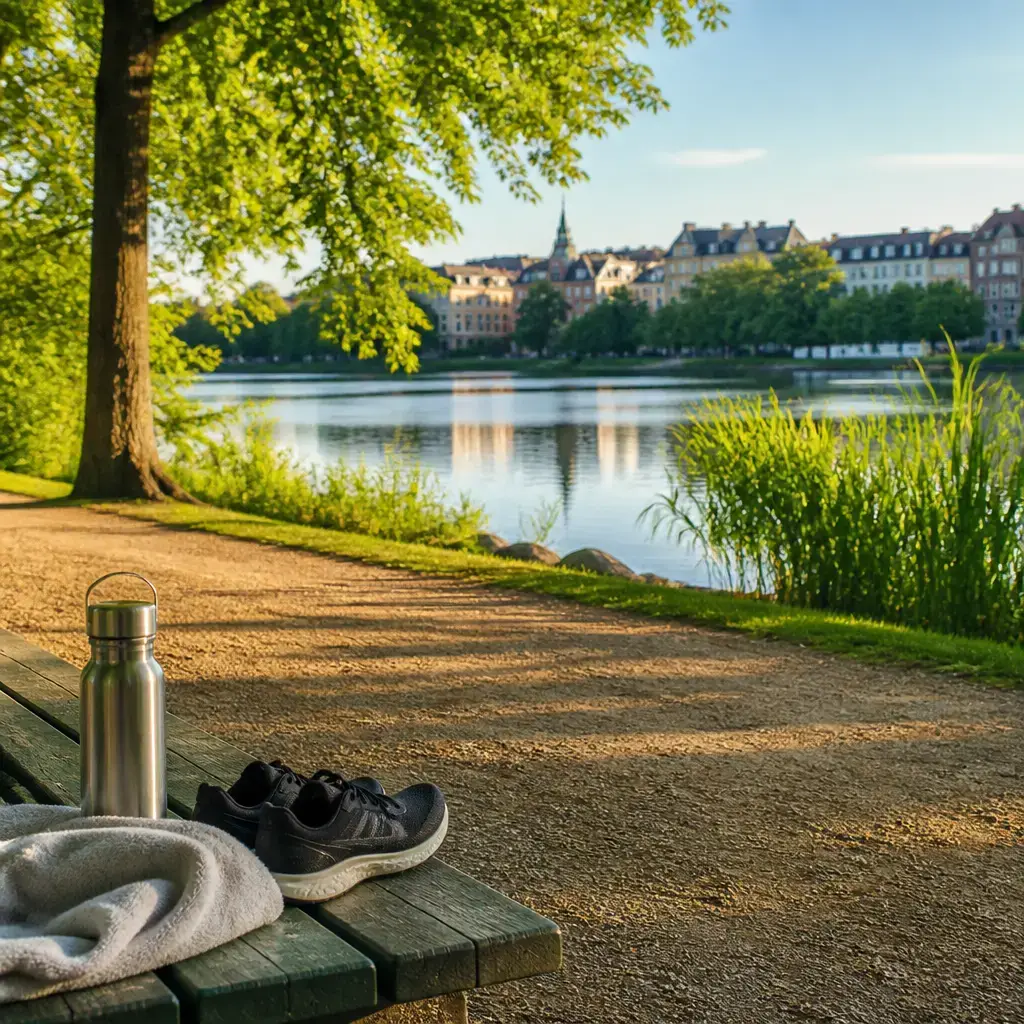
Use Jogging as a Hobby to practice Danish conversation, pronunciation, vocabulary, grammar, and quizzes.
Dialogue
Jeg begyndte at jogge efter arbejde.
yai beh-GUHN-də ad YAW-gə EF-tər AH-bigh-də. I started jogging after work.Hvordan går det indtil videre?
VOH-dan gore deh en-TEEL VEE-thə? How is it going so far?Mit tempo er langsomt, men jeg bliver bedre.
mehd TEM-poh air LAHNG-soom(d), men yai BLEE-və BEH-thrə. My pace is slow, but I am improving.Har du en fast rute?
har doo ən fast ROO-də? Do you have a regular route?Jeg løber normalt rundt i parken.
yai LUH-bə NOR-malt roont ee PAR-gən. I usually run around the park.Hvilket mål arbejder du hen imod?
VIL-gəth mawl AH-bigh-thə doo hen ee-MOH? What goal are you working toward?Jeg vil gerne jogge uden at stoppe.
yai vel GAIR-nə YAW-gə OO-thən ad STUH-bə. I want to jog without stopping.Det er realistisk, hvis du bygger langsomt op.
day air ray-ah-LEES-disk, ves doo BÜG-gə LAHNG-soom(d) ob. That is realistic if you build up slowly.Sentence explanations
Jeg begyndte at jogge efter arbejde.
I started jogging after work.
- Jeg
- I
- begyndte
- started; began
- at jogge
- to jog
- efter
- after
- arbejde
- work
More detail
Jeg means “I” here and functions as the subject. Danish uses jeg for a first-person singular subject; it does not change for the gender of the person speaking. Example: Jeg arbejder. — “I work.” begyndte is the past-tense form of begynde, “to begin/start.” The form places the starting event in the past. A useful pattern is begynde at + an infinitive: Jeg begyndte at læse. — “I started reading.” at jogge means “to jog.” Here, at marks the infinitive, and jogge is the infinitive form of the verb. In the pattern begyndte at jogge, it names the activity that began. Example: Hun begyndte at svømme. — “She started swimming.” efter means “after” when it places one event or time in relation to another. It can be followed by a noun phrase: efter mødet — “after the meeting.” arbejde means “work” here, referring to work as an activity or work period rather than identifying a particular named person. In efter arbejde, Danish uses the noun without an article in this general time expression. Example: Vi mødes efter arbejde. — “We meet after work.” Together, Jeg begyndte at jogge means “I started jogging,” and efter arbejde specifies when this happened: “after work.” The complete utterance is therefore “I started jogging after work.”
Hvordan går det indtil videre?
How is it going so far?
- Hvordan går det
- How is it going?
- indtil videre
- so far
More detail
Hvordan går det is the fixed Danish question pattern meaning “How is it going?” Here, hvordan asks about the manner or state of a situation, while går is the present form of gå (“to go”). In this pattern, gå describes how a situation is progressing, not physical movement. Det is a neutral pronoun referring to the situation as a whole; the sentence does not identify a more specific grammatical noun for it. A useful contrast is: Hvordan går det? — “How is it going?” Hvordan går det med arbejdet? — “How is the work going?” The second version names the area being asked about with med; the fixed sentence leaves that area understood from context. indtil videre is a reusable time phrase meaning “so far” or “up to now.” Indtil means “until,” and videre contributes the idea of continuing onward, but together they function as one temporal expression. It limits the question to the progress made up to the present rather than asking about the eventual outcome. Example: Det går godt indtil videre. — “It is going well so far.” This example uses the same progress pattern and adds godt (“well”); it is a new practice sentence, not a claim about the supplied conversation. Together, Hvordan går det asks about the current progress or state of a situation, and indtil videre specifies the time span: “How is it going so far?”
Mit tempo er langsomt, men jeg bliver bedre.
My pace is slow, but I am improving.
- Mit
- my
- tempo
- pace
- langsomt
- slow
- bliver
- get; become
- bedre
- better
More detail
Mit means “my” here and is the possessive form used with a singular neuter noun. Danish contrasts min with common-gender singular nouns, mit with neuter singular nouns, and mine with plural nouns. The form agrees with the possessed noun, not with the possessor. tempo means “pace” in this sentence. It is a neuter noun, which is why the sentence uses mit and the neuter adjective form langsomt. Example: et højt tempo means “a high pace”; the noun remains the same while the adjective matches its neuter noun phrase. langsomt means “slow” here. It is the neuter form of langsom, used with the neuter noun tempo. With a common-gender noun, the corresponding form is langsom, while plural forms also use langsomme. Example: en langsom rute means “a slow route.” The word er between the selected entries is the present form of være, “to be.” It links the subject to its description: Mit tempo er langsomt literally presents the pace as slow. Danish uses er for a present state or description; it is different from bliver, which presents a change or development. bliver is the present form of blive, “become” or “get.” In this sentence it introduces a change in the speaker’s condition: “I am getting …” or “I am becoming …” It is not the ordinary word for simply being in a state; that role is shown by er earlier in the sentence. Example: Det bliver koldt means “It is getting cold.” bedre means “better” here. It is the comparative form associated with god (“good”): god → bedre → bedst (“best”). In bliver bedre, the comparative describes improvement, without specifying what the pace is being compared with. Example: Jeg bliver bedre til dansk means “I am getting better at Danish.” The first part, Mit tempo er langsomt, says that the speaker’s pace is slow: mit marks possession, tempo is the subject noun, er states its current condition, and langsomt describes that neuter noun. The conjunction men means “but” and contrasts this with jeg bliver bedre, “I am getting better.” Together, the utterance means: “My pace is slow, but I am improving.”
Har du en fast rute?
Do you have a regular route?
- Har du
- do you have
- fast
- regular
- rute
- route
More detail
Har du is a reusable Danish way to ask “do you have…?” har is the present-tense form of have, and du means “you.” Danish forms this yes/no question by placing the verb before the subject: Har du en plan? — “Do you have a plan?” fast means “regular” here: the route is one the speaker has as an established or usual route. The same word can also mean “fixed” or “firm,” depending on context. Its form is fast with a singular common-gender noun; with a plural noun it becomes faste, as in faste ruter — “regular routes.” rute means “route.” It is a common-gender noun: en rute is “a route,” ruten is “the route,” and ruter is “routes.” The indefinite article en marks a singular common-gender noun; here it does not by itself assert a numerical count. Together, Har du + en fast rute asks whether the addressee has a regular route. The adjective fast describes rute, and the complete meaning is “Do you have a regular route?”
Jeg løber normalt rundt i parken.
I usually run around the park.
- Jeg
- I
- løber
- run
- normalt
- usually
- rundt i
- around, throughout
- parken
- the park
More detail
Jeg means “I” here: it is the first-person singular subject pronoun. It identifies the speaker as the person doing the action. A useful contrast is du for “you” when addressing one person. Example: Jeg arbejder. — “I work.” løber is the present-tense form of løbe, “to run.” Danish present forms are used for an action happening now or as a regular activity; here, normalt makes the activity habitual. Example: Jeg løber hver dag. — “I run every day.” normalt means “usually” and describes how often the running happens. It is an adverb, so it modifies the action rather than naming or describing a person or thing. Example: Hun kommer normalt tidligt. — “She usually arrives early.” rundt i combines rundt, “around,” with i, “in,” to express movement around within an area. In this sentence, it presents the running as taking place around the park, rather than naming a specific route. Example: Vi går rundt i byen. — “We walk around the city.” parken means “the park.” The base noun is park; parken is its singular definite form, meaning “the park.” Danish commonly marks definiteness by adding an ending to the noun rather than using a separate word before it. Example: Jeg ser parken. — “I see the park.” Together, Jeg løber normalt rundt i parken. means “I usually run around the park.” The subject is Jeg (“I”), løber says that the speaker runs, normalt makes this a usual or regular activity, and rundt i parken gives the location and movement: around within the park. The sentence is a straightforward statement about the speaker’s routine.
Hvilket mål arbejder du hen imod?
What goal are you working toward?
- Hvilket
- which
- mål
- goal
- arbejder
- work
- du
- you
- hen imod
- toward
More detail
Hvilket means “which” here. It is the neuter singular form of the Danish question word hvilken, agreeing with mål, which is a neuter noun (et mål). Compare hvilken with common-gender singular nouns and hvilke with plural nouns. Example: Hvilket hus? — “Which house?” mål means “goal” here. Its base form is mål; the indefinite singular is et mål, and the definite singular is målet. The word can also mean a target or an aim in other contexts, but “goal” is the intended sense in this sentence. arbejder is the present-tense form of arbejde, “to work.” Danish present-tense verbs generally do not change for person or number: jeg arbejder, du arbejder, and de arbejder. Example: Jeg arbejder hjemme. — “I work at home.” du is the subject pronoun “you” for one person. It is used for all genders; Danish does not use separate masculine and feminine forms for this pronoun. Example: Du arbejder. — “You work.” hen imod is a two-word prepositional expression meaning “toward.” Here it expresses the direction or aim of the work: working toward a goal. Together, Hvilket mål asks about the goal, and arbejder du hen imod asks what goal the person is working toward. The complete utterance is therefore: “What goal are you working toward?” The question uses the present-tense verb arbejder and Danish question-word order, with the verb before the subject: Hvilket mål arbejder du ....
Jeg vil gerne jogge uden at stoppe.
I want to jog without stopping.
- Jeg vil gerne
- I would like to
- jogge
- jog
- uden at
- without
- stoppe
- stop
More detail
Jeg vil gerne means “I would like to” here. vil is the present-tense form of ville, used with a subject to express a desire or intention; gerne makes the expression a willing or polite formulation. A useful pattern is Jeg vil gerne + infinitive: Jeg vil gerne læse. — “I would like to read.” jogge is the infinitive “to jog.” In Danish, an infinitive commonly follows vil gerne, and it does not take a person ending here. The same form can be reused with another subject: Hun vil gerne jogge. — “She would like to jog.” uden at introduces an action that does not happen: “without …-ing.” It is followed here by an infinitive, so the reusable pattern is uden at + infinitive. For example, Han gik uden at sige noget. — “He left without saying anything.” stoppe is the infinitive “to stop.” In this sentence it names the action that is avoided. Its present-tense form is stopper: Jeg stopper. — “I stop.” The infinitive is required after uden at in the pattern used here. Together, Jeg vil gerne expresses the speaker’s wish, jogge states the desired activity, and uden at stoppe adds the condition that the activity should continue without stopping. The complete meaning is: “I want to jog without stopping.”
Det er realistisk, hvis du bygger langsomt op.
That is realistic if you build up slowly.
- Det er
- That is
- realistisk
- realistic
- hvis
- if
- bygger … op
- build up
- langsomt
- slowly
More detail
Det er means “that is” here. Det is the third-person singular pronoun used for the stated “that”; er is the present form of være (“to be”). Danish er is used with all persons in the present: jeg er (“I am”), du er (“you are”), and det er (“it/that is”). realistisk means “realistic”. It is an adjective. The same form is used with a common-gender singular noun and a neuter singular noun; for example, en realistisk plan means “a realistic plan”, while et realistisk mål means “a realistic goal”. hvis introduces a condition and means “if”. It connects a condition with what is realistic. A reusable pattern is hvis + clause: Hvis du træner regelmæssigt, bliver det lettere. — “If you train regularly, it becomes easier.” bygger is the present form of bygge, “to build”. In this sentence it describes what du (“you”) do under the condition. Danish present-tense verbs do not change according to the subject: jeg bygger means “I build” and du bygger means “you build”. op is a particle meaning “up” in the construction bygge ... op. Together, bygge op means “build up” or “increase gradually”. The particle can be separated from the verb by an adverb, as here: bygger langsomt op. langsomt means “slowly” here and describes the manner of building up. It is the adverb related to the adjective langsom (“slow”). Compare Han går langsomt. — “He walks slowly.” The sentence first states Det er realistisk (“That is realistic”). The conditional clause hvis du bygger langsomt op then specifies the condition: “if you build up slowly”. Together, the utterance means “That is realistic if you build up slowly.”
Grammar Points
uden at + infinitiv
uden at stoppe
OO-thən ad STUH-bəwithout stopping
Use uden at before an infinitive to express that an action does not happen.
hvis + sætning
hvis tempoet bliver bedre
ves TEM-poh-ət BLEE-və BEH-thrəif the pace improves
Use hvis to introduce a condition; the following clause describes what must happen first.
Danish Vocabulary
Quiz
Word Order
Arrange the words in the correct order.
I started jogging after work.
Show Answer
Jeg begyndte at jogge efter arbejde.How is it going so far?
Show Answer
Hvordan går det indtil videre?Do you have a regular route?
Show Answer
Har du en fast rute?Spelling
Tap the letters to spell the word.
to start
Show Answer
begyndteto jog
Show Answer
joggebetter
Show Answer
bedrepace