10 minutes free every day
Continue audio lessons in the app
Word explanations appear automatically in sync with the audio.
No login required · synced translations · playback with the screen locked
Choose your learning language and open this lesson in the app.

About This Lesson
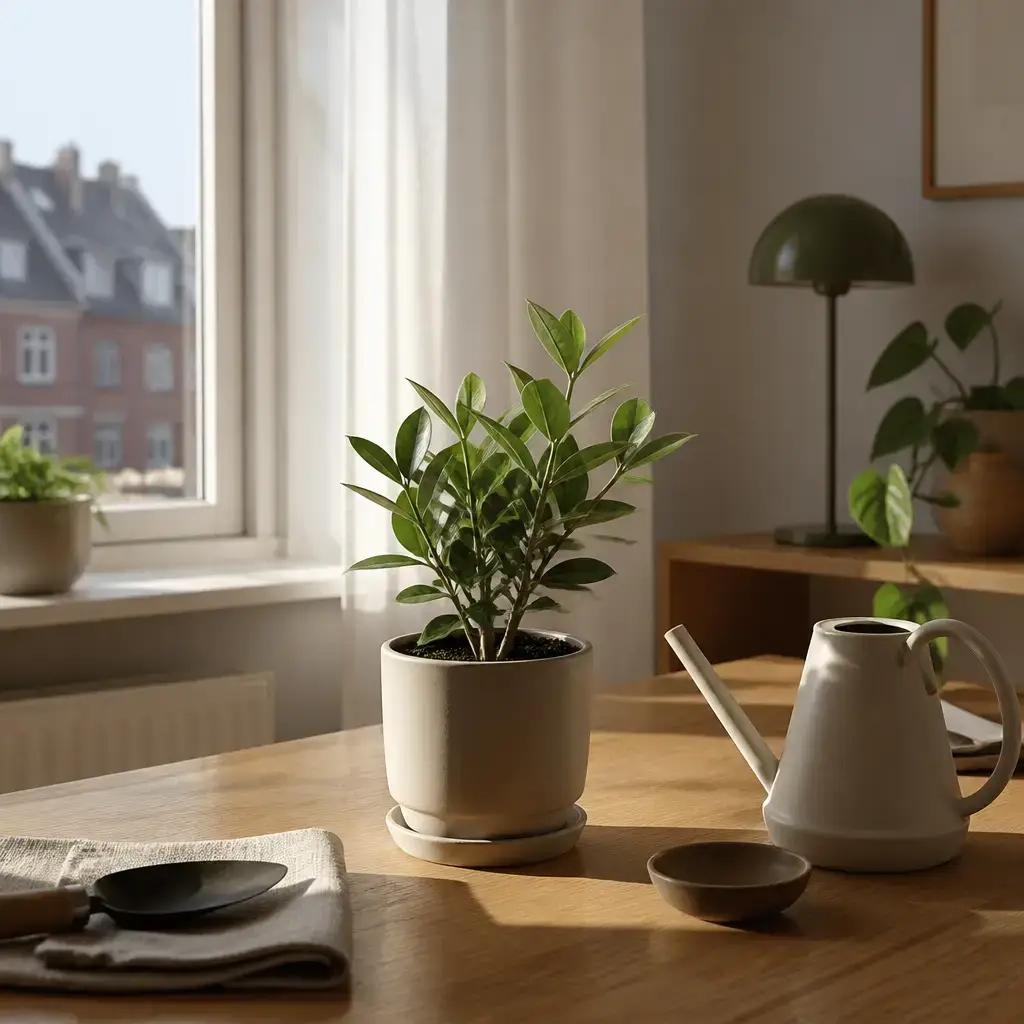
Use Caring for a small room plant to practice Danish conversation, pronunciation, vocabulary, grammar, and quizzes.
Dialogue
Jeg købte en lille plante til mit værelse.
yai KURB-duh en LEL-uh PLAN-duh teel meet VEH-ruh-lsuh I bought a small plant for my room.Har den brug for meget sollys?
hah den broo foh MYE-uhd SOHL-looss Does it need much sunlight?På mærket står der, at den bedst kan lide indirekte lys.
poh MAIR-guhd stoh dair, ad den best kan LEE-thuh en-DEE-rek-duh looss The label says it likes indirect light.Så stil den tæt på vinduet, ikke udenfor.
soh steel den TEHD poh VEN-oo-uh, EG-uh OO-uhn-fohr Then keep it near the window, not outside.Hvor ofte skal jeg vande jorden?
vohr AWF-duh skel yai VAN-uh YOHN How often should I water the soil?Tjek jorden to gange om ugen, før du vander den.
chek YOHN toh SANG-uh om OO-uhn, fur doo VAN-uh den Check it twice a week before watering.Jeg håber, at den vokser godt her.
yai HOH-buh, ad den VOG-suh gohd hair I hope it grows well here.Det skulle den gerne, så længe du ikke vander den for meget.
deh SKOOL-uh den GAIR-nuh, soh LENG-uh doo EG-uh VAN-uh den foh MYE-uhd It should, as long as you do not water it too much.Sentence explanations
Jeg købte en lille plante til mit værelse.
I bought a small plant for my room.
- Jeg
- I
- købte
- bought
- en
- a/an
- lille
- small
- plante
- plant
- til
- for
- mit
- my
- værelse
- room
More detail
Jeg is the subject form meaning “I.” The corresponding object form is mig: for example, Hun ser mig means “She sees me.” købte is the past-tense form of købe, “to buy.” Danish uses this same past form with different subjects: Jeg købte means “I bought,” while De købte means “They bought.” en is the indefinite article used here with the common-gender singular noun plante. It introduces an unspecified plant; by itself, it does not assert a numerical count. Danish also has et for neuter-gender singular nouns, as in et værelse (“a room”). lille means “small” here and describes plante. Its useful comparison chain is lille (“small”), mindre (“smaller”), mindst (“smallest”). With a plural noun, the related form is små, as in the example små planter (“small plants”). plante means “plant.” It is a common-gender noun: en plante; its indefinite plural is planter, and its definite singular is planten (“the plant”). til marks the intended destination or purpose here, so til mit værelse means “for my room.” It can also express movement toward a destination, as in the example Vi går til stationen (“We are walking to the station”). mit is the possessive form meaning “my” used with a neuter singular noun. Compare min with a common-gender singular noun and mine with a plural noun: min plante (“my plant”), mit værelse (“my room”), mine planter (“my plants”). The form agrees with the possessed noun, not with the possessor. værelse means “room.” It is a neuter-gender noun: et værelse; its definite singular is værelset, and its plural is værelser. Together, Jeg købte says “I bought,” en lille plante says “a small plant,” and til mit værelse specifies that the plant was intended for the speaker’s room. The complete meaning is: “I bought a small plant for my room.”
Har den brug for meget sollys?
Does it need much sunlight?
- Har den brug for
- does it need
- meget
- much
- sollys
- sunlight
More detail
Har den brug for is the Danish construction at have brug for (“to need”). Here har is the present-tense form of have, and the yes/no question places the finite verb before the subject: Har den ...? means “Does it ...?” The pronoun den refers here to the plant identified in the preceding sentence. In a different context, den can refer to another suitable non-person referent. meget means “much” before the uncountable noun sollys. It expresses a large amount, not a definite number. Compare meget lys (“much light”) with mange planter (“many plants”), where mange is used with countable plural nouns. sollys means “sunlight” and is a compound noun: sol (“sun”) + lys (“light”). It is treated as an uncountable substance here, so meget is appropriate. The word can be reused in expressions such as direkte sollys (“direct sunlight”) and indirekte lys (“indirect light”). Together, Har den brug for meget sollys? asks whether the plant needs a large amount of sunlight: “Does it need much sunlight?”`
På mærket står der, at den bedst kan lide indirekte lys.
The label says it likes indirect light.
- mærket
- the label
- står der
- it says / is stated
- den
- it
- bedst
- best / most
- kan lide
- likes
- indirekte
- indirect
- lys
- light
More detail
mærket is the definite singular form of mærke, meaning “the label.” Danish commonly marks definiteness by an ending: et mærke means “a label,” while mærket means “the label.” Here it is part of på mærket, “on the label.” står der is a fixed impersonal way to report written information: “it says” or “it is stated.” Literally, it uses står (“stands”) with der (“there”), but together they refer to text being present on a surface, not to a person speaking. For example, Der står “lukket” på døren. means “The door says ‘closed’” or more naturally “It says ‘closed’ on the door.” den is a singular common-gender pronoun. In this utterance, the fixed translation identifies it as “it,” referring to the subject whose light needs are being discussed. Danish uses den for a singular common-gender noun or an entity referred to with that grammatical class; det is the corresponding neuter form. The pronoun itself does not identify the specific entity independently. bedst is the superlative form related to godt (“well” or “good” in the relevant form). In bedst kan lide, it adds a preference meaning: “likes ... best,” rather than simply “likes.” A useful comparison is godt “well,” bedre “better,” bedst “best.” kan lide is the reusable Danish construction for “like.” It consists of present-tense kan (“can”) plus lide (“like” in this construction), but it is learned as the unit kan lide; it does not mean physical ability here. For example, Jeg kan lide te. means “I like tea.” With the third-person subject den, the construction remains kan lide; Danish does not add a separate present-tense ending here. indirekte means “indirect.” It is an adjective describing the kind of light. Danish adjectives can have different forms depending on the noun and construction, but indirekte has this same form with both common-gender and neuter singular nouns. For example, indirekte varme means “indirect heat.” lys means “light.” In this sentence it is a mass-like, indefinite noun after indirekte: indirekte lys, “indirect light.” Danish also uses lys in other contexts for “light” as opposed to darkness; the adjective and surrounding phrase specify the intended kind here. Together, På mærket means “on the label,” and står der reports the information written there. The subordinate clause introduced by at states what the label says: den is the subject, bedst kan lide expresses its strongest preference, and indirekte lys is what it prefers. The whole utterance therefore means: “The label says it likes indirect light.”
Så stil den tæt på vinduet, ikke udenfor.
Then keep it near the window, not outside.
- Så
- then
- stil
- place; keep
- den
- it
- tæt på
- near
- vinduet
- the window
- ikke udenfor
- not outside
More detail
Så means “then” here and introduces the next instruction. Danish så can also have other functions, such as “so,” but this sentence uses it to mean “then.” stil is the imperative of stille, “to place” or “to put.” The imperative addresses the listener directly and has no written subject. A reusable pattern is Stil X ... — “Place X ...”. den is a singular common-gender pronoun meaning “it” here. The fixed translation supports an object referent, but the supplied material does not uniquely identify what that referent is. Danish uses den for a singular common-gender noun and det for a singular neuter noun; the choice follows the grammatical gender of the noun being referred to. tæt på is a prepositional expression meaning “near” or “close to.” It introduces the place where something should be positioned. Example: Bogen ligger tæt på døren. — “The book is near the door.” vinduet means “the window.” Its indefinite form is vindue, and its definite singular form is vinduet; the ending -et marks a neuter noun in the definite singular. et vindue means “a window,” while vinduet means “the window.” ikke udenfor means “not outside.” ikke supplies the negation, while udenfor is an adverb meaning “outside.” Together they exclude the outside location. udenfor can stand by itself when the location is understood. Together, stil den tæt på vinduet means “place it near the window.” Adding ikke udenfor contrasts that location with being outside, producing the whole meaning: “Then keep it near the window, not outside.”
Hvor ofte skal jeg vande jorden?
How often should I water the soil?
- Hvor ofte
- how often
- skal jeg
- should I
- vande
- water
- jorden
- the soil
More detail
Hvor ofte asks about frequency: “how often.” Hvor means “how,” and ofte means “often.” This pattern can be reused with other actions, for example: Hvor ofte læser du? — “How often do you read?” skal jeg combines skal, the present form of skulle, with jeg, “I.” In this sentence, skal expresses guidance or a recommendation, translated as “should,” while jeg identifies the person who will perform the action. Danish skal can also express obligation or a future arrangement in other contexts, so the surrounding meaning determines its force. After a modal such as skal, the following verb is normally in the infinitive. vande means “to water.” It is the infinitive form; the form does not show the subject here, because skal carries the finite verb function. For example: Jeg skal vande planten. — “I should water the plant.” jorden means “the soil.” Its base form is jord, “soil,” and jorden is the definite singular form, marked by the ending -en; the ending is part of the word rather than a separate word before it. For example: Jorden er tør. — “The soil is dry.” Together, Hvor ofte asks for a frequency, skal jeg vande asks how often the speaker should perform the action, and jorden identifies what is watered. The complete meaning is: “How often should I water the soil?”
Tjek jorden to gange om ugen, før du vander den.
Check it twice a week before watering.
- Tjek
- check
- jorden
- the soil
- to gange
- twice
- om ugen
- per week
- før
- before
- du
- you
- vander
- water
- den
- it
More detail
Tjek is the imperative of tjekke, “to check.” It gives a direct instruction to one or more listeners; the form itself does not show the number of people addressed. Example: Tjek døren. — “Check the door.” jorden means “the soil” here. Its base noun is jord, and -en marks the definite singular form: jord “soil” → jorden “the soil.” The definite form presents the soil as identifiable in this context. to gange means “twice,” literally expressing two occasions. gang means “time” or “occasion” in this counting use, and to is the number two. Example: Læs det to gange. — “Read it twice.” om ugen means “per week” or “each week.” ugen is the definite form of uge, “week”; the expression om ugen is a recurring frequency pattern. Example: Jeg træner tre gange om ugen. — “I exercise three times a week.” før introduces the event that must happen earlier: “before.” It can introduce a clause with its own subject and verb, as in før du går — “before you leave.” du is the second-person singular subject pronoun, “you.” It is the subject of the clause after før; Danish uses du when addressing one person informally or neutrally. vander is the present-tense form of vande, “to water.” The present form can describe an action that is to take place in the relevant sequence, so før du vander means “before you water.” In Danish, vander does not change for the subject: jeg vander, du vander, and de vander all use vander in the present tense. den means “it” here and refers to the soil identified by jorden. It is a third-person singular common-gender object pronoun; its form is chosen by the grammatical gender and number of the noun it replaces, not by the person doing the action. The object pronoun follows vander, so vander den means “water it.” Together, Tjek jorden gives the instruction “Check the soil.” to gange om ugen specifies the frequency, producing “twice a week.” The clause før du vander den adds the required order: first check the soil, and afterward water it. The complete meaning is: “Check the soil twice a week before you water it.”
Jeg håber, at den vokser godt her.
I hope it grows well here.
- Jeg håber
- I hope
- den
- it
- vokser
- grows
- godt
- well
- her
- here
More detail
Jeg håber means “I hope” here. Jeg is the first-person singular subject, and håber is the present-tense form of håbe (“to hope”). Danish present-tense verbs generally do not change for person or number: jeg håber, du håber, and de håber. Example: Jeg håber, du kommer. — “I hope you come.” den is a Danish third-person singular pronoun meaning “it” here. Its form is used for a common-gender singular referent; the pronoun’s grammatical form does not by itself identify exactly which thing is meant. Example: Jeg ser planten. Jeg vander den. — “I see the plant. I water it.” vokser means “grows” here and is the present-tense form of vokse (“to grow”). Like håber, it normally has the same present form with different subjects: jeg vokser, den vokser, de vokser. Example: Planten vokser hurtigt. — “The plant grows quickly.” godt means “well” here. It is the adverbial form used to describe how the growing happens. Do not treat this occurrence as an adjective modifying a noun: the adjective god means “good,” while godt can also be its neuter form, but here it functions as an adverb. Example: Det fungerer godt. — “It works well.” her means “here” and indicates the relevant place. It is an adverb and does not change according to the thing referred to. Example: Den vokser godt her. — “It grows well here.” Together, Jeg håber introduces the speaker’s hope, and the clause at den vokser godt her states what that hope concerns: that it grows well in this place. The whole utterance therefore means “I hope it grows well here.”
Det skulle den gerne, så længe du ikke vander den for meget.
It should, as long as you do not water it too much.
- Det
- it
- skulle … gerne
- should
- den
- it
- så længe
- as long as
- du
- you
- ikke
- not
- vander
- water
- for meget
- too much
More detail
Det is the first pronoun in the sentence. Here it presents the expected result expressed by the fixed meaning: “it should.” Danish det is a neuter singular pronoun, and it can also refer to a situation or result rather than to a specifically named noun. skulle gerne expresses an expectation: “should” or “is expected to.” skulle is the form of the modal verb skulle; skal is its present-tense counterpart. In this construction, skulle expresses an expected or reasonably likely result rather than simply a past event. Together, X skulle gerne ... is a useful pattern meaning “X should ...” or “X is expected to ...”. den is a common-gender singular pronoun. In the supplied context, it refers to the same not-explicitly-named entity previously referred to by den; the data does not identify that entity by a noun. Danish uses den for a common-gender singular referent, whereas det is used for a neuter singular referent or for some non-noun situations. Example: Jeg vander planten, fordi den vokser. — “I water the plant because it is growing.” så længe is a conjunction meaning “as long as.” It introduces the condition that limits the expectation. Example: Du kan blive her, så længe du er stille. — “You can stay here as long as you are quiet.” du is the second-person singular pronoun, “you.” It is the subject of the subordinate clause. Danish uses du for one person, and the present-tense verb does not change here to mark the person. ikke marks negation. In du ikke vander ..., it helps form the meaning “you do not water ...”. In this subordinate clause, it appears before the lexical verb vander. vander is the present-tense form of vande, “to water.” Danish present-tense verbs generally do not change according to the subject. Example: Du vander planten hver dag. — “You water the plant every day.” for meget means “too much.” In this sentence it describes excessive watering: for meget means more than is suitable. Compare meget, “much/a lot,” with for meget, “too much.” Example: Hun arbejder meget, men ikke for meget. — “She works a lot, but not too much.” Taken together, Det skulle den gerne gives the expected result, “It should,” with den referring to the same entity as the earlier den. så længe du ikke vander den for meget adds the condition “as long as you do not water it too much.” The complete meaning is therefore: “It should, as long as you do not water it too much.”
Grammar Points
have brug for + substantiv
Har den brug for sollys?
hah den broo foh SOHL-loossDoes it need sunlight?
Danish expresses “need” with have brug for, literally “have use for.”
så længe + sætning
Så længe du ikke vander den for meget, vokser den.
soh LENG-uh doo EG-uh VAN-uh den foh MYE-uhd, VOG-suh denAs long as you do not water it too much, it grows.
Så længe introduces a condition: the main action happens as long as this condition is true.
Danish Vocabulary
den bedst kan lide indirekte lys
Har den brug for meget sollys?
indirekte lys
Jeg købte en lille plante
- Gender
- neuter
indirekte lys
- Gender
- common
På mærket står der
- Gender
- common
en lille plante
- Gender
- neuter
meget sollys
På mærket står der
tæt på vinduet
- Gender
- neuter
tæt på vinduet
- Gender
- neuter
mit værelse
Quiz
Word Order
Arrange the words in the correct order.
Does it need much sunlight?
Show Answer
Har den brug for meget sollys?How often should I water the soil?
Show Answer
Hvor ofte skal jeg vande jorden?Spelling
Tap the letters to spell the word.
buy
Show Answer
købteindirect
Show Answer
indirektelabel
Show Answer
mærketsay; stand