10 minutes free every day
Continue audio lessons in the app
Word explanations appear automatically in sync with the audio.
No login required · synced translations · playback with the screen locked
Choose your learning language and open this lesson in the app.

About This Lesson
Use Checking the Correct Line to practice Danish conversation, pronunciation, vocabulary, grammar, and quizzes.
Dialogue
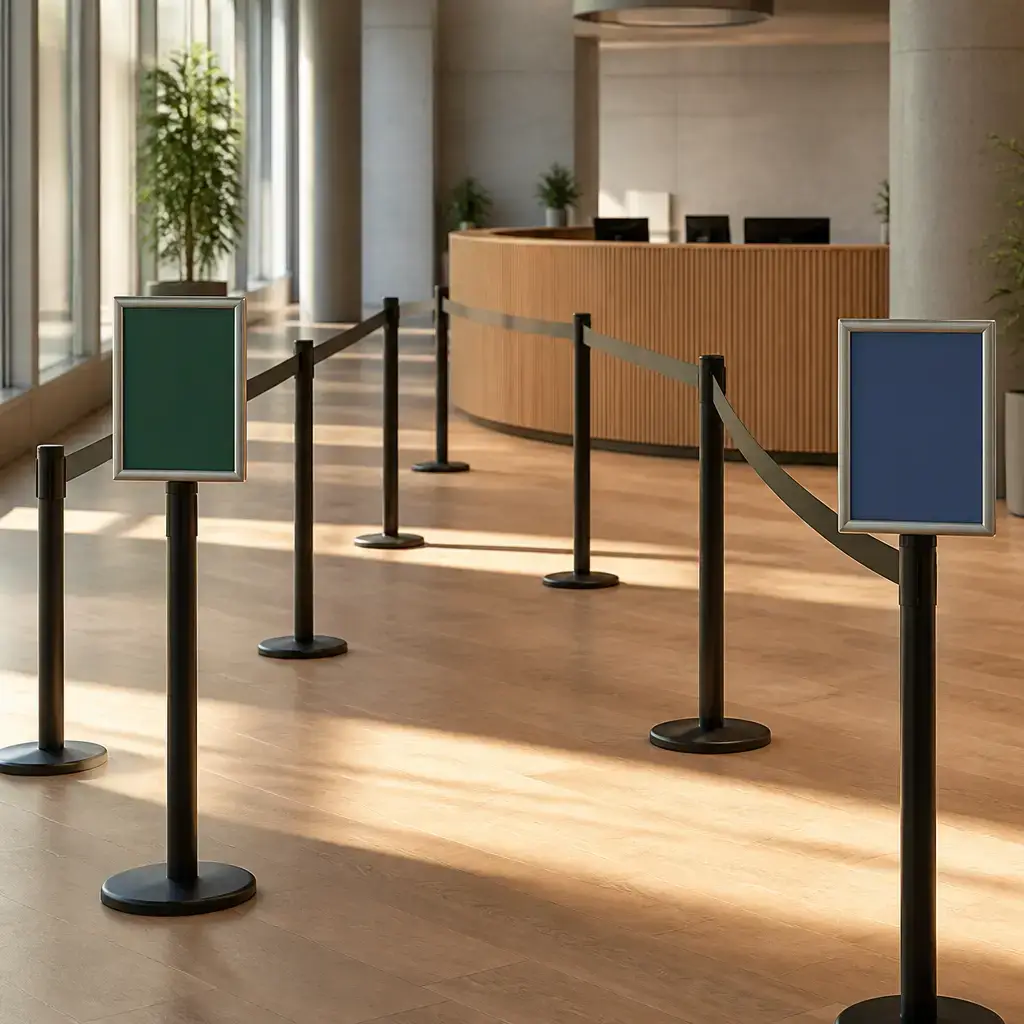
Undskyld, er det den rigtige kø?
oon-SGOOL, air deh den REK-dee-guh kuh? Excuse me, is this the right line?Denne kø er til informationsskranken.
DEN-uh kuh air teel in-for-mah-SHOHNS-sgran-kuhn. This queue is for the information desk.Jeg skal forny mit medlemskort.
yai sgel for-NEW med MED-lemz-kohd. I need to renew my membership card.Så skal du stille dig i køen ved det blå skilt.
soh sgel doo STIL-uh dye ee KUH-uhn veh deh bloh SGEELT. Then you should join the line by the blue sign.Jeg var næsten kommet til at vente det forkerte sted.
yai vah NES-den KOM-uhd teel ed VEN-duh deh FOR-KAIR-duh sdeh. I almost waited in the wrong place.Det er forvirrende, fordi begge køer er tæt på hinanden.
deh air for-VEER-uh-nuh, for-THEE BEG-uh KUH-er air tehd poh hee-NAH-nun. It is confusing because both lines are close.Jeg flytter mig, før der kommer flere mennesker.
yai FLUH-dur my, fur dair KOM-uh FLAY-er MEN-uh-sgur. I'll move before more people arrive.Den kø er kortere nu.
den kuh air KOR-duh-ruh noo. That line is shorter now.Sentence explanations
Undskyld, er det den rigtige kø?
Excuse me, is this the right line?
- Undskyld
- Excuse me
- er det
- is it
- rigtige
- right; correct
- kø
- queue; line
More detail
Undskyld is a polite way to get someone's attention or say “Excuse me.” It is also the imperative form of undskylde (“to excuse/apologize”), but here it functions as a brief politeness formula rather than a full apology. er det places the verb before the subject-like pronoun in this yes/no question. Er is the present form of være (“to be”); det means “it” or “that” and is not identified with a more specific referent by the sentence itself. The reusable question pattern is er det ...? (“is it ...?”). For example: Er det åbent? — “Is it open?” rigtige means “right” or “correct” here. Its base form is rigtig. Danish adjective forms include rigtig with an indefinite common-gender singular noun, rigtigt with an indefinite neuter singular noun, and rigtige with a definite noun or with a plural noun. In den rigtige kø, rigtige is the definite form because den and the noun phrase identify a particular line. This is the adjective's form; kø is not its base form. kø means “queue” or “line” in this sentence. It is a common-gender noun: en kø (“a queue”) and køen (“the queue”). The noun phrase den rigtige kø therefore means “the right queue/line”: den marks the particular common-gender noun phrase, while rigtige describes it. Together, er det + den rigtige kø asks whether the particular line being referred to is the correct one. With the opening politeness formula, Undskyld, er det den rigtige kø? means “Excuse me, is this the right line?”
Denne kø er til informationsskranken.
This queue is for the information desk.
- Denne
- this
- kø
- queue; line
- er til
- is for
- informationsskranken
- information desk
More detail
Denne means “this” here and agrees with the noun kø: kø is a common-gender singular noun, so the form is denne. Compare dette with a singular neuter noun and disse with a plural noun. Example: Denne bog er ny. — “This book is new.” kø means “queue” or “line.” Its plural is køer: en kø — “a queue”; flere køer — “several queues.” In this sentence it refers to the queue being identified, without adding information about its size or number of people. er til is the reusable pattern “is for” when something is intended for a purpose, destination, or group. Er is the present form of være (“to be”), and til is the preposition that gives the intended use here. Example: Dette rum er til møder. — “This room is for meetings.” informationsskranken means “the information desk.” It is a compound built from information and skranke (“desk” or “counter”); the definite ending is attached to the final part: informationsskranke → informationsskranken. The source form is definite, so it identifies an information desk as a particular desk in the situation. Together, Denne kø means “this queue,” and er til informationsskranken says that the queue is intended for the information desk. The complete meaning is: “This queue is for the information desk.”
Jeg skal forny mit medlemskort.
I need to renew my membership card.
- Jeg skal
- I need to
- forny
- renew
- mit
- my
- medlemskort
- membership card
More detail
Jeg skal combines the pronoun jeg (“I”) with skal, the present form of skulle. In this sentence, skal expresses a need or requirement, so Jeg skal ... is a reusable way to say “I need to ...” in this context. It can also express an obligation or a planned action in other contexts. Example: Jeg skal arbejde. — “I need to work” or “I have to work,” depending on the situation. forny means “renew” here. It is the infinitive form used after skal; the pattern is skal + infinitive, as in skal forny. The verb is forny, not a form derived from the noun medlemskort. Example: Jeg skal forny mit pas. — “I need to renew my passport.” mit means “my” before a singular noun of the et type. The noun medlemskort is an et-word, so the possessive form is mit: mit medlemskort. With a singular en-word, the corresponding form is min, as in min billet (“my ticket”); with plural nouns, Danish uses mine, as in mine kort (“my cards”). These forms agree with the possessed noun, not with the possessor jeg. medlemskort means “membership card.” It is a compound noun: medlem means “member,” and kort means “card,” but the complete compound is the useful form for this meaning. Its indefinite form is et medlemskort, while its definite form is medlemskortet (“the membership card”). Example: Jeg har et medlemskort. — “I have a membership card.” Together, Jeg skal + forny gives “I need to renew,” and mit medlemskort identifies what must be renewed: “my membership card.” The complete utterance therefore means “I need to renew my membership card.”
Så skal du stille dig i køen ved det blå skilt.
Then you should join the line by the blue sign.
- Så
- then
- skal du
- you should
- stille dig
- position yourself
- køen
- the line
- ved
- by
- blå
- blue
- skilt
- sign
More detail
Så means “then” here: it links this instruction to what comes before. It is a useful sequencing word; for example, Først betaler du, så går du. means “First you pay, then you leave.” skal du combines skal, the present form of skulle, with du, “you.” In this sentence, skal expresses what you are expected or advised to do, matching “should.” The reusable pattern is skal + subject + verb, as in Du skal vente. — “You should wait.” The form skal is carried by the modal verb, while du is the second-person singular pronoun. stille dig is a reflexive construction. stille means “put” or “place,” and dig is the reflexive second-person singular form, referring back to du; together here they mean “position yourself.” In stille sig i kø, the natural meaning is “join the line” or literally “place oneself in the queue.” The pronoun changes with the subject: Jeg stiller mig means “I position myself,” while du stiller dig means “you position yourself.” køen is the definite form of the noun kø, “line” or “queue.” The ending -en marks this noun as definite: en kø is “a line,” while køen is “the line.” In i køen, i means “in,” so the phrase places the person in the line. ved means “by” or “near” in this sentence. It introduces the location used to identify where the line is: ved skiltet means “by the sign.” This is different from i, which expresses being inside or within something, as in i køen. blå means “blue.” It is the color adjective modifying skilt. In Danish, blå has the same form with common- and neuter-gender singular nouns; its form here does not itself show the noun’s gender. For example, en blå bil means “a blue car,” and et blåt hus means “a blue house”; the adjective changes to blåt with a neuter indefinite noun, while the definite phrase here is det blå skilt. skilt means “sign.” It is a neuter noun: et skilt means “a sign.” In the definite noun phrase det blå skilt, det and the adjective form part of the Danish pattern for “the blue sign.” The noun remains skilt; it is not made definite by an ending in this phrase. The sentence assembles as Så (“then”) + skal du (“you should”) + stille dig i køen (“join the line”) + ved det blå skilt (“by the blue sign”). The complete meaning is: “Then you should join the line by the blue sign.”
Jeg var næsten kommet til at vente det forkerte sted.
I almost waited in the wrong place.
- Jeg var
- I was
- næsten
- almost
- kommet til at
- ended up doing
- vente
- wait
- det
- the
- forkerte
- wrong
- sted
- place
More detail
Jeg var means “I was.” Jeg is the first-person singular subject pronoun. var is the past form of være (“to be”); it is used with all persons, so the form itself does not show the subject’s number beyond the surrounding pronoun. Here it also functions as the auxiliary in var kommet. næsten means “almost” and places the event just short of happening. It modifies the following situation: the speaker did not in fact wait in that place, but came close to doing so. kommet til at is part of the reusable construction komme til at + infinitive. It describes ending up doing something, often unintentionally or as an outcome. kommet is the past participle of komme (“to come”), and var kommet is the past perfect form in this sentence. The construction is not simply physical movement; with til at and an infinitive, it can express an unintended result. For example: Jeg kom til at glemme navnet. — “I ended up forgetting the name.” vente is the infinitive of vente (“to wait”). After til at, Danish uses the infinitive: komme til at vente means “end up waiting.” In this sentence, vente names the action that the speaker almost ended up performing. det is the neuter singular definite determiner here, introducing the noun phrase “the … place.” It is not an independently specified participant; its role is to mark the following noun phrase as definite. Danish uses det with a neuter singular noun, while den is used with a common-gender singular noun. forkerte means “wrong” in its definite form. Its base form is forkert; the -e form is used in this definite adjective phrase. The form agrees with the definite noun phrase rather than expressing a plural meaning by itself. Compare et forkert sted (“a wrong place”) with det forkerte sted (“the wrong place”). sted means “place.” It is a neuter noun: et sted is “a place,” and stedet is “the place” when the noun carries the definite suffix. With an adjective, Danish uses the pattern det + adjective in definite form + noun: det forkerte sted. Together, Jeg var næsten kommet til at vente says that the speaker had nearly ended up waiting, with næsten limiting the event. det forkerte sted identifies the location as the wrong place. The complete meaning is: “I almost waited in the wrong place.”
Det er forvirrende, fordi begge køer er tæt på hinanden.
It is confusing because both lines are close.
- Det er
- it is
- forvirrende
- confusing
- fordi
- because
- begge
- both
- køer
- lines
- tæt på hinanden
- close to each other
More detail
Det er means “it is” here. Det is the Danish subject form corresponding to “it,” and er is the present-tense form of at være (“to be”). This is the useful pattern Det er + description, used when the situation itself is described rather than a specifically named object. forvirrende describes the situation as confusing. It is related to at forvirre (“to confuse”) and functions here as a predicative description after er. The form forvirrende does not show the gender or number of a noun; for example, Det er interessant means “It is interesting.” fordi introduces the reason for the statement and means “because.” It begins a subordinate clause: fordi + clause. In this clause, begge køer comes before er, as in fordi begge køer er ... (“because both lines are ...”). begge means “both” and refers to two items taken together. It is placed before the noun here: begge køer (“both lines”). Unlike an indefinite article, begge explicitly states that there are two. køer means “lines” in this context, specifically queues or lines of people. Its singular base form is kø; køer is the plural form. This word can also refer to other kinds of lines or queues depending on context, but the fixed translation identifies the intended sense here. tæt på hinanden means “close to each other.” tæt means “close” or “near,” på is part of the spatial pattern tæt på (“close to”), and hinanden is the reciprocal form used when the members of a group relate to one another. The phrase A er tæt på hinanden can be reused for two or more entities that are near one another. Together, Det er forvirrende says that the situation is confusing, and fordi begge køer er tæt på hinanden gives the reason: both lines are close to each other. The complete utterance therefore means, “It is confusing because both lines are close.”
Jeg flytter mig, før der kommer flere mennesker.
I'll move before more people arrive.
- Jeg
- I
- flytter mig
- move (myself)
- før
- before
- der kommer
- come / arrive
- flere
- more
- mennesker
- people
More detail
Jeg means “I” here, the first-person singular subject. Danish uses jeg for this role regardless of the speaker’s gender. Example: Jeg kommer. — “I am coming.” flytter mig is the reflexive construction flytte sig, “to move oneself” or “to move out of the way.” flytter is the present form of flytte; mig is the first-person reflexive/object form. Compare Jeg flytter stolen. — “I move the chair,” where the chair is moved, with Jeg flytter mig. — “I move myself.” før means “before” and introduces the event that sets the time for the main action. It can introduce a clause: før han kommer — “before he comes.” der kommer contains kommer, the present form of komme, which means “come” and means “arrive” in this sentence. der is an expletive element in the clause der kommer flere mennesker; it does not identify a particular place or person. Together, the clause means “more people arrive.” Danish present forms can also describe an expected future event, as kommer does here. flere means “more” in this sentence. It is the comparative quantity form in the chain mange (“many”) → flere (“more”) → flest (“most”). Flere mennesker therefore compares the number of people with an understood reference number; the sentence itself does not specify that number. mennesker means “people.” It is the plural of menneske (“person” or “human being”): et menneske → mennesker. In flere mennesker, it is an indefinite plural noun after the quantity word flere. The complete structure is Jeg flytter mig + før + der kommer flere mennesker: “I move myself before more people arrive.” In the fixed translation, this present-form Danish statement is naturally rendered as “I’ll move before more people arrive,” with the future timing understood from the situation.
Den kø er kortere nu.
That line is shorter now.
- Den
- that
- kø
- line; queue
- er
- is
- kortere
- shorter
- nu
- now
More detail
Den means “that” here and is a demonstrative determiner modifying kø. It is used with a singular common-gender noun; det is the corresponding form used with a singular neuter noun. Here Den is not functioning as a standalone pronoun or as the ordinary definite article. kø is a noun meaning “queue” or “line.” It is common gender: en kø means “a queue,” while køen means “the queue.” In this sentence, den combines with it to form the demonstrative noun phrase “that line.” er is the present-tense form of være, “to be.” Danish uses er with different subjects, so this form does not show a person or number distinction here. kortere means “shorter” and is the comparative form of kort, “short.” A useful comparison chain is kort → kortere → kortest (“short” → “shorter” → “shortest”). The comparative expresses a shorter length relative to a relevant comparison, while the sentence leaves that comparison implicit. nu means “now” and places the situation at the present time. Example: Jeg arbejder nu. — “I am working now.” Together, Den kø means “that line,” er kortere says that its length is shorter relative to the relevant comparison, and nu places this state in the present: “That line is shorter now.”
Grammar Points
den + adjective-e + definite noun
den rigtige informationsskranke
den REK-dee-guh in-for-mah-SHOHNS-sgran-kuhnthe right information desk
After den, the adjective takes -e, and the noun is definite: informationsskranken.
komme til at + infinitive
kommet til at vente
KOM-uhd teel ed VEN-duhended up waiting
Komme til at describes an unintended result or something that happens; the following verb stays in the infinitive.
Danish Vocabulary
Quiz
Word Order
Arrange the words in the correct order.
Excuse me, is this the right line?
Show Answer
Undskyld, er det den rigtige kø?This queue is for the information desk.
Show Answer
Denne kø er til informationsskranken.I need to renew my membership card.
Show Answer
Jeg skal forny mit medlemskort.Spelling
Tap the letters to spell the word.
this
Show Answer
Denneto renew
Show Answer
fornyexcuse me; sorry
Show Answer
undskyldright; correct