10 minutes free every day
Continue audio lessons in the app
Word explanations appear automatically in sync with the audio.
No login required · synced translations · playback with the screen locked
Choose your learning language and open this lesson in the app.

About This Lesson
Use Letting someone go ahead in line to practice Danish conversation, pronunciation, vocabulary, grammar, and quizzes.
Dialogue
Undskyld, du må gerne komme foran mig.
OON-sguhl, doo moh GAIR-nuh KUM-uh foh-RAHN my. Excuse me, you can go ahead of me.Er du sikker? Jeg vil ikke tage din plads.
air doo SEH-guh? YIGH vel EH-guh TAY deen plass. Are you sure? I don't want to take your place.Det er helt i orden, dine tasker ser tunge ud.
Deh air HEHLT ee OR-uhn, DEE-nuh TAS-guh sair TOONG-uh ooth. It's all right, your bags look heavy.Det sætter jeg pris på.
Deh SET-uh yigh prees poh. I appreciate it.Jeg skal kun bruge et minut ved disken.
YIGH skal KOON BROO-uh eh mih-NOOT veh DES-guhn. I'll only be a minute at the counter.Jeg kan godt vente lidt længere.
YIGH kan goht VEN-tuh lehd LENG-uh. I can wait a little longer.Jeg skal nok sørge for ikke at forsinke dig.
YIGH skal NOHG SUR-uh foh EH-guh eh foh-SEHNG-uh dye. I'll make sure I don't hold you up.Sentence explanations
Undskyld, du må gerne komme foran mig.
Excuse me, you can go ahead of me.
- Undskyld
- Excuse me
- du må gerne
- you may; feel free to
- komme
- come; go
- foran
- in front of; ahead of
- mig
- me
More detail
Undskyld is a polite way to get attention or say “excuse me.” It can also mean “sorry,” but here it introduces the courteous offer. du må gerne is a reusable Danish permission pattern: må means “may/can” here, and gerne makes the permission affirmative, roughly “you may” or “feel free to.” The subject is du, “you.” For example: Du må gerne sidde her. — “You may sit here.” komme is the infinitive of komme, “to come.” In this sentence, with movement ahead of the speaker, the fixed translation naturally expresses it as “go.” After the modal må, Danish uses the infinitive: må ... komme. foran means “in front of” or “ahead of.” With a person, foran mig expresses being ahead of me or moving in front of me. For example: Hun går foran mig. — “She walks ahead of me.” mig means “me.” It is the object form of the personal pronoun whose subject form is jeg (“I”): Jeg ser dig. — “I see you”; Du ser mig. — “You see me.” Here, mig identifies the speaker as the person whom the other person may move ahead of. Together, du må gerne gives permission, komme names the movement, and foran mig specifies the destination or position relative to the speaker. The whole utterance means: “Excuse me, you can go ahead of me.”
Er du sikker? Jeg vil ikke tage din plads.
Are you sure? I don't want to take your place.
- Er du
- are you
- sikker
- sure
- Jeg
- I
- vil ikke
- do not want
- tage
- take
- din
- your
- plads
- place
More detail
Er du is the Danish question pattern “are you …?”: er is the present form of være (“to be”), and du means “you” for one person. In a yes/no question, the verb comes before the subject: Er du ...? Compare the statement Du er ... (“You are ...”). sikker is the adjective “sure” here. It is the common-singular form; related forms include sikkert for neuter singular and sikre for plural contexts. Example: Hun er sikker. — “She is sure.” Jeg means “I” and is the first-person singular subject pronoun. It is capitalized in this sentence, as Danish normally capitalizes the first word of a sentence. vil ikke expresses “do not want to” here. vil is the present form of ville, which can express wanting or intention; ikke supplies the negation. With an infinitive, vil ikke gives a negative choice or intention: Jeg vil ikke vente. — “I do not want to wait.” tage means “take.” It is the infinitive form of the verb, used here after vil; Danish does not use at between this modal verb and the infinitive. The form tage can also be used after other modal verbs, for example kan tage (“can take”). din means “your” before a singular common-gender noun. It agrees with the possessed noun, not with the owner: the neuter singular form is dit, and the plural form is dine. Here din modifies plads. plads means “place” here, with the intended sense of someone’s place or position. It is a common-gender noun: en plads, “a place/seat.” Example: Denne plads er ledig. — “This place is available.” Together, Er du sikker? asks whether the other person is sure. Jeg vil ikke tage din plads means “I do not want to take your place”: the speaker states a negative intention, with din plads identifying the place as belonging to the other person. The complete utterance therefore means: “Are you sure? I don't want to take your place.”
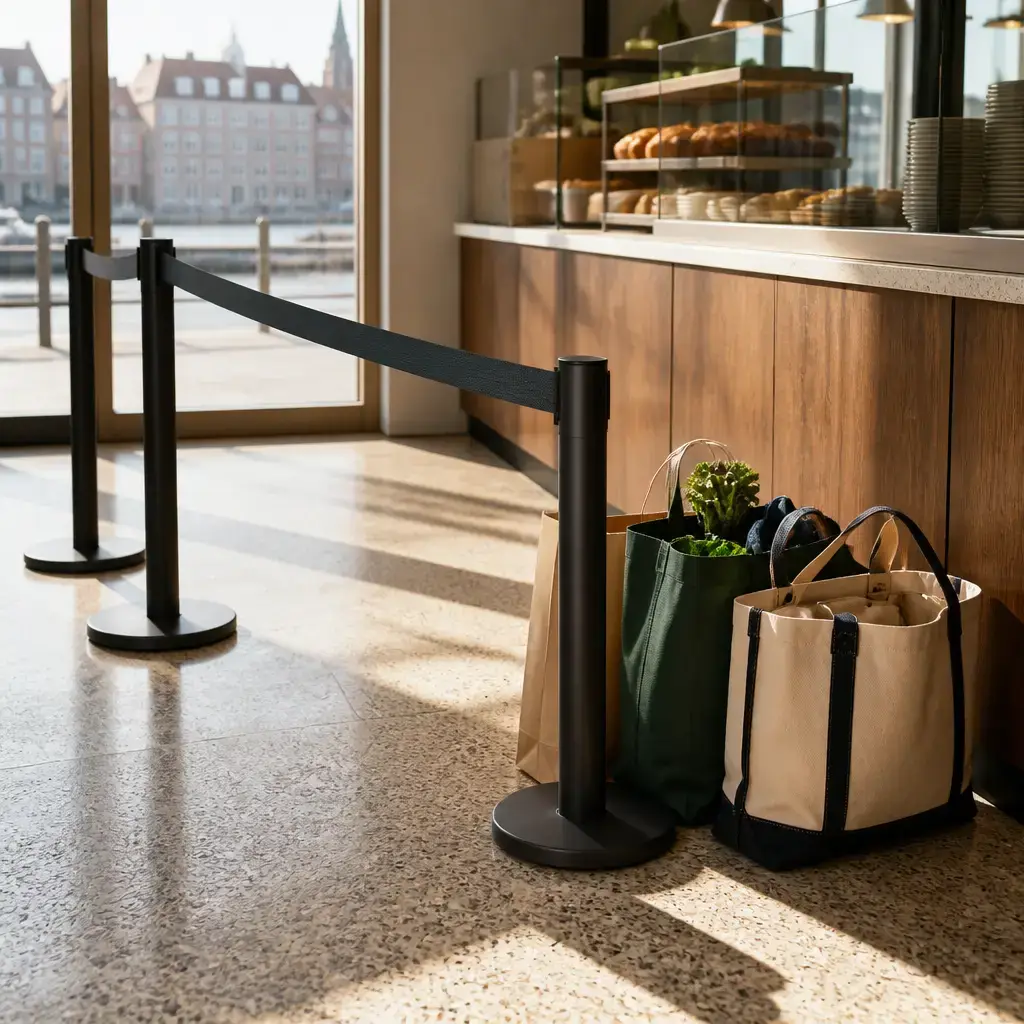
Det er helt i orden, dine tasker ser tunge ud.
It's all right, your bags look heavy.
- Det er
- it is
- helt
- completely
- i orden
- all right
- dine
- your
- tasker
- bags
- ser … ud
- looks
- tunge
- heavy
More detail
Det er uses er, the present form of være (“to be”). Here det is the neutral “it” in the fixed expression; the sentence does not identify a separate concrete referent for it. Danish present er is used with all persons and numbers: jeg er (“I am”), du er (“you are”), de er (“they are”). helt is the adverb “completely” or “entirely.” It strengthens the following expression: helt i orden means “completely all right,” not merely “in order” in a physical or organizational sense. i orden is a reusable Danish expression meaning “all right,” “okay,” or “acceptable.” Together with Det er, it forms Det er helt i orden — “It’s completely all right.” dine means “your” for one addressee when the possessed noun is plural. Compare din with a common-gender singular noun, dit with a neuter singular noun, and dine with a plural noun: din taske, dit brev, dine tasker (“your bag,” “your letter,” “your bags”). The form expresses the possessor and the number of the possessed noun; it does not itself state how many bags there are beyond the plural form of the noun. tasker is the plural of taske, “bag.” The ending -er is a common Danish plural ending: en taske → tasker. Example: Jeg har to tasker. — “I have two bags.” ser ... ud is the Danish verb-particle construction meaning “looks” or “appears” in this use. ser is the present form of se (“to see”), while ud is a separate particle. The construction is used for an outward impression: Hun ser glad ud. — “She looks happy.” In the fixed sentence, ser agrees with the subject in meaning but does not change for person or number in the present tense. tunge means “heavy” here. It is the form of tung used with a plural noun, such as tasker; the adjective therefore matches the plural subject. Compare en tung taske (“a heavy bag”) with tunge tasker (“heavy bags”). Assembled in order, Det er helt i orden reassures the addressee that things are all right. Dine tasker ser tunge ud says that the addressee’s bags appear heavy. The complete meaning is: “It’s all right, your bags look heavy.”
Det sætter jeg pris på.
I appreciate it.
- Det
- it
- sætter … pris på
- appreciate / value
- jeg
- I
More detail
Det means “it” here, referring to something already understood from the situation. Danish det is a neuter singular pronoun; the fixed translation confirms this intended pronoun meaning, but does not identify exactly what it refers to. sætter pris på is the fixed expression “appreciate” or “value.” The verb form sætter is the present tense of sætte; in this expression, sætte pris på is not understood literally as physically setting a price. Keep the whole pattern together: sætte pris på + noget = “appreciate/value something.” Example: Jeg sætter pris på din hjælp. — “I appreciate your help.” jeg means “I” and is the first-person singular pronoun. In the utterance, it is the subject of sætter even though it comes after the verb. The word order illustrates Danish verb-second order. The fronted object Det occupies the first position, so the finite verb sætter comes next, followed by the subject jeg: Det sætter jeg pris på. In a more neutral order, the same pattern can be arranged as Jeg sætter pris på det. Together, Det + sætter ... pris på + jeg expresses “I appreciate it.” The final på belongs to the expression and is retained at the end here because the appreciated object has been moved to the front.
Jeg skal kun bruge et minut ved disken.
I'll only be a minute at the counter.
- Jeg skal
- I will / I need to
- kun
- only
- bruge
- need; use
- minut
- minute
- ved disken
- at the counter
More detail
Jeg skal means “I will” or “I need to” here. skal is the present form of skulle, a modal verb used with an infinitive to express a planned action, necessity, or expectation. The following bruge is the infinitive, so Jeg skal bruge ... is a reusable pattern meaning “I will need/use ...” or, in a time expression, “I will take ...”. Example: Jeg skal bruge en kop. — “I need a cup.” kun means “only” and limits the amount or duration. Its position before bruge makes the limitation apply to what is needed: only a short amount of time is involved here. bruge means “use” or “need,” depending on what follows. Its base form is bruge; after a modal such as skal, Danish uses the infinitive: skal bruge. In the fixed sentence, the time expression et minut gives the relevant meaning “take/need a minute,” rather than physical use of an object. Example: Jeg skal bruge to minutter. — “I need two minutes.” minut means “minute.” The form is singular here. Danish uses the neuter indefinite article et before this noun: et minut; the article marks the noun’s grammatical gender and indefiniteness, not by itself a particular numerical claim. A plural form is minutter: fem minutter — “five minutes.” ved disken means “at the counter.” ved is a preposition meaning “at/by” in this location expression, and disken is the definite form of disk, “counter.” The definite form presents the counter as an identifiable place in the situation. Example: Hun står ved disken. — “She is standing at the counter.” Together, Jeg skal + kun + bruge + et minut gives “I will only need/take a minute,” and ved disken specifies where this will happen. The complete utterance therefore means: “I’ll only be a minute at the counter.”
Jeg kan godt vente lidt længere.
I can wait a little longer.
- Jeg
- I
- kan godt
- can / am able to
- vente
- wait
- lidt
- a little
- længere
- longer
More detail
Jeg means “I” and is the first-person singular subject pronoun. It identifies the speaker as the person who can wait. kan godt is a common Danish construction meaning that the speaker can or is quite willing to do something in the stated situation. kan is the present form of kunne (“can, be able to”), and godt is an adverbial/modal element here; it does not mean that the waiting is done “well.” After kan, the following verb is the infinitive without an English-style “to”: Jeg kan vente means “I can wait.” vente means “to wait.” It is the infinitive used after kan and does not take a special ending there. Example: Jeg kan vente her. — “I can wait here.” lidt means “a little” or “a bit.” Here it marks a small amount of additional duration together with længere. Example: Jeg er lidt træt. — “I am a little tired.” længere means “longer” here, specifically for duration. Danish has the adverb længe (“for a long time”), whose comparative is længere. The same form længere can also be the comparative of the adjective lang (“long”), but the duration context here selects the adverbial use related to længe. Together, Jeg kan godt vente lidt længere. means “I can wait a little longer.” Jeg is followed by kan godt, then the infinitive vente; lidt længere adds a small amount to the waiting duration. The sentence does not specify exactly how much longer.
Jeg skal nok sørge for ikke at forsinke dig.
I'll make sure I don't hold you up.
- Jeg
- I
- skal nok
- will surely
- sørge for
- make sure
- ikke
- not
- forsinke
- hold up
- dig
- you
More detail
Jeg means “I” and is the subject of the sentence. Danish personal pronouns include jeg (“I”), du (“you,” singular informal), and han/hun (“he/she”). skal nok is a useful Danish assurance pattern: literally it contains skal, the present form of skulle, plus nok, but together here it means that the speaker will reliably take care of something: “will make sure” or “will certainly.” It is not simply a prediction of obligation. For example, Jeg skal nok ringe. means “I’ll make sure to call.” sørge for means “make sure” or “take care of.” The reusable pattern is sørge for at + a clause: Jeg sørger for at sende det. — “I’ll make sure to send it.” In the fixed sentence, skal nok combines with sørge for to express the speaker’s assurance. ikke is the negation word “not.” It negates the following action in this clause, so the intended meaning is that the speaker will ensure that the delaying does not happen. Its exact position is important: ikke at forsinke means “not to delay.” forsinke is the infinitive “to delay” or “to hold up.” It is the action being negated. The related noun forsinkelse means “delay,” but it is not the form used here. Example: Trafikken kan forsinke bussen. — “Traffic can delay the bus.” dig means “you” as an object. It is the object form corresponding to the subject form du: Du hjælper mig. — “You help me.” In the fixed sentence, the speaker is not delaying the listener; dig identifies the person who could otherwise be held up. Together, Jeg skal nok sørge for ikke at forsinke dig follows the pattern I + assurance + make sure + not to delay + you. Its complete meaning is: “I’ll make sure I don’t hold you up.”
Grammar Points
skal nok + infinitiv
skal nok sørge for
skal NOHG SUR-uh fohwill certainly make sure to
skal nok expresses confidence that something will certainly happen or be taken care of.
sætter ... pris på
sætter pris på
SET-uh prees pohappreciate; value
This fixed expression means “appreciate” and uses pris, meaning “value,” in its structure.
Danish Vocabulary
Du må gerne komme foran mig.
Du må gerne komme foran mig.
Det er helt i orden.
Du må gerne komme foran mig.
Kom foran mig.
- Gender
- common
Jeg vil ikke tage din plads.
Er du sikker?
Det sætter jeg pris på.
Jeg vil ikke tage din plads.
- Gender
- common
Dine tasker ser tunge ud.
Dine tasker ser tunge ud.
Undskyld, du må gerne komme foran mig.
Quiz
Word Order
Arrange the words in the correct order.
I appreciate it.
Show Answer
Det sætter jeg pris på.I can wait a little longer.
Show Answer
Jeg kan godt vente lidt længere.Spelling
Tap the letters to spell the word.
gladly; willingly
Show Answer
gernesure; certain
Show Answer
sikkertake
Show Answer
tageexcuse me; sorry