10 minutes free every day
Continue audio lessons in the app
Word explanations appear automatically in sync with the audio.
No login required · synced translations · playback with the screen locked
Choose your learning language and open this lesson in the app.

About This Lesson
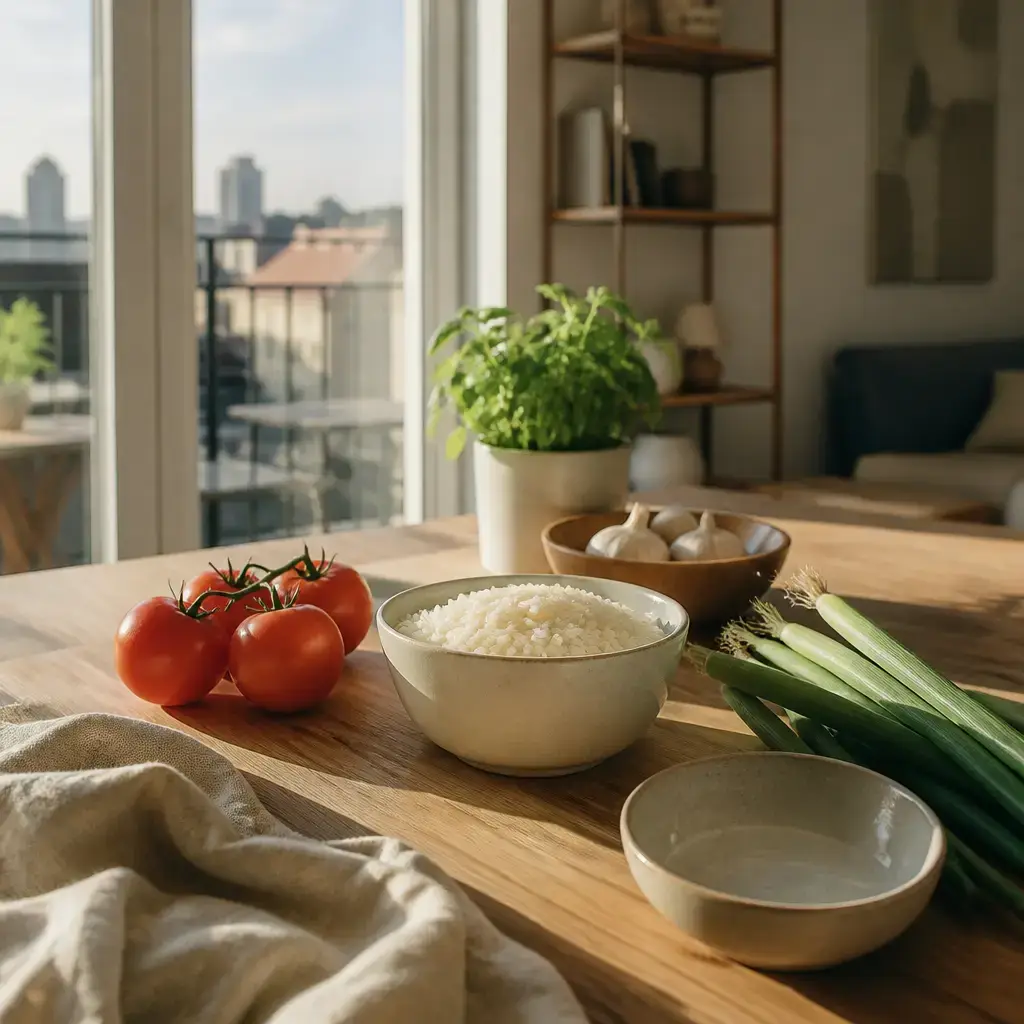
Use Checking ingredients before cooking to practice Danish conversation, pronunciation, vocabulary, grammar, and quizzes.
Dialogue
Før vi begynder at lave mad, hvilke ingredienser har vi?
FUHR vee beh-GUHN-uh uh LAY-vuh MAE-th, VEL-guh eng-greh-dee-EN-suh hah vee? Before we start cooking, what ingredients do we have?Der skal løg og tomater i opskriften.
dah skahl luhw oh toh-MAH-tuh ee AWP-skref-den. The recipe needs onions and tomatoes.Vi har tomater, men vi har ikke flere løg.
vee hah toh-MAH-tuh, men vee hah EG-uh FLEH-uh luhw. We have tomatoes, but we're out of onions.Kan vi bruge forårsløg i stedet?
kan vee BROO-uh foh-AWR-luhw ee STAY-thuh? Can we use green onions instead?Måske, men smagen bliver anderledes.
MOH-skʌh, men SMAY-wuhn BLEE-wuh AH-nuh-LAY-thus. Maybe, but the taste will be different.Så køber jeg løg i butikken på hjørnet.
soh KUH-buh yai luhw ee boo-TEG-un poh YUR-nuth. Then I'll buy onions from the corner shop.Vi skal stadig måle risene.
vee skahl STAY-thee MOH-luh REE-suh-nuh. We still need to measure the rice.Jeg måler nok ris til fire personer, når jeg kommer tilbage.
yai MOH-luh NAWG REES teel FEE-uh peh-SOH-nuh, nawr yai KAW-muh buh-TLAY-uh. I'll measure enough rice for four people after I get back.Sentence explanations
Før vi begynder at lave mad, hvilke ingredienser har vi?
Before we start cooking, what ingredients do we have?
- Før
- before
- begynder
- begin
- lave mad
- cook
- hvilke
- which
- ingredienser
- ingredients
- har vi
- do we have
More detail
Før means “before” and introduces the time clause Før vi begynder at lave mad (“before we start cooking”). It is used for an event that happens earlier than another event. Example: Før jeg går, læser jeg beskeden. — “Before I leave, I read the message.” begynder is the present-tense form of begynde, “to begin/start.” In Danish, the present form does not change for person or number: jeg begynder, vi begynder, and de begynder. Here it follows vi, “we,” and is followed by at plus an infinitive: begynde at + activity. lave mad literally combines lave, “make/do,” with mad, “food,” but together it is the ordinary expression “to cook.” The infinitive lave follows at in at lave mad. Example: Jeg laver mad. — “I am cooking.” The form laver is the present tense of lave. hvilke asks which items when the noun is plural. Its useful contrast is hvilken with a singular common-gender noun and hvilket with a singular neuter noun. Here hvilke modifies plural ingredienser, so the question asks which ingredients, not one ingredient. ingredienser means “ingredients” here. It is the plural of ingrediens; the singular is en ingrediens, and the plural is ingredienser. The word refers to ingredients in general, without specifying a number. Example: Hvilke ingredienser mangler vi? — “Which ingredients are we missing?” har vi means “do we have” in this question. har is the present form of have, “to have,” and Danish does not change it for person or number: jeg har, vi har, de har. vi means “we.” The order har vi is subject–verb inversion, typical of a direct question; the question word and noun phrase come first, followed by the verb and subject. Together, Før vi begynder at lave mad sets the time as “before we start cooking.” Hvilke ingredienser har vi? asks which ingredients are available to us. The complete utterance therefore means: “Before we start cooking, what ingredients do we have?”
Der skal løg og tomater i opskriften.
The recipe needs onions and tomatoes.
- Der skal
- there needs to be
- løg
- onions
- tomater
- tomatoes
- opskriften
- the recipe
More detail
Der skal is a useful Danish pattern for saying that something is needed or required in a place, plan, or situation. Here der is an impersonal placeholder, not a person or thing being referred to. skal is the present form of skulle; in this pattern it expresses a requirement, not necessarily future time. Pattern: Der skal + what is needed + i/på + the relevant place or context. løg means “onions” here. The form løg can represent either an indefinite singular “onion” or an indefinite plural “onions”; the surrounding meaning identifies the plural reading in this sentence. Example: Jeg køber et løg. — “I am buying an onion.” tomater means “tomatoes.” It is the indefinite plural of tomat (“tomato”). The definite plural is tomaterne (“the tomatoes”). Example: Jeg køber tomater.` — “I am buying tomatoes.” opskriften means “the recipe.” Its base noun is opskrift (“recipe”); the ending -en marks the definite singular form for this noun: opskrift → opskriften. Example: Opskriften er enkel. — “The recipe is simple.” The two ingredient nouns are joined by og, “and.” The preposition i means “in.” Together, Der skal + løg og tomater + i opskriften gives the reusable structure “there need to be onions and tomatoes in the recipe,” naturally translated here as “The recipe needs onions and tomatoes.”
Vi har tomater, men vi har ikke flere løg.
We have tomatoes, but we're out of onions.
- Vi
- we
- har
- have
- tomater
- tomatoes
- men
- but
- ikke
- not
- flere
- more; any more
- løg
- onions
More detail
Vi means “we” here: a first-person plural subject. Danish has separate subject forms for singular and plural, such as jeg (“I”) versus vi (“we”). Example: Vi laver mad. — “We are cooking.” har is the present-tense form of have (“to have”). In Danish, har is used with all subjects in the present tense: jeg har, du har, and vi har. Example: Vi har tid. — “We have time.” tomater means “tomatoes.” It is the plural of tomat (“tomato”); the ending -er is a common Danish plural ending, though Danish plural formation is not always identical for every noun. Example: To tomater. — “Two tomatoes.” men introduces a contrast and means “but.” It connects the positive statement about tomatoes with the negative statement that follows. Example: Jeg vil gerne komme, men jeg kan ikke. — “I would like to come, but I can’t.” ikke is the ordinary Danish negation word “not.” In this utterance it negates the following availability statement, so vi har ikke ... means “we do not have ...”. Example: Vi har ikke tid. — “We do not have time.” flere means “more” and is the comparative form used with countable nouns; with a negative statement such as har ikke flere, it commonly means “have no more” or “be out of.” This is distinct from mere, which is generally used for uncountable amounts or activities. Example: Jeg vil have flere æbler. — “I want more apples.” løg means “onions” here. The form løg is both the singular and plural form of the noun: et løg means “an onion,” while flere løg means “more onions.” Example: Jeg køber et løg. — “I am buying an onion.” Together, Vi har tomater says “We have tomatoes.” The second clause repeats the subject and verb: vi har ikke flere løg. Here, ikke flere means that there are no onions remaining, giving the intended natural English meaning “we’re out of onions.” The complete utterance is therefore: “We have tomatoes, but we’re out of onions.”
Kan vi bruge forårsløg i stedet?
Can we use green onions instead?
- Kan vi
- Can we
- bruge
- use
- forårsløg
- green onions
- i stedet
- instead
More detail
Kan vi is a reusable Danish question pattern: kan is the present form of kunne, “can/be able to,” and vi means “we.” In a question, the modal verb comes before the subject: Kan vi ...? This asks whether the speakers can or may do something. Example: Kan vi vente? — “Can we wait?” bruge means “use.” It is the infinitive form, used here after the modal kan; Danish does not add an infinitive marker equivalent to English “to” after kan. Example: Vi kan bruge denne kniv. — “We can use this knife.” forårsløg means “green onions” in this sentence. It is a compound noun: forår (“spring”) + løg (“onion”), but the compound as a whole names the vegetable. The observed form is forårsløg; do not replace it with the separate noun løg when you mean green onions. Example: Jeg køber forårsløg. — “I am buying green onions.” i stedet is the fixed adverbial expression “instead.” It marks the proposed alternative, while the exact thing being replaced is supplied by the context rather than stated inside this expression. Example: Vi kan tage bussen i stedet. — “We can take the bus instead.” Together, Kan vi bruge asks whether “we” can use something, and forårsløg supplies the proposed ingredient. i stedet marks it as an alternative to the onions mentioned in the preceding context. The whole utterance therefore means: “Can we use green onions instead?”
Måske, men smagen bliver anderledes.
Maybe, but the taste will be different.
- Måske
- Maybe
- men
- but
- smagen
- the taste
- bliver
- will be
- anderledes
- different
More detail
Måske means “maybe” and marks uncertainty about the statement that follows. It can stand alone or appear at the beginning of a sentence: Måske kommer hun i morgen. — “Maybe she is coming tomorrow.” men is the conjunction “but.” It connects the possible suggestion in the preceding part with a contrasting result. It does not itself add the meaning “maybe” or “will”; those meanings come from the neighboring words. smagen means “the taste” here. Its base form is smag, “taste,” and smagen is the definite singular form: smag → smagen. The ending -en marks definiteness for this noun; it is not a separate word. Smagen er god. — “The taste is good.” bliver is the present-tense form of blive, “become” or, in suitable contexts, “be.” Danish present tense can refer to a future result when the context makes that clear. Here bliver anderledes describes the taste as becoming or being different, so the fixed translation naturally uses “will be different.” Det bliver koldt. — “It will become cold” or “It is going to be cold,” depending on context. anderledes means “different” in this sentence. It is the form used after bliver to describe the resulting state of smagen. It can also mean “differently” in another construction, so its role is determined by how it functions in the sentence; here it describes the taste, not an action. Together, smagen bliver anderledes means “the taste will be different.” Måske makes that prediction uncertain, while men contrasts it with the possible use of green onions mentioned in the preceding question. The whole utterance therefore means: “Maybe, but the taste will be different.”
Så køber jeg løg i butikken på hjørnet.
Then I'll buy onions from the corner shop.
- Så
- then
- køber
- buy
- jeg
- I
- løg
- onions
- butikken
- the shop
- hjørnet
- the corner
More detail
Så means “then” here: it places this action after an earlier point or decision. In Danish, it can appear first to frame the sentence. Example: Så går vi. — “Then we’ll go.” køber is the present-tense form of købe, “to buy.” Danish present tense can also describe a planned or expected future action when the context makes that clear; here, the fixed translation gives “I’ll buy.” The present form is køber with different subjects as well: jeg køber — “I buy / I’ll buy,” and de køber — “they buy.” jeg is the first-person singular pronoun, “I.” After an initial adverb such as Så, Danish commonly places the finite verb before the subject: Så køber jeg ... — literally “Then buy I ...,” but naturally “Then I’ll buy ...”. This is ordinary verb–subject inversion in a main clause, not a change in the meaning of jeg. løg means “onions” here. It is the indefinite plural of løg; the singular is also løg (“an onion”), while the definite forms are løget (“the onion”) and løgene (“the onions”). The surrounding phrase therefore presents onions as what is being bought, without marking them as a specific previously identified set. butikken is the definite singular form of butik, “shop” or “store”: butik → butikken. The ending -ken marks definiteness for this noun. Example: Jeg går ind i butikken. — “I go into the shop.” hjørnet is the definite singular form of hjørne, “corner”: hjørne → hjørnet. In på hjørnet, the preposition på combines with the noun phrase to mean “on the corner.” Here, på hjørnet modifies butikken, so butikken på hjørnet means “the shop on the corner.” Example: Caféen ligger på hjørnet. — “The café is on the corner.” Putting the parts together, Så sets the sequence, køber jeg gives the inverted main-clause pattern “I’ll buy,” løg is the thing bought, and i butikken på hjørnet identifies the shop where the purchase takes place. The complete meaning is: “Then I’ll buy onions from the corner shop.”
Vi skal stadig måle risene.
We still need to measure the rice.
- Vi skal
- we need to
- stadig
- still
- måle
- measure
- risene
- the rice
More detail
Vi skal combines vi (“we”) with present-tense skal, which here expresses a need or planned obligation. Vi is first-person plural, so it refers to the speaker together with at least one other participant; the sentence does not specify exactly who. After skal, the next verb appears in the infinitive. Example: Vi skal spise nu. — “We need to eat now.” stadig means “still”: the need or plan continues to hold. It commonly appears before the infinitive or other main predicate. Example: Jeg bor stadig her. — “I still live here.” måle is the infinitive of “measure.” The infinitive form follows the modal skal without an infinitive marker such as at in this construction. Example: De skal måle længden. — “They need to measure the length.” risene means “the rice” here. The ending -ene marks a definite plural form; with ris, Danish can use this form for the definite rice grains, while the English mass-noun translation is naturally “the rice.” The indefinite form is ris, and the definite singular form is riset, so these forms should not be treated as interchangeable. Example: Jeg vasker risene. — “I wash the rice.” Together, Vi skal gives “we need to,” stadig adds “still,” måle supplies the action, and risene identifies what is measured. The complete utterance therefore means: “We still need to measure the rice.”
Jeg måler nok ris til fire personer, når jeg kommer tilbage.
I'll measure enough rice for four people after I get back.
- Jeg
- I
- måler
- measure
- nok
- enough
- ris
- rice
- til
- for
- fire
- four
- personer
- people
- når
- when
- kommer tilbage
- come back
More detail
Jeg means “I” and is the first-person singular subject. Danish uses jeg for one speaker; the subject form is distinct from object forms such as mig (“me”). måler means “measure” here. It is the present-tense form of måle (“to measure”): jeg måler = “I measure/am measuring.” Danish present tense can also describe a planned action, so this form works with the future-oriented context here. nok means “enough” in this sentence. It comes before the noun phrase it quantifies: nok ris = “enough rice.” In other contexts, nok can have a different meaning, such as “probably,” so its meaning is determined by how it functions in the sentence. ris means “rice.” It is commonly used as a mass noun when referring to rice as an amount or ingredient. For a countable grain or a specific portion, Danish can use a more specific expression, but the sentence does not specify such a unit. til means “for” in til fire personer, marking the intended recipients or serving group. Its meaning here is not the destination sense of “to.” fire means “four,” the cardinal number. It does not change for the gender of the noun that follows it. personer means “people” and is the plural of person (“person”). The phrase fire personer therefore means “four people.” Example: to personer = “two people.” når means “when” and introduces a time clause. It connects the measuring with the time at which the speaker returns. Danish commonly uses present tense in such a clause even when the event refers to the future: når jeg kommer = “when I come/get.” kommer tilbage means “come back” here. kommer is the present-tense form of komme (“to come”), while tilbage adds the meaning “back.” Together they form a reusable movement expression: Hun kommer tilbage = “She comes back.” The subject jeg in the full clause makes it “I come back.” Together, Jeg måler nok ris til fire personer means “I’ll measure enough rice for four people.” The clause når jeg kommer tilbage adds the time: “after/when I get back.” Thus the whole utterance means: “I’ll measure enough rice for four people after I get back.”
Grammar Points
før + ledsætning
Før vi begynder at lave mad, måler vi risene.
FUHR vee beh-GUHN-uh uh LAY-vuh MAE-th, MOH-luh vee REE-suh-nuh.Before we start cooking, we measure the rice.
før introducerer en tidsledsætning. På dansk står verbet begynder efter subjektet vi.
i stedet for + noun
Vi bruger forårsløg i stedet for løg.
vee BROO-uh foh-AWR-luhw ee STAY-thuh fohr luhw.We use spring onions instead of onions.
i stedet for bruges til at udtrykke et alternativ og står foran det, man vælger fra.
Danish Vocabulary
ikke flere løg
- Gender
- neuter
Før vi begynder
hvilke ingredienser
- Gender
- common
- Gender
- neuter
- Gender
- common
- Gender
- common
Quiz
Word Order
Arrange the words in the correct order.
Can we use green onions instead?
Show Answer
Kan vi bruge forårsløg i stedet?Maybe, but the taste will be different.
Show Answer
Måske, men smagen bliver anderledes.We still need to measure the rice.
Show Answer
Vi skal stadig måle risene.Spelling
Tap the letters to spell the word.
recipe
Show Answer
opskriftenmore, additional
Show Answer
flerewhich
Show Answer
hvilketomato