10 minutes free every day
Continue audio lessons in the app
Word explanations appear automatically in sync with the audio.
No login required · synced translations · playback with the screen locked
Choose your learning language and open this lesson in the app.

About This Lesson
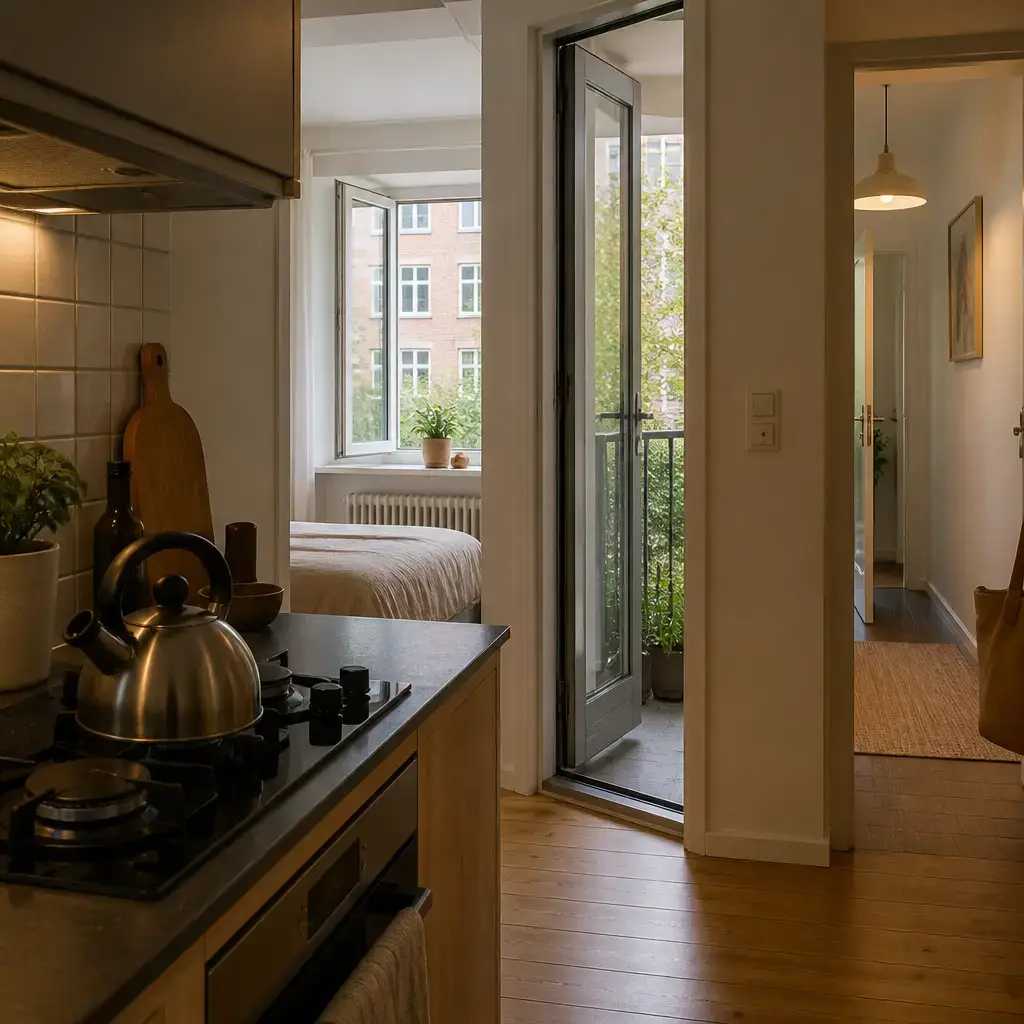
Use Checking the Apartment Before Leaving to practice Danish conversation, pronunciation, vocabulary, grammar, and quizzes.
Dialogue
Før vi går, bør vi tjekke lejligheden.
FUHR vee GOHR, BUHR vee CHEH-guh LYE-lee-HAY-thun. Before we leave, we should check the apartment.Jeg har allerede slukket for komfuret.
YAI hah ah-luh-REH-thuh SLOH-guhd foh kum-FOO-uhd. I already turned off the stove.Er alle vinduerne lukkede?
air AL-uh VEN-oo-uh-nuh LOH-guh-thuh? Are all the windows closed?Vinduet i soveværelset står stadig åbent.
VEN-oo-uhd ee SOH-vuh-VAIR-el-suhd STOHR STEH-thee OH-bun. The bedroom window is still open.Jeg lukker det og låser altandøren.
YAI LOH-guh deh oh LOH-suh AL-tan-DUHR-en. I'll close it and lock the balcony door.Lysene i gangen er stadig tændt.
LYOO-suh-nuh ee GANG-un air STEH-thee TEND. The hallway lights are still on.Så slukker jeg dem.
soh LOH-guh YAI dem. So I'll turn them off.Det burde være det hele.
deh BOO-uh VAIR-uh deh HEE-luh. That should be everything.Lad os gå, før det bliver for sent.
LAD oss GOHR, FUHR deh BLEE-vuh foh SENT. Let's go before it gets too late.Sentence explanations
Før vi går, bør vi tjekke lejligheden.
Before we leave, we should check the apartment.
- Før
- before
- går
- leave
- bør vi
- we should
- tjekke
- check
- lejligheden
- the apartment
More detail
Før means “before” here and introduces the time clause vi går. A reusable pattern is før + clause: “before …”. It can also occur before a noun phrase, as in før mødet (“before the meeting”), but this sentence uses a clause. går is the present form of gå (“to go; to leave”). Here, the fixed translation establishes the meaning “leave.” Danish present-tense verbs do not change for the subject’s person or number, so går can occur with vi (“we”) and with other subjects. Example: Jeg går nu. — “I’m leaving now.” bør vi combines bør, the present form of the modal verb burde (“should; ought to”), with the subject pronoun vi (“we”). Bør has no separate person ending. With a following infinitive, it expresses advice or what is advisable: Vi bør hvile. — “We should rest.” The pronoun vi means “we,” including the speaker and at least one other person; it is not the form for “I” (jeg) or “they” (de). tjekke is the infinitive of tjekke (“to check”). After bør, the infinitive appears without an infinitive marker: Vi bør tjekke ... means “We should check …”. Example: Du bør tjekke døren. — “You should check the door.” lejligheden means “the apartment.” It is the definite singular form of the noun lejlighed (“apartment”): en lejlighed is “an apartment,” while lejligheden is “the apartment.” The ending -en marks the common-gender definite singular form and is part of the noun form, not a separate word. Together, Før vi går means “Before we leave,” bør vi tjekke means “we should check,” and lejligheden is the object, “the apartment.” The whole utterance therefore means: “Before we leave, we should check the apartment.”
Jeg har allerede slukket for komfuret.
I already turned off the stove.
- Jeg har
- I have
- allerede
- already
- slukket for
- turned off
- komfuret
- the stove
More detail
Jeg har combines the first-person singular pronoun jeg (“I”) with present-tense har (“have”). Here har is an auxiliary, not the main meaning “possess”: with a past participle, it helps form the perfect, which presents the turning-off as completed and relevant now. The same pattern is reusable: Jeg har læst = “I have read.” allerede means “already” and marks that the completed action happened before the relevant present point. Its position before the participle is common, but its exact placement can vary in other Danish sentences. slukket for is the perfect-participle form slukket of slukke (“turn off / extinguish”) together with the preposition for. The construction slukke for is used for turning off an appliance or supply. In the perfect, har slukket for means “have turned off.” Example: Hun har slukket for lyset. — “She has turned off the light.” komfuret means “the stove.” The base noun is komfur (“stove”); komfuret is its singular definite form, made with the suffix -et. Danish commonly expresses “the” by a definite suffix attached to the noun rather than by a separate word. Example: Et komfur står i køkkenet. — “A stove is in the kitchen.” Together, Jeg har + allerede + slukket for + komfuret gives: “I already turned off the stove.” The perfect construction identifies the speaker as the person who completed the action, allerede adds that it was done already, and the definite noun identifies the stove as a specific appliance in the situation.
Er alle vinduerne lukkede?
Are all the windows closed?
- Er alle
- are all
- vinduerne
- the windows
- lukkede
- closed
More detail
Er alle begins the question. Er is the present-tense form of være (“to be”). In a yes/no question, Danish commonly places the finite verb before the subject phrase: Er ...? means “Are ...?” here. Alle means “all” and expresses the complete group; it does not itself specify a numeric count. Vinduerne means “the windows.” Its base form is vindue (“window”); the ending -ne marks the definite plural form, “the windows.” The plural is also shown by the noun form rather than by treating -ne as a separate word. Compare the useful forms et vindue (“a window”), vinduer (“windows”), and vinduerne (“the windows”). Lukkede means “closed” here. It is the form of lukket (“closed”) used with the plural subject vinduerne in this sentence. The adjective describes the windows’ state; it is not the action of closing them. In a different sentence, lukke is the verb “to close,” as in Jeg lukker vinduet — “I close the window.” Together, alle vinduerne is “all the windows,” and lukkede says that their state is closed. With the question order Er + subject phrase + description, the whole utterance means: “Are all the windows closed?”
Vinduet i soveværelset står stadig åbent.
The bedroom window is still open.
- Vinduet
- the window
- i
- in
- soveværelset
- the bedroom
- står
- stands
- stadig
- still
- åbent
- open
More detail
Vinduet means “the window” here. It is the definite singular form of vindue: the definite ending is -et, as in et vindue (a window) → vinduet (the window). The form identifies the window as a specific one in this utterance. i places something inside a location. Here it introduces the place where the window is: i soveværelset, “in the bedroom.” With a verb of motion, i can also introduce a destination, but this sentence describes a location. Soveværelset is the definite singular form of soveværelse, “bedroom.” The ending -et marks the definite form: et soveværelse → soveværelset. The phrase i soveværelset therefore means “in the bedroom,” not merely “in a bedroom.” Står is the present form of stå, “to stand.” With a state adjective such as åbent, it can describe something remaining in a particular state, so står åbent means “is standing open” or more naturally “is open.” This is a useful contrast with er åbent, which simply states that something is open. Stadig means “still” and marks a state that continues. In står stadig åbent, it says that the window remains open at the relevant time. Åbent means “open” here and agrees with the neuter singular subject vinduet. The adjective’s base form is åben; its common-gender singular form is åben, neuter singular is åbent, and plural or definite forms are åbne. Example: Et vindue er åbent. — “A window is open.” The sentence combines vinduet (“the window”) with the location i soveværelset (“in the bedroom”), then describes its continuing state with står stadig åbent (“is still open”). Together, the utterance means that the bedroom window is still open.
Jeg lukker det og låser altandøren.
I'll close it and lock the balcony door.
- Jeg
- I
- lukker
- close
- det
- it
- og
- and
- låser
- lock
- altandøren
- the balcony door
More detail
Jeg means “I” and is the subject of both actions. Danish personal pronouns distinguish forms such as jeg “I” and du “you”; the verb after jeg is not marked with a special English-style first-person ending. lukker is the present-tense form of lukke, “to close.” In this sentence, jeg lukker means “I close” or “I am closing”; the English future wording “I’ll close” reflects the intended plan, while Danish present tense can express a near-future action in context. Example: Jeg lukker vinduet. — “I’m closing the window.” det is a neuter singular object pronoun meaning “it.” In the supplied context, the bedroom window is a supported referent because Danish vindue is neuter, reflected in vinduet; the pronoun itself does not repeat the noun. Danish also has den for common-gender singular referents, so the choice between det and den depends on the grammatical gender of the noun being replaced. og means “and” and joins the two coordinated actions. The subject jeg applies to both lukker and låser, so the second verb does not need another subject pronoun. låser is the present-tense form of låse, “to lock.” It is a separate lexical verb from lukker: lukke describes making something closed, while låse describes securing it with a lock. Example: Jeg låser døren. — “I lock the door.” altandøren means “the balcony door.” It is a definite singular noun: altandør means “balcony door,” and the ending -en marks the definite form “the balcony door.” The noun is a compound, with altan “balcony” specifying what kind of dør “door” it is. Example: Altandøren er åben. — “The balcony door is open.” Together, Jeg lukker det means “I’ll close it,” and og låser altandøren means “and lock the balcony door.” The complete utterance is therefore “I’ll close it and lock the balcony door.”
Lysene i gangen er stadig tændt.
The hallway lights are still on.
- Lysene
- the lights
- i gangen
- in the hallway
- stadig
- still
- tændt
- on
More detail
Lysene means “the lights” here. The noun is lys (“light” or “lamp”); its plural is also lys, while lysene is the definite plural, marked by -ene. Example: Lysene er slukket. — “The lights are off.” i gangen means “in the hallway.” i is the preposition “in,” and gangen is the definite form of gang (“hallway” in this context): en gang → gangen. The definite form presents the hallway as an identifiable place, rather than simply “in a hallway.” stadig means “still”: it says that the lights remain on at the relevant time. Example: Hun arbejder stadig. — “She is still working.” tændt means “on” here, describing the lights’ state. It is the past participle of tænde (“to turn on” or “to light”), used adjectivally. The useful state contrast is tændt “on” versus slukket “off.” Example: Lampen er tændt. — “The lamp is on.” Together, Lysene i gangen identifies the lights located in the hallway, er tændt says that they are on, and stadig adds that this state continues. The complete utterance therefore means: “The hallway lights are still on.”
Så slukker jeg dem.
So I'll turn them off.
- Så
- so; then
- slukker
- turn off
- jeg
- I
- dem
- them
More detail
Så means “so” here and links this action to what was just mentioned. It can also mean “then” in other contexts; the intended connective sense here is “so.” slukker is the present-tense form of slukke, “to turn off” or “to put out.” In Danish, the present tense can describe a planned or imminent future action when the context makes that clear. Here, jeg (“I”) and the action context give it the future meaning “I’ll turn off.” The same form is used with different subjects: jeg slukker, du slukker, de slukker. jeg is the first-person singular subject pronoun, “I.” It identifies the speaker as the person carrying out the action. The object form is mig, meaning “me,” so Danish distinguishes jeg as subject from mig as object. dem is the third-person plural object pronoun, “them.” It can refer to people or things and does not itself identify which plural referent is intended. In this supplied utterance, the fixed translation and context identify dem as the hallway lights mentioned as still being on. The subject form is de (“they”); the object form remains dem whether the referents are people or things. The order is Så + slukker + jeg + dem. Literally, this is close to “So turn off I them,” but Danish places the finite verb before the subject when a sentence-initial element such as Så occupies the first position. The combination slukker jeg therefore means “I turn off / I’ll turn off,” not a command to someone else: jeg is explicitly the subject. Assembled, Så slukker jeg dem. means “So I’ll turn them off.” The present form slukker is understood as a forthcoming action, and dem supplies the plural object.
Det burde være det hele.
That should be everything.
- Det
- that
- burde
- should
- være
- be
- det hele
- everything
More detail
Det is the subject here and means “that,” referring to the situation or result being discussed. Danish det is the neuter singular form used for this pronoun; its exact referent is not named in the sentence itself. burde means “should” or “ought to.” It is the past-tense form of bør, but with a modal meaning it commonly expresses an expectation about the present or near future rather than simple past time. Example: Det burde være nok. — “That should be enough.” være means “be.” It is the infinitive form following the modal burde; burde carries the finite verb marking, so være does not change for person or number here. det hele is a Danish expression meaning “everything” or “the whole thing.” hel is the adjective meaning “whole” or “complete.” In this expression, hele is the definite form used with det; it is not simply the neuter indefinite form. Compare en hel dag — “a whole day,” et helt år — “a whole year,” and det hele — “the whole thing/everything.” Together, Det burde være det hele says that the relevant situation or result is expected to constitute everything, giving the natural meaning “That should be everything.”
Lad os gå, før det bliver for sent.
Let's go before it gets too late.
- Lad os
- let’s
- gå
- go
- før
- before
- det
- it
- bliver
- gets
- for sent
- too late
More detail
Lad os is the reusable Danish way to suggest an action together: literally “let us,” but naturally “let’s.” Lad is the imperative of lade (“let/allow”), and os is the object form meaning “us.” The construction is followed by an infinitive: Lad os vente means “Let’s wait.” gå means “go” here. It is the infinitive form, used after Lad os. The same form can be reused in suggestions such as Lad os spise (“Let’s eat”). før introduces the time condition “before.” It is a conjunction here, linking the suggestion to the event that should not happen first. For example, Ring, før du kommer means “Call before you come.” det is the neuter singular pronoun “it.” In this sentence it is the grammatical subject of the impersonal time expression; the translation identifies the intended meaning as “it,” without specifying a concrete object. bliver is the present-tense form of blive, “become/get.” With det as subject, it means “gets” in the expression “it gets late.” The infinitive is blive; for example, Det bliver mørkt means “It gets dark.” for sent means “too late.” for means “too” here, and sent means “late.” Together they express that the time has passed an appropriate limit. sent is related to sen (“late”), but the form used in this time expression is sent. The sentence combines the suggestion Lad os gå (“Let’s go”) with the time clause før det bliver for sent (“before it gets too late”). The complete meaning is: “Let’s go before it gets too late.”
Grammar Points
før + subjekt + verb
før vi går
FUHR vee GOHRbefore we leave
Use før to introduce a time clause. The subject comes before the verb: før vi går.
et-ord + adjective ending in -t
vinduet står stadig åbent
VEN-oo-uhd STOHR STEH-thee OH-bunthe window is still open
With an et-noun such as vinduet, the adjective takes the -t ending: åbent.
Danish Vocabulary
Før vi går
- Gender
- neuter
- Gender
- common
- Gender
- neuter
Quiz
Word Order
Arrange the words in the correct order.
I already turned off the stove.
Show Answer
Jeg har allerede slukket for komfuret.Are all the windows closed?
Show Answer
Er alle vinduerne lukkede?The bedroom window is still open.
Show Answer
Vinduet i soveværelset står stadig åbent.Spelling
Tap the letters to spell the word.
turned off
Show Answer
slukketthe stove
Show Answer
komfuretalready
Show Answer
alleredethe apartment