10 minutes free every day
Continue audio lessons in the app
Word explanations appear automatically in sync with the audio.
No login required · synced translations · playback with the screen locked
Choose your learning language and open this lesson in the app.

About This Lesson
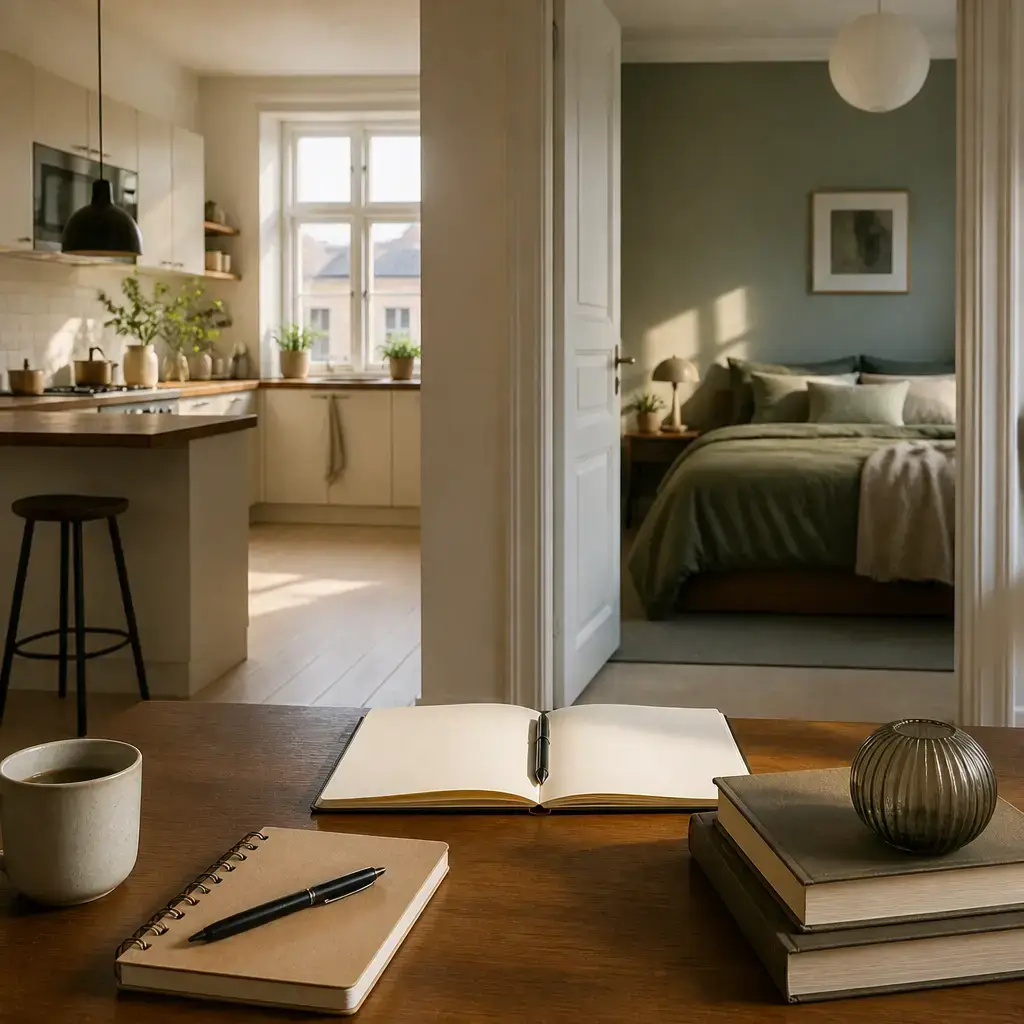
Use Choosing a quieter room for studying to practice Danish conversation, pronunciation, vocabulary, grammar, and quizzes.
Dialogue
Hvilket rum skal jeg bruge til at studere?
VIL-gud rohm skal yai BROO-uh tehl stoo-TAIR-uh? Which room should I use for studying?Hvad med soveværelset eller køkkenet?
Vah meh SOH-vuh-VAIR-uhl-suhd EL-uh KUR-kuh-nuhd? What about the bedroom or the kitchen?Køkkenet er lysere, men der bliver larm.
KUR-kuh-nuhd air LOO-suh-ruh, men dair BLEE-uh larhm. The kitchen is brighter, but it gets noisy.Soveværelset er mere stille og mere behageligt.
SOH-vuh-VAIR-uhl-suhd air MAIR-uh SDEH-luh oh MAIR-uh beh-HAI-uhld. The bedroom is quieter and more comfortable.Jeg skal kunne koncentrere mig uden afbrydelser.
Yai skal KUN-uh kon-sen-TRAI-uh-reh mai OO-un OW-BRYOO-duhl-suh. I need to focus without interruptions.Så giver det bedre mening at vælge det mere stille rum.
Soh KEE-uh deh BEH-druh MAY-ning ad VEL-guh deh MAIR-uh SDEH-luh rohm. Then the quieter room makes more sense.Jeg vil studere i soveværelset i dag.
Yai vel stoo-TAIR-uh ee SOH-vuh-VAIR-uhl-suhd ee dah. I'll study in the bedroom today.Luk døren, hvis der bliver larm på gangen.
Loog DUR-uhn, ves dair BLEE-uh larhm poh GANG-uhn. Close the door if the hallway gets noisy.Sentence explanations
Hvilket rum skal jeg bruge til at studere?
Which room should I use for studying?
- Hvilket
- which
- rum
- room
- skal jeg
- should I
- bruge
- use
- til at
- for/to
- studere
- study
More detail
Hvilket means “which” here and is the form used with the neuter singular noun rum. Danish question words agree with the noun’s gender and number in this way: hvilken is used with common-gender singular nouns, hvilket with neuter singular nouns, and hvilke with plural nouns. The question asks the listener to choose a room; it does not itself state how many rooms there are. rum means “room.” Its plural is rum, so the same written form can mean “room” or “rooms”; here the singular meaning is supported by hvilket and the translation. skal jeg combines skal, a form of skulle, with the subject pronoun jeg (“I”). Skal can express obligation, a planned or expected action, or— as here in a question—what would be the appropriate choice: “should I.” The subject comes after skal because this is a question. The pattern Skal jeg + infinitive? is reusable for asking what one should do, for example: Skal jeg vente? — “Should I wait?” bruge is the infinitive of bruge, “to use.” The infinitive follows the modal skal; it does not take a personal ending here. Its present-tense form is bruger, as in Jeg bruger rummet — “I use the room.” til at introduces an infinitive phrase that expresses purpose in this sentence: “for/to.” The pattern bruge noget til at + infinitive means “use something for doing something.” studere is an infinitive meaning “to study.” After til at, it names the purpose of using the room. For example, Jeg bruger biblioteket til at studere means “I use the library for studying.” Together, Hvilket rum asks which room is being selected, skal jeg bruge asks which room the speaker should use, and til at studere gives the purpose. The complete meaning is: “Which room should I use for studying?”
Hvad med soveværelset eller køkkenet?
What about the bedroom or the kitchen?
- Hvad med
- what about
- soveværelset
- the bedroom
- eller
- or
- køkkenet
- the kitchen
More detail
Hvad med is a reusable Danish construction for asking about, suggesting, or considering something: “What about …?” It does not itself identify a particular grammatical number. Example: Hvad med fredag? — “What about Friday?” soveværelset means “the bedroom” here. Its base noun is soveværelse, “bedroom”; the ending -et marks the definite singular form of this neuter noun. The word is not a plural form. Example: Et soveværelse — “a bedroom”; soveværelset — “the bedroom.” eller connects alternatives and means “or.” It presents the bedroom and the kitchen as two options in the question. Example: Te eller kaffe? — “Tea or coffee?” køkkenet means “the kitchen” here. Its base noun is køkken, “kitchen”; -et marks the definite singular form of this neuter noun. Example: Et køkken — “a kitchen”; køkkenet — “the kitchen.” Together, Hvad med soveværelset eller køkkenet? asks which of the two specified rooms should be considered: “What about the bedroom or the kitchen?” The construction is a concise way to propose or raise alternatives without stating that either one has been chosen.
Køkkenet er lysere, men der bliver larm.
The kitchen is brighter, but it gets noisy.
- Køkkenet
- the kitchen
- lysere
- brighter
- bliver
- becomes; gets
- larm
- noise
More detail
Køkkenet means “the kitchen” here. The base noun is køkken (“kitchen”), and Danish marks definiteness by attaching -et: et køkken = “a kitchen,” køkkenet = “the kitchen.” The noun is neuter, which is why the indefinite article is et and the definite ending is -et. lysere means “brighter” here. It is the comparative form of lys (“bright”): lys, lysere, lysest = “bright,” “brighter,” “brightest.” The comparative compares the kitchen with another understood place or situation; the sentence does not specify that comparison directly. For example: Dette rum er lysere. — “This room is brighter.” bliver is the present form of blive (“become; get”). In der bliver larm, it contributes the change or resulting situation expressed by “gets noisy.” Danish blive can describe becoming or getting into a state, not only a permanent change. For example: Det bliver koldt. — “It gets cold.” larm means “noise” here. It is a noun referring to unwanted or disruptive sound. In the pattern der bliver larm, it forms an idiomatic way to say that it gets noisy. The der in this construction is a formal grammatical element introducing the situation; it is not the English location word “there” in the fixed translation. The opening Køkkenet er lysere combines the definite subject “the kitchen” with er, the present form of være (“be”), and the comparative lysere: “The kitchen is brighter.” men introduces a contrast: “but.” The second part, der bliver larm, presents the resulting sound situation as “it gets noisy.” Together, the utterance means: “The kitchen is brighter, but it gets noisy.”
Soveværelset er mere stille og mere behageligt.
The bedroom is quieter and more comfortable.
- Soveværelset
- the bedroom
- mere stille
- quieter
- mere behageligt
- more comfortable
More detail
Soveværelset means “the bedroom” here. It is the definite singular form of et soveværelse (“a bedroom”): the neuter noun takes -et in the definite form. The ending belongs to the noun, not to an adjective. Example: Et soveværelse kan være lille. — “A bedroom can be small.” mere stille means “quieter.” Stille means “quiet”; mere forms the comparative pattern “more [adjective]” and is useful when comparing with an understood or previously mentioned situation. Example: Dette rum er mere stille. — “This room is quieter.” mere behageligt means “more comfortable.” The adjective is behagelig, and behageligt is its neuter singular form, agreeing with the neuter noun soveværelset. Its comparative is formed with mere: mere behageligt. The adjective changes here because of the noun’s neuter form; mere itself does not carry that agreement. Example: Et behageligt rum hjælper mig med at koncentrere mig. — “A comfortable room helps me concentrate.” The linking verb er means “is.” The sentence has the pattern [subject] er mere [adjective] og mere [adjective]: Soveværelset er mere stille og mere behageligt. The two coordinated comparisons describe the same bedroom: it is quieter and more comfortable. The complete meaning is “The bedroom is quieter and more comfortable.”
Jeg skal kunne koncentrere mig uden afbrydelser.
I need to focus without interruptions.
- Jeg skal
- I need to
- kunne
- be able to
- koncentrere mig
- focus
- uden
- without
- afbrydelser
- interruptions
More detail
Jeg skal means “I need to” here. Jeg is the first-person singular pronoun “I”, and skal is the present form of skulle. In this sentence, skal expresses a present requirement or necessity. Danish skal can also express a future arrangement or obligation in other contexts, so its meaning is determined by the construction and context. kunne means “be able to”. It is the infinitive of kunne, and it follows skal in the pattern skal kunne (“need to be able to”). The first verb carries the present tense; kunne stays in the infinitive. For example: Jeg skal kunne se skærmen. — “I need to be able to see the screen.” koncentrere mig means “focus”. koncentrere is the infinitive of the verb “to concentrate/focus”, and mig is the first-person singular reflexive pronoun used with this verb. The reflexive form shows that the focusing is done by and directed back to the speaker. With another subject, the reflexive pronoun changes: Hun skal koncentrere sig. — “She needs to focus.” uden means “without”. It is a preposition that introduces what is absent or not present. Here it introduces afbrydelser, the thing that should not occur during the focusing. afbrydelser means “interruptions”. It is the plural indefinite form of afbrydelse, “interruption”. The singular indefinite form is en afbrydelse, and the definite plural is afbrydelserne, “the interruptions”. Together, Jeg skal kunne gives “I need to be able to”, koncentrere mig gives “focus”, and uden afbrydelser gives “without interruptions”. The complete utterance therefore means: “I need to be able to focus without interruptions.”
Så giver det bedre mening at vælge det mere stille rum.
Then the quieter room makes more sense.
- Så
- then
- giver
- makes
- bedre
- better
- mening
- sense
- vælge
- choose
- mere stille
- quieter
- rum
- room
More detail
Så means “then” here. It links this conclusion to what was said before. In other contexts, Danish så can have other functions, but here it marks the result or consequence. giver is the present-tense form of give (“to give”). Danish present-tense verbs do not change for person or number, so giver is also the form used with other subjects in the present tense. In the reusable expression give mening, it means “make sense”: Det giver mening = “That makes sense.” The past form is gav, and the infinitive is give. bedre is the comparative form of god (“good”), so bedre means “better.” In give bedre mening, it says that the option makes more sense than another option or than the previously considered arrangement. A common comparison is god – bedre – bedst (“good – better – best”). mening means “sense” in the expression give mening; it can also mean “meaning” in other contexts. The noun is used with give to form the reusable pattern give mening (“make sense”), rather than being translated word for word as “give sense.” at vælge is the infinitive “to choose.” Danish commonly places the infinitive marker at before an infinitive: at vælge, at studere (“to study”). The verb is vælge; the present form is vælger, as in Jeg vælger et rum (“I choose a room”). mere stille means “quieter” here. stille is the adjective “quiet,” and mere forms a comparative phrase meaning “quieter” or “more quiet.” Danish can also use the comparative form stillere; the supplied sentence specifically uses mere stille, which should be retained when quoting this utterance. The comparison concerns the room’s quietness. rum means “room.” It is a neuter singular noun, shown by the form det in det mere stille rum. With a preposed adjective, Danish uses the pattern det + adjective + noun for a definite singular neuter noun phrase: det stille rum = “the quiet room.” The noun’s ordinary definite form without a preposed adjective is rummet (“the room”). Together, det giver bedre mening at ... is a useful impersonal pattern meaning “it makes more sense to ...”. at vælge det mere stille rum supplies the action being evaluated: “to choose the quieter room.” The whole utterance is therefore: “Then it makes better sense to choose the quieter room.” The fixed translation gives the compatible shorter rendering “Then, the quieter room makes more sense.”
Jeg vil studere i soveværelset i dag.
I'll study in the bedroom today.
- Jeg vil
- I will
- studere
- study
- soveværelset
- the bedroom
- i dag
- today
More detail
Jeg vil means “I will” here: Jeg is the first-person singular subject “I”, and vil is the present form of ville. With an infinitive, vil expresses the speaker’s intention or a future action. Danish uses the infinitive directly after this modal: Jeg vil læse means “I will read.” studere is the infinitive “to study.” It follows vil without at, so Jeg vil studere means “I will study.” The same form can be reused after other modal verbs, for example Jeg kan studere — “I can study.” soveværelset means “the bedroom.” It is the definite singular form of soveværelse, so the ending -t marks “the” for this neuter noun; the indefinite form is et soveværelse, “a bedroom.” The form refers to the bedroom as a specific room in this utterance. i dag is the two-word time expression “today.” It identifies when the studying is intended to happen. For example, Jeg arbejder i dag means “I am working today.” Together, Jeg vil studere gives the intention “I will study,” i soveværelset specifies the location “in the bedroom,” and i dag specifies the time “today.” The complete utterance is therefore: “I’ll study in the bedroom today.”
Luk døren, hvis der bliver larm på gangen.
Close the door if the hallway gets noisy.
- Luk
- close
- døren
- the door
- hvis
- if
- bliver
- becomes; gets
- larm
- noise
- gangen
- the hallway
More detail
Luk is the imperative of lukke (“to close”). It gives a direct instruction; Danish imperatives commonly use this short form without an expressed subject. Example: Luk vinduet. — “Close the window.” døren means “the door” here. It is the definite singular form of dør; døren refers to a specific door understood in the situation. The definite ending is part of the noun form, rather than a separate word. Example: Jeg åbner døren. — “I open the door.” hvis introduces a condition and means “if.” A useful pattern is imperative, hvis ...: give an instruction whose condition is stated afterward. Example: Ring, hvis du har brug for hjælp. — “Call if you need help.” bliver is a present-tense form of blive, “to become” or “to get.” In der bliver larm, it describes noise arising or the place becoming noisy, matching “gets noisy” here. Example: Det bliver koldt. — “It gets cold.” larm means “noise” in this sentence. It is used as a mass-like noun, so the sentence does not state a particular number of noises. In the construction der bliver larm, Danish uses der as the grammatical subject of an existential or occurrence expression: literally, “there becomes noise.” gangen means “the hallway” here. It is the definite singular form of gang, “hallway” in this use. Together with på, the phrase på gangen means “in/on the hallway,” conventionally translated here as “in the hallway.” Example: Hun står på gangen. — “She is standing in the hallway.” The sentence starts with the instruction Luk døren (“Close the door”). The conditional clause begins with hvis and describes the condition: der bliver larm på gangen (“the hallway gets noisy,” literally, “there becomes noise in the hallway”). Together, the utterance means: “Close the door if the hallway gets noisy.”
Grammar Points
hvilket + intetkønsord
hvilket rum
VIL-gud rohmwhich room
hvilket is the neuter form of “which” and agrees with the neuter noun rum.
Bestemt form: -et / -en
soveværelset
SOH-vuh-VAIR-uhl-suhdthe bedroom
Danish often adds a suffix to the noun to express “the”; -et is used here with a neuter noun.
Danish Vocabulary
- Gender
- common
Jeg skal kunne koncentrere mig uden afbrydelser.
- Gender
- neuter
Soveværelset er mere stille og mere behageligt.
Hvilket rum skal jeg bruge til at studere?
- Gender
- neuter
Hvilket rum skal jeg bruge til at studere?
Jeg skal kunne koncentrere mig uden afbrydelser.
- Gender
- neuter
Hvad med soveværelset eller køkkenet?
- Gender
- common
Køkkenet er lysere, men der bliver larm.
Køkkenet er lysere, men der bliver larm.
- Gender
- neuter
Hvilket rum skal jeg bruge til at studere?
- Gender
- neuter
Hvad med soveværelset eller køkkenet?
Soveværelset er mere stille og mere behageligt.
Hvilket rum skal jeg bruge til at studere?
Quiz
Word Order
Arrange the words in the correct order.
What about the bedroom or the kitchen?
Show Answer
Hvad med soveværelset eller køkkenet?Spelling
Tap the letters to spell the word.
brighter
Show Answer
lyserewhich
Show Answer
hvilketstudy
Show Answer
studereuse