10 minutes free every day
Continue audio lessons in the app
Word explanations appear automatically in sync with the audio.
No login required · synced translations · playback with the screen locked
Choose your learning language and open this lesson in the app.

About This Lesson
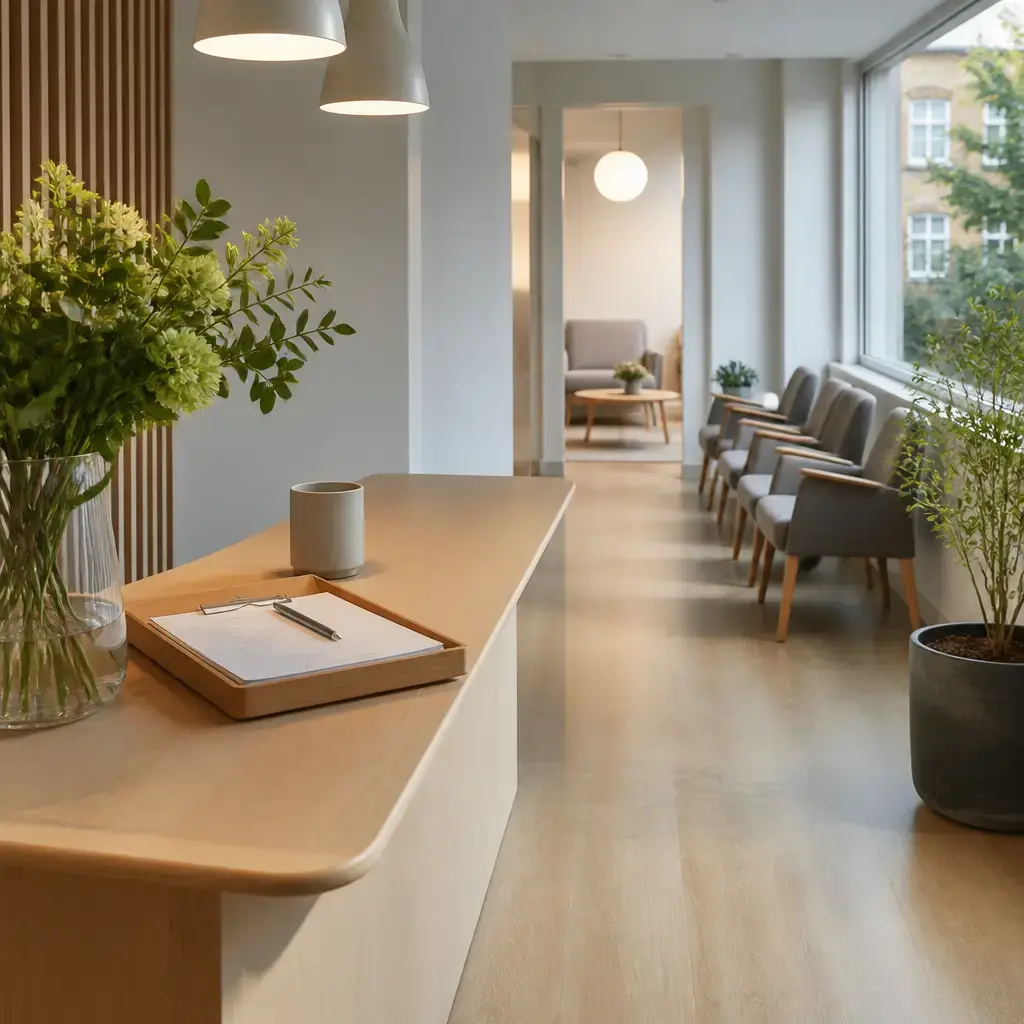
Use Finding the waiting room and checking in to practice Danish conversation, pronunciation, vocabulary, grammar, and quizzes.
Dialogue
Undskyld, hvor er venteværelset?
oon-SGUHL, vohr air VEN-uh-vair-lsuhth? Excuse me, where is the waiting room?Gå forbi receptionen.
goh for-BEE reh-sep-SHOh-nun. Go past the front desk.Det er til venstre for dig.
deh air til VEN-strah for dye. It will be on your left.Skal jeg tjekke ind, før jeg sætter mig?
sgal yai CHEH-guh en, fur yai SET-uh my? Do I need to check in before I sit down?Udfyld først denne formular.
OOD-fühl furst DEN-uh foh-MAY-lah. Fill out this form first.Aflever den derefter ved skranken.
AH-flay-vuh den deh-REF-tuh veh SKRONG-un. Then hand it to the desk.Vil nogen kalde på mig, når det er min tur?
vil NOH-un KAY-luh poh my, nor deh air min toor? Will someone call me when it's my turn?En sygeplejerske burde snart kalde på dig.
en SOO-uh-PLY-uh-skuh BOO-uh snart KAY-luh poh dye. A nurse should call your name shortly.Skal jeg have mit sygesikringskort klar?
sgal yai HAH-wuh mit SOO-uh-see-grings-kort klair? Should I keep my insurance card ready?Hav det ved hånden, hvis skranken får brug for det igen.
hahw deh veh HON-un, ves SKRONG-un foh BROO for deh ee-GEN. Keep it handy in case the desk needs it again.Sentence explanations
Undskyld, hvor er venteværelset?
Excuse me, where is the waiting room?
- Undskyld
- Excuse me
- hvor er
- where is
- venteværelset
- the waiting room
More detail
Undskyld is a polite imperative/interjection from undskylde, used here as “Excuse me” to get someone’s attention before a question. The same form can also mean “Sorry” in another situation; here the fixed translation establishes the attention-getting use. hvor er combines the question word hvor (“where”) with er, the present-tense form of være (“to be”). Danish location questions commonly use this order: Hvor er ...? = “Where is ...?” The form er is used with a singular subject here; it does not itself show grammatical gender. venteværelset means “the waiting room.” Its base form is venteværelse; the ending -et marks singular definite form for this neuter noun, giving “the waiting room.” The noun is a compound: vente (“wait”) + værelse (“room”), but the complete compound is the noun used in the sentence. For comparison, et venteværelse means “a waiting room,” while venteværelserne means “the waiting rooms.” Together, Undskyld, hvor er venteværelset? asks politely for the location of the specific waiting room: “Excuse me, where is the waiting room?”
Gå forbi receptionen.
Go past the front desk.
- Gå
- Go
- forbi
- past
- receptionen
- the front desk
More detail
Gå is the imperative of gå (“to go”): it gives a direct instruction to go. In Danish, the imperative of this verb is gå, while the infinitive is also gå, so the surrounding sentence shows which use is intended. Example: Gå hjem. — “Go home.” forbi means “past” or “by” when it marks movement beyond a place. In this sentence it combines with the destination noun to make the reusable pattern gå forbi + place: “go past + place.” Example: Cyklen kører forbi huset. — “The bicycle rides past the house.” receptionen means “the front desk” here. The base noun is reception; the ending -en marks the definite singular form, “the reception/front desk.” The noun itself, not forbi, carries this definiteness. Example: Jeg venter ved receptionen. — “I am waiting at the front desk.” Together, Gå forbi receptionen. is a direct instruction: “Go past the front desk.” The imperative Gå expresses the action, forbi specifies movement past something, and receptionen identifies that place as the front desk.
Det er til venstre for dig.
It will be on your left.
- Det er
- it is
- til venstre
- to the left
- for dig
- for you
More detail
Det er contains det, a neutral third-person singular pronoun, and er, the present-tense form of være (“to be”). Here det refers to the thing or place being located; the supplied translation renders the situation as “it will be,” so the English tense should not be used to claim that the Danish form itself is a future form. Være has the useful present form er; for example, Det er her. means “It is here.” til venstre means “to the left.” The phrase til venstre for ... is a reusable way to locate something relative to a person or object. venstre contrasts with højre (“right”): til højre means “to the right.” For example, Døren er til venstre. means “The door is on the left.” for dig means “for you” here, identifying the person whose left side or orientation is the reference point. dig is the object form of du (“you”): use du as the subject and dig after a preposition such as for. For example, Det er for dig. means “It is for you,” though in this sentence for dig combines with til venstre to mean “to your left.” Together, Det er + til venstre for dig gives the location “It is to the left relative to you.” In the supplied context, the fixed translation expresses this as “It will be on your left.”
Skal jeg tjekke ind, før jeg sætter mig?
Do I need to check in before I sit down?
- Skal jeg
- do I need to / should I
- tjekke ind
- check in
- før
- before
- sætter mig
- sit down
More detail
Skal jeg puts the modal skal before the subject jeg in a yes/no question. Here, skal asks whether the speaker needs to or should do something; it is not the ordinary present-tense form of “to be.” After a modal, Danish uses the infinitive without at: Skal jeg ...? = “Do I need to ...?” or “Should I ...?” tjekke ind is the infinitive expression “check in.” The verb is tjekke; ind contributes the “in” part of this fixed verb combination. After skal, tjekke remains in the infinitive form. Example: Du skal tjekke ind. — “You need to check in.” før means “before” and introduces the event that must come later in the sequence. It is followed here by a clause, jeg sætter mig, rather than by a noun. A reusable pattern is før + clause: før jeg går — “before I leave.” In sætter mig, sætter is the present-tense form of sætte, and mig is the reflexive object referring back to the subject jeg. Together, sætte sig means “sit down,” an action of moving into a seated position. This contrasts with sidde, which means “be sitting” or “sit” as a state. Example: Jeg sætter mig her. — “I’ll sit down here.” The utterance combines the yes/no question pattern Skal jeg + infinitive? with før + clause: Skal jeg tjekke ind, før jeg sætter mig? The meaning is “Do I need to check in before I sit down?”
Udfyld først denne formular.
Fill out this form first.
- Udfyld
- fill out
- først
- first
- denne
- this
- formular
- form
More detail
Udfyld is the imperative of udfylde, “to fill out.” Danish commonly forms this imperative by removing the infinitive ending -e: udfylde → udfyld. It is a direct instruction to the addressee. Example: Udfyld skemaet. — “Fill out the form.” først is an adverb meaning “first.” It places the filling-out before another relevant action or step. Example: Læs først. — “Read first.” denne means “this” and identifies one nearby or contextually selected noun. It is the singular common-gender form; Danish uses dette with a singular neuter noun and disse with a plural noun. Here, denne agrees with the common-gender noun formular. formular means “form,” as in a document to be completed. It is a common-gender noun: en formular is “a form,” and formularen is “the form.” Example: Jeg udfylder en formular. — “I am filling out a form.” Together, Udfyld denne formular means “Fill out this form”: the imperative Udfyld gives the instruction, while denne formular identifies what should be filled out. Adding først makes the complete utterance “Fill out this form first.”
Aflever den derefter ved skranken.
Then hand it to the desk.
- Aflever
- hand in; deliver
- den
- it
- derefter
- then; afterward
- skranken
- the desk; counter
More detail
Aflever is the imperative of aflevere, meaning “hand in” or “deliver.” The imperative gives a direct instruction and commonly uses the verb form without an expressed subject. The form aflever is addressed to one or more people; the wording itself does not specify the addressee’s number. Compare the reusable pattern Aflever + object: “Hand in the form.” den is a singular common-gender object pronoun meaning “it” here. In this context, the fixed translation identifies the item as “it,” and the preceding sentence supplies the form being handed in. Danish object pronouns are separate words: compare den for a common-gender singular referent with det for a neuter singular referent. Example: Jeg afleverer den. — “I hand it in.” derefter means “afterward” or “then,” referring to the next step in the sequence. It is an adverb and does not change form for the person or number of the person addressed. Example: Læs den derefter. — “Read it afterward.” skranken means “the desk” or “the counter.” It is the definite singular form of skranke; the indefinite singular is en skranke, and the definite form adds -n: skranken. With ved, the phrase ved skranken means “at the desk/counter.” Example: Jeg venter ved skranken. — “I am waiting at the desk.” Together, Aflever den gives the instruction “Hand it in,” derefter places that action afterward in the sequence, and ved skranken identifies the location. The whole utterance therefore means: “Then hand it to the desk,” as fixed by the translation; more idiomatically in English, this can also be understood as “Then hand it in at the desk.”
Vil nogen kalde på mig, når det er min tur?
Will someone call me when it's my turn?
- Vil nogen
- will someone
- kalde på
- call for
- mig
- me
- når
- when
- det er
- it is
- min
- my
- tur
- turn
More detail
Vil nogen puts the present form vil of ville before the subject nogen to form a yes/no question. Here vil expresses an expected or requested future action, and nogen means “someone” in this question. The same pattern is reusable: Vil nogen hjælpe? — “Will someone help?” kalde på is the verb construction meaning to call for someone, often to summon them when it is their turn. Its base form is kalde; på belongs to the construction and is not the object pronoun. For example, Lægen kalder på dig. means “The doctor calls for you.” mig is the object form of the first-person pronoun: jeg is used as a subject, while mig is used after a verb or preposition as “me.” Here it is the person being called for. Hun ser mig. means “She sees me.” når introduces the time clause “when.” In this sentence it connects the calling with the time at which the speaker’s turn arrives. For example, Jeg går, når du kommer. means “I leave when you come.” det er consists of det, “it,” and er, the present form of være, “to be.” In det er min tur, det is the grammatical subject of the clause, while the following noun phrase identifies what the situation is: “it is my turn.” The form er is used with all subjects in the present tense; it does not change for person or number. min is the first-person singular possessive meaning “my.” It agrees with the noun it modifies here, tur: en tur, so the common-gender form is min. With a neuter singular noun, Danish uses mit, as in mit hus (“my house”); with plural nouns, it uses mine, as in mine bøger (“my books”). tur means “turn” here: a person’s opportunity or place to do something. It is a common-gender noun, en tur, and its definite singular form is turen (“the turn”). The expression det er min tur is the reusable pattern for saying that it is the speaker’s turn. Together, Vil nogen kalde på mig asks whether someone will call for the speaker. når det er min tur specifies the time: when it is the speaker’s turn. The complete utterance therefore means, “Will someone call me when it’s my turn?”
En sygeplejerske burde snart kalde på dig.
A nurse should call your name shortly.
- sygeplejerske
- nurse
- burde
- should; ought to
- snart
- soon
- kalde på
- call for; summon
- dig
- you
More detail
sygeplejerske means “nurse.” The form is a common-gender noun, so the indefinite article used with it is en: en sygeplejerske = “a nurse.” The noun itself does not identify whether the nurse is male or female. burde expresses that something is expected or advisable: “should” or “ought to.” It is the form used here before the infinitive kalde; the related present-tense form bør can also mean “should,” but it is a different form. Example: Du burde hvile. — “You should rest.” snart means “soon” or “shortly.” It places the expected action in the near future. Example: Toget kommer snart. — “The train is coming soon.” kalde på is a reusable verb construction meaning “call for” or “summon” someone. Here kalde is the infinitive after burde, while på belongs to the construction; it is not the ordinary verb kalde used alone. In this context, calling for someone corresponds to calling that person’s name. Example: Lægen kalder på patienten. — “The doctor calls for the patient.” dig is the second-person singular object form, “you.” The corresponding subject form is du: Du hjælper mig. — “You help me,” but Jeg hjælper dig. — “I help you.” Here dig is the person being called for. Together, en sygeplejerske burde presents a nurse as the expected or appropriate actor, snart places the action shortly, and kalde på dig means “call for you.” The complete utterance therefore means: “A nurse should call your name shortly.”
Skal jeg have mit sygesikringskort klar?
Should I keep my insurance card ready?
- Skal jeg
- Should I
- have
- have
- mit
- my
- sygesikringskort
- insurance card
- klar
- ready
More detail
Skal jeg begins a yes/no question. skal is the present form of skulle; with an infinitive, it can express what is expected, intended, or appropriate. Here, together with have, it asks whether the speaker should keep the card ready. Danish questions commonly place the finite verb before the subject: Skal jeg ...? means “Should I ...?” have is the infinitive of “to have.” After skal, the following verb stays in the infinitive, so the pattern is skal + subject + infinitive. In this sentence, have ... klar means to have or keep something ready, rather than merely to possess it. Example: Jeg skal have passet klar. — “I should have the passport ready.” mit means “my” and is the neuter singular form of the possessive corresponding to min/mit/mine: min with common-gender singular nouns, mit with neuter singular nouns, and mine with plural nouns. Here it agrees with the neuter noun sygesikringskort; the form marks the noun’s grammatical gender, not a numerical quantity. sygesikringskort is a noun meaning “health-insurance card” or, in this context, “insurance card.” It is a compound noun, written as one word in Danish. The final part, kort, means “card” and is the head of the compound; the earlier part specifies what kind of card it is. Example: Hvor er mit kort? — “Where is my card?” klar means “ready” or “prepared” here. In have noget klar, it describes the object as being ready for use or needed later. Do not confuse this meaning with the possible meaning “clear” in other contexts. Danish also has the forms klart and klare in contexts where the adjective’s form changes; the fixed expression here uses the observed form klar. Together, Skal jeg + have forms the question “Should I have/keep ...,” mit sygesikringskort identifies the speaker’s insurance card, and klar says that it should be ready. The complete meaning is: “Should I keep my insurance card ready?”
Hav det ved hånden, hvis skranken får brug for det igen.
Keep it handy in case the desk needs it again.
- Hav det
- keep it
- ved hånden
- handy; at hand
- hvis
- if
- skranken
- the desk; the counter
- får brug for
- needs
- det
- it
- igen
- again
More detail
Hav det uses hav, the imperative of have, followed by the object pronoun det (“it”). In Danish, this imperative form is used for a direct instruction; the form does not mark the addressee’s gender. The pronoun det is neuter singular, and here the fixed translation identifies its referent as the item that should be kept ready. Example: Hav den klar. — “Have it ready,” with den used instead when the referent is common gender. ved hånden is a reusable idiomatic expression meaning “at hand” or “readily available.” hånden is the definite form of hånd (“hand”): en hånd → hånden. Together with hav, the pattern have noget ved hånden means to keep something handy, not literally to hold it in one’s hand. hvis introduces a condition: “if” or “in case.” It starts the subordinate clause that states the circumstance under which the instruction matters. Example: Tag en paraply med, hvis det regner. — “Take an umbrella, if it rains.” skranken is the definite form of skranke, meaning “the desk” or “the counter.” The definite ending makes it a specific desk/counter in this utterance, as reflected by the translation. Example: Jeg går hen til skranken. — “I’m going to the desk.” får brug for is the Danish construction for “needs” or “will need.” It is built from får, the present form of få (“get”), and brug for; as a whole, få brug for noget means “need something.” The literal parts should therefore not be translated separately in this use. Example: Hun får brug for hjælp. — “She will need help.” Danish present forms can also describe a future situation when the context makes that clear. The second det is the object of får brug for. In the fixed translation, it refers to the same item introduced by the first det, so the conditional clause says that the desk may need that item again. igen means “again,” indicating a repeated need or use. It modifies the situation as a whole rather than changing the form of det. Together, Hav det ved hånden gives the instruction “Keep it handy.” The conditional clause hvis skranken får brug for det igen adds the condition “in case the desk needs it again.” The complete utterance is therefore: “Keep it handy in case the desk needs it again.”
Grammar Points
Bestemt form med endelsen -et eller -en
venteværelset, receptionen, skranken
VEN-uh-vair-lsuhth, reh-sep-SHOh-nun, SKRONG-unthe waiting room, the reception desk, the desk
Dansk markerer ofte bestemt form med en endelse på substantivet i stedet for et separat ord som “the”.
Imperativ: udfyld, aflever
Udfyld formular. Aflever.
OOD-fühl foh-MAY-lah. AH-flay-vuh.Fill out the form. Hand it in.
Bydeform bruger ofte verbets korte form uden et subjekt.
Danish Vocabulary
- Gender
- common
- Gender
- common
- Gender
- common
- Gender
- neuter
Quiz
Word Order
Arrange the words in the correct order.
Excuse me, where is the waiting room?
Show Answer
Undskyld, hvor er venteværelset?Go past the front desk.
Show Answer
Gå forbi receptionen.It will be on your left.
Show Answer
Det er til venstre for dig.Spelling
Tap the letters to spell the word.
Excuse me
Show Answer
Undskyldthe reception desk; reception
Show Answer
receptionenpast; by
Show Answer
forbifill out