10 minutes free every day
Continue audio lessons in the app
Word explanations appear automatically in sync with the audio.
No login required · synced translations · playback with the screen locked
Choose your learning language and open this lesson in the app.

About This Lesson
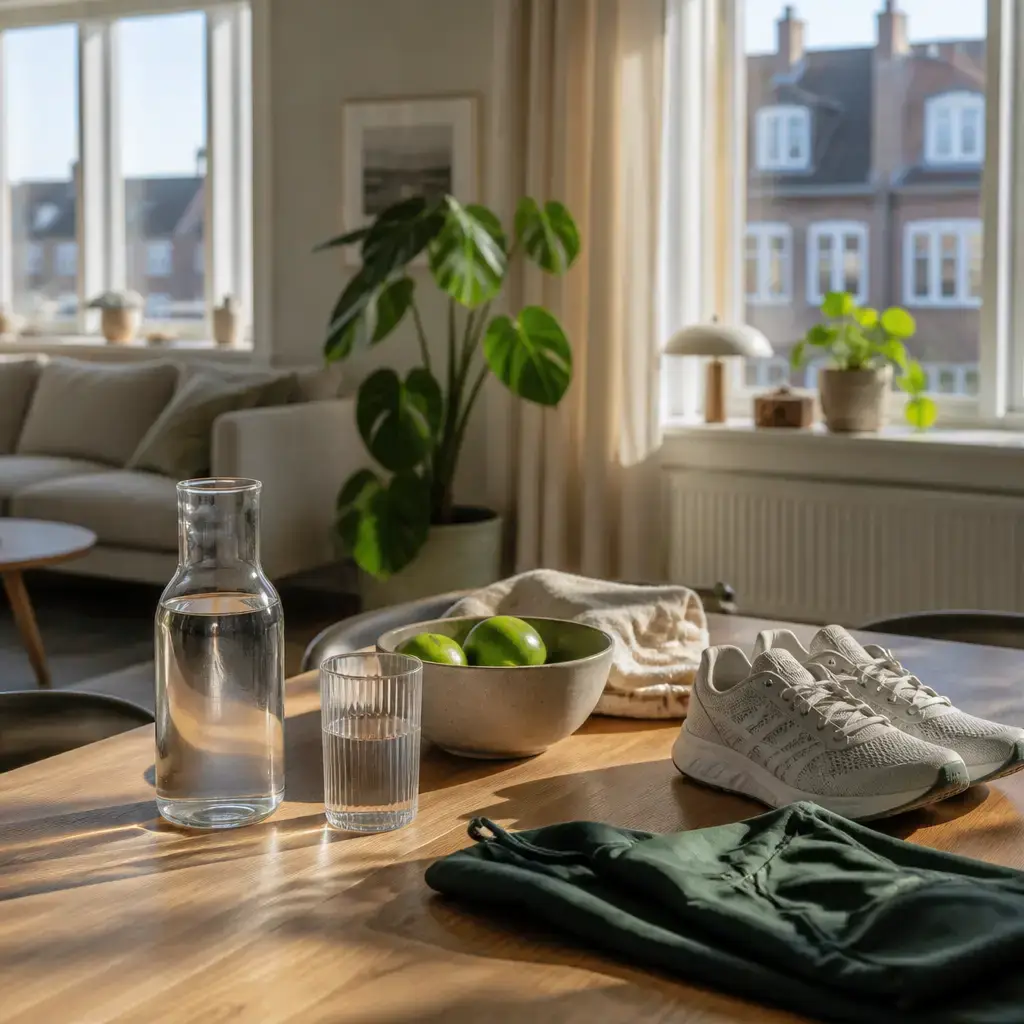
Use Small Healthy Daily Changes to practice Danish conversation, pronunciation, vocabulary, grammar, and quizzes.
Dialogue
Jeg vil gerne have en sundere daglig rutine.
YIGH vil GAIR-nuh HAY-vuh uhn SUN-uh-ruh DAY-lee roo-TEE-nuh. I want a healthier daily routine.Start med små ændringer, som du kan holde fast i.
SDAHD meh smoh EN-dring-er, suhm doo kan HOL-luh fast ee. Start with small changes you can stick with.Jeg kan drikke mere vand, mens jeg er på arbejde.
YIGH kan DREH-guh MAIR van, mens yigh air poh AH-bigh-thuh. I can drink more water while I'm at work.Det kan måske give dig mere energi om eftermiddagen.
Deh kan MOS-kuh GEE-vuh dai MAIR en-uh-SHEE ohm EF-tuh-MEH-thane. That may help your energy in the afternoon.Skal jeg også træne efter aftensmaden?
Skel yigh OSS-uh TRAY-nuh EF-tuh AFD-en-SMAY-thun? Should I also exercise after dinner?En kort gåtur ville være en start, der er nem at klare.
Uhn kohd GOH-toor VEL-uh VAIR uhn SDAHD, dair air NEM uh KLAIR-uh. A short walk would be a manageable start.Jeg kan stille mine sko ved døren, så jeg husker at gå en tur.
YIGH kan SDEH-luh MEE-nuh SGOH veh DUR-un, soh yigh HOOS-kuh uh GOH uhn TOOR. I can put my shoes by the door so I remember to go.Det lyder realistisk og nemt at holde fast i.
Deh LOO-uh ray-uh-LIS-dessg oh NEMD uh HOL-luh fast ee. That sounds realistic and easy to keep up.Sentence explanations
Jeg vil gerne have en sundere daglig rutine.
I want a healthier daily routine.
- Jeg
- I
- vil gerne
- would like to
- have
- have
- sundere
- healthier
- daglig
- daily
- rutine
- routine
More detail
Jeg means “I” here. It is the first-person singular subject pronoun. A reusable contrast is jeg “I” versus du “you”: Jeg læser. — “I am reading.” vil gerne expresses a desire or willing preference: “would like to.” In this use, vil is the present form of ville, and gerne makes the intended meaning a positive wish. The pattern Jeg vil gerne + infinitive is reusable: Jeg vil gerne lære dansk. — “I would like to learn Danish.” have is the infinitive “to have.” After the modal expression vil gerne, the following verb is in the infinitive, so the form stays have rather than changing for the subject. Here it means having or maintaining something, not simply possessing an object. sundere means “healthier.” It is the comparative form of sund “healthy”; the comparison chain is sund → sundere → sundest (“healthy” → “healthier” → “healthiest”). The comparative presents the routine as healthier than a relevant alternative or earlier state, without specifying exactly what that comparison is. daglig means “daily” and describes rutine. Danish adjectives can change form according to the noun phrase: daglig is used here with the common-gender singular indefinite noun rutine; compare dagligt with a neuter singular noun and daglige in plural or definite forms. For example, en daglig vane means “a daily habit.” rutine means “routine.” It is a common-gender noun, shown here in the indefinite singular after en: en rutine, “a routine.” Its plural is rutiner, “routines.” Together, Jeg vil gerne have gives “I would like to have,” and en sundere daglig rutine gives “a healthier daily routine.” The complete utterance therefore means: “I want a healthier daily routine.”
Start med små ændringer, som du kan holde fast i.
Start with small changes you can stick with.
- Start med
- start with
- små
- small
- ændringer
- changes
- du kan
- you can
- holde fast i
- stick with
More detail
Start med uses the imperative Start of starte (“to start”) followed by med (“with”). The imperative addresses the listener directly and has no written subject here. The reusable pattern is Start med + [something]: “Start with [something].” For example, Start med en kort pause. — “Start with a short break.” små means “small” here and modifies ændringer. It is the plural form of lille; små ændringer therefore means “small changes.” Danish adjectives commonly use små with plural nouns, while lille is used with a singular noun in relevant forms. Example: en lille ændring — “a small change”; to små ændringer — “two small changes.” ændringer means “changes” here. Its base form is the noun ændring (“change”), and ændringer is its plural form. The sentence refers to changes in general rather than marking a specific definite set; the adjective confirms the plural. Example: Jeg laver nogle ændringer. — “I am making some changes.” du kan means “you can.” du is the second-person singular pronoun “you,” and kan is the present-tense form of kunne (“can; be able to”). In this sentence, it introduces something the listener is able to maintain. Danish modal verbs such as kan are followed by an infinitive without at: du kan holde — “you can stick with.” Example: Du kan begynde i dag. — “You can start today.” holde fast i is a separable-looking fixed verb construction meaning “stick with” or “keep to” something. Its base verb is holde (“hold; keep”), while fast adds the idea of maintaining a firm commitment and i introduces what is maintained. In the observed form, holde is the infinitive required after kan. Example: Jeg holder fast i planen. — “I stick to the plan.” Together, Start med små ændringer means “Start with small changes.” The clause som du kan holde fast i describes those changes: they are changes that you are able to stick with. Thus the complete utterance means “Start with small changes you can stick with.”
Jeg kan drikke mere vand, mens jeg er på arbejde.
I can drink more water while I'm at work.
- Jeg kan
- I can
- drikke
- drink
- mere
- more
- vand
- water
- mens
- while
- jeg er
- I am
- på arbejde
- at work
More detail
Jeg kan combines the first-person pronoun jeg (“I”) with kan, the present-tense form of kunne (“can; be able to”). In this sentence, kan expresses ability or possibility, and a modal verb like this is followed by an infinitive without at. Example: Jeg kan svømme. — “I can swim.” drikke is the infinitive “to drink.” It keeps this form after kan; the modal carries the finite verb marking. The same infinitive can be used after other modal verbs, for example Jeg vil drikke vand. — “I want to drink water.” mere means “more” here. It is the comparative form related to meget (“much; a lot”) and indicates a greater amount. In mere vand, it modifies the amount of vand, not the act of drinking. Example: Jeg vil have mere kaffe. — “I want more coffee.” vand means “water.” It is commonly used as a mass noun when referring to water in general or an unspecified amount, as here. The phrase mere vand therefore means “more water,” without specifying a number of separate units. mens is a conjunction meaning “while.” It introduces an activity or situation that is simultaneous with the main clause. The clause after it has its own subject and verb. Example: Hun læser, mens hun spiser. — “She reads while she eats.” jeg er means “I am.” er is the present-tense form of være (“to be”); unlike English, this present form does not change between persons, so jeg er is “I am,” while du er is “you are.” på arbejde is the Danish expression for “at work.” In this use, arbejde refers to the state or setting of being at work, and the phrase normally has no article. This is a fixed expression rather than a literal claim about being physically on top of work. Together, Jeg kan drikke mere vand means “I can drink more water.” The subordinate clause mens jeg er på arbejde adds that this happens while the speaker is at work. The complete utterance is therefore: “I can drink more water while I’m at work.”
Det kan måske give dig mere energi om eftermiddagen.
That may help your energy in the afternoon.
- Det
- That
- kan måske
- may perhaps
- give
- help / give
- dig
- you
- mere
- more
- energi
- energy
- om eftermiddagen
- in the afternoon
More detail
Det means “that” here and functions as the subject. It is a neuter singular pronoun; in this sentence it points to an understood situation or action, but the supplied sentence does not uniquely identify exactly what that is. Danish det can also be used in other constructions as a non-referential subject, so its role must be learned from the sentence rather than from the form alone. kan måske combines the modal verb kan with måske. kan is the present form of kunne and expresses ability or possibility; with the infinitive give, it contributes a possibility reading here. måske adds uncertainty: “perhaps.” The reusable pattern is [subject] kan måske + infinitive, as in Det kan måske hjælpe. — “That may perhaps help.” give is the infinitive of give and means “give” in its basic sense. In give dig mere energi, Danish uses it for causing someone to have more energy, so “give you more energy” is the natural underlying meaning; the fixed translation presents this as helping your energy. After a modal such as kan, the infinitive appears without an infinitive marker. dig is the object form of the second-person singular pronoun: du is the subject form, while dig is used after a verb or preposition. Thus give dig means “give you.” It does not itself mean “your”; possession would normally be expressed with a possessive form such as din or dit, depending on the noun. mere means “more” and compares an amount or degree with a reference amount. It is the comparative form associated with meget (“much” or “very”), and it is used here with the mass noun energi: mere energi — “more energy.” energi is the noun “energy.” In this sentence it is an uncounted resource or state that someone can have more of. A reusable pattern is give nogen energi, “give someone energy,” where nogen stands for the recipient. om eftermiddagen is the time expression “in the afternoon.” eftermiddagen is the definite form of eftermiddag (“afternoon”), and om introduces this part of the day as the time when something happens. The definite form is part of this established time expression. Together, Det supplies the subject, kan måske expresses a possible outcome, and give dig mere energi says that the outcome is giving you more energy. om eftermiddagen specifies when that effect is relevant. The whole utterance therefore means: “That may help your energy in the afternoon,” naturally understood as “That may give you more energy in the afternoon.”
Skal jeg også træne efter aftensmaden?
Should I also exercise after dinner?
- Skal jeg
- Should I
- også
- also
- træne
- exercise
- efter
- after
- aftensmaden
- dinner
More detail
Skal jeg is a reusable Danish question pattern meaning “Should I …?” Here skal is the present-tense form of skulle, a modal verb, and jeg is the subject “I”. In a question, the modal comes before the subject: Skal jeg ...? The following verb remains in the infinitive. Example: Skal jeg komme nu? — “Should I come now?” også means “also” or “too”. It adds this activity to something already relevant, without changing who performs it. In this sentence it follows jeg: Skal jeg også ...? træne means “to exercise” or “to train”. It is the infinitive used after the modal skal; the form does not change here for the subject. The same verb can refer to general exercise or training for a particular activity, but the fixed sentence supports the general sense “exercise”. Example: Jeg vil træne i morgen. — “I want to exercise tomorrow.” efter is a preposition meaning “after” when it introduces a later time or event. It is followed here by the noun phrase aftensmaden, so efter aftensmaden means “after dinner”. aftensmaden means “dinner” or “the evening meal” here. Its base form is aftensmad; aftensmaden is the definite singular form, marked by -en. The definite form presents the meal as the relevant evening meal rather than as an unspecified meal. Example: Vi går en tur efter aftensmaden. — “We go for a walk after dinner.” Together, Skal jeg forms the “Should I ...?” question, også adds “also”, træne supplies the action, and efter aftensmaden places it after dinner. The whole utterance therefore means: “Should I also exercise after dinner?”
En kort gåtur ville være en start, der er nem at klare.
A short walk would be a manageable start.
- kort
- short
- gåtur
- walk
- ville være
- would be
- start
- start
- nem
- manageable; easy
- at klare
- to manage
More detail
kort means “short” here and describes the noun gåtur. It is the singular common-gender form: kort with an en-word, kort with a neuter noun, and korte in the plural or definite form. Example: en kort pause — “a short break.” gåtur is the noun “walk.” Its indefinite singular is en gåtur; useful forms include gåturen “the walk” and gåture “walks.” In the supplied sentence it is the activity being proposed as a start. The context also uses the related expression gå en tur, literally “go a walk,” meaning “go for a walk”; that is a verb phrase, whereas gåtur is one noun. ville være expresses a hypothetical or conditional “would be.” ville is the form of ville used with the subject understood here as en kort gåtur, and være is the infinitive “be.” Example: Det ville være en god idé. — “That would be a good idea.” start means “start” or “beginning.” It is the common-gender noun en start; starten means “the start,” and starter means “starts.” In this sentence, the walk is presented as a possible starting point, not as an already completed action. nem means “easy” or, in this context, “manageable.” As an adjective, it has nem with an en-word, nemt with a neuter noun, and nemme in the plural or definite form. Example: Opgaven er nem. — “The task is easy.” at klare is the infinitive “to manage” or “to handle.” at marks the infinitive, while klare is the verb; its present form is also klarer. In nem at klare, the construction means that something is easy to manage or cope with. Example: Det er nemt at klare. — “It is easy to manage.” Together, en kort gåtur is “a short walk,” ville være makes it hypothetical (“would be”), and en start identifies it as a beginning. The relative clause der er nem at klare describes that start as manageable. Thus the whole utterance means: “A short walk would be a manageable start.”
Jeg kan stille mine sko ved døren, så jeg husker at gå en tur.
I can put my shoes by the door so I remember to go.
- Jeg kan
- I can
- stille
- put; place
- mine
- my
- sko
- shoes
- ved døren
- by the door
- så
- so that
- husker
- remember
- gå en tur
- go for a walk
More detail
Jeg kan combines Jeg (“I”) with kan, the present form of kunne (“can; be able to”). Jeg is first-person singular, and kan does not change for person or number. A modal such as kan is followed by an infinitive without at: Jeg kan stille ... means “I can put ...”. stille means “put/place” here. It is the infinitive form used after kan; its present form is stiller and its past form is stillede. The choice of stille expresses placing something in a position, rather than merely possessing or carrying it. mine means “my” with a plural noun. Danish possessive forms distinguish number and, for singular nouns, grammatical gender: min with a common-gender singular noun, mit with a neuter singular noun, and mine with a plural noun. Here mine agrees with sko. sko means “shoes”. It is plural; the singular is sko as well, so number is identified from the surrounding grammar rather than from a different spelling. The plural possessive mine makes the intended form clear here. ved døren means “by the door”. ved is a preposition meaning “by/near” in this use. døren is the definite singular form of dør, “door”: en dør means “a door”, while døren means “the door”. The phrase therefore identifies the location where the shoes are placed. så connects the action with its intended result here: “so that”. It introduces the following clause, rather than describing the shoes or the placing itself. husker is the present form of huske, “remember”. In så jeg husker ..., the subject jeg is stated explicitly, and husker agrees with that first-person singular subject only through the clause structure; Danish present-tense verbs generally do not take different person endings. For example, Jeg husker navnet means “I remember the name.” gå en tur is a reusable expression meaning “go for a walk” or “take a walk”. gå is the infinitive of “go”; the preceding at in the sentence is the infinitive marker, so at gå means “to go”. en tur literally contains en (“a”) and tur (“trip/walk”), but together in this expression it refers to a walk. The sentence does not specify how long the walk will be. Taken together, Jeg kan stille mine sko ved døren says “I can put my shoes by the door.” så jeg husker at gå en tur adds the purpose or intended result: “so I remember to go for a walk.” The complete utterance means: “I can put my shoes by the door so I remember to go for a walk.”
Det lyder realistisk og nemt at holde fast i.
That sounds realistic and easy to keep up.
- lyder
- sounds
- realistisk
- realistic
- nemt
- easy
- holde fast i
- keep up; maintain
More detail
lyder is the present-tense form of lyde, “to sound” or “to seem.” In this sentence it introduces an assessment: something gives the impression of being realistic and easy. Danish verbs generally do not change for person or number in the present tense, so lyder is used with singular and plural subjects. Example: Det lyder godt. — “That sounds good.” realistisk means “realistic” here. It is an adjective describing how the situation appears. The form ending in -isk does not add the usual -t in the neuter form: en realistisk plan and et realistisk mål both use realistisk. nemt comes from the adjective nem, “easy.” The -t marks the neuter form in this use, matching the neutral placeholder det and the following infinitive clause. Compare en nem opgave — “an easy task” — with et nemt mål — “an easy goal.” Nemt is the basic adjective form here, not a comparative; the comparative is nemmere, “easier.” holde fast i is a reusable construction meaning “to stick to,” “maintain,” or “keep up” something. holde is the infinitive of holde, and after at, Danish uses this infinitive: at holde fast i. The construction normally takes the thing being maintained after i, for example, holde fast i en vane — “stick to a habit.” In the fixed sentence, that maintained thing is understood from the context rather than stated again. Together, Det lyder means “That sounds,” while realistisk og nemt gives the two assessments. at holde fast i identifies what is realistic and easy: maintaining the relevant action or routine. The whole utterance therefore means, “That sounds realistic and easy to keep up.”
Grammar Points
små + flertalsnavn
små ændringer
smoh EN-dring-ersmall changes
In Danish, adjectives take a plural form: små ændringer. English keeps the adjective small unchanged.
gerne + infinitiv
vil gerne træne
vil GAIR-nuh TRAY-nuhwould like to exercise
gerne is used with vil and an infinitive to express what someone would like to do.
Danish Vocabulary
- Gender
- common
- Gender
- common
- Gender
- neuter
Quiz
Word Order
Arrange the words in the correct order.
Should I also exercise after dinner?
Show Answer
Skal jeg også træne efter aftensmaden?Spelling
Tap the letters to spell the word.
routine
Show Answer
rutinechanges
Show Answer
ændringermore
Show Answer
meredrink